Greetings and welcome to the Microsoft fiscal year 2024 third quarter earnings conference call at this time all participants are in a listen only mode a question and answer session will follow the formal presentation if anyone should require operator assistance during the conference please press star zero on your telephone keypad as a reminder this conference is Being recorded I would now like to turn the conference over to your host Brett Iverson vice president of investor relations good afternoon and thank you for joining us today on the call with me are Sati Nadella chairman and chief executive
officer Amy Hood Chief Financial Officer Alice Jala Chief accounting officer and Keith Dober corporate secretary and Deputy General Counsel on the Microsoft invest Relations website you can find our earnings press release and financial summary slide deck which is intended to supplement our prepared remarks during today's call and provides the reconciliation of differences between Gap and non-gaap financial measures more detailed Outlook slides will be available on the Microsoft invest relations website when we provide Outlet commentary on today's call on this call we will discuss certain non-gaap items The non-gaap financial measures provided should not be considered
as a substitute for or superior to the measures of financial performance prepared in accordance with gap they are included as additional clarifying items to to Aid investors in further understanding the company's third quarter performance in addition to the impact these items and events have on the financial results all growth comparisons we make on the call today relate to the corresponding period Of last year unless otherwise noted we will also provide growth rates and constant currency when available as a framework for assessing how our underlying businesses performed excluding the effect of foreign currency rate fluctuations where
growth rates are the same in constant currency we'll refer to the growth rate only we will post our prepared remarks to our website immediately following the call until the complete transcript is available today's Call is being webcast live and recorded if you ask a question it will be included in our live Transmission in the transcript and in any future use of the recording you can replay the call and view the transcript on the Microsoft invest relations website during this call we'll be making forward looking statements which are predictions projections or other statements about future events
these statements are based on current Expectations and assumptions that are subject to risks and uncertainties actual results could materially differ because of factors discussed in today's earnings press release in the comments made during this conference call and in the risk factor section of our form 10K forms 10q and other reports and filings with the Securities and Exchange Commission we do not undertake any duty to update any for looking statement and with that I'll Turn the call over to Saia thank you Brett it was a record third quarter powered by the continued strength of Microsoft cloud
which surpassed $35 billion in Revenue up 23% Microsoft co-pilot and co-pilot stack spanning everyday productivity business process and developer services to models data and infrastructure are orchestrating a new era of AI transformation driving Better Business outcomes across every role and Industry Now I'll highlight examples walking up the stack starting with AI infrastructure Azure again took share as customers use our platforms and tools to build their own AI Solutions we offer the most diverse selection of AI accelerators including the latest from Nvidia AMD as well as our own first party silicon our AI Innovation continues to
build on our strategic partnership with openai more than 65% of the Fortune 500 now use Azure openai Service we also continue to innovate and partner broadly to bring customers the best selection of Frontier models and open source models llms and slms with 53 which we announced earlier this week we offer the most capable and cost effective slm available it's already being tried by companies like call Miner LTI M tree PWC and TCS our models as a service offering makes it easy for developers to use llms and slms without having to manage any underlying Infrastructure hundreds
of paid customers from Accenture and ey to Schneider Electric are using it to take advantage of API access to third party models including as of this quarter the latest from coher meta and Mistral and as part of a partnership announced last week g42 will run its AI applications and services on our Cloud all up the number of azure AI customers continues to grow and average spend continues to increase we also saw an acceleration of Revenue from migrations to Azure Azure Arc continues to help customers like de sporting goods and World Bank streamline their Cloud migrations
Arc now has 33,000 customers up over 2X year-over-year and we are the hyperscale platform of choice for sap and Oracle workloads with conduent and Medline moving their on premise Oracle Estates to AIA and kendrell and L'Oreal migrating their sap workloads to Azure overall we are seeing an Acceleration in the number of large Azure deals from leaders across Industries including Billion Dollar Plus multi-year commitments announced this month from cloud software group and the Coca-Cola Company the number of100 million plus Azure deals increased over 80% year-over-year while the number of $10 million plus deals more than doubled
now on to data and analytics I'm our Microsoft intelligent data platform provides customers with the broadest Capability spanning databases analytics business intelligence governance and AI over half of our Azure AI customers also use our data and analytics tools customers are building intelligent applications running on Azure postra SQL and Cosmos DB with deep Integrations with Azure AI TomTom is a great example they've used Cosmos DB along with Azure open AI service to build their own immersive incar infotainment system we are also encouraged by our momentum With our next Generation analytics platform Microsoft fabric fabric now has
over 11,000 paid customers including leaders in every industry from ABB EDP energy transfer to equinor Foot Locker itude and Lumen and we are seeing increased usage intensity fabric is seamlessly integrated with Azure AI Studio meaning customers can run models against Enterprise data that's Consolidated in Fabric's multicloud data Lake one Lake And powerbi which is also natively integrated with fabric provides business users with AI powered insights we now have over 350,000 paid customers now on to developers getup co-pilot is bending the productivity curve for developers we now have 1.8 million paid subscribers with growth accelerating to
over 35% quarter over quarter and continues to see in increased adoption from businesses in every industry including itah lansa systems Nokia Pinterest and Volvo cars co-pilot is driving growth across the broader GitHub platform too AT&T City group and Honeywell all increase their overall GitHub usage after seeing productivity and code quality increases with co-pilot all up more than 90% of the Fortune 100 are now GitHub customers and revenue accelerated over 45% year old over year anyone can be a developer with new AI powered features across our low code no code tools which makes it easier to
build an App automate workflow or create a co-pilot using natural language 30,000 organizations across every industry have used co-pilot Studio to customize co-pilot for Microsoft 365 or build their own up 175% quarter over quarter clex for example built a co-pilot for customer service agent reducing query handling time from as much as 15 minutes to 30 seconds all up over 330,000 organizations including over half of Fortune 100 have used AI powered capabilities in Power Platform and power apps now has over 25 million monthly active users up over 40% year overy year now on to future work
we seeing AI democratize expertise across the workforce what inventory turns are to efficiency of Supply chains knowledge turns the creation and diffusion of knowledge are to productivity of an organization and co-pilot for Microsoft 365 is helping increase knowledge turns That's having a cascading effect changing work work artifacts and workflows and driving better decision-making collaboration and efficiency this quarter we made co-pilot available to organizations of all types and sizes from Enterprises to small businesses nearly 60% of the Fortune 500 now use co-pilot and we have seen accelerated adoption across Industries and geographies with companies like Amgen
BP cognizant Coke Industries Moody Nova Nordisk Nvidia and Tech Mahindra purchasing over 10,000 seats we're also seeing increased usage intensity from early adopters including a nearly 50% increase in the number of co-pilot assisted interactions per user in teams bridging group AC ity with business process workflows and Enterprise knowledge and we're not stopping there we're accelerating our Innovation adding over 150 co-pilot capabilities since the start of the year with co-pilot in Dynamics 365 we're helping businesses transform every role and business function as we take share with our AI powered apps across all categories this quarter we
made our co-pilot for service and co-pilot for sales broadly available helping customer service agents and sellers at companies like Lander Lakes Northern Truck Rockwell Automation and Toyota group generate role specific insights and recommendations from across Dynamics 365 and Microsoft 365 as well As thirdparty platforms like Salesforce service now and zenes and with our co-pilot for finance we are drawing context from Dynamics as well as Erp systems like sap to reduce labor intensive processes like Collections and contract and invoice capture for companies like denu and IDC I isvs are also building their own co-pilot Integrations for
example new Integrations between Adobe experience cloud and co-pilot will help marketeers Access campaign insights in the Floor of their work when it comes to devices co-pilot in Windows is now available on nearly 225 million Windows 10 and windows 11 PCS up 2x quarter over quarter with co-pilot we have an opportunity to create an entirely new category of devices purpose-built for this new generation of AI all of our largest OEM Partners have announced AIP PCS in recent months and this quarter we introduce new Surface devices which Includes integrated npus to power on device AI experiences like
autof framing and live captions and there's much more to come in just a few weeks we'll hold a special event to talk about our AI Vision across windows and devices when it comes to teams we once again saw year-over-year usage growth where rolling out a new version which is up to two times faster while using 50% less memory to all customers we surpassed 1 million teams rooms for the First time as we continue to make hybrid meetings better with new AI powered features like automatic camera switching and speaker recognition and teams phone continues to be
the market leader in Cloud calling now with over 20 million pstn users up nearly 30% year-over Year all of this Innovation is driving growth across Microsoft 365 companies across the private and public sector including amadas Black Rock Chevron eolab Kimberly Clark all chose our premium E5 offerings This quarter for advanced security compliance voice and analytics now on to Industry and cross industry clouds we're also bringing AI power transformation to every industry in healthcare Dax co-pilot is being used by more than 200 Healthcare organizations including Providence Stanford Healthcare and WellSpan Health and in manufacturing this week
at Hanover massay customers like BMW seens and Volvo Penta shared how they're using Our cloud and AI solutions to transform Factory operations now on to security security underpins every layer of the tech stack and it's our number one priority we launched our secure future initiative last fall for this reason bringing together every part part of the company to advance cyber security protection and we are doubling down on this very important work putting security about all else before all other Features and Investments we have focused on making continuous progress across the six pillars of this initiative
as we protect tenants and isolate production systems protect identities and secrets protect networks protect Engineering Systems Monitor and detect threats and accelerate responses and Remediation we remain committed to sharing our learnings tools and Innovation with customers a great example is co-pilot for security which We made generally available earlier this month bringing together llms with domain specific skills informed by our threat intelligence and 78 trillion daily security signals to provide security teams with actionable insights now let me talk about our consumer businesses starting with LinkedIn we continue to combine our unique data with this new generation
of AI to transform the way members learn sell and get hired features like LinkedIn AI assisted Messages are seeing a 40% higher acceptance rate and accepted over 10% Faster by job Seekers saving hirers time and making it easier to connect them to candidates our AI powered collaborative articles which have reached over 12 million contributions are helping increase engagement on the platform which reached a new record this quarter new AI features are also helping accelerate LinkedIn premium growth with Revenue up 29% year-over-year and we are Also seeing strength across other businesses with hiring taking share for
the seventh consecutive quarter now on to search advertising in news we once again took share across Bing an edge as we continue to apply this new generation of AI to transform how people search and browse Bing reached over 140 million daily active users and we are particularly encouraged by our momentum in Mobile our free co-pilot apps on IOS and Android saw Surge and downloads After a Super Bowl ad and are among the highest rated in this category we also rolled out co-pilot to our ad platform this quarter helping marketeers use AI to generate recommendations for
product images headlines and descriptions now on to gaming we are committed to meeting players where they are by bringing great games to more people on more devices we set third quarter records for game streaming hours console usage and monthly active Devices and last month we added our first Activision Blizzard title Diablo 4 to our Game Pass service subscribers played over 10 million hours within the first 10 days making it one of our biggest first party game pass launches ever we also encouraged by ongoing success of Call of Duty's Modern Warfare 3 which is attracting new
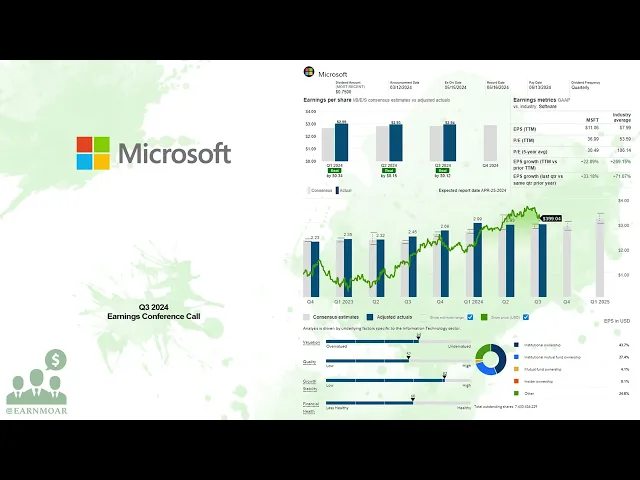
Gamers and retaining franchise loyalists finally we are expanding our games to new platforms bringing four of Our fan favorite titles to Nintendo switch and Sony PlayStation for the first time in fact earlier this month we had seven games among the top 25 on the PlayStation Store more than any other publisher in closing I'm energized about our opportunity ahead as we innovate to help people and businesses thrive in this new era with that let me turn it over to Amy thank you safia and good afternoon everyone our third quarter Revenue was 61.9 billion Up 177% and
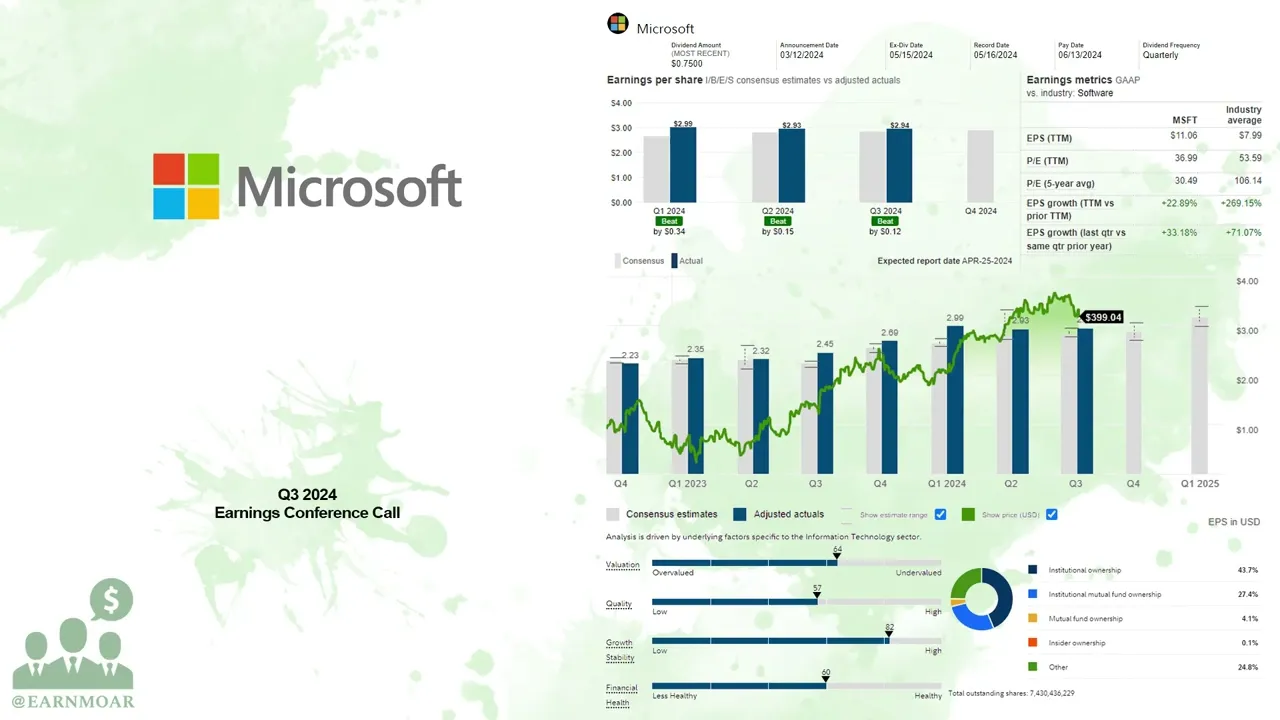
earnings per share was $2.94 up 20% results exceeded expectations and we delivered another quarter of double- digigit top and bottom line growth with continued share gains across many of our businesses in our Commercial Business bookings increased 29% and 31% in constant currency significantly ahead of expectations driven by Azure commitments with an increase in average deal size and deal length as well as strong Execution across our core annuity sales motions in Microsoft 365 sweet strength contributed to arpo expansion for our office Commercial Business although new business growth continued to moderate for Standalone products sold outside the
Microsoft 365 Suite commercial remaining performance obligation increased 20% and 21% in constant currency to $235 billion roughly 45% will be recognized in Revenue in the next 12 months up 20% year-over-year the Remaining portion recognized beyond the next 12 months increased 21% in this quarter our anuy mix increased to 97% in our consumer business PC market demand was slightly better than we expected benefiting Windows OEM while advertising spend landed relatively in line with our expectations in gaming we also saw better than expected performance of Activision titles benefiting Xbox content and services at A company level Activision
contributed a net impact of approximately Four Points to revenue growth was a two-point drag on operating income growth and had a negative 4C impact to earnings per share a reminder that this net impact includes adjusting for the movement of Activision content from our prior relationship as a thirdparty partner to first party and also includes $935 million from purchase accounting adjustments integration and transaction related cost FX did not have a significant impact on our results and was roughly in line with our expectations on total company Revenue segment level Revenue cogs and operating expense growth Microsoft cloud
Revenue was $35.1 billion and grew 23% ahead of expectations Microsoft cloud gross margin percentage decreased slightly year-over-year to 72% a bit better than expected excluding the impact of the change in accounting estimate for useful lives gross margin Percentage increased slightly driven by Improvement in Azure and Office 365 even with the impact of scaling our AI infrastructure partially offset by sales MC shift to Azure company gross margin dollars increased 18% and gross margin percentage increased slightly year-over-year to 70% excluding the impact of the change in accounting estimate gross margin percentage increased roughly 1 Point even with
the impact from the purchase accounting Adjustments integration and transaction related cost from the Activision acquisition growth was driven by the Improvement in Azure and Office 365 just mentioned as well as sales mix shift to higher margin businesses operating expenses increased 10% with nine points from the Activision acquisition at a total company level head count at the end of March was 1% lower than a year ago operating income increased 23% and operating margins Increased roughly two points year over-year to 45% excluding the impact of the change in accounting estimate operating margins increased roughly three points driven
by the higher gross margin noted earlier and improved operating leverage through continued cost discipline now to our segment results revenue from productivity and business processes was $19.6 billion and grew 12% and 11% in constant currency in line with Expectations office commercial Revenue grew 133% and 12% in constant currency Office 365 commercial Revenue increased 15% in line with expectations driven by healthy renewal execution rpu growth from continued E5 momentum and early co-pilot for Microsoft 365 progress paid Office 365 commercial seats grew 8% year-over-year with installed base expansion across all customer segments seat growth was again driven
by our small and medium business And Frontline worker offerings although growth continued to moderate in SMB office commercial licensing declined 20% and 18% in constant currency with continued customer shift to Cloud offerings office consumer Revenue increased 4% slightly below expectations Microsoft 365 subscriptions grew 14% to 80.8 million LinkedIn Revenue increased 10% and 9% in constant currency ahead of expectations driven by slightly better than expected performance in our premium Subscriptions and Talent Solutions businesses however in Talent Solutions booking growth continues to be impacted by the weaker hiring environment and key verticals Dynamics Revenue grew 19% and
177% in constant currency ahead of expectations growth was driven by Dynamic 365 which grew 23% and 22% in constant currency with continued growth across all workloads and better than expected new business although bookings growth remains moderated segment gross Margin dollars increased 11% and gross margin percentage decreased slightly year-over-year excluding the impact of the change in accounting estimate gross margin percentage increased slightly driven by Improvement in Office 365 operating expenses increased 1% and operating income increased 177% and 16% in constant currency next the intelligent Cloud segment Revenue was $ 26.7 billion increasing 21% ahead of expectations
with better than expected Results across all businesses overall server and cloud services Revenue grew 24% Azure and other cloud services Revenue grew 31% ahead of expectations while our AI Services contributed seven points of growth as expected in the non-ai portion of our consumption business we saw greater than expected demand broadly across Industries and customer segments as well as some benefit from a greater than expected mix of contracts with Higher in Period recognition in our per user business the Enterprise mobility and Security install base grew 10% to over 274 million seats with continued impact from the
growth Trends in new Standalone business noted earlier in our on- premises server business Revenue increased 6% ahead of expectations driven by better than expected renewal strength particularly for contracts with higher in Period Revenue recognition Enterprise and Partner Services Revenue decreased 9% on a strong prior year comparable for Enterprise Support Services segment gross margin increased 20% and gross margin percentage decreased slightly year-over-year excluding the impact of the change in accounting estimate percentage increased slightly primarily driven by the Improvement in Azure noted earlier even with the impact of scaling our AI infrastructure partially offset by sales mix
shift to Azure operating Expenses increased 1% and operating income grew 32% now to more personal Computing Revenue was 15.6 ion increasing 177% with 15 points of net impact from the Activision acquisition results were above expectations driven by better than expected performance in gaming and windows OEM Windows OEM Revenue increased 11% year-over-year ahead of expectations primarily driven by the Slightly better PC market noted earlier as well as mix shift to higher monetizing markets Windows commercial products and cloud services Revenue increased 133% and 12% in constant currency below expectations with impact from the growth Trends and new
Standalone business noted earlier as well as lower in Period Revenue recognition from the mix of contracts devices Revenue decreased 177% and 16% in constant currency as we Remain focused on our higher margin premium products overall surface demand was slightly lower than expected search and news advertising Revenue xtac increased 12% ahead of expectations with continued volume growth grow and increased engagement on Bing and Edge and in Gaming revenue increased 51% and 50% in constant currency with 55 points of net impact from the Activision acquisition results were ahead of expectations primarily driven by Call of Duty Xbox
content and services Revenue increased 62% and 61% in constant currency with 61 points of net impact from the Activision acquisition Xbox Hardware Revenue decreased 31% and 30% in constant currency segment gross margin dollars increased 27% and 26% in constant currency with 13 points of net impact from the Activision acquisition gross margin percentage increased roughly Four Points year-over-year primarily driven By sales mix shift to higher margin businesses operating expenses increased 41% with 43 points from the Activision acquisition operating income increased 16% and 15% in constant currency now back to Total company results Capital expenditures including Finance
leases were $14 billion to support our Cloud demand inclusive of the need to scale our AI infrastructure cash paid for PP was $ 11 billion cash flow from operations was 31.9 billion of 31% Driven by strong Cloud Billings and collections free cash flow was $21 billion of 8% year-over-year reflecting higher Capital expenditures to support our cloud and AI offerings this quarter other income in expense was netive $854 Million lower than anticipated driven by losses on investments accounted for under the equity method our effective tax rate was approximately 18% and finally we returned 8.4 billion dollar
to shareholders through dividends And share repurchases now moving to our Q4 Outlook which unless specifically noted otherwise is on a US dollar basis first FX based on current rates which reflect the recent strengthening of the US dollar we now expect FX to decrease total revenue and segment level Revenue growth by less than one point when compared to our January guide for Q4 FX this is a decrease to total revenue of a roughly $700 Million we expect FX to decrease cogs growth by approximately 1 point and operating expense growth by less than 1 point in commercial
bookings we expect solid growth on a relatively flat XPR base driven by continued strong commercial sales execution as a reminder larger long-term Azure contracts which are more unpredictable in their timing can drive increased quarterly volatility in our bookings growth rate Microsoft cloud gross margin percentage should Decrease roughly two points year-over-year excluding the impact from the change in accounting estimate Q4 Cloud gross margin percentage will be down slightly as Improvement in Azure inclusive of scaling our AI infrastructure will be offset by sales mix shift 2 Azure we expect Capital expenditures to increase matly on a sequential
basis driven by cloud and AI infrastructure Investments as a reminder there can be normal Quarterly spend variability in the timing of our Cloud infrastructure build outs and the timing of Finance leases we continue to bring capacity online as we scale our AI Investments with growing demand currently near-term AI demand is a bit higher than our available capacity next to segment guidance in productivity and business processes we expect Revenue to grow between 9 and 11% in constant currency or 19.9 to 20.2 billion US an office commercial Revenue growth Will again be driven by Office 365 with
seat growth across customer segments and arpo growth primarily through E5 we expect Office 365 Revenue growth to be approximately 14% in constant currency we continue to progress with adoption of co-pilot for Microsoft 365 and remain excited for the long-term growth opportunity in our on- premises business we expect Revenue to decline in the mid to high teens in office consumer we expect Revenue growth in the low to mid single digits driven by Microsoft 365 subscriptions for LinkedIn we expect Revenue growth in the mid to high single digits driven by continued growth across all businesses and in
Dynamics we expect Revenue growth in the low to mid- teens driven by Dynamics 365 for both LinkedIn and Dynamics the continued bookings growth moderation noted earlier is a headwind to Q4 Revenue growth for intelligent Cloud we expect Revenue to Grow between 19 and 20% in constant currency or 28.4 to 28.7 billion US Revenue will continue to be driven by Azure which as a reminder can have quarterly variability primarily from our per user business and in Period Revenue recognition depending on the mix of contracts in Azure we expect Q4 Revenue growth to be 30 to 31%
in constant currency or similar to our stronger than expected Q3 results growth will be driven by our Azure consumption business and continued contribution from AI with some impact from the AI capacity availability noted earlier our per user business should see benefit from Microsoft 365 sweet momentum though we expect continued moderation in seat growth rates given the size of the installed base in our on premises server business we expect Revenue growth in the low to mid single digits with continued hybrid demand including licenses running in multicloud Environments and an Enterprise and partner Services Revenue should decline
in the mid to high single digits on a high prior year comparable for Enterprise Support Services in more personal Computing we expect Revenue to grow between 10 and 133% in constant currency or 15.2 to 15.6 billion US Windows OEM Revenue growth should be in the low to mid single digits as PC Market unit volumes continue at pre Pandemic levels in Windows commercial products and cloud services customer demand for Microsoft 365 and our Advanced Security Solutions should drive Revenue growth in the mid single digits as a reminder our quarterly Revenue growth can have variability primarily from
in Period Revenue recognition depending on the mix of contracts in devices Revenue should decline in the mid teens as we continue to focus on our higher margin premium products search And advertising xtac Revenue growth should be in the low to mid teens driven by continued volume strength this will be higher than overall search and news advertising Revenue growth which we expect to be relatively flat end in gaming we expect Revenue growth in the low to mid-40s including approximately 50 points of net impact from the Activision acquisition we expect Xbox content and services Revenue growth in
the high 50s driven by approximately 60 Points of net impact from the Activision acquisition Hardware Revenue will the decline again year over year now back to company guidance we expect cogs between 19.6 to 19.8 billion us including approximately $700 million from purchase accounting integration and transaction related costs from the Activision acquisition we expect operating expense of 17.15 to 17.25 billion us including approximately $300 million from purchase accounting integration and transaction Related costs from the Activision acis position therefore we now expect full year sy24 operating margins to be up over 2 points year-over-year even with our
clouded AI Investments the impact from the Activision acquisition and the headwind from the change in useful lives last year this operating margin expansion reflects the hard work across every team to drive efficiencies and maintain disciplined cost management knowing we will continue to grow our Cloud and AI Investments next year year other income and expense should be roughly negative $850 million as interest income will be more than offset by interest expense and losses on investments accounted for under the equity method as a reminder we are required to recognize gains or losses on our Equity Investments which
can increase quarterly volatility we expect our Q4 effective tax rate to be approximately 18% now I'd like to share some closing thoughts as we look to the next fiscal year we continue to f focus on building businesses that create meaningful value for our customers and therefore significant growth opportunities for years to come in fi25 that focus and execution should again lead to double- digit revenue and operating income growth to scale to meet the growing demand signal for our cloud and AI products we expect fy2 Capital Expenditures to be higher than fy4 these expenditures over the
course of the next year are dependent on demand signals and Adoption of our service services so we will manage that signal through the year we will also continue to prioritize operating leverage and therefore we expect FY 25 operating margins to be down only about 1 Point year-over-year even with our significant cloud and AI Investments as well as a full year of impact from the Activision Acquisition we are leading the AI platform wave and are committed to bringing that value to our Global customers as we enter the final quarter of our fiscal year with that let's
go to Q&A Brett thanks Amy we'll now move over to Q&A out of respect for others on the call we request that participants please only ask one question operator can you please repeat your instructions thank you ladies and Gentlemen if you would like to ask a question please press star one on your telephone keypad and a confirmation T will indicate your line is in the question que you may press St two if you would like to remove your question from the queue for participants using speaker equipment it may be necessary to pick up your handset
before pressing the star keys and our first question comes from the line of Keith Weiss with Morgan Stanley please Proceed excellent uh thank you guys for taking the question and congratulations on a fantastic quarter uh a lot of excitement in the marketplace around gender of AI and the potential of these Technologies uh but there's also a lot of investment going on behind them it looks like uh Microsoft's on track to ramp capex over 50% year on year this year to over $50 billion and there's media speculation of more spending ahead with some reports talking about
like a a Hundred billion dollar data center so obviously Investments are coming well ahead of the revenue contribution but what I was hoping for is that you could give us some color on how use the management team try to quantify the potential opportunities that underly these Investments because they they are getting very big and and maybe if you give us some hint on whether there's any truth of the potential of like a hundred billion dollar data C out there thank You so much thank you Keith for the question let me start and then maybe you
can could add um at a high level the way we as a management team uh talk about it is there are two sides to this right there is training and there's inference uh what you know given that we want to be a leader um in this big generational shift and paradigm shift in technology uh that's on the training side we want to be able to allocate the Capital required to essentially be training these large Foundation models uh and stay on uh the leadership position there and we've done that successfully all the way today and you've
seen it flow through our pnl and you can continue uh to see that going forward then Amy referenced uh what we also do on the inference side which is one we first innovate and build products um and of course uh we have an infrastructure business that's also Dependent on a lot of isvs building products that run on our uh infrastructure and it's all going to be demand driven and in other words uh we track uh very closely what's happening with inference demand uh and uh that's something that we'll manage as Amy said in her remarks
uh very very closely uh so we feel uh and obviously we've been doing this quite frankly uh Kei for now multiple years so this is not the quarter I realize in the news it's a lot More in the quarter nowadays but if you look at it we've been doing what is essentially Capital allocation to be a leader in AI for multiple years now and we plan to sort of essentially keep you know taking that forward and Keith I do think it's important uh to really think about um our planning cycles and we we do talk
about uh spending sequentially higher and uh we look forward to being able to continue to build out the INF structure Needed to meet the demand another thing that you really asked in the beginning was the opportunity and the and the size of that and I think in some ways um it's important to think about every business process that can be impacted and the opportunity that's represented by every business process uh and so when you think of it that way uh I think the opportunity is uh significant uh the opportunity to power that next wave of
quote unquote Cloud infrastructure Uh is important it's important because uh we've been the leader through this decade of the cloud transition and it's important for us to confidently invest to do that in the second wave building on our success in the first um and I think that's really the best way to think about how we'll spent is the same way we approached it for a decade uh watch the signal invest to be a leader uh in the technical foundation and then execute consistently to add value to Customers uh the opportunity is represented by the amount
of value we add uh and I look forward to being able to you know to continue to deliver that excellent thank you so much thanks Keith operator next question please the next question comes from the line of Brent till with Jeff please proceed zaa um how would you characterize the demand environment on one hand you have bookings and Azure Both accelerating uh year of year in the order uh but we're seeing a lot of future concern hesitation from other vendors we all cover uh so I think everyone love to get your sense of budget health
for customers this year a great uh question Brent um there couple of things i' would say on the um uh on the Azure side which I think is what you specifically asked uh we feel very very good about um the you know we're a fundamentally a share taker There because if you look at it for our from our perspective at this point Point uh Azure has become a protocol for pretty much anybody who is doing any AI project uh and uh so that's sort of been uh a significant help for us in terms of acquiring
even new customers some of the logos uh I even referenced in my uh remarks are new Azure customers uh so that's one the second thing uh that we're also seeing is AI just doesn't sit on its own um so AI projects obviously Start with calls to AI models but they also use um a vector database in fact Azure search which is really used by even chat GPT is one of the fastest growing Services uh for us uh we have fabric integration to Azure AI um and so Cosmos DB integration so the data tier uh the
dev tools um is another place where we're seeing great attraction so we are seeing adjacent services in Azure that get attached to uh AI uh and lastly I would say U Migrations uh to Azure as well so this is not just all an AI story uh we are also looking at customers I this is something that we have talked about in the past right which is you know there's always an optimization cycle uh but there's also as people optimize they spend money on new project starts which will grow and then they'll optimize so it's a
continuous uh side of it so these are the three trends that playing out uh on Azure um in terms of what at least we See on uh demand side thank you thanks Brent operator next question please and the next question comes from the line of Mark morler with Bernstein research please proceed thank you very much for taking my question and congratulations on the quarter and the guidance um want to follow up on the AI obviously um we're seeing companies shifting their it spending to invest in um and learn about AI rather than receiving additional budgets
for AI at some point for AI to be transformative as everyone expects it needs to be creative to spending SAA when do you believe AI will hit the maturity level where'll be net increased to it or outside of it spending and what would be the leading indicators of that maturation and Amy am I characterizing this correctly as it relates to Azure some projectss are being BL so that that spending could be shifted to from core Azure toward Azure AI thank you yeah great set of questions uh Mark let me just uh start by saying you
know a good place to start is to watch what's happening in terms of standard issues for software teams right I mean if you think about it uh they bought tools in the past now you basically buy Tools Plus co-pilot right so you could even say that this is character characterized as perhaps shift of what is Opex dollars into effectively tool spent uh because It gives operating leverage to all of the Opex dollars you're spending today right that's really a good example of I think what's going to happen across the board we see that in customer
service we see that in sales we see that in marketing uh anywhere there is Operation that's why I described it as you know knowledge turns uh you can even think of it as lean for laage work right so because it just reduces waste increases speed uh and customer value um and so One of the interesting rate limiters here is culture change uh inside of organizations when I say culture change that means process change and Amy referenced this even in her answer to the first question because at the end of the day companies will have to
take a process simplify the process automate the process and apply these Solutions uh and so that requires not just technology but in fact companies to go do the hard work of culturally changing how they Adopt technology to drive that operating leverage and this is where we're going to see firm level performance differences uh so one of the things we see is any customer who is working closely with us deploying it internally at Microsoft we see it right we're also taking our own medicine to apply this across every process and we know that this is not
just about technology it's about being able to have the methodology that goes with it and so we see it in Software development we see it in customer service we're see seeing it even in the horizontal use of co-pilot today uh where every day people are discovering new workflows that they can optimize and so that's like the you know the PC when it became standard issue in early 90s that's the closest analogy I can come up with uh and so yes it will take time uh to for it to percolate through the economy but this is
faster diffusion faster rate of adoption uh Than anything we have seen in the past as evidenced even by co-pilot right it's faster than any Suite we have sold in the past uh and uh but it is we going to require workflow and process change and Mark maybe to answer your question on are we seeing project starts uh transition from maybe the something that was core consumption to an AI project um you know in our results that's not what we saw we saw more what SAA was speaking to earlier which is you see um maybe Growth
in migrations again you're seeing work in the data space again and you're seeing AI project starts um and I think that's why maybe you see our growth be different of course than you see it budget spend it's because it's a it's a share uh I think Improvement Plus also um really focusing on what faki said it's about spending maybe in other areas that we don't traditionally think of as being in the it budget um spend under a CIO it's spending being done by the head Of customer service it's spend being done by the head of
marketing and I do think um that will be important as we think about the opportunity ahead incredibly helpful thank you both thanks Mark operator next question please the next question comes from the line of Carl kirad with UBS please proceed oh thank you and uh SAA and Amy congrats on these outstanding um Azure results I'd love to hone in a little bit on the the seven-point lift to Azure Growth from AI outstanding number but it it's leveling off a little bit from six points in December I'm wondering if you could unpack that a little bit
to what extent did the capacity issues that you Amy uh highlighted on the call uh impact that number is there any seasonality I wouldn't think so or any other factor that can swing around that number that you'd advise us to keep in mind thanks so much thanks Carl um there's not a Seasonality to the number so you're absolutely right to start there and it's a good question um the way to think about it is uh a bit more by is um how much capacity we have uh in play and how much capacity um that we
have to sell uh on the inferencing side uh in particular and so uh that is partially why you see the capital investment uh in the shape that it is is because right this minute we do have demand that exceeds um our supply by a bit so it is fair to say That that could have been an impact on the number for the quarter and uh does impact a little bit the the number in Q4 okay helpful thank you thanks Carl operator next question please and the next question comes from the line of rol Leno with
Barclays please proceed thank you and I have more conceptual question for Saia um if you think about co-pilots and and what you're doing there you're kind of impacting a lot of dis businesses and The opportunities seem very broad-based um how do you think this will play out in the industry between you guys offering certain co-pilots versus like the rest of the industry following and everyone seems to have a co-pilot now and seems to be talking about that how does that impact what you want to do your partner strategy going forward thank you yeah it's a
great question um so the way we see it play out is if you think about it um The way office was used broadly for knowledge work was in the context of business processes right so it's not like when when people do knowledge work they're not doing knowledge work they're doing knowledge work in support of making progress in the context of sales enablement customer service um Revenue Ops supply chain or what have you right so that's the first thing to know and they do it inside of email they do it in inside of teams they do
it inside of Excel PowerPoint word and what have you now we have the ability to essentially Bridge the work and the work artifacts inside of these knowledge worker tools with the workflow and the business process and the business process data so when we think about our copilot our co-pilot has that ability to integrate where whether it's with uh service now where it has the ability to integrate with sap with Salesforce with obviously Dynamics uh that's what we are seeing in Fact you'll you'll hear us talk a lot about it at our developer conference which is
the extensibility and co-pilot studio is you know it's really Off to the Races in terms of the product that most people are excited because one of the things in the Enterprise is you want to ground your co-pilot with Enterprise data which is in all of these SAS applications and co-pilot studio is the tool to use it um to make that happen and so that's what we're seeing with Which is we are building a co-pilot which also happens to be an orchestrator of all these other co-pilots which to us appear as extensions uh and net net
what happens is some of these knowledge worker tools that people have used all the time right because when you think about teams when you're having a meeting you're not doing a random meeting the meeting is in the context of some business process it could be a supply chain uh you know meeting where you're Trying to understand which suppliers to bet on or what terms to do and so now you can access all of that data right in the teams context so that's I think what's exciting for us having built all these horizontal tools which I
would say were under um you know you you know underappreciated for the amount of um work they you know how you people use those tools to Pro make progress on business process but we now get to bridge that uh between uh the business Applications and knowledge worker tools more horizontally okay perfect thank you congrat for me as well thanks Ryo operator next question please and the next question comes from the line of Michael Turan with Wells Fargo please proceed hey great I appreciate you taking the question I wanted to go back to Azure you've been
hinting at stabilization there for the past couple Of quarters but still uh very good to see the balance maybe you can expand on just what the commercial bookings number appreciating the variability there does in terms of visibility and any characterization you can give us around what you're seeing in areas like cost optimization and core workload growth coming back is just helpful cont context for us and unpacking the numbers thank you thanks Michael um maybe to I may take those a bit in Reverse uh it's a Little easier to address them um when you think about
we've been talking about sort of stabilization and what you saw this quarter if you break break down the Azure number as you saw um which I think I talked a little bit about with with Carl was you know seven points of contribution from Ai and you could call then the difference uh 24 from our core um really Azure business and within that the activity we saw on the consumption Side was really this balance that we were quite used to and and have seen throughout the cloud transition we saw new workload starts and we saw optimizations
and then those optimizations create new budget and you apply it and that cycle um which is actually quite normal we saw it again this quarter in a balanced way and I think so when we talk about you know stabilization or even what we saw between Q2 and Q3 which is a bit of Acceleration uh in that core was a lot of the newer project starts relating back to not just AI starts but lots of other workflows that companies are still going from on Prem to Cloud that's why Sakia mentioned migrations um and some of that
uh which I know isn't as exciting as talking about all the AI projects this is still really foundational work to allow companies to take advantage of the cost savings uh and the total TCO is still Really good and so I think that balance is really what you saw this quarter and I I I feel like um there wasn't really a big difference Michael uh across Industries or across GEOS so I would say it was actually pretty consistent uh is the other maybe texture that I could give you uh to that to that question and so
then when you're saying do we keep sort of pointing to stabilization I really do look sort of work load to workload what what are we Seeing where are starts and this one actually felt quite balanced and uh optimizations looked like they normally would which by the way is super important it's something we encourage customers to do um you want to run your workloads as efficiently as you possibly can it's it's critical to uh customers being able to grow and get value out of that so I sometimes think we uh you all may ask the question
more as a negative and and for us it's just about a healthy Cycle uh at at the customer account level now consistent core Cloud growth still pretty exciting to us as well thank you thank you thanks Michael uh operator next question please the next question comes from the line of Kirk matern with evercore isi please proceed uh yes thanks for taking the question I'll add my congrats on the quarter yes Saia I was wondering if you could um chime in on on a discussion that comes up a lot with investors which Is you know is
there a sort of data quality problem in the market in terms of being able to take advantage of all these new geni capabilities and I was just curious if you could comment on do you see companies making uh inroads on on on sort of addressing that and and do you see that as sort of inhibitor to AI growth at all uh at this point thanks yeah it's a great great question because there are two sets of things um in order to make sense of for you know Successful deployment of these new AI capabilities I mean
if you sort of say this what is this AI it does two things right there's a new user experience there's a natural language interface and second thing is it's a reasoning engine and the reasoning engine uh requires good data and it's good requires good data for grounding right so people talk about something called retrieval augmented generation uh and in that context having good grounding data uh That then helps uh with the reasoning I think is helpful and then of course people are also looking to sort of fine tune or rhf or essentially take the large
model and ground it further so all of these tools are now available the sophistication of how to people can deploy these models across various business processes uh where there is data and where there is tuning of these models is also getting more widespread even system integrators and other Developers are there to help Enterprises so all that's maturing uh so we feel you know good and this is what I think on the commercial side these are some of the harder problems to solve broad consumer right I mean I think this is a couple of orders of
magnitude of improvements in uh uh I'll call it our models uh before we can sort of have more sophisticated open-ended consum scenarios where is in the Enterprise these are all things we can go tackle uh Again I point to gith up uh if you think about how it's got an entire system right it's just not an AI model it's the AI SC or the user experience SC folding the editor the chat The Interpreter and the debugger work along with the the continuations of the model uh to help essentially create these reasoning traces uh which help
uh the entire thing work and effectively what we're doing with co-pilot co-pilot studio and connectors to all these Business Systems Think of it as we're creating GitHub co-pilot like scenarios for every business system that's what I think is going to have both what Amy referenced as business value and better grounding but you are absolutely right in saying a lot of you know work we're doing with fabric or Cosmos or postgress or SQL is about preparing that data so that it can be integrated with these AI projects thank you thanks Kirk operator we have time For
one last question and our last question will'll come from the line of Alex zukin with wolf research please proceed hey guys thanks for taking the question I I wanted to ask the AI question but from a Microsoft 365 co-pilot perspective I think you talked a little bit about uh starting to see some of those impacts positively uh in the quarter uh on the office business I wanted to ask more broadly around that Capacity constraint that you alluded to uh in in your prepared remarks Amy and and and kind of how does the easing how tied
are we like as you invest for that capex uh and bring more of the capacity online how much uh does that unblock or unlock the ability to deliver both uh a higher Azure AI number as well as a uh higher Microsoft 365 co-pilot number uh thanks for the question it's a good opportunity to clarify um we and I would not say that there is a capacity Constraint on the co-pilots it's a real priority for us to make sure uh we optimize uh the ation of our capacity uh to make sure that those per user businesses
are able to continue to grow uh and so think about that as our our Priority One and so then what that does mean is uh capacity constraints when we have them uh you'll tend to see them on the uh Azure infrastructure side the consumption side of the business as a better way of thinking about It perfect thank you thanks Alex that wraps up the Q&A portion of today's earnings call thank you for joining us today and we look forward to speaking with all of you soon thank you all thank you this concludes today's conference you
may now disconnect your lines at this time enjoy the rest of your day