so what we're going to try and do here is put some of the um sediment hosted copper silver mineralization drilling and the targets in in context we've we've drilled six holes now and we're beginning to understand the system quite quite a lot better this is a a list of uh requirements by murray hitzman and his group as to what a red bed basin should have in it and in order to have real potential for for sediment copper and potentially copper silver and you know what i'm going to try and do is we've had a lot
of feedback um that you know okay you guys are always excited you're always positive about what you're seeing but why why can't you hit anything in in the drilling and you know i just wanted to get this across because those out our red bed basin is called the chapissa so it's about a hundred and forty million years through to about 170 million and so our chapisa murray hitzman wants to see at least half a kilometer of thickness of red beds we've got at least three times that he talks about mafic or intermediate volcanics and and
the mafic volcanics are just volcanics that are lavas and and intrusives um that come up into the crust that just have a particular composition they come out very hot and we know that we've we've got this right in the middle of the chip we've got a formation where they're they're four different kinds of lava and we'll talk about that a little bit later but more importantly our chapisa has it's not the normal red bed it's it only has a quartz so most red bed basins are archoses which means that they've got you know maybe 50
silica grains in them the rest is is felt for ours only has less than 10 silica so instead of being a sand it's actually just a a mess of tiny little sand-sized volcanic fragments so and and all of those those fragments are of this mafic lava which is a fantastic source for copper lead zinc silver and then a couple of others that i won't even talk about because we don't want to get people's expectations up and also the basin must have something that's going to pull the copper out of solution and and that can be
a number of things most of our high grade samples that come from surface have always got some black in them those are are carbonized uh little wood fragments or leaves or whatever and then oil and gas and and we know that the sequence underlying our red beds is a source of oil and gas that's produced from from empire evaporates we now know that we've got we suspected that we had evaporites and we've now drilled evaporite in hole six at second in one um and we can also see where that salt actually came from in the
in the in the sedimentary layering that's that's under the red vents and on the chapissa basin he also wanted to see evidence of white's widespread um leaching of minerals so the the red beds we know that our red beds had are a better source of those interesting metals the copper lead zinc silver that they're a better source than most red bed basins but he also wants to see proof that those little grains that make up the sand in the in the chapiso in our case he wants to see a footprint that those little grains have
been attacked and rusted effectively which makes them makes the whole sequence red and he also wants to see evidence that there were reasonably hot fluids going through these these basins so we look uh for the little alteration minerals which are mainly clay in this place and they're a little bit different and then you know any deposit you you want a a source of metals as big as you can possibly get it this is a big basin um but you need to squeeze all of that big volume imagine it as a as a sort of funnel
uh you want to take a big volume of of fluid and squeeze it into the smallest place possible to get the grade that is likely to be uh form a deposit in the economy and then you know you need a triggering mechanism to to actually squeeze that that fluid out of the rock it's no use having it in in the rock it can sit there forever you need a way of of squeezing the basin and um you know there's there's lots of evidence of that in the in the chapiso with our drilling we've seen more
and more evidence of it but the very obvious evidence is that the andes are right here they are on the edge of the property and you know the andes obviously was immense force that's that's squeezing this basin and there's basically like a sponge the fluids that are leeching the metals are going to be stuck in the basin and they can sit there forever but we need to take that big volume and force it into a small volume so we need that that thing that's going to squeeze the um the fluid itself and squeeze the sponge
so just talking i'm going to go from a slightly different point of view um we need a source of metals for any deposit you need a source of metals you need some sort of transport mechanism some sort of plumbing system to get those fluids out of wherever that metal source is into the place where the deposit is going to be you need to be able to basically drive it along the plumbing system and then you need the metal traps and in sedimentary copper silver you you know the salt is is hugely important um and i'll
come back to that in a minute so we want not only the salt but the gypsum and the anhydrite the salt because it's got chlorine in it and the gypsum and anhydride because uh we need the the sulfur form for that from that to develop the deposit and then hydrocarbons also have uh sulfur in them both in oil and in in natural gas so just looking at that first point the source of metals um you know we've we've got this very thick sequence of of red beds importantly over 90 percent um actually volcanic fragments of
fantastic source of of metals and we can see that the the black mud stones which are underlying the basin they are also a good source of other metals and they are the source of oil and gas um and then you know copper bearing porphyries alike like warrings are going to if they were to intrude red beds all the low-grade material that's normally deposited at sort of point one point two point three percent around the porphyrin it's just gonna go into solution because of the salt um and you know in our case we've also got this
chapissa lava it's called the misogyny that is mineralized in places and i'll come back to that in a in a second mineralize with copper so the basin as a source of metals so this is just a very generalized vertical slice through the basin so we've got a red bed so up here the chipisa formation we've got this lava in the middle that we thought was a crucially important seal and in a lot of our press releases we've we've shown that as a as a green line and we've drilled four um four metal accumulations under under
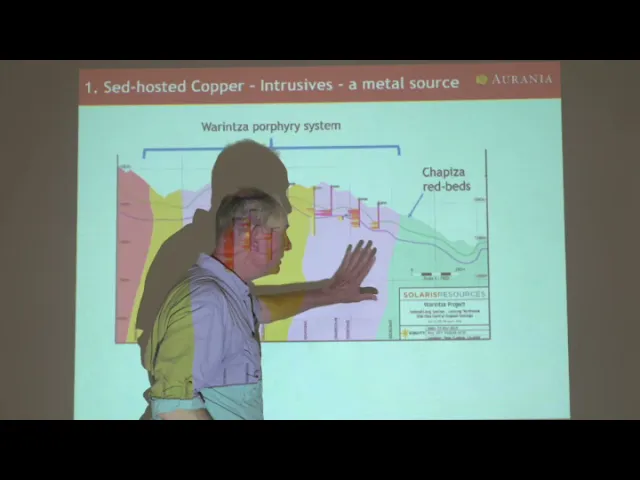
the lava we've also got the mudstone under here and the limestone that's an older basin source of hydrocarbons and and other metals as well so there's no problem with sauce and this is a a cross section that sorry i haven't put the um credit on on here this is from uh samaras resources or one of their 43 101s and again this is a vertical slice across lorenza and so this uh this sort of purplish rock and and this greeny yellow stuff is support free system um so that is a source of metals but what's important
about this cross section is that what's colored in green here is such a piece of formation it's it's it's the red bit so we know we've got a prime example of a beautiful deposit one percent copper of a thousand meters or whatever the guys are drilling there and we know that that is intruding into the chapissa so it's a source of metals copper particularly um and and also a source of heat we want we want um the basin stewing as much as we can this lava is about 150 meters thick and so it's like putting
a lid on a pressure cooker and all this stuff under here is going to be stewing if you were to intrude warinsa into this it would not only put in metals but it would put in heat too to help leech those those metals out of out of the red beds so a you know how this is our particular example again um our seal of the top which is the volcanics and we're looking at sort of folded sequences and we've got the porphyry like like wherein so theoretically coming into this so we've got a source of
metals in the red beds and key to this is the salt because salt is nacl and the chlorine from that salt keeps the zinc copper and lead in solution and that can sit there while the metal is in and silver while the metal is sitting in that chlorine complex they call it while the the metal is bound to the chlorine that can sit there for hundreds of millions of years because nothing's going to happen to it it's absolutely stable we need to get that fluid into a place where it's going to react to crop it's
drop its metal out so that's why we we've we've been talking so much about about the salt and then obviously down here um the the so-called santiago formation limestone and and black shales a source of petroleum so we can put a big check mark against number one moving on to number two how are we going to move those metals around and what is the footprint that we can see that can convinces us that the um those those fluids have moved around around the basin so in terms of the salt again here's the metal and the
chlorine complex you have to have salt and we've we've drilled um the other thing that's just so very nice about this is that we can also see this uh so-called chicken wine texture these are lime stones um from the tirioshimpia area from the drilling that we're doing there and these textures are absolutely typical of an area that had salt in it and the salt has flown out of there so salt becomes very um very fluidized and under certain conditions and maybe with a little bit of seismic activity the the salt will move out of where
it was originally deposited and it moves along until there's a break in the in in the in the sedimentary layering like a fault and then it will go up to fault and some mushroom out so we've got the salt we've drilled it in all six it's sank in in one and we've also got the footprint where that salt came from down in this area where we drilling trees the evidence of the basin wide fluid flow this is actually the the volcanic rock this is a little quartz vein about a centimeter wide two centimeters wide and
it's got native copper and cuprite which is a copper oxide mineral in it and this rock looks as though it's never seen a fluid it looks like a horrible rock from an exploration geologist's point of view because it's got these white feldspar crystals in it beautiful crystals and that under normal circumstances means that it's a disaster this hasn't seen any fluid but we know that it has and what's happening here is that the feldspar is actually stable with the mineralizing food the other bizarre mineral that we've we've got in here was a soft bazaar that
is bizarre that's preserved is the um is the the organic um and you know it's it you would expect it normally to have disappeared in the reaction from those fluids around the copper but the fact that it hasn't that it's stable means that we're dealing with a copper bearing fluid or one of the interpretations is that we're dealing with a copper variant fluid that's got calcium in it this is a calcium bearing mineral so we've got our first evidence that this basin saw quite a special fluid that was that was hot and it was full
of calcium and i'll talk about where the calcium comes from in a minute this is um sorry and and i should have explained these the last graphic and this one and i think the next one is going to be of um thin sections that are cut the rocks cut into these very very thin little wafers and then light has passed through from from beneath and these are photomicrographs that photographs taken through a microscope so um this is about 0.2 millimeters that that scale bar so we're going right down into into the rock and looking for
this footprint that the metals have been through there um so this is i just don't it's it's it's um again an organic crystal it was an organic crystal um and this is the the remnants of the of the all blacks in there that has been completely wrinkled large parts of it have been replaced by the copper mineral and the the original mineral is showing up as blue here is just the gray hair there's pale stuff in the reflected the light that's coming through is um is the uh it is the copper mineral so again um
you know we're seeing that a copper bearing fluid was now starting it was once stable with with these minerals and now it's starting to interact with them a little bit and and precipitate copper and then you know just the the last one on on this again this is 200 microns so 0.2 um 0.2 millimeters uh this is an illuminated crystal um ilminitis is very very stable it's an iron titanium mineral the black between quite often sees on on beaches is this mineral very very stable but in our case um the the the ilmanite is starting
to be replaced by hemotypes so we see almond notes in the inner corner that affects hematite around the edge so again this is in the footprint of a iron an iron-bearing fluid and sorry just one more again a point two millimeters uh in the pail so it's exactly the same image the pale is the uh copper mineral coming coming through here in these tiny little mainlands and it's cross cutting something that's called plagioclase feldspar which normally just gets obliterated by alteration by the fluids that bring minerals in bring bring the metals in but in this
situation um the the plagioclase is just sitting there the plagioclase is stable with the copper bearing fluid and and that copper bearing through this just precipitating the the copper within a mineral that you normally don't see in in deposits so again this says that the copper bearing fluid is stable with with sodium and uh calcium and potentially a little bit of potassium as as well and you know the footprint of the metals and and the deposition of the metals in the chapiso is the mineralization that we we're seeing at surface and and this is not
quite as glamorous we see a little bit of um the green mineral malachite coming through but this is the black is a cover-bearing middle risk as well in what's quite clearly a sedimentary rock so the third point that you know what what is going to um so we we can see that we've got the the footprint of a fluid the whole of the basin has seen this this fluid that can can leech the metals it's the right sort of temperature how are we going to take that big volume and squeeze it into something that's that's
high enough great to be a a mineral deposit the first thing is um false so in this in this cross section um this is between ecuador and and peru as part of our justification for applying for the land in the peru in peru so we've got the red beds forming against these these folks in a rift uh basin um and you know right from the beginning we could see um copper mineralization the the green and black in here with fragments in it that looks as though it came from a fault and then the classic red
mineralization that was in our cases always got the the black carbon fragments in it in the sedimentary layering so the faults are important in moving the mineralization around and this is just a little 3d block diagram just to try and illustrate that so the copper would be moving out of the red beds so and and the fluids would be moving along the sedimentary layering until it hits something like a fault and then it's going to move up that so the fault can be mineralized and then the any um reactive bed that's in our case got
carbon fragments on it that's that's sitting within this uh sedimentary layering so this is the sedimentary layer here this is looking at the one surface of the sedimentary layer the whole thing would be carbon bearing but then the copper would be coming up the fault and spreading back into the sedimentary the reactive sedimentary bed and that's where the deposit would be um and you know the perfect illustration of this is kakuna in in the congo ivanhoes uh this is close on on 40 billion pounds of copper at about three percent here's the kind of fold
that we were talking about so these are red beds down here this is an impermeable layer over the top of it in the mineralization these are little um histograms the red histograms just showing the grade distribution so the copper gray sitting right along that that contact so this is a vertical slice through kakula notice the number of holes that they've drilled here and this is a vertical view um just showing that you know this is very much a worm shaped deposit and some sedimentary layer would form it would be throughout this area that the copper
is only precipitating in one place and that presumably is because there's a fault up here or up here and the mineralization is moving into into that that fold the top of that fold the other absolutely key thing that has come through just very recently a discovery again made by ivanhoe and this is again a vertical slice um the blue so this and the colors are great copper grade distribution so we've seen the classic sediment hosted copper here in this layer here and then it's faulted down by this bonanza fault and and so that just moves
like that so you see the copper in in this layer and that's a more permeable layer so it makes this is classic uh sediment hosted copper mineralization however this discovery is absolutely massive on the fault itself so the fault comes up here and it goes through through there more or less there's there's this huge mineralization that's about 30 meters wide and just extreme grade almost 11 grade and this has been absolutely crucial for our understanding of the chapisa and what we're looking for in the chapissa because this is an impermeable sedimentary rock so and this
unit here where the mineralization is moved along that is a slightly more permeable unit so we've got impermeable permeable impermeable gains and the fluid can't get into this impermeable rock even if it was reactive even if it was carbon bearing or oil bearing or or hydrocarbon gas bearing the fluid can't get into it so in this particular case ivanhoe has made this incredible discovery right on the font because the fault is the only way um that there's going to be permeability in in this in the sequence the pump driving these these fluids um again we've
got the list of things that happen in a normal red bed basin like the completion for the the centromere copper belt that goes between zambia and in the congo and we've got our such a piece of formation which we know is a little bit different because it's got all these volcanics in it um faults in terms of a plumbing system so important because of that last slide we've got lots lots of evidence of of heat we know that we've got things like morinsa coming into the system somewhere we don't know exactly where and we've also
got you know there's some evidence of iotg's as there are in the as it is in the in the zambian copper belt um and we've also got extrusion so lavas uh those green lavas that we've had in all the all the profiles coming out on surface and those things are coming in at 100 and about over a thousand degrees or whatever and then the the basin in terms of moving squeezing that fluid out we know that we've got at least the andes uh and and a couple of other squeezing mechanisms so the chapisa basin has
been moving around it's been sort of pumped like an accordion the red beds are normally permeable the chapisa is not it's an absolute mess and that is a curveball for for us so again these are photomicrographs they're little weightless thin um slivers of of rock where uh this the light is being passed through from from underneath this is just taken uh from an oil reservoir rock because oil reservoirs we're talking about exactly the same thing we're taking talking about the oil bearing fluid coming from one rock and and needing to get into another rock to
make a reservoir this is a um one of those uh wafer thin slices of the chip um any sandstone within the chicken so it's an absolute myth and it's not essential i'm using the wrong term it's a uh what they call it's it's a volcano sedimentary rock it's a sedimentary rock but completely full of volcanic fragments so and in here i mean you know you can see the odd little bit of quartz that's been labeled in here but otherwise it's an absolute mess you can't get fluid into a rock like that so the red bed
in most of the drilling that we've done cannot contain a copper deposit well not a big one anymore um in terms of just going back to the faulting because we we need the faults to be able to drive the fluids and and also to form um pathways um fought for those those copper-bearing fluids this is a map so we're looking down from from above and you know as exploration geologists we always get pretty excited when we see curves and faults and i will i'll talk about why in a second but this one these these two
faults that were taken from satellite imagery and they've been confirmed by the field mapping go and north this up that way um and let me just orient you these these little red marks here are where we've drilled in n1 this is a sink in in two and three up in this area and the red are the different railcars that we have um that lava unit the green the green layer on on all of our profiles it consists in a little bit of detail of four units and the lower unit um we've just mapped out here
um so that that unit would cover this whole area that it extends up into second n2 and m3 but what is important about it is that it's it's a marker horizon it tells us what is happening in the basin at at that time and these um different shades of green um and and this is just uh listen to the blow-up of this the different shades of green uh the darker the green the thicker the lava so what's happening here is the larvae is relatively thin here and this is a lava that because of its it's
its composition the minerals that are in it is coming straight up from from from extreme depth um it's a primitive lava and it goes from about 10 meters thickness down to about 60 meters thickness here and it looks as though that change in thickness of the lava is coming where this fold the fault starts to curve so in other words this fault had a hole next to it that was being filled in by the lava and as we make that hole so the the deeper we make that hole the the thicker the library inside and
there are a couple of other illustrations of that i i won't go into that before for time so i i just wanted to illustrate why that's important to us one it says that that fault was moving at the time that the lava was developing and we need to see faults that were moving during the basin development so the lava the air is part of the the the basin um and you know just the fact that it's a lava helps us to distinguish it so we can see what's what's happening with it so what i've just
done is highlighted i've just traced over one of these faults here that we think is related with this change in thickness of of the lava and all i'm going to do no i can't do it here actually um sorry okay we're just going to have to imagine it so um if one were to move a way of making a hole here is to move this fault in this sense because as you move it you can imagine this line moving up relative to um relative to to fault line as you move this block up so you're
going to create a hole here and as you create the whole the sedimentary basin tilts down into it and that's why we filling that gap with lava so we know that this fault was moving at the time and if that one's moving at the time that the red beds were deposited and the volcanics um if that one was moving that one is probably moving and this one probably as as well but in in looking at this fault we would not be so interested in this part of it we would be interested in where it starts
to curve because that's where the biggest hole is going to be so going back to that slide of the copper mineralization from pipe and hose presentation that the copper sitting along that fault that's exactly what happened that fault opened up and the copper mineralization went into was was deposited in that gap made by the fault so we've got we've got big check marks against these three what about metal traps um we've seen that we've got evaporite uh and that is important in getting the metal into solution of the red bed because it's got the chlorine
in it okay after the chlorine we can sort of forget about the salt for it for a little bit and then we focus on the other two uh minerals that form with the salt in in evaporate sequences um and evaporate sequences are just where there's been a very shallow sea or whatever that's been isolated and then in in hot areas around the gulf today for example you you get the evaporation of the water and you leave the the salt behind so the gypsum is important because it's a source of sulfur so we now we we
know that we've got the metals in solution or we're very likely to have the metals in solution now we need to find the thing that's going to precipitate and precipitate the copper and all of these sediment hosted deposits the mineralization is made up of copper sulphides so we need a source of sulfur there's a source of sulfide of gypsum and and also anhydride they they're so-called um sulfate minerals bacterials for sulfur yeah yeah and yeah and then you know hydrocarbons um very often when we break those black shales you can you can smell the some
diesel with smell and then we and we know from the oil industry that that they are a source of hydrocarbon which is a good reduction for the copper bearing fluid as well and a good source of sulfur and you know just bringing up this slide again so just to reiterate that this is impermeable this is impermeable so this would be very very much like the chapissa where ivanhoe have come up with this discovery we are going to see little permeable units in the chapisa and and we can see that we can see that where um
the permeability increases where the sediment is a little bit cleaner a little bit more quartz in it we see the fluids getting into that and bleaching the rock and um they leave behind a tracer which is um sometimes elite and sometimes it's it's pre night they're just two alteration minerals that tell us hey these these were hot fluids but we haven't hit a horizon you know drilling in the in the chapisa yet that has really nice um permeability with some trap some chemical way of of getting the um the copper out of solution so from
what we've seen in the chapiso so far this is our principal target and if we just go back to this slide um sorry we already know from the lava and without the love and the sequence we would not have been able to identify this because one red head looks like another we think that this part of this fault would have opened up and be a a great target for surviving her um this kind of of mineralization so sorry there's a mistake on this that should be the the chapissa is impermeable um let me say that
again i said in in most cases most red beds are permeable and that's why we originally went for the drilling under the the lava we've now realized that we've got a curveball but it's not permeable so we have to change our thinking if you're in a permeable basin you need to find the trap sites that are in permeable and in the chapiso it's the other way around we're now instead of looking for trap sites we're looking for permeable layers and we need a reductant in those permeable layers either bitumen or pyruvate bitumen or plant fragments
or or whatever and the other source of sulfur is the evaporates and you know that are related with the with the salt so our drilling up till now in in the chapisa has been mainly focused on uh and this is more or less the same sort of graphic that we've we've had in solar press releases the lava seal uh we know that this is a source of of hydrocarbons the gas and the oil would have gone up into these trap sites the oil guys are always drilling these with we're talking oil geology here but in
our case we know that we've got salt we know where it's coming from we've got the source of oil we've got the porphyries coming in here and the chopisa is a great source of of metals so our thinking on our drilling to find the copper under the seal was was absolutely correct in a permeable basin but the problem the visa isn't permeable and we didn't know that until we drink or this part of the chapissa basin that we just that we've focused our exploration so this is just the illustration it's been in a couple of
the press releases an east-west profile uh quite a big profile about a kilometer here and in about a kilometer so no vertical exaggeration big fault system we now know from the lava which way that fault was moving and when it was moving which is fundamentally important and originally on this graphic we've drawn the evaporite being controlled by the faults that coming out of this material here so that we know that the sultan voids here these yellow layers come out along the folds this fork probably has salt on it as well it could make sense and
we drew the salt originally down here somewhere we've now hit it in hole six so we know that we were sort of underestimating the extent of of the salt and and this is in in in cross section in a in a in a cut um through the central area and in three dimensions this would probably be a salt water that's what we see in the seismic data from the same basin in peru so a good idea but the permeability is uh is a bit of a curveball so just going back to um putting tyria shapia
in context with this tyria champion metals lead and zinc and silver in sulfide it's crucial that it's in sulphite as an indicator for us so we know that we're getting sulfur from somewhere and in fact this is uh a bit of salt fat from tearing shampoo so we know that there's an excess of sulfur so sulfur source in this area is not a problem so we've got a metal source in the red bed basin we've got sulfur source at least a tear exchanger and we just need to get those two things together we need to
be thinking about where that's going to happen so on on on a big scale um this is gregor orb's um graphic of of the metal zoning in the sheep and you also see it in parts of the zambian pocket belt hematite we've drilled that out at uh sinkhem at n2 and m3 and in fact we're drilling lots of magnetite as well that's secondary magnetite in other words it's it's an another iron mineral that's been forced in into the basin uh so we've got this red part we've got this part up here and we just have
to nail where the copper bearing zone is and our thinking on that at the moment we've put this graphic out in a press release as well is this is our lava seal across the top here we drilled underneath that thinking that that would be the place where the copper would be concentrated because of the lack of permeability it didn't work we were wrong um we've drilled the hematite and and magnetite and single n2 and n3 it looks as though that's part of the same system and we're drilling the interior shapia zinc silver now and we've
seen really beautiful permeability in the very top of of this unit so theoretically if we go down at sinking we're eventually going into the same layer it's mineralized it's got this mineralist anterior champion it's got this beautiful permeability that then it holds a hydrocarbon you can see fire fire regiment in it we just need to find where this is and this is the thing that we're doing at the moment just focusing in on um tyrio shimpier uh as sick um so that would so in this vertical profile i should have said that um just a
a very simplistic and idealized one the whole thing is tilted a little bit so today's erosion level is something like that so it's thinking we're looking up in this area where it's interior shooter this is actually the surface um sorry still in the budget this layer down here uh just homing in on on where we've seen that interior ship here um this is a vertical profile of a carbonate ramp uh the kind of you know flying over the caribbean or something you see the islands with those big white sheets around them um underwater that is
mostly carbonate and so what we've got here in these two black lines is just different tidal levels of uh of the ocean um so down at depth and normally these things are ramps so they're very shallow water and then they go deep pretty quickly and these are this is taken from a study of three of those little very detailed laminae of three different places in whole thinking sorry to shimpier whole one um and and this study that was done by a bunch of guys in in quito absolutely top class they identified that part of hole
one at tyrion shimpier has hit this part of the system but crucially it's starting to be very shallow water and that ties with some of the elements some of the features that we've seen in the in the field and even more importantly here they've identified this kind of rock which is right next door to the sapca environment and the sap environment is is where in very shallow sea water you get huge evaporation of in in hot climates of of the water you left with salt and and the sulphates behind so this is an evaporite sequence
so it makes sense with those chicken wire textures that we've seen in the core these carbon expressions identifying that we can see that the rock that you would expect to rock and lie right next to that and behind the sabka environment sorry i've changed up their diagram a little bit are red beds that's exactly what you would expect to see red beds are formed in a continental setting and then so i've i've changed this up a little bit to put the chafisa in there and then the volcanics that we've seen and awareness are kind of
porphyrin so the whole thing comes together from an absolutely microscopic level that we're seeing in these in these laminae right through to you know what's what the guys are publishing out of out of worry so gregor borg was was here a couple of weeks ago a couple of months ago and to me the the most critical thing that gregoire switched on to um was the fact that in our thinking we and i've been saying it and it's it's it's been uh shown like that on all of our vertical cross sections i'm showing that the limestones
and black shales the santiago formation at the bottom and the red beds the chipiso over the top that is a slice through the basin but in terms of time in the real world and you see this in the caribbean or anywhere else you you see this shelf environment forming at the same time that all of this is forming and the volcanism so if we were to take a timeline at 155 million units or whatever number you want to choose we would have this whole sequence for me and we would call this the santiago formation which
we think is being lower and we would call this the chapisa and we would call these the volcanics and the porphyries would be called something else uh and and we tend to think about them as having it you know some different times they're all forming together and the way that you get the red beds over this is just to have the river system uh encroaching on the the ocean system so you end up over time with the red light sitting on top of the limestones but basically we've we've got every part of the system and
this is why we're so excited about sinking um we are getting close to to nailing it so basically um in terms of where we go next in our drilling it at senke we can see the chicken wire texture we know whether the um the salt and more importantly that the the sulfate species have come from we've drilled the evaporate mushroom or dome and what we need to do to find the permeability is none of this is permeable is to get down in the sequence a little bit down into this area where we know from arterial
shampoo journey that there's a permeable end and that's what we need to do next so what we're looking for we know that these folks were probably bringing up copper so we're going to be looking for proper a long permeable units just into that limestone sequence under the fault and also we probably have the same thing going on in this area and so what we're drilling at the moment is this stuff that instead of being in this profile we're drilling it further away where this has come closer to surface so we don't have to deep drill
such deep holes and this stuff just needs some agreements from the land owners that you know takes a couple of months and a drill camp to be built and then we we need to get in and drill that as well so we have every single element and it's just a matter of having put it together in the right way these these are the same faults and that's a that's a great question these folks are the ones that go into during shooting so we know that they're moving they're precipitating uh zinc and lead and silver up
in interior shim here and here we think that they're going to meet a possible coffee so sorry in in length uh that's about well the whole thing is about 50 kilometers um yeah and you know just going back i glossed over it a little bit through let me just go back to this you know looking on on this scale we're we're looking at about uh sorry business going on here about 10 kilometers or so um so the most obvious target is is this curve um but then each one of these little jogs every time it
changes direction that's that that's going to be an interesting spot because and then anything else so this is why we believe we're getting we're getting close to close to it so this is what our target is that at the moment so on this profile um interior shim here would be here outcropping its surface but that you know it we we believe that it could um link up with with copper minimization there and we would obviously like this copper to be a lot more extensive as well there's absolutely no reason that it can't be so you
know that that's that's the sort of model that we've got in mind yeah and you know we've we've got very little constraints on on this over over here um we know that this is a normal fault so the sense of movement has been like that so we know that this is reasonably shallow but there's minimal constraint on on what gaps that the the interesting horizon could be 100 meters below so we don't know we we're going to have to drill uh a nearby wall here to see what's what's going on and you know now that
we've got this concept we can use the mobile entity a little bit more cleverly and of course the evaporator the sultan is going to conduct like that you