welcome back the Rome statute on the international criminal court was adopted on the 17th of July 1998 60 states were needed to ratify the Rome Statute in order for it to come into force and this duly happened on the 1st of July 2002 unlike the two international criminal tribunals for the former Yugoslavia and for Rwanda the ICC is the product not of a binding Security Council resolution but of an international treaty this was essentially because States while being prepared to accept the creation of a geographically limited Yugoslavia and temporarily constrained Rwanda tribunals by Security Council
action were not willing to be so Bound by the establishment of a permanent international criminal court with much more extensive jurisdiction without Express consent secondly it is to be noted that the range and content of the Rome statute is far greater than those of the two international criminal tribunals the Rome statute contains 128 articles while the ICT statute contained 34 and the ICT are 32 the Rome statute provides that the jurisdiction of the international criminal court is limited to the most serious crimes of concern to the International Community as a whole being genocide crimes against
humanity war crimes and aggression and that a person who commits a crime within the jurisdiction of the Court shall be individually responsible and liable for punishment in accordance with the statute the ICC only has jurisdiction with respect to crimes committed after the statute came into force and with respect to states which have become parties to the statute further jurisdiction may only be exercised provided either the state on the territory of which the conduct in question occurred or the state of which the person accused of the crime is a national is a party to the statute
this means that the jurisdiction of the IC is not Universal but territorial or personal in nature it also means that the national of a state which is not a party to the statute may be prosecuted where the crime is committed in the territory of a state which is a party further under article 123 a non-state party may make a declaration accepting the jurisdiction of the court for a particular purpose Ukraine did this twice first on the 9th of April 2014 with respect to alleged crimes committed on Ukrainian territory from the 21st of November 2013 to
the 22nd of febru 2014 and secondly on the 8th of September 2015 extending this time period on an open-ended basis to accompass ongoing alleged crimes committed throughout the territory of Ukraine from the 20th of February 2014 onwards on the 2nd of March 2022 the ICC prosecutor announced that having received a joint referral from eventually for 41 states he would open an investigation into the situation in Ukraine the court may also have jurisdiction where a situation has been referred to the prosecutor by the security Council acting under chapter 7 of the charter which is therefor thereby
binding and in which case it is unnecessary that a relevant State be a party to the statute this has happened with regard to the situation in darur Sudan which was referred to the prosecutor on the on the 31st of March 2005 by the security Council in resolution 1593 after a preliminary examination of the situation an investigation was opened on the 1st of June 2005 and after a 20mon investigation into crimes allegedly committed in darur since the 1 of July 2002 the prosecutor presented evidence to the judges and a summons to two named Sudanese individuals one
being a government Minister and the other a military officer to appear was issued with regard to charges alleging the commission of war crimes and crimes against humanity warrants of arrest were issued on the 27th of April 2007 against the two individuals by pre-trial chamber one two warrants of arrest were subsequently issued against the then president Al Basher on the 26th of February 2011 the situation in Libya was referred to the prosecutor by the security Council this resulted in warrants of arrest being issued by pre-trial chamber one for moama Gaddafi the then leader of Libya who
is subsequently killed Saif Al Islam Gaddafi and abdah Al suusi the appeal chamber declared the case against the former admissible in May 2014 while holding in July 2014 that the case against the latter was inadmissible as it was currently subject to proceedings in Libya and that Libya was willing and able to carry out the necessary investigation in addition to the security Council referral the ICC is also able to exercise its jurisdiction with with regard to one or more of the crimes in question were the situation in which one or more of these crimes appears to
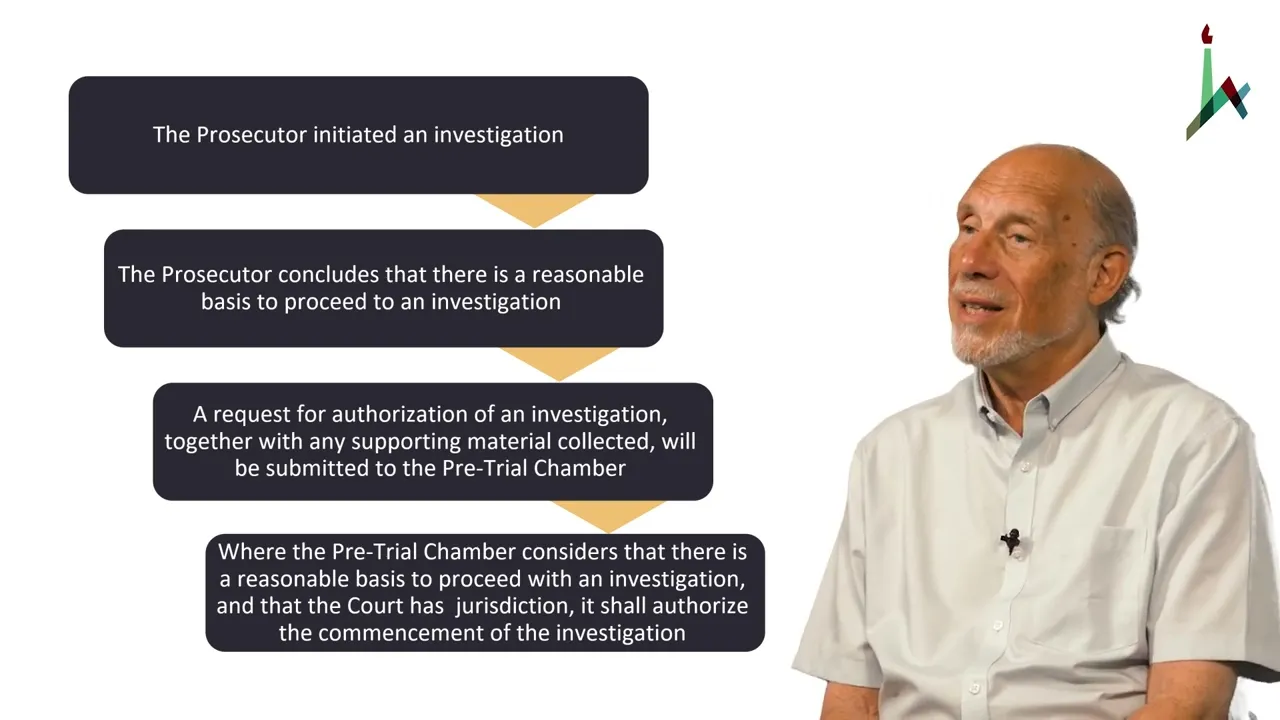
have been committed has been referred to the prosecutor by a state party to the statute or where the prosecutor has himself or herself initiated an investigation in the latter case where the prosecutor concludes after having analyzed the seriousness of the information received that there was a reasonable basis to proceed to an investigation a request for authorization of an investigation together with any supporting material collected would then be submitted to the pre-trial chamber victims may also make representations to the pre-trial chamber in accordance with the rules of procedure and evidence were the pre-trial chamber upon examination
of the request and the supporting material considered that there is a reasonable basis to proceed with an investigation and that the case appears to fall within the jurisdiction of the Court it shall authorize the commencement of the investigation without prejudice to subsequent determinations by the court with regard to the jurisdiction and admissibility of the case there have to date been five examples of referral by a state party in December 2003 Uganda referred to the prosecutor the situation with regard to the Lord's resistance Army in April 2004 the Democratic Republic of the Congo referred to the
prosecutor the situation of crimes committed in its territory in December 2004 the Central African Republic referred the situation in its country during the armed conflict of 2002 to3 to the prosecutor in July 2012 the government of marlei referred the situation in its country to the prosecutor and then made a further reference two years later the prosecutor may also initiate an investigation under Article 13 proprio Motu on the basis of information on crimes within the jurisdiction of the Court received from individuals or organizations this has happened with regard to Kenya in 2010 10 and cot devois
in 2011 in January 2016 the prosecutor was authorized to open a proprio Motu investigation concerning alleged war crimes and crimes against humanity committed during the armed conflict in Georgia between July and October 2008 while a propro Motu investigation was authorized concerning barunda Burundi in October 2017 and in November 2019 with regard to alleged crimes within the Court's Jurisdiction in Bangladesh and Myanmar and Afghanistan at the time of recording this lecture the prosecutor is conducting preliminary examinations concerning alleged crimes committed on the territories of Guinea Nigeria and Venezuela as regards Palestine the prosecutor decided on the
3rd of March 2021 to open an investigation following the ruling by pre-trial chamber one that the territorial jurisdiction of the international criminal court extended to Gaza and the West Bank including East Jerusalem however in a concession to obtain the support of states to the IC article 16 of the statute provides that no investigation or prosecution may be commenced or proceeded with for a period of 12 months after the security Council in a resolution adopted under chapter 7 has so requested the court such a request may be renewed by the council under the same conditions a
key feature of the IC and one that distinguishes it from the two international criminal tribunals is that is that it is founded upon the concept of complimentarity which means essentially that the national courts have priority a case will be inadmissible and the court will be unable to exercise jurisdiction where the case is being investigated or prosecuted by a state which has jurisdiction over it this is unless the state is unwilling or unable genuinely to carry out the investigation or prosecution or secondly where the case is being investigated or prosecuted by a state which has jurisdiction
over it and the state has decided not to prosecute the person concerned unless that decision resulted from the unwillingness or inability of the state genuinely to prosecute and thirdly where the person concerned has already been tried for conduct which is the subject of the complaint unless the proceedings before the court other than the ICC were in reality for the purpose of shielding the person concerned from Criminal responsibility for crimes within the jurisdiction of the IC or indeed where those proceedings were not conducted independently or impartially the court consists of four organs these are respectively the
presidency an appeals division a trial Division and a pre-trial division the office of the prosecutor and the registry the 18 judges elected must be independent and serve on a full-time basis have competence in criminal law or in relevant areas of international law and must represent the principal legal systems in the world as well as reflecting Equitable geographical representation there is also the need for a fair representation of male and female judges the judges are elected by the Assembly of States parties using a rather complicated voting system it is interesting to note that while the pre-trial
chamber and trial chamber established in the respective divisions are staffed by criminal law judges the appeals division vision is composed of Judges with established competence in relevant areas of international law and the appeals chamber is composed of all the judges assigned to the appeals division in addition to the temporary and geographically limited international criminal tribunals and the permanent international criminal court a new style of judicial institution has made an appearance recently in which both International and National elements Co coexist in varying combinations such institutions which may for convenience be termed hybrid courts exist primarily to
enhance legitimacy and increase acceptability both locally and internationally where Reliance upon purely domestic me mechanisms carry significant political risks or costs there are a number of models which have been adopted which differ as to formal legal origin constitutional status applicable law and structure some of these mechanisms May more correctly be termed internationalized courts or tribunals as to the balance between the international and the domestic tips far to the latter these are essentially domestic courts applying domestic law but with an international element these include the special court for Sierra Leon the extraordinary Chambers in the courts
of Cambodia the Kosovo specialist Chambers the East t- more special panels for serious crimes the Bosnia war crimes chamber and the special Tribunal for Lebanon time does not permit more than a bare mention in addition it is possible for domestic courts to prosecute persons found in their jurisdiction for alleged International crime times under domestic legislation most countries for example have Incorporated the Geneva conventions into the law however this jurisdiction depends upon the alleged perpetrator being present in the country concerned I turn now to have a brief look at some of the international crimes genocide has
been regarded as an international crime since the Second World War and the genocide convention 1948 was a critical step in that process the crime of genocide has also being included in the operative provisions of the statutes of most of the courts and tribunals we have discussed genocide has been defined as meaning any of a series of Acts committed with intent to destroy in whole or in part a national ethnical racial or religious group as as such the acts are killing members of the group causing bodily harm or mental harm to members of the group deliberately
inflicting on the group conditions of Life calculated to bring about its physical destruction in whole or in part imposing measures intended to prevent births within the group and forcibly transferring Children of the group to another group further conspiracy to commit genocide direct and public incitement to commit genocide attempt to commit genocide and complicity in genocide are all punishable Kate law before the two international criminal tribunals has helped clarify many of the many of the relevant principles for example the ICT in the jealous case emphasized that it was the intention as distinct from the actual act
which gives genocide its speciality and distinguishes it from an ordinary crime and other crimes against International humanitarian law the element of intention was further discussed by the ICT in the kich case where it was noted that the intent to eradicate a group within a limited geographical area such as a region of a country or even a municipality could be characterized as genocide while the intent to destroy destroy a group if only in part means seeking to destroy a distinct part of the group as opposed to an accumulation of isolated individuals within it the part of
the groups sought to be destroyed had to constitute a distinct element and constitute a substantial part of the group noted the court it was also emphasized that each perpetrator must possess the necessary specific intent the intention to destroy means the physical or biological destruction of all or parts of the group and not for example attacks upon the cultural or so sociological characteristics of a group in order to remove its separate identity the sometimes difficult question of the definition of membership of the groups specifically referred to in the relevant instruments has also been analyzed it has
also been noted for example that ethnic cleansing as such does not constitute genocide but may amount to a pattern of conduct demonstrating genocidal intent the akuu case has also been important in emphasizing that rape and sexual violence May amount to genocide when committed with the necessary specific intent to commit genocide at the time of this recording there are two ongoing cases before the international court of justice concerning genocide on the 11th of November 2011 The Gambia brought an application against Myanmar alleging violation of the genocide convention with regard to the rohinga people while on the
26th of February 2022 Ukraine far application against Russia alleging that the latter state had used false allegations of genocide in the donet and luhansk regions in order to justify its invasion of Ukraine war crimes are essentially serious violations of the rules of customary and treaty law concerning International humanitarian law article two of the statute of the ICT by way of example provides for jurisdiction with regard to grave breaches of the 1949 Geneva conventions namely a series of acts against persons or property protected under the Gen Geneva Convention such as willful killing torture or inhuman treatment
willfully causing great suffering or Serious injury to Bar your health extensive destruction and appropriation of property not justified by milit milary necessity and carried that unlawfully unwantedly unlawful deportation or transfer or unlawful confinement of a civilian and taking civilians as hostages such violations also include the employment of poisonous weapons or other weapons calculated to cause unnecessary suffering want and destruction of cities towns or Villages or Devastation not justified by military necessity and the plunder of public or private property the key modern decision has been the Tage case before the ICT the appeals chamber in the
jurisdictional phase of the case noted that an armed conflict existed Whenever there was a resort to Armed Force between states or protracted armed violence between governmental authorities and organized armed groups or between such groups within a state International humanitarian law applied from the initiation of such armed conflicts and extended beyond the cessation of hostilities until a general conclusion of Peace was reached or in the case of internal conflicts a peaceful settlement achieved until that moment International humanitarian law continued to apply in the whole territory of the Waring States or the the case of internal conflicts
the whole territory under the control of a party whether or not actual combat takes place though although it was noted that international law did not regulate internal conflict in all aspects it was held to cover such areas as protection of civilians from hostilities in particular from indiscriminate attacks protection of Civilian objects in particular cultural property protection of all those who do not or no longer take part in hostilities as well as prohibition of means of warfare prescribed in international armed conflicts and a ban on certain methods of conducting hostilities further it was held that individual
criminal responsibility existed with regard to violations laid down in customary and treaty law irrespective of whether the conflict was an international or an internal one this Tadich judgment can now be taken as reflecting international law and it is to be noted that a significant number of Provisions dealing with International conflicts now apply to internal conflicts as laid down in the statute of the international criminal court the international Criminal Court's first conviction for sexual slavery was in the bosow case 2019 where it was determined that sexual slavery constituted both a crime against humanity and a war
crime article 6 C of the nurenberg charter included crimes against humanity within the jurisdiction of the tribunal and these were defined as murder extermination enslavement deportation and other inhumane acts committed against any civilian population before or during a war or persecutions on political racial or religious grounds in execution of or in connection with any crime within the jurisdiction of the tribunal whether or not in violation of the law of the country were perpetrated Article Five of the statute of the ICT provided for jurisdiction with regard to particular crimes when committed in armed conflict whether International
or internal in character and directed against any civilian population including murder extermination deportation torture rape and persecutions on political racial and religious grounds article seven of the statute of the IC like the statute of the ICT notes that the crimes in question enforced disappearance and aparte are in fact added to the list appearing in the statutes of the two international criminal tribunals have to be committed as part of a widespread or systematic attack directed against any civilian population with knowledge of the attack the requirement of widespread or systematic was examined in akayesu where the trial
chamber declared that the concept of widespread could be defined as massive frequent large-scale action carried out collectively with considerable seriousness and directed against a Multiplicity of victims while systematic could be defined as thoroughly organized and following a regular pattern on the basis of a common policy involving substantial public or private resources it was noted that there was no requirement that this policy must be adopted formally as the policy of a state although there has to be some kind of preconceived plan or policy however in karak the ICT appeals chamber held that while proof that the
attack was directed against a civilian population and proof that it was widespread or systematic were legal elements of the crime it was not necessary to show that they were the result of the existence of a policy or plan the existence of a policy or plan could be evidentially relevant but it was not a legal element of the crime aggression is recognized as a crime in customary international law article six of the Newberg Charter defined its jurisdiction as including crimes against peace namely planning preparation initiation or waging of a war of aggression or a war in
violation of international treaties agreements or assurances or participation in a common plan or conspiracy for the accompl accomplishment of any of the foregoing and the number of defendants were indeed convicted of offenses under this head General Assembly resolution 951 affirmed the principles recognized by the nurenberg charter and its judgment aggression was termed the Supreme International crime in one of these judgments the Tokyo char included the same Principle as did Allied control Council law number 10 General Assembly resolution 3314 of 14th of December 1974 contained a definition of aggression in contravention of the charter the crime
of aggression is referred to in article five of the statute of the international criminal court but in no other such instrument however the court was unable able to exercise jurisdiction over this crime until a provision had been adopted defining the crime and setting out the conditions under which the court May exercise jurisdiction with respect to it at the ICC review Conference held in Cala in 2010 amendments to the statute were adopted which Define the crime of aggression in a new article 8 B and laid down jurisdictional conditions in in order for this special jurisdictional regime
to come into Force at least 30 acceptances or ratifications of the amendments were required together with a decision taken by twoth thirds of the state parties to activate the jurisdiction at any time after the 1st of January 2017 this was done on the 17th of July 2018 however the ICC will not have jurisdiction over non-member States or States parties or their Nationals that have not ratified the amendments in the case of a state referral or ICC prosecutor initiated investigation as of April 2022 there were 43 parties to these amendments I make a few brief concluding
comments the rules are relatively clear and relatively comprehensive but enforcement is a problem the situation in Ukraine at the time of recording is a vivid and tragic example of this there is no International court with binding and comprehensive jurisdiction the IC does exist and with all of its problems does Mark a step forward but it has no jurisdiction over Nationals of non-states part ities unless the alleged crimes have been committed on the territory of a state party however as we have seen in the case of Ukraine a state that is not a party to the
ICC statute May declare that it accepts the jurisdiction of the court for a specific purpose specialist criminal tribunals can be established but require either a binding Security Council resolution or a comprehensive treaty which in the latter case would not cover States not parties to it apprehension is a further problem but what seems impossible at one time may become possible at a later time as we have seen with regard to the former Yugoslavia and other situations international criminal law is at the sharp end of international law and it reflects the strengths and weaknesses of that system
thank you
![[ Ukraine Frontline Changes ] RUSSIA REACH THE BORDER~! Surprise return to Dachi; V.N line collapsed](https://img.youtube.com/vi/Nlr4PM5LDGg/maxresdefault.jpg)