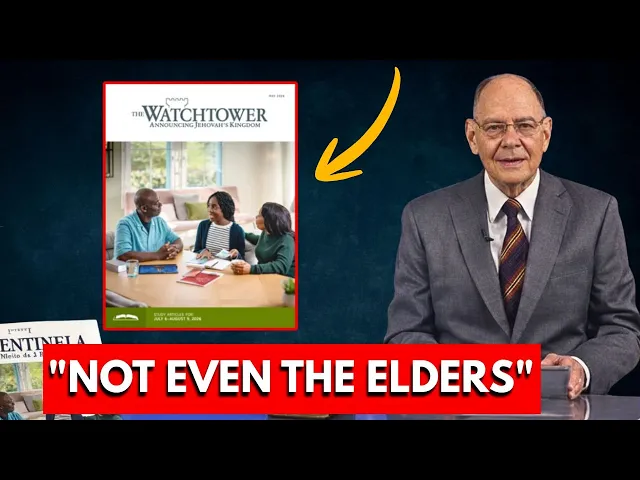
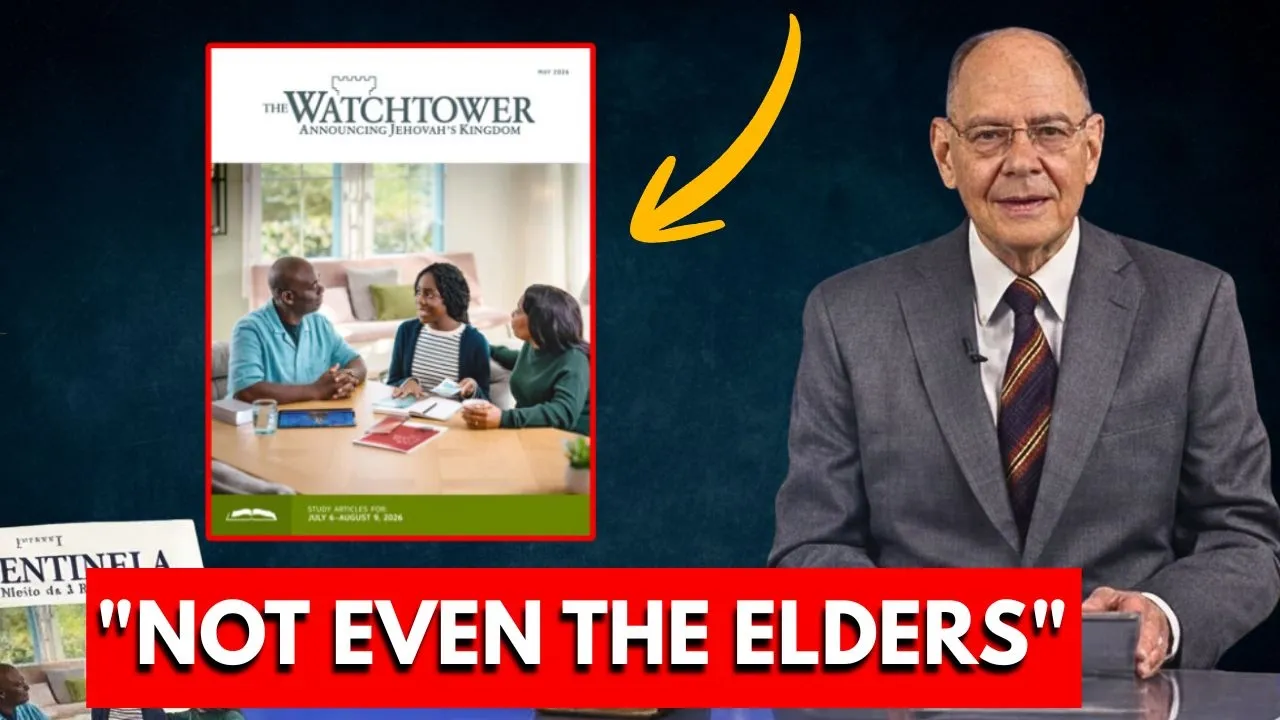
The May 2026 Watchtower just told elders they have no right to judge personal decisions. It said higher education is now a personal matter. It used the beard issue as a live example of exactly the kind of congregation policing that should stop.
[music] And it put all of this in official study material that 8 and a half million members will be reading in Kingdom Halls this summer. That is what is in this magazine. And for anyone who spent years inside this organization, who sat across from a local body of elders and was counseledled about choices that had no direct biblical prohibition attached to them, what comes next is going [music] to hit close to home.
The world that older members actually lived in to understand the significance of what the governing body has just quietly published. It helps to go back not to the organization as it presents itself today, but to the organization as it actually functioned for the men and women who grew up inside it during the 60s,7s, 80s, and '90s. In 1969, the Watchtower published guidance that would shape the educational decisions of an entire generation.
The message was explicit and direct. Young people were told that pursuing higher education was not simply unwise, it was spiritually dangerous. The reasoning was tied to the organization's expectation that Armageddon was imminent.
Why spend years in university? The argument went. Building a career in a world that was about to end.
The faithful were encouraged to pioneer to dedicate themselves fully to the ministry to treat the approaching end of this system of things as the only deadline that mattered. That guidance was not presented as a suggestion. It was presented as the spiritually mature position.
And young people who chose differently, who enrolled in college, who pursued careers, who decided that building a life in this world was not incompatible with serving God, found out very quickly what the local body of elders thought about that choice. They did not need to be called before a judicial committee to get the message. Judicial committees were reserved for more serious matters.
Sexual immorality, apostasy, conduct, unbecoming a Christian. For the softer offenses, the ones that lived in the gray zone between formal prohibition and cultural expectation, the mechanism was different. It was the elder who pulled you aside after a meeting, the pioneer sister who expressed concern about your priorities.
The subtle but unmistakable shift in how the congregation regarded someone who had chosen the world's path over the organizations. By 2012, the guidance had evolved in tone but not in direction. Publications from that period continued to frame higher education as a spiritual risk, describing the university environment as a place where young witnesses would be exposed to dangerous philosophies, immoral associations, and thinking patterns incompatible with biblical values.
The council was to consider alternatives, vocational training, technical courses, anything that would provide a livelihood without requiring years of immersion in what the organization characterized as worldly thinking. For an entire generation of men and women who are now in their 50s, 60s, and beyond, this guidance was not academic. It was the context in which the most consequential decisions of their young lives were made.
Some complied and later questioned what they had given up. [music] Some resisted and paid the social price, and some left entirely, walked away from the organization, from the congregation, from families who had been instructed to treat their departure as a kind of spiritual death. Those are the people who need to hear what the May 2026 Watchtower is now saying.
The article and what it actually says. The final study in this issue is titled, "Respect the decisions of others. It is scheduled for congregation meetings in the first week of August 2026.
Its opening scripture is Romans 14:1, a verse instructing Christians not to make judgments about differing opinions. What follows is a series of scenarios drawn from congregational life that any long-term member will immediately recognize. [music] A brother who grew up with an alcoholic father and judges other members for drinking at a social gathering.
A sister who recovered from a serious illness and pressures another sick sister to follow the exact same treatment path. A member who is offended that another attended a funeral service held inside a church. These scenarios are familiar.
They are the texture of ordinary congregational life. the kind of low-level social policing that happens in every Kingdom Hall, in every country where this organization operates. And then comes the scenario that longtime members will find most striking.
A brother who grew up in an era when beards were considered inappropriate for men in the congregation. The article acknowledges explicitly that this brother knows the organization has made recent adjustments on this subject. He is aware the position has changed, but he continues telling other members that men should not wear beards to spiritual activities.
The article does not present this brother sympathetically. He is the cautionary tale. His offense, as the article frames it, is enforcing a cultural norm that the organization itself has walked away from, using his personal history and accumulated opinion to pressure others in ways that go beyond his actual authority.
The article then delivers its central argument. No member has the right to judge another member's personal decisions. James 4:12 is the foundation.
There is one lawgiver and one judge, and it is not a member of the local body of elders in any congregation anywhere in the world. Brothers and sisters, answer to Jehovah, not to each other. And the article states directly that nobody, not a fellow member, not a congregation elder, not anyone, has the authority to sit in judgment over decisions that do not violate a clear biblical principle.
Then it addresses the elders by name. Elders help the congregation stay united, the article says, by not creating rules about personal matters, by not going beyond what is written in scripture, by basing their council on the word of God rather than on their own experience and personal opinion. For anyone who has sat across a table from a local body of elders and been counseledled about a personal decision that had no direct scriptural prohibition attached to it, about education, about career, about appearance, about associations, about the dozens of life choices the organization has historically treated as spiritually significant.
That sentence lands with a particular weight because that council delivered in those meetings was always presented as spiritually grounded. It was always framed as the elders responsibility to the congregation. And now the organization that trained those elders, that appointed them, that gave them their authority is publishing study material that describes that very behavior as going beyond what is written.
The footnote that rewrites history. The article about personal decisions is significant, but it is a footnote on page 15 of this same issue that represents the most direct reckoning with the organization's own past. The third study article covers the question of additional education, whether young witnesses should pursue schooling beyond the minimum required by their government.
The article itself is cautious, framing education primarily as a tool for sustaining oneself in the ministry. But at the bottom of page 15, in small text, the organization says something it has almost never said publicly before. The footnote acknowledges that in the past the organization's own publications advised Christians against certain types of additional education.
It references the 2005 Watchtower article on higher education specifically by name without euphemism. It does not deny that this guidance existed. It does not reframe it as guidance that was misunderstood or misapplied.
Instead, it draws a line. Pursuing additional education, the footnote states, is a personal matter. And then it adds the sentence that has been circulating in former member communities since this issue was released.
No one, not even the elders, should judge a Christian's decision on this subject. No one, not even the elders. Read that against the backdrop of 1969.
Read it against 2005. Read it against every congregation meeting where a young person was made to feel that choosing education over pioneering was a sign of insufficient faith, insufficient love for Jehovah, insufficient commitment to the organization that claimed to speak on his behalf. The governing body is not calling it an error.
It is not apologizing. It is not acknowledging the generations of lives that were shaped by guidance. It is now quietly reversing in a footnote.
But it is drawing that line. And that line, however late it arrives, is now part of the official record. What is being lost and why that matters.
There is another dimension to what is happening here that deserves serious attention, and it is one that longtime members and former members will understand better than anyone else. The Jehovah's Witnesses built their identity on separation, on being distinct, on being the one true organization in a world of false religion and moral compromise. The strictness was not incidental to the identity.
[music] It was the identity, the restrictions on education, on associations, on appearance, on entertainment, on virtually every domain of personal life. These were not arbitrary. They were the markers of a community that believed it was different from the world in a way that carried eternal consequences.
When members were told not to pursue university education, the message was not just about the dangers of worldly thinking. It was about being visibly, demonstrably set apart from a world that the organization taught was under the control of Satan. Every restriction was a boundary marker.
Every sacrifice was evidence of loyalty. Every judgment passed by a local body of elders on a member's personal choices was an assertion of the community's collective identity against the encroachment of the world. Strip away those boundary markers one by one and something happens to that identity.
The beard rule changes. The education guidance softens. The article about respecting personal decisions tells members to stop policing each other.
And with each adjustment, the organization that presented itself as the only community on earth living by Jehovah's standards begins to look in practice increasingly like every other large religious institution that accommodates individual difference in order to retain members. That is not a neutral development. For people who gave up significant portions of their lives to maintain that distinctiveness, who sacrificed education, career, relationships, personal freedom, watching the organization quietly abandon the standards it used to justify those sacrifices raises questions that do not have comfortable answers.
If the decision to attend university is now a personal matter that no elder has the authority to judge, then what was it when an elder sat across a table from a 19-year-old and counseledled against it in 1985? Was it overreach then? Was the authority being exercised in that conversation always illegitimate even when the organization was publishing guidance that supported it?
And if the organization's published guidance was capable of being wrong, then in ways the organization is now implicitly acknowledging, what does that say about the authority behind every other decision made in the name of that guidance? The governing body does not answer these questions. It does not acknowledge them.
It simply publishes new study material and moves forward, leaving the implications to settle wherever they land. The question of motive. The organization will not explain publicly why these particular adjustments are appearing now, but the circumstances surrounding their publication are not difficult to observe.
The last decade has not been kind to the Watchtower Society's public standing. Judicial proceedings in the United States, Australia, and multiple European countries have examined the organization's internal handling of child abuse cases and found it wanting. Courts have issued substantial financial judgments.
Investigative journalism has documented cases in detail that the organization spent years managing internally through judicial committees rather than through law enforcement. The gap between how the organization presented its elder arrangement as a spiritually guided body of mature Christian men and how that arrangement actually functioned in cases involving vulnerable members became publicly visible in ways that could not be easily managed. At the same time, the dysfellowshipping practice has come under increasing scrutiny from human rights bodies, particularly in Europe, where courts have examined whether the practice of organized family shunning is compatible with fundamental freedoms.
The organization has already made public adjustments to how it describes this practice. Adjustments that longtime members immediately recognized as more cosmetic than substantive, but adjustments nonetheless. Membership in Western countries has not grown at the rates the organization saw in previous decades.
Young people raised in the organization are leaving at increasing rates. Many citing the gap between what they were taught about organizational authority and what they observed when they looked closely at how that authority was actually exercised. [music] And the organization now operates in an information environment it cannot control.
Every publication is digitized and distributed globally within hours. Former members analyze every sentence. Journalists and researchers track policy shifts across decades.
The cost of maintaining positions that cannot survive public scrutiny has risen in ways that the organization's leadership, whatever else might be said about them, would be well aware of. Whether the May 2026 adjustments represent genuine theological evolution or institutional risk management, or both is a question that the organization's behavior over the coming years will answer more clearly than any study article can. What the magazine does not say [music] for all that this issue acknowledges the silences are just as significant as the statements.
[music] There is no apology to the generation that was steered away from education by published guidance. The organization is now reversing in a footnote. There is no acknowledgement of what was lost.
the careers, the opportunities, the intellectual development that was quietly redirected under the authority of men who by the logic of this very magazine were operating beyond their scriptural mandate. There is no examination of the blood transfusion doctrine which has resulted in deaths and which remains unchanged. There is no reckoning with the full scope of what dysfellowshipping has caused families across generations.
There is no honest accounting of the judicial committee process and the role it has played in enforcing cultural norms that the organization is now describing as personal matters beyond any elers's authority to judge. What exists is a footnote, a study article, carefully worded guidance that within the organization's own framework represents a meaningful shift. But meaningful shifts and honest accountability are different things.
And the people who paid the highest prices under the system this magazine is quietly adjusting deserve more than a footnote. A question for the people who lived this here is what this comes down to for the men and women who were there who sat in those congregation meetings who received that council from the local body of elders who made decisions about their education, their careers, their personal lives under [music] a framework of authority that the May 2026 watchtower is now drawing limits around. The organization did not give those years back.
The footnote on page 15 does not restore what was redirected [music] or taken. The study article about respecting personal decisions does not rebuild the [music] relationships that were fractured by a system of social that is now in its own publications being described as going beyond scriptural authority. But something has been said that cannot be unsaid.
And the people who understand most clearly what it means, who lived through the decades that preceded it, who know in their own lives what the words local body of elders and judicial committee actually represent, are precisely the ones whose voices matter most in this conversation. So the question being left here is a simple one. What did they judge you for that the May 2026 Watchtower now says was never their place to judge.
The education you pursued or did not pursue. The beard someone told you to shave. The medical treatment someone pressured you toward or away from.
The career choice that raised an elers's eyebrow. The personal decision that was treated as a spiritual failing because the organization had trained an entire generation of men to treat their opinions as the voice of Jehovah. Whatever it was, it matters.
Drp it in the comments. Because history is not only what organizations publish. It is also what the people they governed actually experienced.