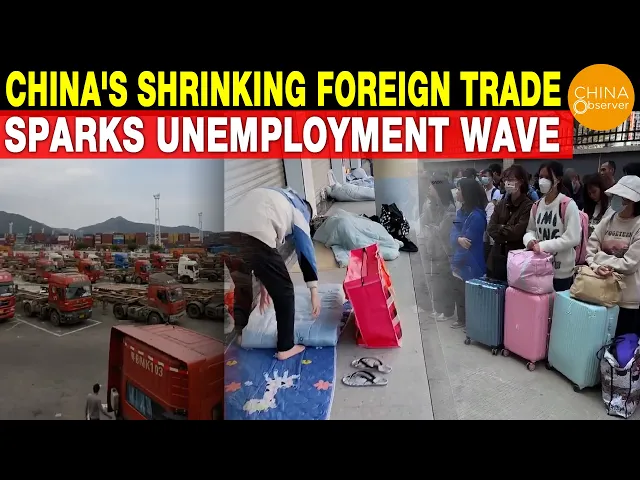
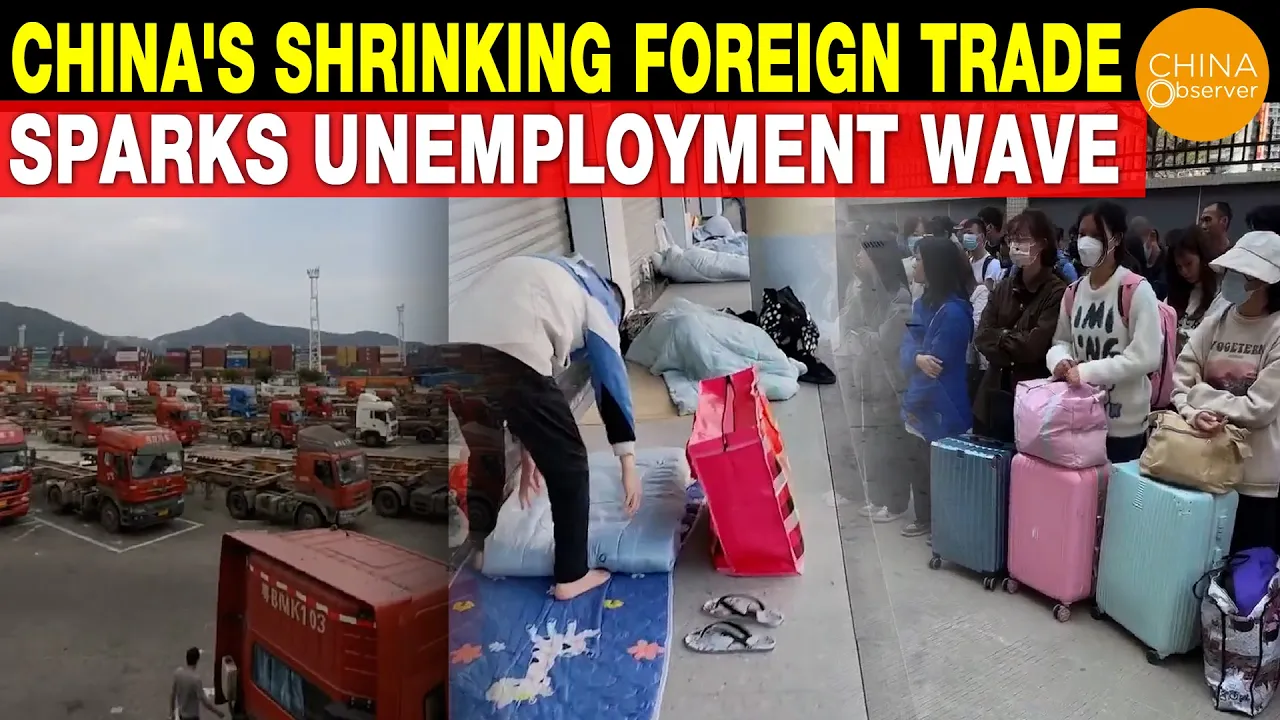
On March 6th, large numbers of rural workers gathered at Guangdong South Station and Dongguan East Station, waiting to return home. A similar phenomenon occurred in Shenzhen and Beijing earlier. In the past, this time of the year was when rural workers would return to the city to work after the Lunar New Year.
However, they are now going in the opposite direction. In the video clip, it is explained that after the Lunar New Year, they are returning home because they couldn’t find work. As there were too many people, one train departing from Dongguan was unable to depart due to severe overcrowding.
A long-distance bus stop in Zhejiang was also crowded with people returning home. Someone in the clip said that it was just like during the Lunar New Year period with mass influx of people returning home. Those who persist are sleeping on the streets as they don’t have any income.
Some netizens have shared that a large number of rural workers cannot find work and are stranded in major cities such as Shanghai, Suzhou, Shenzhen and Guangzhou. Many of these workers cannot afford to stay in hotels, so they spend nights in train stations, bus stations, the corridors of internet cafes and even under the bridge or in tunnels, still awaiting job opportunities. This is Shenzhen, where many unemployed rural workers are lying under the eaves and on benches on the streets, which is truly heart-wrenching to see.
But we don’t know how long they can stay there as the municipal authorities will probably evict them soon. Some have chosen to stay and join the arm of delivery drivers. However, with the increasing unemployment impacting the number of orders, the delivery industry has also become highly competitive.
We can see that many delivery drivers are waiting for orders at nearby restaurants. One delivery driver said that now there is a sharp decline in delivery orders in Shenzhen, and it’s difficult to make even 100 RMB a day. One of his colleagues only received one order in an hour, and another worked for most of the day but only earned 40 RMB.
It’s not only Shenzhen, the delivery industry in Beijing is also bleak and desolate. We can see hundreds of delivery drivers gathering on the streets, waiting for orders. One said that he only earned 98 RMB in 18 hours, working from 6 am to midnight, and this was on a Sunday.
This delivery driver said, the industry has also begun to lay off a large number of employees, and even delivery drivers are facing the risk of unemployment. He said that it is now the peak period, but most delivery drivers have nothing to do and are playing on their phones. This phenomenon used to only happen during the off seasons, but now it seems to be the norm.
Delivery orders have fallen by 60% and five million delivery riders in China are facing unemployment. The woman in the video said that she had visited more than 20 factories, but still wasn’t able to find a job. She has nowhere to live and no money for food, so things are looking bleak and she probably needs to return to her hometown.
Another young man said that he just returned from Kunshan, an industrial city in Jiangsu, but the job market there is also slow. It’s even impossible to find part-time or casual day jobs. Due to the transfer of the industrial chain and a significant reduction in export orders, factories in the Pearl River Delta Economic Zone and the Yangtze River Delta Economic Zone, which are the most active economic regions in China, have been forced to close down, relocate or reduce production on a large scale.
This has not only led to a large number of manufacturing workers losing their jobs but also caused a downturn in surrounding industries. Take Dongguan, Guangdong for example, this city relies mainly on processing and exporting trade, and is one of the world’s largest manufacturing bases, with an export dependency ratio that reached 145. 5% in 2019, ranking first among all Chinese cities.
In recent years, due to the transfer of the industrial chain, its export dependency ratio has dropped to 82. 5%, ranking second after Jinhua, Zhejiang at 99%. Dongguan used to house the production factories of Nokia, Samsung and many other international mobile phone brands and in recent years, it also became a production base for Chinese brands such as Huawei, OPPO, Vivo and Gionee.
In addition, there are more than 1,000 upstream and downstream supporting enterprises here, making it known as the “World Captial of Mobile Phones”. According to 2019’s “5G Smart Port White Paper”, Dongguan’s smartphone shipments in 2018 reached 368 million, accounting for one-quarter of the global total. Therefore, this city of mobile phones has witnessed and experienced the development and changes of the global mobile industry, as well as generations of workers.
On December 17th, 2014, Microsoft announced the closure of Nokia’s mobile phone factories located in Beijing and Dongguan. After the closure of the factories in China, some of the equipment was transferred to the factory in Hanoi, Vietnam. Due to US sanctions and a shortage of chips, Huawei’s smartphone shipments have also decreased significantly.
Recently, there have been reports of the relocation of domestic brand OPPO’s second factory. This electronic giant, which once employed thousands of employees, also brought about the prosperity of the surrounding rental and commercial markets. However, today, thousands of people have lost their jobs and the surrounding businesses have also been affected.
Someone posted a video showing that with Dongguan’s current situation, many people have lost their jobs. A factory that offers an hourly wage of only 15 RMB has a long queue of people applying for work. Another person said that the hourly wage in Dongguan has dropped to a new low of 13-14 RMB, which is less than US$2.
Many rural workers have no choice but to return home. A similar situation is happening in Shenzhen, where a factory was only hiring 200 people but there were around 800-900 applicants. Many waited for more than 7 hours to be interviewed, only to find out that they were looking to hire a few women, so all the men had to leave.
In Longgang, Shenzhen, an electronic factory was recruiting and the applicants filled up an entire basketball court. In addition, many factories in Jiangsu, Zhejiang and Shanghai have stopped hiring. In a Suzhou electronic factory, they were only hiring a few dozen people, but nearly 200 people went to apply.
In Jiaxing, Zhejiang, a material factory was recruiting 20 employees, but more than 300 people braved the cold and rain to attend an interview. Another factory in Jiaxing was only hiring 5 people, but 60-70 people came to apply. In Chengdu, Sichuan, an electronic factory was recruiting for 300 positions and even before dawn, thousands of people were queuing at the front.
A recruitment agency at the Longhua Talent Market stated that many factories have shut down their channels of temporary employment and are only hiring permanent staff. Under the pressure of reduced orders and overcapacity, many companies have given their employees extended leave. For example, Dongguan Chitwing Tech, a listed mold manufacturer, has arranged for some employees to take an extended leave of 89 days from 21 February to 20 May.
They will be notified if it needs to be extended further. Radio Free Asia reported that in the economically active “Yangtze River Delta Economic Zone”, more than 90% of export processing enterprises have stopped recruiting after this year’s Lantern Festival. Moreover, the recruitment criteria are becoming increasingly harsh, and the entitlements are decreasing.
At the recruitment sites for the electronic supply chain in southern and eastern China, intermediaries take advantage of the situation and cut wages ruthlessly, with hourly wages at only 6 RMB, which is less than US$1. Based on the minimum hourly wage, working 8 hours a day, they would earn less than 50 RMB per day, which would not be enough even for daily expenses. In addition, the age requirement is also stricter.
We had previously seen that a factory was only recruiting employees born after 1986, but now the situation is even more severe. We can see that in this video, the person is shouting “We only want those born in the 1990s, we don’t want anyone over 33 years old! ” The main reason for the surge in unemployment in China is the significant decrease in foreign trade orders, which has led to many companies shutting down or going out of business, as well as the transfer of industries.
Data shows that there are 200 million people employed in China’s foreign trade industry, including a large number of upstream and downstream enterprises. Therefore, the recession in the foreign trade industry has directly or indirectly caused an incalculable number of job losses. According to mainland media reports, China’s overall foreign trade order for the spring of 2023 has decreased by 40%, with traditional products decreasing by more than 50%.
We previously reported that Yantian Port in Shenzhen is densely packed with trucks waiting for business, layers of containers are covered in dust, and empty containers have reached the highest number in 29 years. Empty containers at the Shanghai Port have even reached Taicang, Jiangsu which is located dozens of kilometres away. Similar situation are also seen at the Ningbo Port and Guangzhou’s Nansha port.
On March 7th, data released by the Chinese Customs showed that China’s imports and exports from January to February this year once again dropped year-on-year. Exports fell by 6. 8% while imports fell by 10.
2%. China’s export growth rate reached its peak in July last year and has been declining month by month since then. From October, it reached a negative growth rate, and the decline continued to grow.
Last year in December, China’s exports fell by 9. 9% year-on-year. It appears the downward trend in exports will continue.
A report recently released by the Institute of Economics, Chinese Academy of Social Sciences predicts that this year’s export growth rate will continue to be negative. For a long time, the US has been China’s largest export destination, but since December last year, China’s exports to the US fell by 19. 5% year-on-year.
The Voice of Germany previously quoted the Executive Director of the EU-ASEAN Business Council as saying that “decoupling from China and diversification of supply chains” has become a “foregone conclusion” for European businesses. Therefore, the decline in China’s exports to the US and Europe is a major factor in encumbering China's export growth. At the same time as the decline in foreign trade orders in Europe and the US, the speed of the industrial chain’s withdrawal from China is also increasing.
For example, in the past two years, Apple’s industry chain has been gradually withdrawing from China and building factories in India, Vietnam and other places. After the end of the pandemic, they sped up their withdrawal. On January 10th, India published news that drew attention: negotiations between India’s largest conglomerate Tata Group and Taiwanese company Wistron are nearly complete.
Tata Group will acquire a large iPhone assembly plant located in southern India, making Tata Group the first local iPhone manufacturer in India. There are also rumors that Apple has plans to transfer some of its Macbook production lines to Vietnam in 2023 and that Apple wants to “de-Chinese-ify” their products within three years. Foxconn, Apple’s largest producer, also has plans to expand to India.
On March 4th, Foxconn’s Chairman Young Liu met with Indian Prime Minister Modi to expand Apple’s factories in the southern Chennai region of India. Bloomberg reported on March 3rd, citing insiders that Foxconn has decided to invest $700 million in Bangalore to build a new factory to produce Apple’s iPhone components and earphones. According to Caijing News Agency, citing reports from senior Indian officials, as Apple’s top manufacturer Foxconn plans to expand its factory near Chennai, they are aiming to achieve an annual output of 20 million mobile phones by 2024 and triple its workforce to 100,000 people.
The company also plans to build a new OEM factory in southern Karnataka and Hyderabad, the fourth largest city in India, to produce iPhones and other devices. In addition to an OEM factory, Foxconn is also preparing to build silicon carbide processing plants and chip packaging factories in India to develop its semiconductor businesses. One major reason for Foxconn to expand to India is that Apple has announced its intention to produce over 25% of its iPhones in India by 2025.
Indian media is even more optimistic, hoping that after 2025, iPhones produced in India can account for over 50%. Apart from Foxconn, there are at least two of Apple’s global suppliers assembling the iPhones in India, including Wistron and Pegatron. It is worth noting that the relocation of large enterprises has also led to the withdrawal of upstream and downstream companies.
Especially after the US-China trade war, many Chinese companies that relied heavily on the US market have also moved to Southeast Asian countries due to tariffs. This is especially true for electronic companies and their linked enterprises that are on the US sanction list. Some predict that in about 3 to 5 years, a highly integrated electronics industry chain will be formed in Southeast Asia.
Many of these manufacturing industry chains that have relocated are export-oriented enterprises, which directly influences the decline in China’s foreign trade orders.