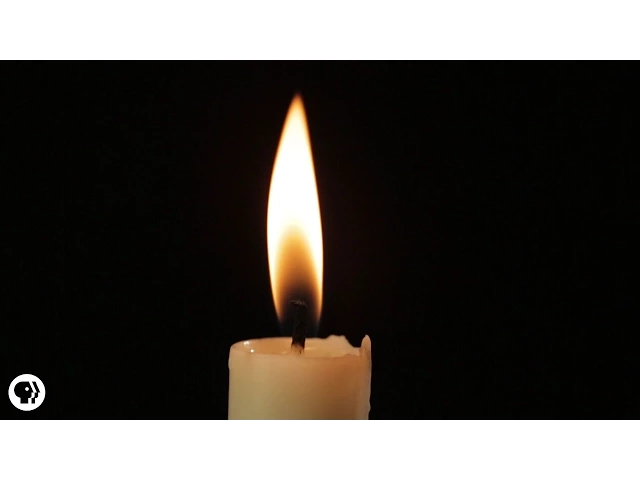
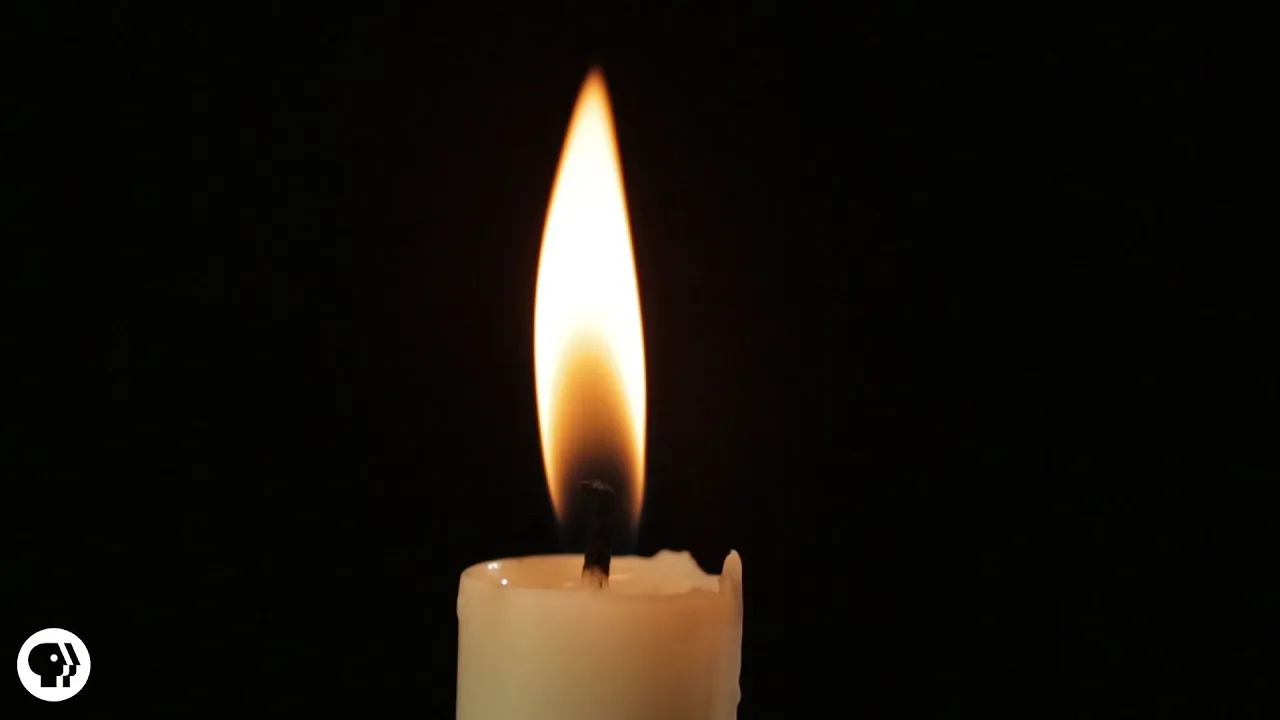
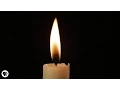
Faraday was particularly interested in candles, because inside their delicate flames, they hold some amazing lessons on how fire really works. You might have seen fire described like this in chemistry class, but a chemical formula doesn’t explain what fire is anymore than a recipe explains what chocolate chip cookies taste like. The first thing we notice about a candle flame is all those colors.
Hot things glow because of black body radiation, which we talked about in our video about the color of the universe. Down at the bottom of the flame, it’s hotter, so it glows blue, and in the middle it’s cooler, so it glows yellowish-orangish. Inside of that flame, there can be hundreds of chemical reactions taking place.
The oxygen in the air and the carbon and hydrogen in the candle don’t do anything on their own. It takes a little outside heat to get things started. Solid fuel is vaporized by the heat and ripped into smaller chunks.
This is called pyrolysis, and you can’t have a flame without it. You can sometimes see a dark cone around the wick where there’s no fire, where vaporized wax is coming off the candle, but hasn’t started to burn yet. The hydrocarbons hot oxygen in the air slam into each other and their atoms begin to rearrange.
Sometimes electrons in those atoms get into an excited state, and when they come back down again they give off light. That’s why the bottom of the flame glows blue. Not all the carbon in the candle gets converted to CO2, so leftover carbon atoms come together and form tiny particles of soot, which heat up and glow orange and yellow like the hot coals under a grill.
This glowing soot is where most of a candle’s light comes from. Eventually, at the tip of the flame, all the soot has burned away, and we’re left with only carbon dioxide and water floating off into the air. You can investigate all the different parts of a flame for yourself with just a cold piece of metal.
Up here, water vapor. In the yellow part of the flame, soot. And down just next to the wick, we can even recover unburned wax.
Flames look really cool. They’re almost hypnotic… Sorry, what was I talking about? Oh right, shape.
Gravity pulls cool, denser air down, and makes hot air rise, and this buoyancy is what gives flames their familiar shape. But if you light a flame in zero-g, like on the space station, it will look very different. All of the chemical and quantum reactions that make a flame glow can only happen where it meets the air, so even though they look like solid cones, candle flames are actually hollow.
As long as there’s fuel and oxygen, a flame will burn and burn. Why? It’s not the molecular ripping apart that makes a flame hot, the formation of new molecules and new bonds is what creates heat, and that heat drives the chain reaction forward, vaporizing more fuel, slamming more molecules into one another, making the fire burn on.
Our species has been gathering around fire for thousands of years, and sitting around, asking questions and telling stories over a flickering flame, is what helped made us human in the first place. Stay curious.