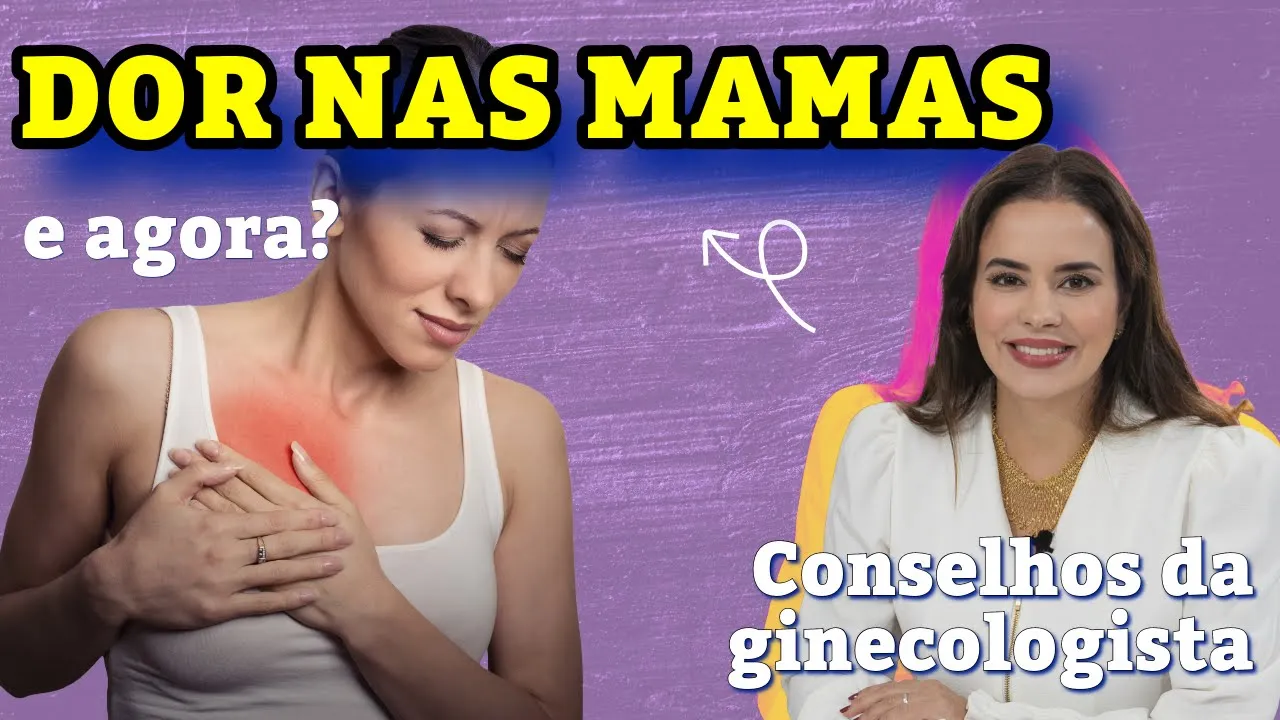
Breast pain or mastalgia is a very common complaint in the gynecology office. Many women come to the office when they have breast pain and are very worried and are already thinking about a diagnosis of breast cancer. Nowadays, this cancerophobia is very acute and no wonder.
We have seen many cases of breast cancer increasing and increasingly in younger women. But stay here with me in this video and I'll answer several questions about breast pain and when you should worry about them. My name is Juliana Amato and I am a gynecologist here at Instituto Amato.
What woman has never felt pain in her breast once in her life? It could be that pain in the breast that just touching it becomes super sensitive or that sharp or burning pain in the breast that sometimes goes away on its own, sometimes comes close to the menstrual period and sometimes has nothing to do with it. Breast pain is more common in women under 50 years of age.
But it can also happen for other reasons after that age. We have some types of breast pain that are very characteristic and help a doctor both to diagnose the cause of this pain and help the doctor to advise the woman whether this pain is worrying or not. So mastalgia, which is pain in the breasts, is divided into some types of pain.
Could it be mastalgia or cyclical breast pain and what does that mean? It's that pain in the breast that comes around the menstrual period. So normally both breasts hurt, they feel tense.
Sometimes you even feel an increase in volume in these breasts and this pain is more, it happens more in these regions of the upper and lateral quadrants of the breast, which is where we have more tissue or mammary gland distribution. This pain is associated with normal changes in a menstrual cycle, hormonal changes, especially the hormone progesterone, which is high at this stage. This hormone is what gives the sensation of heaviness and pain in the breasts.
In relation to this pain, women can rest assured because it is a physiological pain, it is caused by a change in the menstrual cycle, a hormonal change that is normal in our body. What is the other type of pain that can occur? It could be acyclical pain, that is, acyclical means that it does not form a cycle, so it does not come and go according to the menstrual period.
This acyclical pain is different from this menstrual period pain, it can be felt like a pinprick, like a burning sensation, like a twinge and can be in just one breast, not necessarily in both breasts. And what causes this acyclical pain, that is, this unilateral pain that we are talking about now? It can have several causes, it can even be the product of inflammation of the breast, that is, mastitis, it can be caused by some trauma to the breast that you have had, some injury, or a bump, the presence of cysts as well, depending on the size, it can also cause this discomfort and painful sensation in the breast.
Previous surgeries can also cause this pain, you know when you have surgery, place a prosthesis in your breast, or when you remove the prosthesis, have a mastopexy, that is, have a breast lift surgery, this pain can occur and it It is more characteristic as if there were stitches there, which is the healing of that breast, or sometimes even the formation of some adhesions. How do we manage this type of pain? It really depends on the cause, if it is mastitis, it is logical that the doctor will prescribe an antibiotic to treat this infection, because it is an infection, there is pus inside, it is quite painful.
If it is due to a condition of trauma, of a crash, you normally do not need medication for treatment, a conversation and elucidation of what is happening, why you are having this pain, is already efficient for you to be aware that this pain will pass on its own and do not need medication. Cysts, if it is discomfort due to cysts, the doctor will advise you to observe the evolution of these cysts every six months or a year, depending on your age, depending on the size and distribution of these cysts and will also advise that the presence of this pain, When you have cysts, it can happen. What if it is due to previous surgeries?
Normally this pain is very punctual, it occurs right after surgery, in recovery from surgery, then it will pass on its own. Breast pain does not necessarily require medication to be treated, but there is also another type of breast pain that we call referred breast pain, which is extra-mammary. What is this, this extra-mammary pain, if I'm feeling pain in my breast?
In fact, it's when you have some pain, for example, muscle, you have pain in the pectoral muscles, or you've done too much exercise, or you've had a crash, or it could even be due to inflammation in that muscle, you can feel it. this pain as if it were in the breast, but in fact it is not primary to the breast, it is the pain that is there in your rib or in your muscle. Often this pain can also be due to inflammation of the ribs, of the rib joint, which is costro chondritis, which is also very common to cause this pain referred to as if it were in the breast.
And the treatment of this pain will depend on the cause, it will depend on whether it is muscle pain, just wait for the muscle to stop hurting. If it is an inflammation, costoschondritis, the doctor will advise you to take anti-inflammatory drugs if necessary. This pain can also be caused by the spine, sometimes patients who have poor posture, who have a problem with the spine, may also feel this pain referred to in the breast area, but in fact it is a postural problem.
And the diagnosis, how is this pain made? In fact, the diagnosis is clinical, that is, you will consult the gynecologist, he will talk to you, you will explain all the pain, how it has happened, whether it is close to the menstrual period or not, what is the characteristic of pain and the doctor will evaluate it, do a physical examination of your breast, examine the breast with palpation and, if necessary, he will order an examination, if not, it is not necessary. And the burning question, what about breast cancer?
Oh, I'm in pain, I'm scared to death of having breast cancer, I felt the lump, this pain won't go away. Breast cancer, does it hurt? The answer to this question is very simple, normally no.
Breast cancer is associated with a primary lesion of the breast, which may be a breast lump. If this nodule, if this cancer, is initial, it doesn't hurt. It is very rare for a woman, when she is diagnosed with breast cancer, to go to the doctor reporting breast pain.
Normally, she goes for a gynecological exam, an exam with her routine gynecologist and tests are carried out that have found today a different calcification on the mammogram or a nodule on palpation that the doctor does in the breast. Then, the examination reveals the presence of this lesion, which will be biopsied and thus, a diagnosis of breast cancer is made. So normally, breast cancers, they don't hurt.
They are at a very early stage, you don't feel anything. When will you feel pain from breast cancer? Normally, it is in inflammatory breast cancer, where you even have a change in the texture of the skin.
So, there is a type of cancer that is inflammatory, in which women sometimes have no pain. She has pain in the breast wall and when she sees a change in the skin, which is redder, warmer, this could be an inflammatory carcinoma. And then, she feels this pain in her own breast, in the skin of her breast.
Now, when the cancer is a more invasive cancer, when it is a cancer that has already spread further, then, depending on the size, depending on the location, it can cause painful symptoms. What is the tip I give to all women? See a gynecologist every year.
Get your routine exams every year. If you feel any difference, for example, doing a self-examination of a nodulation, look for it before the desired period, that is, if it is a year, go to the gynecologist before a year to evaluate this breast. At first, breast cancer doesn't hurt.
When it hurts, it's usually more associated, really, with the menstrual cycle or other changes that we talked about. Don't let it be in doubt. See your doctor.
Perform breast self-examination regularly. How do I self-examine my breasts? It has to be away from the menstrual period.
And if you do it close to menstruation, or right after menstruation, when you palp the breast, you may feel several nodulations, which, in fact, are not nodules, but rather, It's the most swollen mammary gland, because you've just had your period. So, ideally, you should touch yourself away from your menstrual period and if you feel any nodulation. Normally, it is a hardened ball.
This hardened ball, in cases of breast cancer, is a fixed ball, it is a ball that does not move, does not leave the location. And in cases of benign nodules, it is a hardened ball, however, it is mobile. When you touch it, it feels like it runs away from your finger.
If you liked this video, subscribe to our channel, like and activate the notification bell. Until next time!