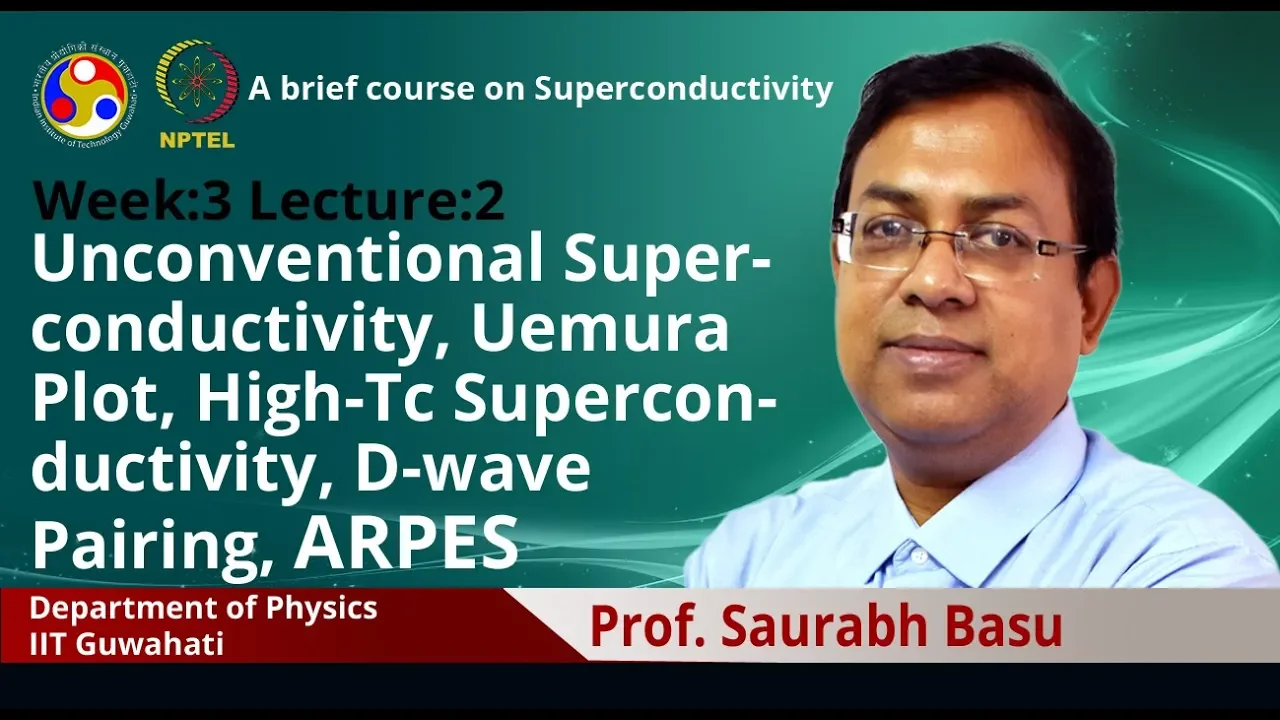
[Music] you [Music] you so having discussed the conventional super conductivity thus far with some details let us resort to the rather take a course of the discussion towards the unconventional super conductivity and will explain what we mean by unconventional super conductivity so so the topic is unconventional super conductivity but in order to do that let us look at some of the features of the conventional superconductors which differ from the unconventional superconductors and we'll see that how they differ and how much they differ by so the features are that the Cooper pairs form with opposite spins
and momentum just to remind you that the Cooper pairs have momentum K and minus K and the spins are up and down and these are the constituents of the Cooper pair and they form via wire electron-electron interaction mediated by phonons a very important point which is not explicitly stated is that the angular momentum of the pair that is a net angular momentum of the pair of the pair as well as the condensate superconducting condensate is zero the TC the transition temperature that we actually see for these superconductor that is the temperature at which the system
makes a transition from a normal metal to a superconductor it's of the order of so TC is small and in most cases TC is less than equal to about 25 Kelvin so that's a maximum TC that one can get for these conventional superconductors the magnitude of the gap cap is rather small it's 1 to 2 milli electron volt or it could be 3 or 4 milli electron volt but it's of the order of a few milli electron volts and so this is called as the Delta and this quantity - Delta zero over KT see it's
a number which is like 3.5 - usually it varies from 3 to 4 point 5 and these are the and Delta 0 is the the magnitude of the gap at zero temperature so how do we now recognize that the uninvent unconventional super conductors how do they differ from these conventional superconductors so in order to understand that there are some empirical data that were first plotted by way Mura and they are presented in in the name where Mura plot so what happens is that the TC versus TF so this is TF in Kelvin and this is
TC in Kelvin again they are plotted in the log log scale so it's a it's a log log plot so it's actually a log TC log TF plot and so this is like 10 to the power 1 this is 10 to the power 2 10 to the power 3 and 10 to the power 4 in 10 to the power 5 and these are again so 110 and hundred and so on so we Mura found that for the unconventional superconductors they fall in a reasonably a straight line in this log log plot so this is where
the organic superconductors light and here are the so-called high-temperature superconductors and we'll include a discussion on them and this is where the you know the conventional superconductors so these are the conventional superconductors in short writing SC and these are the line the straight line that is drawn is where the unconventional superconductors light so in the locked EC versus log tftf being the Fermi temperature so they lie on the straight line where these initial portion is occupied by some of the organic superconductors and the later ones are occupied by the high TC superconductor so this is
called as a whim or a plot and the conventional superconductors stay far away from this straight line so if you take this I mean of course there are you know sort of it's not along a line it's just in a region which is far away from this straight line so if you take this as a marker for the unconventional superconductors from those from the conventional ones then of course we know that so this is an empirical plot and so what happens in this unconventional superconductors do we still have Cooper pairs we have to have Cooper
pairs right because the Cooper pairs are the the most important ingredients for an energy gap in the excitation spectrum and that makes the superconductivity stable even if the gap is of the order of you milli electron volt it still gives rise to a transition temperature to the tune of ten to fifteen Kelvin so if it involves formation of Cooper pairs as the unconventional superconductors still have cooper pairs have you know the most important elements or constituents so there's a tui charge that needs to be seen and this tui charge as we have seen earlier that
the tui charge is confirmed from the flux quantization measurement and the value that we we get is around 2 into 10 to the power minus 15 Tesla meter square is a small value but it still confirms that one means a tui charge in order to get the flux quantum to be having this value which are verified in experiments now we need to understand that how the spin our spins are opposite equal and I mean that is the the formation of Cooper pairs is facilitated by the pairing of an up and down spin electron that can
be done or understood by the night shift measurement and so what's a night shift measurement let me describe this in ordinary metals the electrons the magnetic moment effective magnetic moment of the electrons they are really the net magnetic moment is really small and it gives no contribution to the precision of the atomic nuclei but however if you put them in an external magnetic field the electron spins will tend to align in the direction of the field due to Simon coupling and because of this the atomic nuclei now will be in a much greater field and
will start processing about that that magnetic field with a frequency which is known as larmor frequency now what happens is that if in a superconducting specimen this conduction electrons are minimal or they are almost absent then this processional frequency of the atomic nuclei or the nuclear as the spins these frequency will go down drastically and this shift in the frequency as we go deeper into the superconducting specimen is called as a night shift so a night shift measurement is usually like this so this is plotted as a function of P over T C and it
falls off like this very quickly up beyond so this is T by TC equal to 1 so this is the superconducting part of the sample and this is a normal phase of the sample so as the number of conduction electrons go down drastically this night shift also goes down drastically as we are deeper into the superconducting specimen so this again gives rise to the fact that the tuple pairs are indeed formed of charge to e that is there are two electrons involved along with the fact that they have the total angular momentum equal to zero
now we are going to talk about angular momentum having different values and that could be one way to give rise to unconventional super conductivity so let's just write this thing that Cooper pairs charge to e spins up and down which is encoded into this discussion so in the conventional superconductors the this is the free for me C and this is what the so sort of if we write it in a KX KY in a two-dimensional momentum vector of a vector space this is basically the field for me see so this is the gap that we
call as Delta a which is of course a function of temperature but we are just denoting it at a given temperature so this gap is isotropic in a conventional superconductor okay which means that the Delta has no K dependence okay and this was also clear when we actually derived the bcs equations in which the gap equation took a form that there is a sum over K Prime and VK K Prime with a delta K Prime and to e K Prime and then of course we can have a tan hyperbolic beta ek prime by 2 now
this if we take an approximation that V KK prime equal to a minus v-0 for sy k and sy K prime to be both within an energy range which is H cross Omega D then of course then this equation tells you that if you put V KK prime equal to minus v-0 it tells that Delta K is independent of K and we have an isotropic gap that is doesn't matter which way you try to or which part of the Fermi surface you try to excite an electron to overcome the gap you have to supply the
same amount of energy so this is the story with the conventional superconductor now the question is that if that does not happen for the unconventional superconductor then let's see or less SS evaluate the scenario now it could happen the unconventional features could actually get generated from a variety of factors but at this point we are considering that this is one of the reasons that unconventional superconductivity can arise so let's talk about finite momentum pairing in other words the two electrons come and they collide to form a pair and which is mediated by this pairing is
mediated by phonons in this particular case the vertex actually contributes to the momentum either it carries momentum away from this collision or it imparts momentum to the collision so a finite momentum pairing we can think of that the angular momentum of the pair can be a 1 even multiple of H cross and 2 odd multiple of H cross this odd multiple of H cross involves what are called as triplet pairings or p-wave paintings and so on which will shell for the time being and only talk about even multiple of 2 H or even multiple of
H cross so which is the lowest value is to H cross and that is called as a so this even multiple of H cross is called as the singlet pairing and the odd multiple is called as a triplet pairing so we are just going to talk about the singlet pairing and we'll talk about an angular momentum equal to 2 H cross and so this is called as Adi wave bearing this is true in the context of atlases believed to be true in the context of the high TC superconductors that many of the high TC superconductors
they have a d-wave bearing now in order to understand what d-wave bearing is let us see that your so this is in units of H cross so we'll just take that unit out so L equal to 2 that's angular momentum quantum number so basically the capital L has got to H cross so L equal to 2 means ml equal to minus 2 minus 1 0 1 2 so these are magnetic quantum number values so these so they'll be a terms such as 2 minus 2 2 minus 1 to 0 and 2 1 and 2 2
so these are the possible d-wave pairing and they have names we are not writing them particularly in order but they are written as d XY pairing and dyz pairing and d ZX pairing and then or it's also called XZ bearing and the DX square minus y square and B 3 Z square minus R square so let us only discuss one candidate and see that how this this particular symmetry each of these symmetries they look like and we'll just take a look at this DX square minus y square paring and for illustration let us take a
function take DX square Y square in the XY plane okay and we'll write this f of X Y as X square minus y square on a unit circle X square plus y square equal to R square equal to one so which means that Y square is equal to one minus X square if we substitute in F X Y this will be like two X square minus one and so this two X square minus one is the function so you see that this function is maximum or rather it is minimum and has a value which is
when X equal to zero that is on Y axis and it has a assumes a value assumes a value minus 1 right when X is equal to 0 it is equal to minus 1 so this is 1 & 2 it is maximum for X equal to 1 so maximum when X equal to 1 that's of course on the x-axis and assumes a value plus 1 so that's the nature of this and so basically it changes sign somewhere of going from y-axis to the x-axis let's see what more we can learn from this third is simple
that 4x squared equal to 1/2 or X equal to plus minus 1 by root 2 basically FX changes sign you saw that on the y-axis its minus 1 on the x-axis its equal to +1 and so it must be changing sign somewhere and we want to say and see where it changes sign it changes sign along the diagonal so at this locations we have mod of X equal to mod of Y ok so so the sign change along the diagonal diagonals there are of course two diagonals there so so how what does the function look
like the function looks like this it's called as a clover leaf and it has a form which is okay so this is equal to minus or this is y axis this is x axis this is plus and this is minus again and this is plus and this looks like a cloverleaf so this is the form of this DX square minus y square symmetry and we can also you know characterize this F X Y in terms of in terms of polar angle theta I mean F of theta can be written as sine squared theta minus a
cosine square theta which is minus cosine of two theta and if you plot it it looks like minus one and then it goes down and then it goes up and then it goes down and so on so this is where it goes down once more so this is zero and this is two pi this is PI by 4 where it is zero this is three PI by 4 this is 5 PI by 4 and this is 7 PI by four and these are the positions which are PI by 2 and 3 PI by 2 and
5 PI by 2 and so on so this is I'm sorry so this is PI by 2 and so this is actually 3 PI by 2 and so on anyway so that is the form for this d-wave water parameter now what is it good at and how are we going to connect it to the superconducting order parameter now if you have if you consider the same picture as we have considered earlier that is that there is a Fermi sphere or the field Pharmacy which is like this and we break it into quadrants and so on
and then we draw diagonals let's draw the diagonals with a different color so these are the diagonals and we could draw it with another color so these are the gap functions now the gap has a K dependence it's not isotropic along all directions and we have so this is called as the d-wave gap okay and so what it means is that there are points which are along the diagonals these along the diagonals there are points which are zero gap or the gap less superconductors so along this direction there is no gap in the single particle
excitation spectrum and the electrons can actually be excited without imparting any extra energy and if this is truly the the structure or the geometry of a gap function which has of course a K dependence now we are drawing it as a function of KX and KY then these should be able one some experiments should be able to see these gaps and let's call these points as a B C D which are these points where the which are called the gapless points and this ABCD are also called as nodal points or they are also called as
a gapless points so if this is the structure of the order parameter in an unconventional superconductor in the conventional superconductor of course we have seen that the gap is isotropic in any direction but suppose the gap has such a symmetry then what's what are the things that we expect and of course as you can see that and the other dxz divisor and the XY etc 3 Z square minus R square is more complicated well these other things have gaps around different directions and but by and large this explains that how's the DX square minus y
square that gap looks like so it has a K dependence so the gap has a K dependence which means that the wave function that the Cooper pair wave function pear has a form which is sie equal to size zero kxky and exponential I theta where theta is a phase factor and the energy gap has also a structure this is Delta equal to Delta zero K X K Y and exponential I theta and of course what we understand by these this picture is that so this phase factor of course indicates the motion of the center of
mass of the Cooper pairs along a specific direction around a particular direction and the mod size squared gives the density of Cooper pairs in k-space so since along this diagonal the density vanishes which means at the nodal points ABCD the density of Cooper pairs is equal to zero and additionally one can say that there could be gapless excitations at those nodal points and of course one understands that size zero is proportional to Delta 0 so one actually gives a measure of of another so if even if we talk about just one quantity that is going
to be enough and let's now see that a possible experiment that can determine a gap structure of this kind and that is called as the angular resolved photo emission spectroscopy and in short it's called ARP s let's draw this 110 so this is the surface of a superconductor and there is a photon that comes there is let's draw the coordinate axis here so there's an electron that is emitted in this direction so this is a H nu which is characterized by a vector potential a and this is in a detector so this is a detector
and the electron is actually captured by the detector so this angle is called Phi and this angle is called theta and so this is the y axis this right handed coordinate system and this is the z axis so the photon falls on a certain material which is a superconductor and then electrons are emitted and they are collected by the detector so it's very clear that if you have electrons available in certain directions then only the detector will be able to detect electrons and this detector can be actually placed at any angle in a 360 degree
or rather full you know covering the full angle it can be placed at any angle so this detector only detects electrons at say for location or the four points in the K X K Y direction in which the system has or the the superconductor has gapless points and if we can do that then only we see that the the electronic density of states and which is obtained from peek in the single particle density of states so it basically scans or rather detects the electronics electron single particle electronic states so this signal is a Fourier transform
to k-space to obtain k vs e plot which is nothing but the density of states where the photo emission intensity is given by I'm going to write some equations which are really required but just understanding the physical context of doing this experiment is good enough so what I mean to say is that this detector only detects electrons in certain directions when it's Fourier transformed into the k space and those directions are the gapless points or the nodal point from which electrons can be emitted with with absolutely without any difficulty because the other places there is
a superconducting gap and the electrons cannot come out because that is the the energy barrier that has been created by the formation of the Cooper pairs so the photo emission intensity is given by W fi which is equal to 2 pi over H cross and si F H prime sy i mod square Delta of EF minus e I minus H nu that's the energy conservation and what is the so one has to do a second order perturbation theory in H Prime in order to get the intensity this called as a Fermi's golden rule this you
might be knowing from your pores of quantum mechanics on perturbation theory of scattering theory and this H prime is nothing but the ebuy 2m and the a dot P plus a P dot a that is the coupling between the the vector potential and the momentum of the Tron and by a suitable choice of gauge one can show that these two with the gauges that Delta there's divergence of a equal to 0 in this gauge this e / M it becomes e / M a dot P that is both the terms become equal and they add
up in order to give a factor of two which cancels with this two for a given gauge I simply write it as this and this can be shown now H nu which is the energy of the photons and a are basically for a given radiation are fixed during experiments the kinetic energy of the electron Ek then the work function which you must be knowing from Einsteins photoelectric effect that there is a certain amount of wave work function which is associated with a particular material which is a property of the material which is called work function
that has to be overcome in order for the electron to to emit and the polar angles theta phi are measured okay so what are the conservation laws the conservation laws for this photoelectric or rather this angular resolve photoemission spectroscopy are simple that is the kinetic energy of the electrons which is equal to H nu which is energy of the photon minus the work function minus the binding energy of the electrons in a material and the parallel component that is conserved and this is equal to 2m e K and the sine theta so now the only
constraint is that the ejected electron of the emitted electron rather this assumption should be fast enough to be able to neglect the interaction with the whole left behind so our Pez finally gives direct information the electronic states so that is the way that one can actually understand that the gap function of this Cooper pairs that has a structure and it's not uniform in k-space it has some nodal points from which electrons can be excited and that can be detected via an angular result spectroscopy photo emission spectroscopy and this has indeed confirmed the presence of a
D wave gap in certain unconventional superconductors you [Music] you