Most people are trying to loosen tension in their neck, their shoulders, in their head, without addressing the cause, your nervous system. In this video, I'm going to show you a simple 3inut nerve reset that's going to help calm your mind and calm your body. The Vegas nerve is the main switch to your parasympathetic nervous system.
the part of the nervous system that is responsible for calmness, resting, healing, digestion, everything that we need in order to achieve good health. We want to send a message directly to the brain to calm ourselves down. Here's the thing.
In clinical practice, in the last 23 years of clinical practice, I've never seen so much tension, anxiety, stress. Patients and people just like you are stuck in flight or flight mode. It's that sensation that you can never really truly calm down.
You put your head down at night. Your brain is racing. You can't focus.
You can't sleep. It's like running your car in park and putting the metal to the floor and revving that engine. Without taking your foot off the gas pedal, your body is unable to feel good and most importantly heal.
If you cannot turn down or turn off your fight orflight mode, your body will never achieve its full capacity to heal and express good health. This threeinut nerve reset is going to turn your parasympathetic nervous system on. This will allow you to relax the tension in your neck, your jaw, your head, your shoulders, and calm down.
Your breathing will slow. Your digestion will improve. This can even shift the chemistry in your brain.
lowers cortisol, reduces inflammatory signals, and improves serotonin pathways. All to make you feel calmer and more relaxed. Simply put, stimulating this nerve is going to tell your body it's safe.
It's time to relax and increase your healing. This Vegas nerve reset will involve three parts. The first, a very simple breathing technique.
The second, I'm going to show you an upper cervical or a Vegas nerve glide or floss. And finally, in the third part, I'll show you a technique on how you can stimulate the uricular branch of your vagus nerve. All to help get you out of fight orflight into rest, digest, and in healing mode.
Let's get to it. Breathing. I've spoken about this in other videos.
The fightlight breathing that we all tend to do and not even know it is through our chest. The Vegas nerve comes down and supplies our diaphragm. And we need to stimulate the vagus nerve through the appropriate way to breathe.
We want to breathe in a safe, comfortable way. Very simply, we're going to extend up, sit tall, one hand on your abdomen or belly, the other hand on your chest. When we breathe, a normal, relaxed, healthy breathing is through our belly, not through our fight and flight up here.
So, what we want to do is very simply sit tall. We want to breathe in for three seconds through our nose. holding for two seconds.
But the breath has to come from below. If your chest moves, it's not the right breath. Focus on pushing it through your belly for 3 seconds.
I did it wrong there. Watch. Watch what hand moves through the nose.
Hold for two seconds and then blow out for double the time. Six seconds through pursed lips. I'm going to start again and watch.
It takes some concentration because we're so used to expanding our ribs. We're in fight flight. We're in a rush.
We're in a hurry. Calm. Focus on 3 seconds in through your nose.
Hold for 2 seconds. And then breathe out through ped lips for double or 6 seconds. If you want to take a deeper breath, you can do 4 seconds in through the belly, through your nose.
Hold for two and blow out through your lips or purse lips for 8 seconds. So, let's try this again. Sit tall.
This hand doesn't move. The rib cage doesn't move. The belly moves through your nose.
Do this for four to five sets or rounds. Right away from the breathing technique, you've already started to stimulate your vagus nerve. Your calmness should be setting in and your rest mode should begin.
But next, we're going to get to the nerve glide. the Vegas nerve glide or stretch. This if you suffer from neck pain, jaw pain, tightness, headaches will be gamechanging for you.
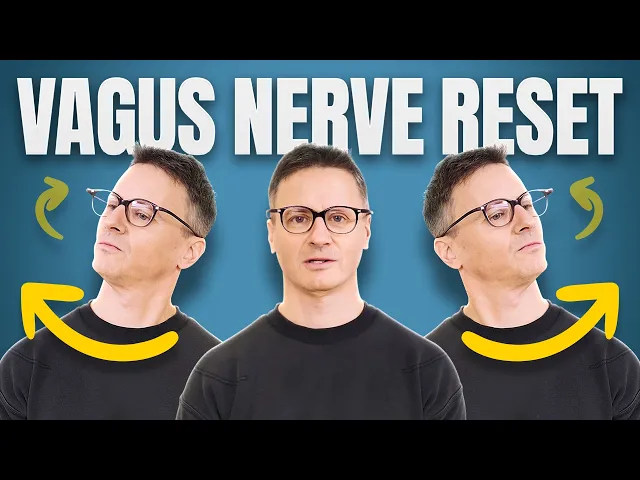
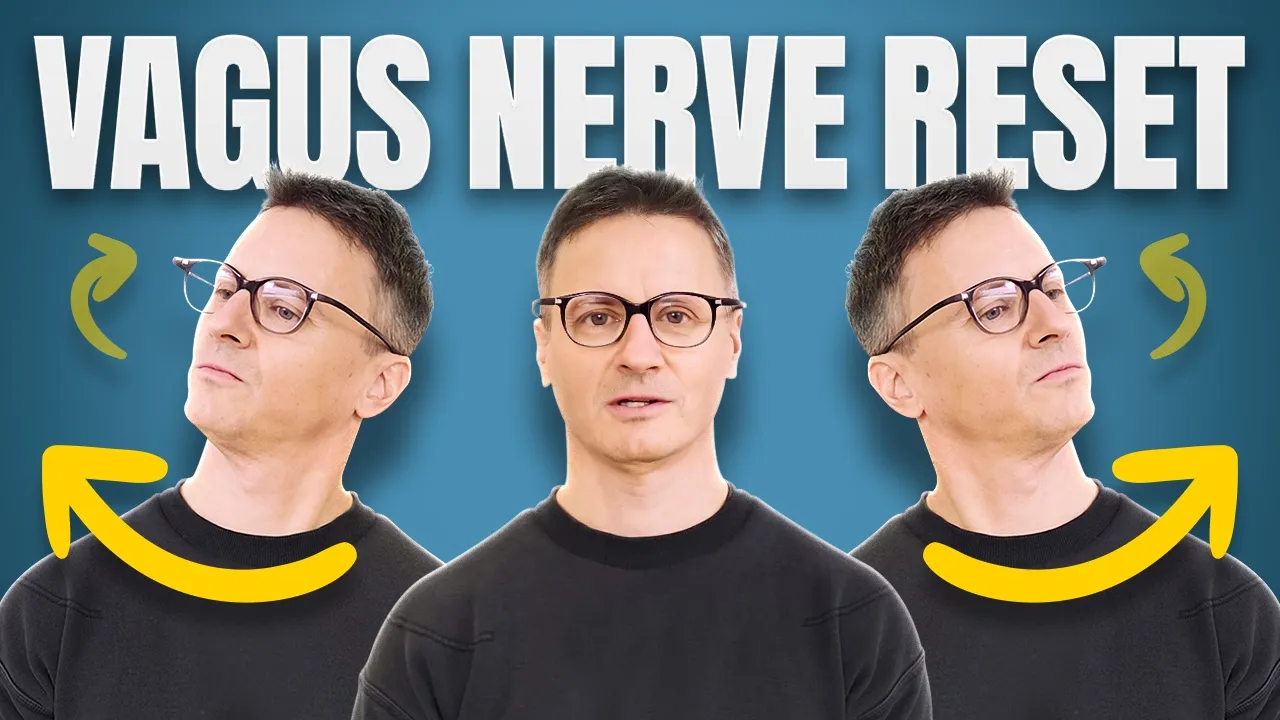
The next thing I'm going to go through with you is the upper cervical vagus nerve glide, vagus nerve decompression, whatever you want to call it, that's going to help reduce your fight orflight. The ve nerve comes out through your jugular fammen in your skull and it sits in close proximity to your upper cervical spine your CO which is your skull C1 and C2. So if we can glide the nerve open this area up it's going to switch off or help switch off your fight orflight mode and it's something that can break it almost instantly.
The nerve glide or the veagal pathway release has subtle movements. We're going to do it on both sides, holding each position for five to six seconds. First thing we're going to do is we're going to sit up tall, shoulder blades engaged.
We're going to extend slightly, rotate until you feel a slight extension, and you're going to laterally flex the opposite way. You'll feel it in the upper cervical spine. And we're going to hold this for five to six seconds, and we'll come back to neutral.
up. Rotate laterally flex and hold back to neutral. Extend.
Rotate till you feel tension and then come back with a lateral flexion. Again, subtle but really effective. Extend, rotate, lateral flex.
the opposite way of rotation and hold. You're really trying to open up this part of the spine where that vagus nerve comes down through and it can create tension there. If there's tension up here and it's translated to those segments which can help when you get this moving or you open it up or you glide it, it can help turn off that flight or fight which is exactly what we want to do.
If stress lives in your neck and shoulders, that glide will probably give you the quickest immediate relief. Let me show you from behind so you understand the movements. They're very subtle.
So, shoulder blades engaged, slight extension. We'll rotate to your right and then later flex to your left. Hold for 5 seconds and then come back to neutral.
Extend. Rotate. and lateral flex.
Really decompressing the sub oipital area, all the nerves there that helps take tension out of the area in the vicinity of the Vegas nerve. This last method to stimulate your vag nerve might seem a little bit odd, but for some people, you're going to find that the breathing method worked and that's all you need to do. Others might find that the nerve glide, the open decompression, that area of the vagus nerve, that's all you need to do.
Or some people need to do both. This is for the people that maybe didn't get relief from the first two or that need to do all three together. But I love this one because it's simple, it's easy, and it can be done anywhere.
Take your fingers, grab the inside of your ears. Why this seems to help for people is because it stimulates the uricular branch of the Vegas nerve. All you're going to do is grab Let me take my glasses off.
Grab them like this. Not too hard, but we're going to just rotate circles. Need three to five front and then three to five backwards.
Like I said, it's simple. It's stimulating the vagus nerve through the uricular branch. Just trying to break the fight or flight.
Turn your parasympathetic nervous system on so things can calm. You can heal better. You have less inflammation.
You can turn that racing mind off and break the cycle of that stress. Once you've done this, you might feel, you know, a little more calm in the shoulders. Your swallowing might become easier.
You're blinking freer. little subtle cue cues, sorry, that you've been successful in breaking that fight or flight mode. This video was motivated by the tension I feel in my patients on the day-to-day that I feel right now that I'm hoping that most people can use these techniques to break the cycle of their fight flight.
We live in a busy world, a stressed world. And if we can't change the environment around us, I'm hoping that we can change the environment and how our body is better able to deal with stress. When you're stressree or when you break the cycle of stress, your body works better, it heals better, you sleep better, and life becomes better.
I really hope you enjoyed this video. I hope that you use the breathing technique, the nerve glide technique, or the ear stimulation technique to give you some tools that can help your body adapt better to the environment you're in. If you have a question about this video, please leave it below.
I'll do my best to answer it as soon as possible. And if you enjoy videos like this, maybe you'll show some support by giving me the thumbs up. And if you're new to my channel, maybe you'll consider subscribing so you can be informed when I upload a new video.
I really appreciate you tuning in with me. I hope you found value here and I can't wait to see you in my next video. Most people are trying to loosen tension in their neck, their shoulders, in their head, without addressing the cause, your nervous system.
In this video, I'm going to show you a simple 3inut nerve reset that's going to help calm your mind and calm your body. The Vegas nerve is the main switch to your parasympathetic nervous system. the part of the nervous system that is responsible for calmness, resting, healing, digestion, everything that we need in order to achieve good health.
We want to send a message directly to the brain to calm ourselves down. Here's the thing. In clinical practice, in the last 23 years of clinical practice, I've never seen so much tension, anxiety, stress.
Patients and people just like you are stuck in flight or flight mode. It's that sensation that you can never really truly calm down. You put your head down at night.
Your brain is racing. You can't focus. You can't sleep.
It's like running your car in park and putting the metal to the floor and revving that engine. Without taking your foot off the gas pedal, your body is unable to feel good and most importantly heal. If you cannot turn down or turn off your fight orflight mode, your body will never achieve its full capacity to heal and express good health.
This threeinut nerve reset is going to turn your parasympathetic nervous system on. This will allow you to relax the tension in your neck, your jaw, your head, your shoulders, and calm down. Your breathing will slow.
Your digestion will improve. This can even shift the chemistry in your brain. lowers cortisol, reduces inflammatory signals, and improves serotonin pathways.
All to make you feel calmer and more relaxed. Simply put, stimulating this nerve is going to tell your body it's safe. It's time to relax and increase your healing.
This Vegas nerve reset will involve three parts. The first, a very simple breathing technique. The second, I'm going to show you an upper cervical or a Vegas nerve glide or floss.
And finally, in the third part, I'll show you a technique on how you can stimulate the uricular branch of your vagus nerve. All to help get you out of fight orflight into rest, digest, and in healing mode. Let's get to it.
Breathing. I've spoken about this in other videos. The fightlight breathing that we all tend to do and not even know it is through our chest.
The Vegas nerve comes down and supplies our diaphragm. And we need to stimulate the vagus nerve through the appropriate way to breathe. We want to breathe in a safe, comfortable way.
Very simply, we're going to extend up, sit tall, one hand on your abdomen or belly, the other hand on your chest. When we breathe, a normal, relaxed, healthy breathing is through our belly, not through our fight and flight up here. So, what we want to do is very simply sit tall.
We want to breathe in for three seconds through our nose. holding for two seconds. But the breath has to come from below.
If your chest moves, it's not the right breath. Focus on pushing it through your belly for 3 seconds. I did it wrong there.
Watch. Watch what hand moves through the nose. Hold for two seconds and then blow out for double the time.
Six seconds through pursed lips. I'm going to start again and watch. It takes some concentration because we're so used to expanding our ribs.
We're in fight flight. We're in a rush. We're in a hurry.
Calm. Focus on 3 seconds in through your nose. Hold for 2 seconds.
And then breathe out through ped lips for double or 6 seconds. If you want to take a deeper breath, you can do 4 seconds in through the belly, through your nose. Hold for two and blow out through your lips or purse lips for 8 seconds.
So, let's try this again. Sit tall. This hand doesn't move.
The rib cage doesn't move. The belly moves through your nose. Do this for four to five sets or rounds.
Right away from the breathing technique, you've already started to stimulate your vagus nerve. Your calmness should be setting in and your rest mode should begin. But next, we're going to get to the nerve glide.
the Vegas nerve glide or stretch. This if you suffer from neck pain, jaw pain, tightness, headaches will be gamechanging for you. The next thing I'm going to go through with you is the upper cervical vagus nerve glide, vagus nerve decompression, whatever you want to call it, that's going to help reduce your fight orflight.
The ve nerve comes out through your jugular fammen in your skull and it sits in close proximity to your upper cervical spine your CO which is your skull C1 and C2. So if we can glide the nerve open this area up it's going to switch off or help switch off your fight orflight mode and it's something that can break it almost instantly. The nerve glide or the veagal pathway release has subtle movements.
We're going to do it on both sides, holding each position for five to six seconds. First thing we're going to do is we're going to sit up tall, shoulder blades engaged. We're going to extend slightly, rotate until you feel a slight extension, and you're going to laterally flex the opposite way.
You'll feel it in the upper cervical spine. And we're going to hold this for five to six seconds, and we'll come back to neutral. up.
Rotate laterally flex and hold back to neutral. Extend. Rotate till you feel tension and then come back with a lateral flexion.
Again, subtle but really effective. Extend, rotate, lateral flex. the opposite way of rotation and hold.
You're really trying to open up this part of the spine where that vagus nerve comes down through and it can create tension there. If there's tension up here and it's translated to those segments which can help when you get this moving or you open it up or you glide it, it can help turn off that flight or fight which is exactly what we want to do. If stress lives in your neck and shoulders, that glide will probably give you the quickest immediate relief.
Let me show you from behind so you understand the movements. They're very subtle. So, shoulder blades engaged, slight extension.
We'll rotate to your right and then later flex to your left. Hold for 5 seconds and then come back to neutral. Extend.
Rotate. and lateral flex. Really decompressing the sub oipital area, all the nerves there that helps take tension out of the area in the vicinity of the Vegas nerve.
This last method to stimulate your vag nerve might seem a little bit odd, but for some people, you're going to find that the breathing method worked and that's all you need to do. Others might find that the nerve glide, the open decompression, that area of the vagus nerve, that's all you need to do. Or some people need to do both.
This is for the people that maybe didn't get relief from the first two or that need to do all three together. But I love this one because it's simple, it's easy, and it can be done anywhere. Take your fingers, grab the inside of your ears.
Why this seems to help for people is because it stimulates the uricular branch of the Vegas nerve. All you're going to do is grab Let me take my glasses off. Grab them like this.
Not too hard, but we're going to just rotate circles. Need three to five front and then three to five backwards. Like I said, it's simple.
It's stimulating the vagus nerve through the uricular branch. Just trying to break the fight or flight. Turn your parasympathetic nervous system on so things can calm.
You can heal better. You have less inflammation. You can turn that racing mind off and break the cycle of that stress.
Once you've done this, you might feel, you know, a little more calm in the shoulders. Your swallowing might become easier. You're blinking freer.
little subtle cue cues, sorry, that you've been successful in breaking that fight or flight mode. This video was motivated by the tension I feel in my patients on the day-to-day that I feel right now that I'm hoping that most people can use these techniques to break the cycle of their fight flight. We live in a busy world, a stressed world.
And if we can't change the environment around us, I'm hoping that we can change the environment and how our body is better able to deal with stress. When you're stressree or when you break the cycle of stress, your body works better, it heals better, you sleep better, and life becomes better. I really hope you enjoyed this video.
I hope that you use the breathing technique, the nerve glide technique, or the ear stimulation technique to give you some tools that can help your body adapt better to the environment you're in. If you have a question about this video, please leave it below. I'll do my best to answer it as soon as possible.
And if you enjoy videos like this, maybe you'll show some support by giving me the thumbs up. And if you're new to my channel, maybe you'll consider subscribing so you can be informed when I upload a new video. I really appreciate you tuning in with me.
I hope you found value here and I can't wait to see you in my next video.