Hello, I'm Terry Fisher. This is the second segment of a lecture on the welfare theory of copyright. In this portion, I'll examine in more detail how copyright law works-- specifically, how it functions from the standpoint of the welfare theory.
Along the way, I'll point out a few of its advantages and disadvantages, again, viewed from the standpoint of welfare. For this purpose, we'll be using a slightly fictionalized real-world example. Cambridge Documentary Films is a small documentary filmmaking company.
It's run by two people, Margaret Lazarus and Renner Wunderlich. It's called Cambridge Documentary Films because it used to be based here, in Cambridge, Massachusetts. But it's now housed in Santa Barbara, California.
Cambridge Documentary Films, or as we will call them, CDF, produces very high-quality, short documentaries. One of those documentaries is Defending Our lives. It's 30 minutes long.
Its subject is the scourge of domestic violence. Domestic violence is a phenomenon that, as many of you know, is global in character. If anything, it's increasing in severity.
This film examines the subject by talking with, doing interviews with, many of the women who've been subjected to domestic violence. It won the Academy Award for Short Documentary in 1993. Because of the continued salience of the social problem and the quality of the film, demand for the film remains sizable and fairly constant.
And as a result, CDF continues to sell copies of it. So that's the real-world case. We're going to use an adapted, simplified version of that case to explore the way in which the copyright system works.
First question-- suppose CDF wants to make some money by distributing copies of the film in DVD format. How much should CDF charge for each copy? To answer that question intelligently, CDF would need some more information.
I'm going to supply you hypothetical, but reasonably realistic, data of the sort they would need. For simplicity and clarity, I'm going to present that information graphically. To those of you who've studied some economics, graphs of the sort you see on your screen will surely be familiar to you.
The x-axis, the horizontal axis, represents quantity-- in this case, the quantity of DVDs containing the film Defending Our Lives. The vertical axis is money-- we'll use dollars, but we could use any currency-- to represent first the cost of those DVDs, and then the revenue that they could generate for CDF. The first thing we'd want to know in order to determine how much CDF should charge is the cost of producing the DVDs.
CDF surely doesn't want to charge less than the cost of generating them. So here are some numbers. It turns out that producing and distributing a DVD is inexpensive.
It costs approximately $1 to reproduce the film in the physical disc, $0. 90 to package it, and $0. 80 to distribute it to customers.
So roughly speaking, $2. 70 is the cost of making and distributing each copy of the film. That cost doesn't vary much with how many copies you make.
Expressed graphically, this means that the marginal cost of producing DVD copies of Defending Our Lives is low and flat-- flat because it doesn't change, as I indicated, materially as the total number of copies produced increases or decreases. Now, this is not true of all cultural products. With respect to some, there are economies of scale, meaning that the marginal cost of making copies of them goes down the more you produce.
There may be a few types of cultural products, though examples are hard to think of, in which the marginal cost of making copies goes up if the materials used to produce them are scarce. But many, perhaps most, will have marginal cost curves that look roughly like this, low and flat. But this information actually doesn't get us very far.
As any business school professor will tell you, the seller of a commodity should be paying primary attention when pricing that commodity not to the cost of producing it, but to what potential buyers of the commodity are able and willing to pay. How would CDF get information of that sort? Perhaps through consumer surveys, focus groups, or projections on the basis of what earlier films sold for.
To keep things simple, we'll supply them with the information they are seeking. If CDF set the price of the DVDs up here, where the red dot is located on the vertical axis, a modest number of people would pay for it each month. The high price would keep it out of the hands of most potential customers.
If, by contrast, it's priced at a lower point, the number of people who would purchase it is larger. Still lower price, still larger a number of purchasers. And if CDF priced it at 0-- in other words, if they just gave the DVDs away-- this even larger number of people would accept it and watch it each month.
The number here is not infinite, because not everyone is interested in domestic violence. Put differently, there are other things they'd rather do with their time. But as one might expect, the total number of copies sold would be greatest if the price were 0.
It will turn out to be helpful to plot these pairings on the two-dimensional space of the graph. This is a representation of the combination of price and quantity associated with the red option. Here's the blue, and here's the green.
Finally, yellow is already marked at the bottom. When you connect up all these dots, the result is a demand curve. To keep things simple, I've chosen combinations of price and quantity that would generate a straight line, rather than a curve.
In the real world, the shape of this line would, of course, be more complex. But a simple straight line enables us to illustrate the basic principles more clearly. The demand curve, to repeat, is merely the accumulation of many observations of the sort we just did; namely, for any given price, how many copies of the movie could CDF sell each month.
Having built the curve, we can now remove the scaffolding. OK, so against this backdrop, what should CDF charge for the DVDs? In other words, where along this curve should CDF position itself?
We'll try to answer that question first in a hypothetical environment in which copyright law does not exist, and then in a hypothetical environment in which copyright protection is available. If copyright law does not exist, then the CDF managers will quickly recognize that, sooner or later, if they wish to sell significant numbers of DVDs, they will have to set the price very low. They could, of course, begin by setting the price up here.
The result will be that, in the first month, they would sell a modest number of copies and earn a fair amount of money. More specifically, they would earn the amount of money equal to the number of copies sold times the price of each copy; in other words, revenue equal to this area. But if they did this, CDF would very quickly face competition, because a rival would purchase one of their copies and then replicate it, selling the knockoffs for a lower price.
So let's suppose that this occurs in month number two. By choosing this price, the competitor would sell a much larger number of DVDs. But even more seriously, it would eliminate or largely undermine the demand for the CDF authorized version.
CDF's market would more or less go away. So to respond, CDF would be obliged, if they wished to continue to sell films at all, to lower their price in the third month. In the fourth month, the rival would respond by lowering its price, and CDF will be obliged to lower its price, and so forth, until the price of the copies of the film fell all the way down to almost the marginal cost of producing copies.
The general point illustrated by this simple sequence is that, in the absence of copyright, copying and competition will drive the price down to marginal cost or nearly so. In two related respects, this is socially beneficial. Indeed, in most contexts, antitrust law is designed to generate exactly this behavior.
First, the total number of DVDs produced and distributed in this scenario is very large, meaning that a lot of people get the benefit of access to the film. Second, the consumer surplus generated by this pricing pattern is very large. Consumer surplus is just a term that represents the difference between the price that a given consumer pays for the product and the value of that product to the consumer, measured most easily by the maximum amount the consumer would be willing to spend.
A rough measure of the total surplus generated by a particular marketing practice is the area between the demand curve, which represents consumers' willingness and ability to pay, and the price of the product; in other words, the green zone in the graph in front of you. So you might think, great, we hope this scenario does indeed occur. The trouble is that the CDF managers, anticipating this effect, won't produce Defending Our Lives in the first place, because they will recognize that they will be unable even to recoup their costs.
Or, perhaps more realistically, they won't make any more of their wonderful films in the future. So the seemingly large social benefits associated with the absence of copyright protection turn out, unfortunately, to be illusory. Very few films will be produced in this legal environment.
So wait a minute, you may be thinking, won't some of the alternative motivations that are sources of revenue for filmmakers that I discussed in the first segment of this lecture prompt CDF to keep making films? Perhaps, for example, CDF can get a government grant. Or perhaps private philanthropists will come forward.
Maybe. But for the time being, we're focused exclusively on the incentives that the copyright system can generate. So ignore for the moment the possibility of other sources of funding.
Returning to our story, the purpose of copyright law is to avoid this outcome. How? By suppressing competition in the production and distribution of embodiments of the creative work; in this case, the film-- in other words, to eliminate CDF's rivals.
If the managers enjoy protection against competition, how, then, will they price the film? Well, if they have very good and detailed information concerning the ability and willingness to pay of every individual customer, plus the capacity to vary the price of the DVDs, then the managers will charge each customer the maximum amount that they can. So for example, if the managers know that X is able and willing to spend PX, they will charge that much.
If they know that Y is able and willing to spend PY, they'll charge that much. If they know that Z is able and willing to spend PZ, they'll charge that much. And the result is that they will enjoy, the managers will enjoy, through this pricing strategy, monopoly profits that occupy the same area in our graph that, in the competitive model, was devoted to consumer surplus.
From the standpoint of the CDF managers, this, of course, is wonderful. It gives them a very large return on their original investment. From a social welfare standpoint, it's beneficial in two respects.
The total output, meaning the number of consumers who get copies of the film, is maximized. And the prospect of these large potential profits will induce CDF to keep making the films from which we all benefit and will draw many other aspiring documentary filmmakers into this field. On the other hand, consumers are much less happy with this outcome, because each individual consumer has paid the most that he or she would be willing to pay.
The result-- the large amount of consumer surplus, generated by the competitive scenario, has been altogether replaced here by producer surplus. In other words, all of the benefit that, in the previous narrative, was reaped by consumers in this scenario goes to CDF, the producer. So what we've just illustrated is profit-maximizing behavior by a copyright owner who can engage in so-called perfect price discrimination-- in other words, differentiate perfectly among buyers-- charging each one the maximum amount that he or she would be willing to pay.
Now, as you can imagine, this never happens. Perfect price discrimination is impossible. Later in this lecture series, I'll discuss some circumstances in which, aided by copyright law, the producers of informational goods can engage in imperfect forms of price discrimination.
But for now, let's assume that CDF doesn't have good information about their consumers and thus cannot and does not discriminate at all. In other words, we'll assume that CDF will charge the same price for every copy of the DVD. OK, so now how much will the managers charge?
Well, they might determine the price by experimentation. Remember, the demand for Defending Our Lives is stable. So the managers could experiment.
In month one, they could set the price at p. They discover that u number of consumers buy it. They earn revenues of this amount.
This zone is, of course, the cost to them of producing and distributing the DVDs. But that still leaves them a quite generous profit. So they try an alternative approach.
The next month, the managers lower the price slightly to q, here. They discover that v number of consumers buy it, a larger number, not surprisingly, because the price is lower. They make this much more money in the second month, because they've sold more copies.
They forfeit this much money, because they've had to reduce the price for everyone. But notice that the purple zone is larger than the orange zone. So it was a good idea to have reduced the price.
Put differently, the size of the monopoly profits in the second month is larger than the amount that CDF enjoyed in the first month. Suppose that, encouraged by this beneficial price reduction, the managers lower the price more dramatically in the third month. An even larger number of people buy it.
Again, the result is a revenue gain that exceeds the revenue lost. Once again, the profits enjoyed are larger than in the previous month. So the managers try this strategy once more.
They reduce the price of the DVD from r to z. An even larger number of people buy it. This time, the price reduction turns out to have been a mistake.
The revenue gained through increased quantity is smaller than the revenue lost because of diminishing the price. What I've just outlined is a possible experimental way of discovering the profit-maximizing price for copies of the film. Notice that the profit-maximizing price, when it finally emerges from this experimental process, is still well above marginal cost, but not as high as the managers might initially have been inclined to charge.
Now, let's change the assumptions once more. Suppose that the CDF managers have no practical way of differentiating among individual consumers, but on the basis of their experience making and selling other documentaries in the past, they are able to estimate the overall shape of the demand curve for Defending Our Lives. If they knew that, then they can determine the profit-maximizing price in a less haphazard, less trial-and-error fashion.
They would do so by plotting the marginal revenue curve. What's that? It's a representation of the impact on their total revenues caused by each change in the price.
Here's what it looks like. The reason why this curve drops more steeply than the demand curve is that, as we've seen, each price decrease benefits CDF by expanding the set of people who purchase, but also injures CDF by forfeiting some of the profit that CDF could've enjoyed by targeting a smaller set of customers. So on the highly simplified assumptions embodied in this graph, the marginal revenue curve will bisect the angle between the demand curve and the vertical y-axis.
By plotting this line, the CDF managers are able to locate the place where the marginal revenue and marginal cost curves cross. They should then select the price for their DVDs that will reach a set of consumers that, in turn, will cause those curves to intersect. If they drop the price any further, the marginal revenue they gain through additional purchases will be less than the marginal cost of producing the additional DVDs.
If they increase the price, they will forfeit in potential revenue more money than they save in costs. So they should settle at this point. If they do, the number of consumers who purchase the DVD each month will be q.
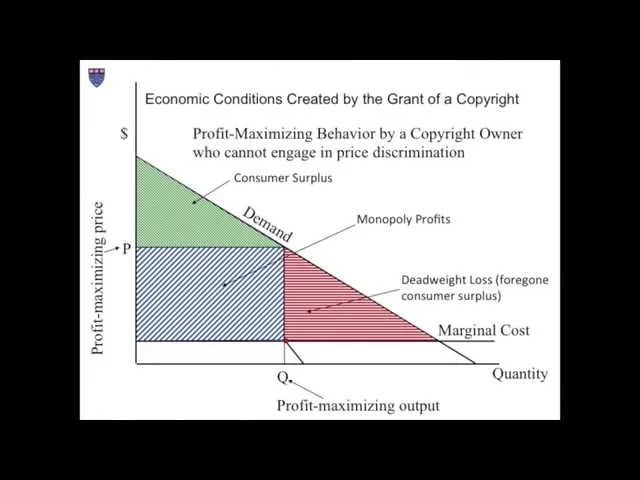
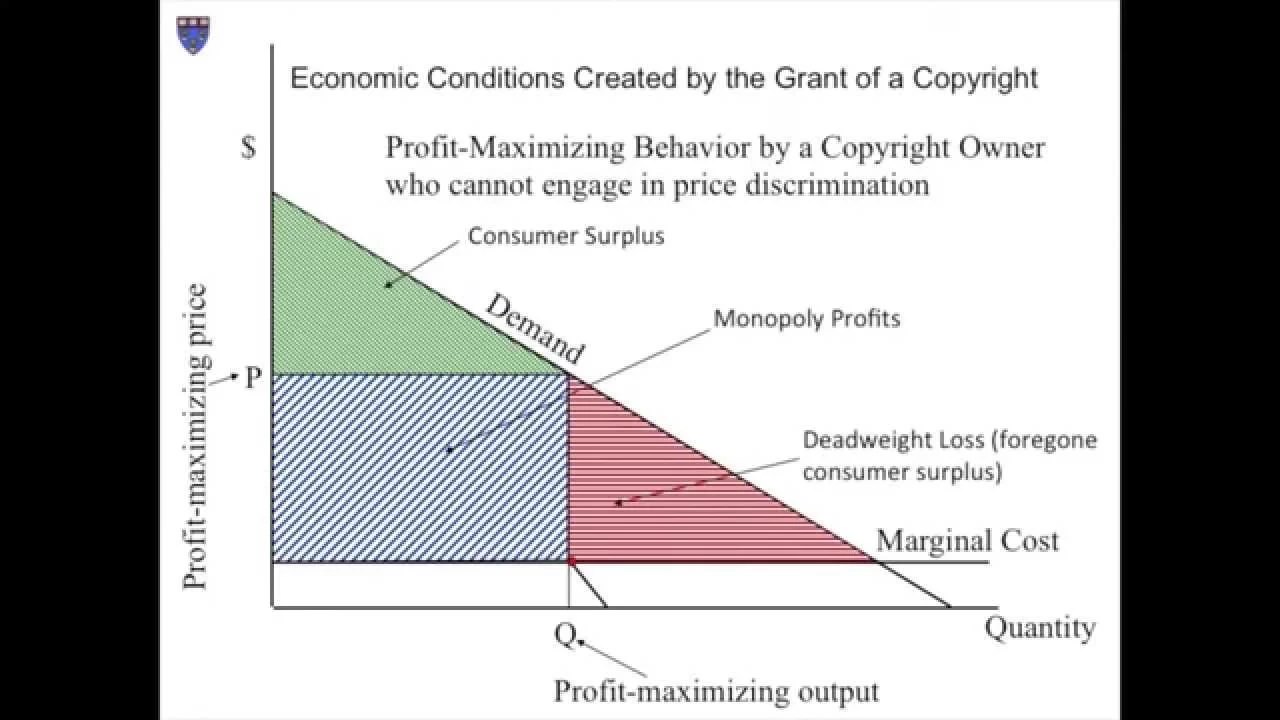
p on the graph is the corresponding profit-maximizing price. And q is the profit-maximizing output. This strategy, to repeat, will generate each month profits measured by the blue zone.
The strategy I've just outlined will have two crucial side effects-- one of them good, the other one bad. The good one is that, unlike perfect price discrimination, which we discussed a minute ago, this more familiar and feasible strategy will leave many consumers happy. Specifically, the people who buy the DVD at price P feel better off.
Specifically, they experience pleasure measured by the difference between what they paid-- that's price p-- and the maximum amount that they would have been willing to pay. The sum of all of the benefits enjoyed by all of the consumers who bought the DVD-- in other words, the total consumer surplus-- is represented on the graph by the green zone. The bad side effect is that many of the people who would have purchased the film, had it been priced at the actual cost of making the copies, won't, because they can't afford price p.
The result is what economists refer to as deadweight, a somewhat grim term. In this case, it refers to consumer surplus that could have been gained, but is sacrificed or foregone as a result of the pricing strategy pursued by CDF. So the green zone is socially beneficial, while the red zone is unfortunate.
Why do we tolerate the red zone? The conventional justification is that films, like Defending Our Lives, will only exist if potential creators, like CDF, are attracted by the opportunity to enjoy profits, measured by the blue zone. In short, the red zone is regrettable, but is necessary to enable us to reap the blue and green zones.
That, in brief, is the core of the justification and explanation of the copyright system seen from the standpoint of welfare theory. Now, those of you who are economists have undoubtedly recognized respects in which this scheme is oversimplified. Some of those respects I'll address in the remainder of this lecture.
Others I'll examine in subsequent lectures in this series. And still others I won't address at all. But this is enough to get us started.
It's very important that you feel comfortable with the primary features of this argument. To repeat one more time, the heart of welfare theory is the proposition that, unless creators can recoup the costs of their creations, their so-called costs of expression, they won't produce those creations in the first instance. And the way that the law enables them to recoup their costs of expression is to suppress competition in the creation and distribution of their works.
The absence of competition, in turn, enables the creators to price copies of their creations well above the costs of making and distributing them, which enables the creators to reap monopoly profits. That still leaves consumers who are able to purchase the goods better off than before, but has the unfortunate side effect of pricing out of the market a significant set of potential consumers. That's regrettable, but we tolerate it in order to stimulate creativity in the first instance.
Some confirmation for this approach can be gleaned from the fact that actual pricing practices in the film industry align reasonably well with the predictions generated by this model. Here, for example, is the price on amazon. com of a DVD of Schindler's List, which, like Defending Our Lives, won an Academy Award in 1993.
Like Defending Our Lives, Schindler's List remains popular, so there's still considerable consumer demand for copies of it. So how was it priced? Well, as you can see, the list price is $15.
Amazon sells it for $10. As you'll recall, the cost of producing a DVD, including one containing Schindler's List, is roughly $2. 70.
So P, on this graph, which, you'll recall, emerged from our analysis as the profit-maximizing price, is more or less in the zone of $10 to $15. Now, interestingly, the film that we've been discussing thus far, Defending Our Lives, is not priced at $15. On the screen is the website for Cambridge Documentary Films from which you can purchase the copies of the DVD.
Enlarging it a bit, you can see that CDF is selling it for $175. That's hard to explain on the basis of the analysis we've conducted thus far. It would seem that CDF has chosen to set the price way up here.
A price this high will earn CDF some monopoly profits. But the CDF managers seem to be forfeiting a large potential market. So why do they do this?
A clue is provided by their website, which indicates, as you can see, that the prices of their DVDs include public performance rights. To understand the significance of that statement, I need to provide you a preview of some material that we'll discuss in much more detail in lectures number seven and number eight. When you buy a DVD, you're permitted to do a lot of things with it, including, of course, watch it at home in your living room or den.
But you're not permitted to use that DVD to display the film on a screen in a public place. The reason is that the owner of the copyright in the film enjoys, among other rights, the exclusive right to perform it publicly. Your ownership of a copy of the DVD does not authorize you to encroach upon the copyright owner's public performance right.
So if you want to show it to people other than your family and friends, you have to get a separate license to do so. So what CDF is doing here is selling a bundle of two things-- a physical DVD and a separate public performance license. The latter is worth much more than the former.
Another inference we can draw from this somewhat unusual pricing strategy is that the customers that CDF has primarily in mind are not ordinary consumers, people who buy DVDs in order to play them on televisions in their dens. Rather, the CDF managers are aiming primarily at teachers or institutions that want to educate people about domestic violence. Put slightly differently, it seems that there are two quite different markets for Defending Our Lives-- regular consumers and institutions.
To represent the two markets, I have to adjust the graph that I've been using, first by shrinking it and then by expanding the scales. The institutional market for Defending Our Lives would then look something like this, while the market consisting of ordinary consumers would look like this. Why is the demand curve for the former so high and steep?
Because the institutions anticipate showing it to lots of people repeatedly in educational settings. And at least some of those institutions are thus able and willing to spend quite a bit for that opportunity. Individual consumers, by contrast, are able and willing to spend much less.
If CDF's customers are clumped this way, then CDF's pricing practice makes a lot more sense. The managers are setting the price way up here. They are, to be sure, forfeiting a significant number of potential consumers.
But this price is indeed profit-maximizing. Now, there's a nuance lurking here. Why don't the managers separate the two markets and charge the two sorts of customers different amounts?
That would represent a form of price discrimination, not the perfect price discrimination of the sort we considered before, but imperfect discrimination. it would not be as lucrative as perfect discrimination, but it would generate higher profits than flat pricing. Indeed, my brief discussion a few minutes ago of public performance rights may alert you to one way in which the CDF managers could separate the two markets.
They could offer the DVDs with public performance rights for one price, $175, and then DVDs without such public performance rights for much less, say $10. Not only would that practice currency df more money you would also be socially beneficial because more people would have access to the film. So why don't the CDF managers do this?
The most likely explanation is unenforceability. Even though copyright law, on its face, seems to give them the power to differentiate prices in the two markets by granting to some buyers public performance rights and denying those rights to others, in practice, CDF could not detect and punish violations of their public performance rights by institutions that purchase the plain DVDs. Anticipating this, some teachers would buy the inexpensive, plain copies and then unlawfully perform them for their classes.
And the result would be to corrode CDF's high-end market. The result in loss of revenue would exceed the gain that CDF gets for making the simple DVDs available to non-teachers. Several important themes lurk in this last example-- the merits and demerits of price discrimination, the marketing possibilities created by the various exclusive rights held by a copyright owner, and the limitations on those options created by the difficulty in some settings of enforcing copyrights.
We'll return to all of these themes later in the course. This concludes our initial exploration of the welfare theory of copyright. In the third and final segment of this lecture, I'll discuss a few applications and refinements of the welfare approach and then step back from the details and ask you, through these lenses, what are the strengths and weaknesses of copyright.