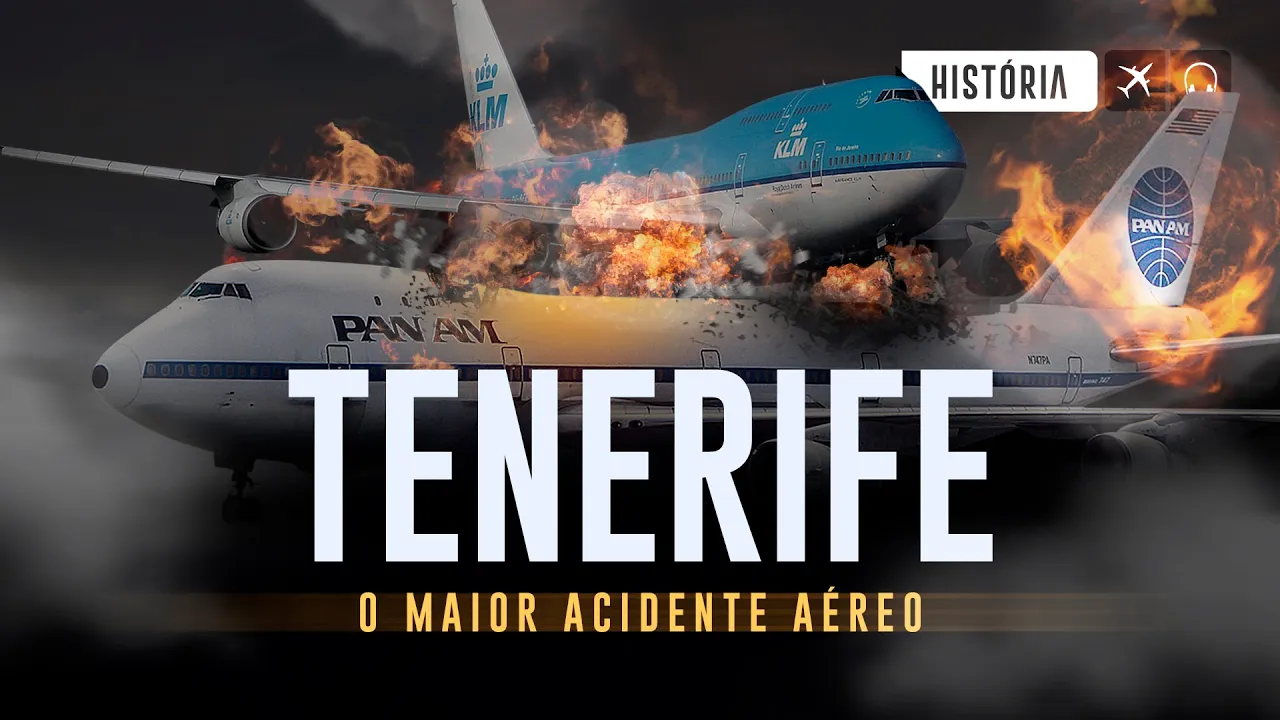
Last Monday was the 40th anniversary of the biggest plane crash of all times, which changed a lot of things in aviation as we know it today Aeronautical greetings, how you doing? Sit down, here comes the story. Panam's Boeing 747, registered as N736PA, was already famous.
In January 1970 it completed the first commercial jumbo flight between New York and London, all painted white and with that characteristic Panam blue stripe. He had been named Clipper Victor. The KLM jumbo registered as PH-BUF, also in blue and white, was named Rijn.
These two planes were part of the biggest air disaster of all time, which is called the Tenerife disaster. Tenerife is a small island that is part of the Canary Islands archipelago. It’s on the west coast of Africa.
The Panam jet was on a charter flight from Los Angeles to Las Palmas in the Canary Islands and had already been flying for more than eight hours with 396 people on board among passengers and crew, when it was informed that it would not be able to land in Las Palmas because a terrorist group had exploded a bomb in the airport lounge, and it was closed for takeoffs and landings. All the flights that were going to Las Palmas were being diverted to Tenerife, which is 70 kilometers away from Las Palmas. Obviously, nobody is happy about this, but there was no other option.
The same thing had already happened to the KLM jumbo and all its two hundred and forty-nine occupants. The Tenerife airport didn't have the infrastructure to receive all these flights that alternated there. It’s a small airport and for lack of space they started to stop the planes at the holding point on runway 12, the larger planes, and they also stopped several planes at the taxiway.
Look at this picture, it’s how the planes had stopped. The KLM captain asked for a refueling of 50 tonnes of fuel while he was waiting for Las Palmas to reopen. This is an unusual amount of fuel for this short flight.
You can imagine that he was thinking that by the time Las Palmas reopened, there would be so many planes there that it would take time to refuel, he would be late, and his time would run out and he wouldn't be able to get back to Holland. When Las Palmas airport reopened, Panam asked for permission to takeoff. But Panam couldn't leave because KLM had parked in front of him, and to make things worse, the captain of the KLM flight had authorized the passengers to disembark, unlike Panam.
This delayed even more the taxiing of the Panam that was wanting to leave. When the passengers boarded and everything was fine, KLM was allowed to takeoff because it was in the front. As it wasn’t possible to take the taxiway to the runway where they were going to takeoff, because the way was blocked, the tower asked them to follow the runway to the end and make a 180 turn to takeoff.
This is what we call backtracking in aviation. Since KLM was already positioned in front, it went first, while Panam was waiting for authorization. During this time while KLM was going to the takeoff point, a dense fog began to cover the runway and visibility dropped to about 300 meters, less than half that the legal requirement of 700 meters for takeoff.
When KLM was reaching the end of the runway, the tower authorized Panam to taxi, and told the Panam guy: go to the third exit, which is the taxiway, and then you clear the runway for KLM to takeoff. This third exit was a 150-degree left turn, too sharp for a 747. This confused the Panam crew, who asked several questions to the tower.
And to this day we don't know exactly why the tower didn't instruct them to exit at the fourth taxiway, which is only a 35-degree turn in the same direction as the taxiway, not the opposite direction, going back to the terminal. While Panam was trying to find this third exit, with the fog increasing, KLM captain van Zanten did something unimaginable, he started to advance the throttles for takeoff. His copilot Klaas Meurs incredulously said "wait a minute, we don't have authorization to takeoff yet" and van Zanten reduced the throttles and told him "So ask for authorization".
The copilot asked for takeoff authorization and then it was discovered in the investigation that Van Zanten was in a hurry to takeoff because there was a regulation that KLM had at that time that punished pilots who exceeded the on-duty time limits, so if he didn't takeoff soon, and he was seeing the fog coming in, he would be penalized for that, he would be punished. Another interesting fact: he was one of KLM's most respected pilots. He even appeared in the on-board magazines as a model for the company, he was an instructor and a highly skilled pilot.
He had great prestige in the airline. The miscommunication that happened after that, proved to be fatal for the accident to occur. It’s important to remember that by this time, the tower could no longer see the runway, the fog was very heavy.
The copilot told the tower they were ready to takeoff and the tower's response was that they were free to fly the specified route after takeoff instead of simply saying "standby" or "hold". The copilot repeated the tower's instructions meanwhile the captain began to advance the throttles for takeoff. And then the copilot said they were already taking off, he said, "we are now at takeoff” and that's not standard phraseology and no one understood what he meant by that, if they were at takeoff point or if they were already taking off.
So, neither the tower or Panam, who was on the runway at that time, understood that the KLM was already starting to move. Panam's crew informed the tower that they were still on the runway, the controller responded by asking them to confirm when they were off the runway, when they were in the taxiway. The controller doesn't know that KLM is already moving.
When the controller tells KLM to standby for takeoff, the controller says "ok standby for takeoff, I'll call you" KLM never answered that and if they didn't answer it’s because the message was not understood. Actually, it was discovered that the tower and Panam spoke at the same time on the radio. When Panam said that he hadn't cleared the runway yet, that's when the tower told KLM to wait in position.
And the only thing that KLM heard was "ok". This happens because the communication radios of the airplanes are one-way communication, you talk and only after you release the button another person can talk. Only one can talk at a time.
Ten seconds later, the tower says to Panam to report when they leave the runway, and Panam answers "we will". Since Van Zanten was very focused on takeoff, both he and the copilot didn't even hear this message from Panam saying that they would report when they were leaving the runway. But the flight engineer heard, he asks, with the plane already running in the fog, he asks the commander "has that Panam left yet?
" Then Van Zanten doesn't understand what the engineer says, then the engineer repeats to him "the Panam, has the Panam left the runway yet? " then Van Zanten says "of course" emphatically. At this point neither of the other two crew members questioned him, because a pilot of Van Zanten's level wouldn't make a mistake, basically that's what they thought.
In the cockpit of Panam, the nose is already pointing to KLM, and they’re not seeing each other yet because of the fog. Something tells the pilot that something isn't right and then Captain Victor Grubbs says, "let's get out of here", but a few seconds later the lights of KLM appear in the middle of the fog, 600 meters ahead of Panam. Grubbs yells “look at him over there” and curses into the voice recorder.
He pushes the throttles hard, he puts the throttles forward to takeoff position and he turns the wheel for the 747 to go to the grass, to get off the runway that KLM is running. We can hear the copilot yelling "get out! get out!
get out! " (from the runway). Van Zanten also sees the Panam jumbo but it's too late for him.
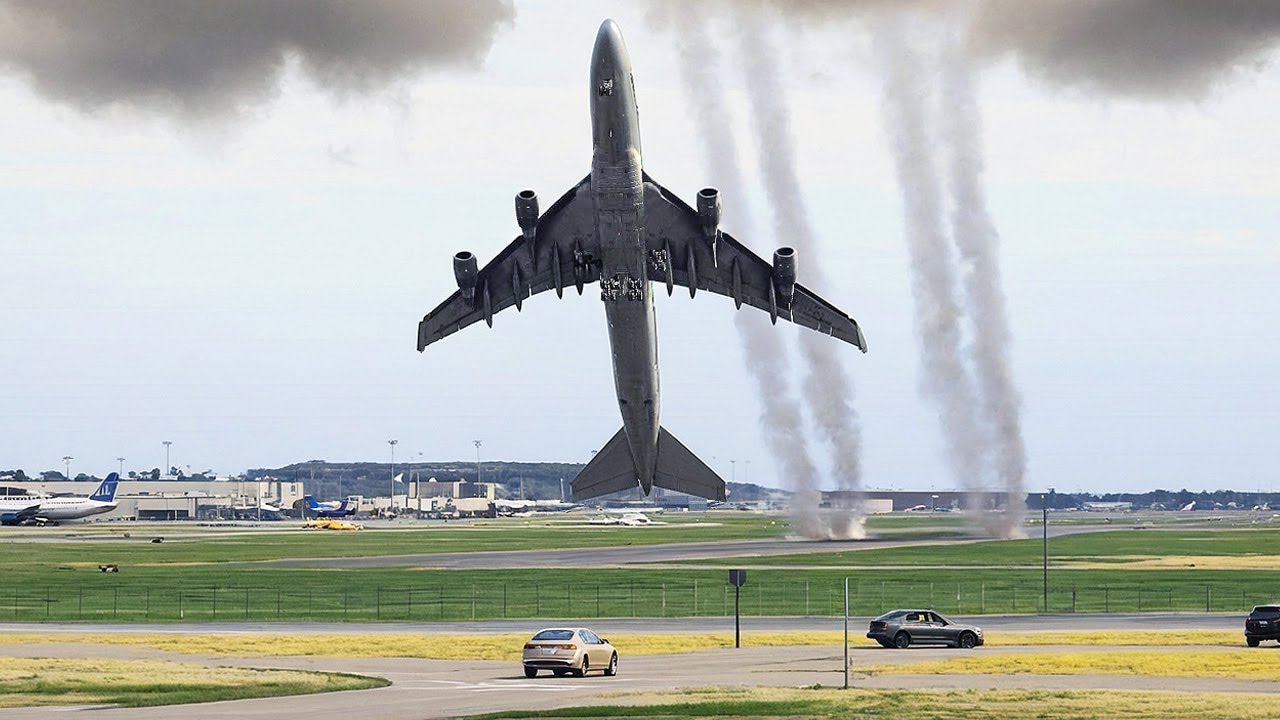
He will try to pass over the Panam, and he elevates the nose before reaching the rotation velocity. As the plane is very heavy because of the extra fuel that was added, he lifts the nose, but the tail keeps scraping the ground for 25 meters. As he leaves the ground, he almost succeeds in passing over Panam, but as soon as he has left the runway, the landing gear hits the roof of Panam's plane, and the engines hit the top of Victor's fuselage as well.
None of the 248 occupants of the KLM survived. Of the 396 occupants of the Panam 61 survived including the five cockpit occupants, but in total there were 583 fatalities. Not a single life is lost in vain in an air crash.
But what has been learned, and what has changed in aviation so that 40 years later the number of fatalities for an entire year is three times less than that single accident? Procedures in the cockpit. It’s obvious that several factors contributed to this accident, for example, the first time the KLM captain advanced the throttles without permission from the tower, the fact that the copilot called attention is very interesting because 40 years ago it wasn’t common for the copilot or flight engineer to question an attitude of the captain.
To give you an idea, when I joined Varig in 1986, there was a bus that transferred passengers from Congonhas to Guarulhos. Not passengers, employees, workers. And from Guarulhos to Congonhas.
The front seats of this bus were reserved for the captains. If you sat down, you were forced to get out if a captain got on. And sometimes the bus was crowded, and those seats were empty, but you couldn't sit down.
You would have a problem in your life. So, questioning the attitude of a captain at that time was unthinkable. The Tenerife accident changed this relationship in the cockpit all over the world.
Today all crew members are encouraged to question the captain and offer recommendations in the name of safety, of course. This factor alone has increased in a huge way the safety in the cockpit, the operational safety of a flight. And this has been proven, remember the incident with a Qantas A380 that had a catastrophic engine failure?
That plane was saved because of this process that is called CRM - cockpit resource management. Another thing that has changed: communication. Standard phraseology has been adopted worldwide regardless of the size of the airport or airline.
The study of human factors and how a human being reacts when he is under pressure or when he is managing stress or under time pressure, this has advanced a lot in the last few years to the point that today there are companies that work with error prediction instead of error prevention. You can already predict when the human being is going to make a mistake. Crew regulations: the fact that Van Zanten didn't wait for the tower meant an anxiety of not being able to take off in time and having to stay overnight in Tenerife together with its more than 230 passengers.
Today the rest regulations are much better programmed and managed as well. Flights today are cancelled more at origin than at destination, so you don't even leave the airport if your regulation is going to expire. Extra fuel: the extra mass of fuel prevented the KLM from leaving the ground before the crash.
After that accident the amount of fuel that goes into the tanks became much more regulated and watched over by the companies as well. But probably the biggest change with these lessons learned was the prevention of runway incursions. Runway incursion is the name we give to any case where the pilot makes a mistake during taxiing or trespasses on a runway without authorization.
Not only the pilot, also a ground vehicle, anything that enters a runway is a runway incursion. Even the maintenance people who are authorized to taxi planes, we must do recurrent training on runway incursion prevention. Most modern airports also have ground radar so that planes can be seen on a screen even if visibility is zero.
And a new runway light system is being tested in the United States. In an automated way this system will prevent planes from making wrong turns. It’s like a traffic light, if the guy is on the taxiway and a red light turns on, he has to stop.
That's it, the great beauty of aviation is in learning from its mistakes. If we had something like this in politics, São Paulo wouldn't have run out of water last year and practically nothing was done to change the habits of the consumers. And not even the guys who should take care of this.
Unfortunately, we can't expect this from most politicians, so do your part by learning from your own mistakes, society thanks you. Thanks for watching, leave your like and see you next video!
![O maior DESASTRE AÉREO de todos os tempos [Remake] | EP. 1166](https://img.youtube.com/vi/OgGLxbzjzcg/maxresdefault.jpg)