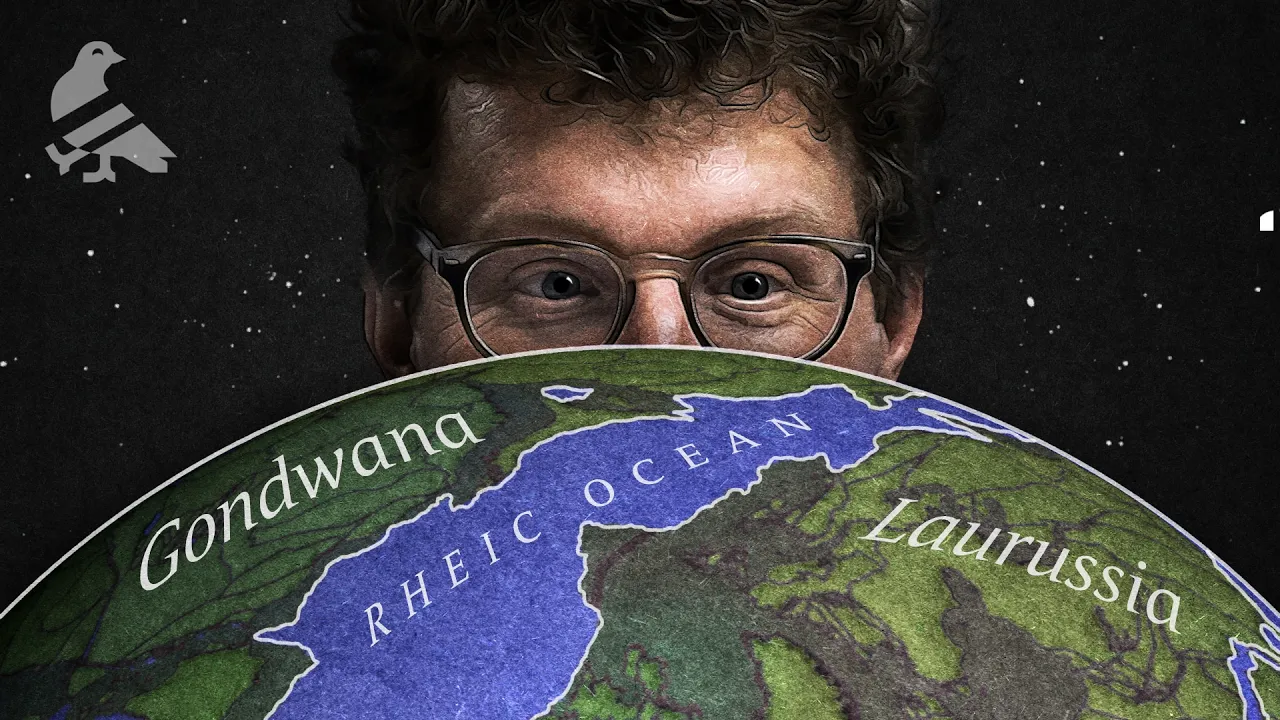
[Music] let's rewind you've seen this Pangia some 200 million years ago but we're going way further back to 1. 6 billion years ago when big pieces of India Antarctica and Ukraine were neighbors so were parts of Africa and South America Canada and Australia this is the strange geography revealed by this brand new model of play tectonics that was released at the end of last year it spans 1. 8 billion years and of course here at howtown we ask how do they know this you know how did they come up with this model how do they know where all these continents were a billion years plus in the past so to find out you and I are going to hitch a ride on two of these continents I'm going to drop you off in Canada near some of the oldest rocks ever found and I'm going to start on the other side of the world in Australia we'll ride these patches of crust into the ancient past and along the way we'll dig up some of the clues that scientists use to map a world that no longer exists [Music] our journey will span 4 billion years every pixel on this timeline is 3 million years and this tiny fraction of this pixel contains all of human civilization okay let's start rewinding we'll give each region its own color so they're easier to follow and we'll get rid of the ocean so we can have a better view these are tectonic plates they typically have some dense oceanic crust and lighter continental crust floating on top of the the softer solid mantle just 65 years ago most scientists didn't accept play tectonics people really didn't think this was happening I would have thought this would have been back in like the 1700s that somebody came up with this but this was in people's lifetimes that are still around yeah totally one of one of the first clues that this is happening is just looking at the continents and this map was one of the first that showed semi accurate outlines its creator a Flemish cartographer who definitely could be played by James Cromwell noticed that Africa and South America looked like they had been torn apart over the centuries a few other people noticed the same thing and other odd Clues started piling up old shark teeth were Unearthed high in the Alps identical plant fossils were found spread across different continents some people suggested that maybe land could rise and fall connecting continents and creating new oceans but in the 1910s Alfred vager proposed a different Theory the continents were drifting if you smooshed all the continents together in what is now called G those identical fossils matched up perfectly other scientists didn't buy it though for decades they called the idea a fairy tale what was keeping the scientific Community from acknowledging the the possibility of this like what's the big hold up it's funny cuz he was a meteorologist he was working in a field that he wasn't brought up in and I think that was an advantage for him because everyone else immediately encountered the problem well well how would this even work Alfred incorrectly thought that Earth's rotation might be causing the continents to plow through oceanic crust like ships through ice but physicists and geologists knew that those forces and The Rock itself weren't strong enough for that to work they really wanted more proof and a better mechanism and they were about to get both sonar gave us a new way to scan the ocean floor and in the 1950s Marie Tharp spent years at the drafting table translating this kind of data into incredibly detailed maps she would hand draw these I mean it's kind of incredible it looks like the in the back of Lord of the Rings she noticed what looked like a long trench in the middle of the Atlantic it stretched all the way up to Iceland and you can actually see where it splits this Valley she pointed this out to her supervisor and he was like that's just girl talk but eventually he published the findings under his own name Jac custo was also skeptical at first so he dropped a camera into the middle of the Atlantic revealing pillows of lava newly extruded from the center of the earth this cuz you have you know an eruption under Thea you sort of need to prove that the plates are actually moving you know volcanoes erupt in Hawaii too but that doesn't necessarily prove plate tectonics they needed more proof that the ocean floor was spreading and that proof came in the form of a miraculous little mineral called magnetite ooh has a cool name it's this iron rich mineral and when it's hotter than about 580° Celsius it's not really affected by Earth's magnetic field but as it cools it locks into alignment with that field and stays there it's like a built-in burnt in compass mark inside the rock exactly it's a compass that that captures that moment in time and it turns out that over time Earth's poles switch places at irregular intervals and you can see that switch in the ocean floor the magnetite Points North then South then North again and so on providing proof that the SE Flor was spreading but they still needed to explain what was causing the movement of the plates can you guess what the the early theories were I mean is it like little bath toys kind of just bobbing up and down on a sea of of hot magma yeah I mean that's that that is sort of what they were they were initially thinking so the mantle isn't this ocean of molten rock it's mostly solid it can still flow over millions of years but it looks like these currents have only a tiny effect on plate movement instead they're pretty sure the main driver is what's going on at the other end of the plate in subduction zones the densest oceanic crust sinks into the man and pulls the rest of the plate with it you actually are like tugging the conveyor belt of the continents behind you as you sink yeah that's that's the that's the main Force they think yeah what kind of scale of movement are we even talking about here like the fastest moving plate on earth like how much is it moving in a year to help answer that very question NASA sent up this satellite in 1976 well was the 70s so of course it had to be a giant disco ball satellite they bounced lasers off all these reflectors to measure how much the continents were drifting and they found for example that North America and Europe are moving apart at a rate of about 2 to 3 cm per year and the fastest plate the Pacific Plate is going 7 to 11 cm a year wow slow down buddy Carl Sean placed a plaque inside the satellite that showed Earth today and Pangia 268 million years ago this arrangement of Pangia makes sense if you look at the age of oceanic crust red is the newest Rock blue the oldest rewinding so that newer crust disappears back into the mantle we can follow how the plates must have moved and Pangia is where we find ourselves now we've zoomed past a bunch of stuff this is before mammals there's not even dinosaurs yet oh wow we skipped a lot of cool chapters of the book here because there's so much more to go I mean we're going to go 4 billion years in the past we're only like 300 million right now oxygen is thicker we're surrounded by giant insects and the ancient relatives of amphibians and reptiles it gets way harder to map the world before Pangia for one thing hardly any oceanic crust survives from that time so we can't rely on that but luckily there are other hidden Clues we'll get to that in a second but first I want to thank today's sponsor story blocks story blocks when I was making my last episode I wanted to do a little scene where I represented all of the journal articles that I read by having them sort of rain down so I was going to ask my wife to like drop them from a ladder or maybe like hide and throw them up in the air I was wondering how you did this one it just proved to be too complicated so I just went on story blocks and found a piece of footage that worked and comped it into the scene so yeah they have unlimited downloads of different kinds of media yes they have video images they have sound effects illustrations and music so if you if you want to get started with unlimited media downloads at one set price you can head over to story blocks.
com sh Town you're on loua right now which formed when your bit of Canada crunched into part of Europe about 400 million years ago that series of collisions created a long line of mountains and we can still see them today spread across continents how do we know that those mountain ranges used to be the same mountain range if they're spread across is a great question one thing they all look like they're same made from the same kind of rock but they can also tell that they're the same age over on Joe's Channel we explain how scientists figure out when rocks formed it's a technique called ziron dating you can see the whole explanation and Jos and I forming a crystal lattice over on be smart ziron dating helped scientists figure out that these separate mountain ranges used to be one made of the same stuff cooked at the same time probably not a coincidence as we speed into the past it's getting a little lonely because animals and plants are devolving back into the ocean it's a Barren Wasteland okay got it and on top of that oxygen levels are are dropping the model shows that a lot of the continents have drifted closer to the South Pole and you're now near the equator in Canada they actually find hot water corals left over from this time that's a picture of a fossilized like coral reef that's super cool meanwhile in what is now Morocco we find the remains of only cold water species but there's actually a more precise way to tell that Africa was once near the South Pole and once again it's magnetite when they find these little Frozen compasses on continents they seem to tilt in wildly different directions As you move back through older and older rock but this makes sense if the continents are moving relative to magnetic north and you can use this to reconstruct their positions so they're always pointing towards the same pole paleomagnetism is one of the most important Tools in building a model like this it should be said that it's not like the Silver Bullet these dots are points in time when we have data for magnetite for different chunks of crust and there are big gaps as we move backward in time uncertainty in Crees and so does danger we need to strap on oxygen tanks now because the microorganisms in the sea aren't pumping out enough oxygen for us to survive and things are getting icy look at this photo from Norway in the lower layer you can see lines scratched into the Rock by ancient glaciers and then in the top layer you can see the stones and sediment that those glaciers left behind in many places those glaciers seem to have scraped away eons of rock then the glaciers retreated and new layers were added creating this big age Gap you can see this in the Grand Canyon where there's a jump of over a billion years some people think that during this time period most of the globe was covered in ice with a belt of water in the middle we're now 780 million years in the past and we've joined the superc continent of rodinia it's got pieces of most of the continents so the gang's all here but they're all scrambled up quite jumbled all right I'm nodding cuz I'm taking your word for it but inside this is like very hard to believe I mean it is hard to believe it's hard to believe that things made a journey this this far I mean the paleomagnetism is a big help in sort of proposing where things were but then they find these other Clues like there are layers of rock in the Grand Canyon from this time period that perfectly match up with layers of rock in this outcropping in Tasmania which suggests that they were both once part of a shallow Inland Sea that formed right here it's still worth noting though that this this configuration isn't certain this is one recent model but of course there are other scenarios that people have proposed and it's also hard to say exactly what rodinia was shaped like these chunks of crust could have been warped in different ways extending the coastline or leaving gaps that would have been filled by ocean basins over the next hundreds of millions of years we'll float apart and then come back together again we we needed to do our own thing for a while but we're coming together we're coming back together this new supercontinent is called Nuna or Hudson land or Columbia depending on who you ask and this is one of those moments where again you can see the Rocks there's part of Queensland that looks exactly like the rock up in this part of Canada and so they think that it just formed broke off and drifted over and became part of Australia so this this piece of Canada is still in Australia today A Farewell gift no matter where you go part of me will be traveling with you when we're going this far back like are there the same number of tectonic plates as there are today or do these things like hook up for a little while and you get ones breaking off yeah I mean it's always changing so yeah there's not the same number of tectonic plates you can see over time new cracks forming others closing what is maintained is the cratons so these chunks of continental crust that are part of the plates that have persisted To This Day Canada is made up of a bunch of different ones that are all kind of mushed together you can almost imagine like chunks of clay that are slowly being added to create what is now Canada Australia is the same deal both Australia and Canada have some of the oldest cratons even though they're they're going to drift further into the past it's probably not safe for us to stay on them any longer so I think we got to hop off the crust watch from a safe distance over the next couple billion years these crons are going to probably spend some time under the ocean under other Rock so it wouldn't be a good good place for us to stand in the Deep Roots of some cratons diamonds are forming and so where these oldest bits of crust ended up is where most diamond mines are found today below us cratons are melting back into the mantle but a few remain including the copf fall Katon from South Africa and the pillbook Katon from Australia and because of the kind of rock that they're made of scientists think they might have formed in a similar place and been part of maybe another continent that they cleverly called vbra it's a celebrity couple but it's kons they both have these weird little sphere rules you any guesses about where these might have come from how far back in time are we now this is 3. 47 billion years ago if I remember right like life is starting to happen around this time this that that's a good guess um but these are unrelated to Life as a turns out darn these actually come from a meteor strike so a meteor hits it liquefies The Rock and it splashes up in this little spray that cools into these little marbles that's horrific that's so violent like for something that hits so hard that it melts the earth into glass droplets and that violence is becoming more common we're getting hit by quite a lot of meteors and the best evidence for this bombardment doesn't come from Earth it actually comes from the Moon here you can see one of the moon's giant impact craters Apollo 15 visited its rim and grabbed a chunk of this rock it turned out to be 3.