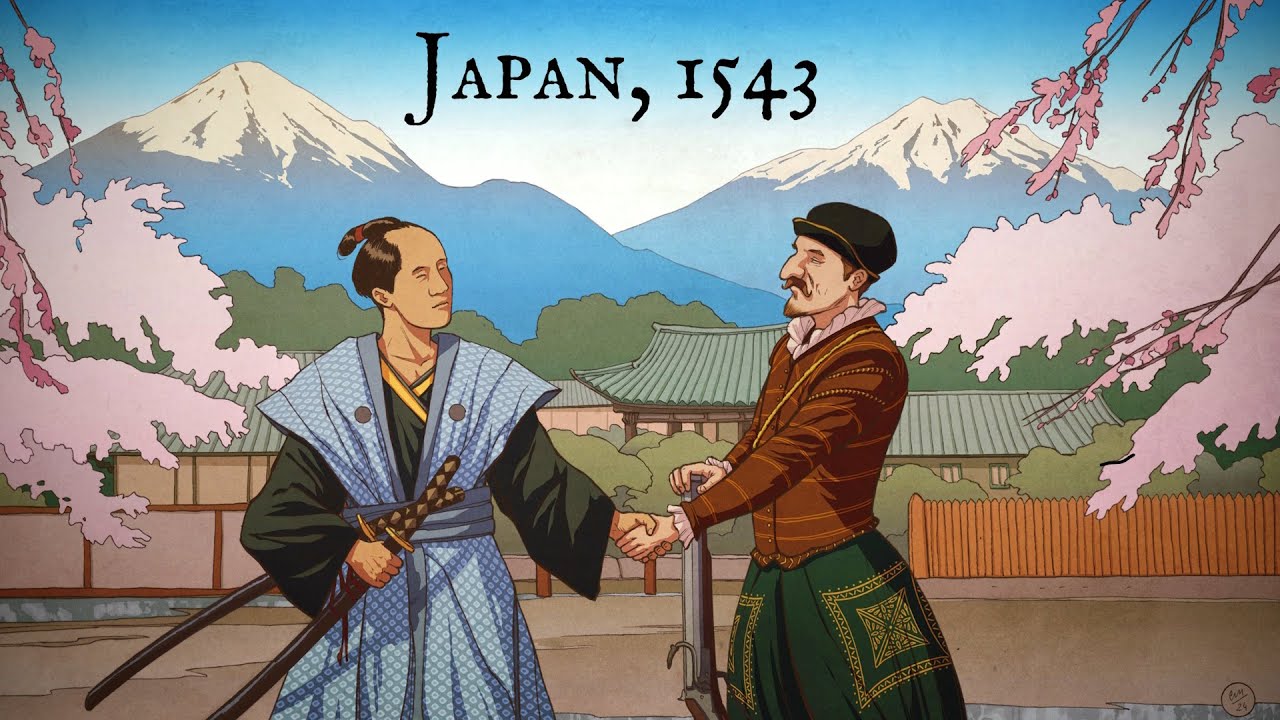
it's 1543 on the small Japanese island of tanegashima a group of villagers see something truly bizarre off the coast a distant object is growing larger by the minute it's a massive black ship its Hull has been weatherproofed by black tar making it look Sinister like the people aboard are about to steal everything you own but that's not the case yet the local Lord of tanik gashima comes down from his castle to see what all the fuss is about on board are around 100 people some with strange physical features who are speaking an unintelligible language among
them is a Chinese scholar Named Goo tokida is able to communicate with goo through writing goo explains that the foreigners are Portuguese traders from the nanban the southern barbarians who travel widely for Commerce but lack any real knowledge of formal Customs two Portuguese leaders named Morita and Christal have with them a mysterious iron object called AO what we' call a musket when it's loaded with gunpowder and ammunition it can accurately hit targets from a distance with stunningly loud explosions Amazed by this technological Marvel TOA asked the Portuguese to teach him how to use the Teo
through an interpreter they explain the basic mechanism of aiming by Closing one eye for better concentration on the target TOA practices and then fires a Tempo himself hitting a Target squarely from 100 steps away recognizing its military significance he buys two teos from the Portuguese who then depart for other trade opportunities this is one of the most most significant meetings in Japanese history TOA would go on to reverse engineer those two muskets and within a few decades they'd spread across Japan revolutionizing Warfare during one of the most violent eras in Japan's history the Waring States
period but aboard that ship was something else that would leave a lasting Legacy on Japanese culture Christianity so let's unpack this let's see why the Portuguese wanted to colonized Japan through religion but then why they kind of just gave up let's see how Japanese resistance and geography conspired to kick the Portuguese out and how Japan nearly became a Christian Nation in the [Music] process okay so after this initial meeting in 1543 more and more of these Portuguese Black Ships started pulling into Japanese ports they're bringing all kinds of stuff with them spices from Southeast Asia
wool from Europe silk from China in return the Japanese are giving them things like porcelain and silver this kicks off the nanban trade the first time Europeans and Japanese started doing business with each other in Japanese nanban means Southern barbarians before the Portuguese arrived they used the term for anyone from Southern China the Indian subcontinent and Southeast Asia when the Portuguese showed up they just lumped these Europeans in with the rest of them but there was another type of trade a much more Sinister trade that the Portuguese helped build in Japan the trade of people
most of us hopefully know about the role the Portuguese played in the Atlantic slave trade but what isn't so well documented is the Asian slave trade the trade saw thousands of Chinese Japanese and Korean slaves transported from Japan to distant lands like maau Manila Goa Europe and Latin America at first the slave trade was pretty unregulated during this time most of the slaves bought by the Portuguese were abducted from China by Pirates or the woku these Chinese slaves were then transported to Japan where they were sold to Portuguese Merchants this trade was largely opportunistic and
disorganized driven by the chaotic political social conditions in China and facilitated by The Pirates Who operated along the Chinese Coast the Portuguese presence in Japan provided a ready market for these unfortunate people who would then ship to maau and other Portuguese outposts the growing scale of the trade and the involvement of influential Portuguese merchants in Goa and Macau led to an expansion of the slave trade despite official attempts to regulate it in 1570 King Sebastian of Portugal issued an edict forbidding the enslavement of Japanese people but enforcement was lacked and Powerful Merchants basically just ignored
the ban the next stage of the slave trade saw an increasing number of Japanese prisoners and refugees sold into slavery these people were mostly victims of the constant Wars among the kushu Doos part of Japan's Waring States period which we'll talk about in a second these people were captured during military conflicts and sold to Portuguese traders in Nagasaki who would then transport them along a route that stopped at maau Mala Goa and then off to Lisbon all in those Black Ships we talked about at the top of the video the slave trade in Japan would
luckily fizzle out by the early 1600s to see why we need to talk about Nagasaki and about the Jesuits so around the same time all this tradeit is going on the good kind of trade and the evil kind this group of Catholics starts streaming into Japan from Portugal they're Jesuits an order of Catholics who are really into missionary work education and converting people in Far Away Heathen lands to Christianity specifically they start streaming into the city of Nagasaki which by the mid 1500s becomes a hub for the slave trade and Christianity at first a lot
of these Jesuits support the slave trade they see it as a way of financing their missionary activities in Japan but understandably they have some moral dilemmas about it which we can see through some of their letters or maybe at least we can see the kind of weird Colonial logic these guys had towards buying and selling people one Jesuit priest named Luis fre for example wrote in his book history of Japan about how he and his fellow Jesuits would separate the women from Men on these Portuguese slave ships quoting all the women were to be inclosed
Chambers and that two Honorable Men should have the keys and take care of them because they were carrying many women on the ship which they had bought at a very low price from the Japanese I mean I I guess that's a good deed the rationale here was so that the women could be safe but they were being sold into slavery another priest named balasar Gago wrote that he quoting again enclosed the girls they brought in a small small closed chamber and there they stayed for 5 months all promising and vowing to abide by everything I
ordered for the good of their soul removing All Occasions of sin okay so those quotes don't really show any real remorse or big-time moral dilemas the priests had about these slaves in reality a lot of Jesuits saw them as an opportunity to win converts well except maybe Gaspar Coello the leader of the Jesuit mission in Japan who wrote back to Rome in 1587 that quoting the second evil they carry out with which they cause enormous Scandal is to want to purchase Japanese men and women in whatever way they can through Force as a Japanese are
poor they represent a good opportunity of profit by selling them the merchants are always using a thousand ways of deception and because the priest allowed this and gave authorization to the merchants stating that the Japanese could be enslaved they practiced many injustices against the Japanese I feel a great compassion and pity to see this horrible spectacle the poor slaves with chains being loaded into the Ship by this time Nagasaki was turning into what historians have called the Rome of Japan thanks to the Relentless efforts of Jesuit missionaries by 1587 Nagasaki had a thriving Christian Community
that would grow to around half a million converts by 1600 the Portuguese missionaries were quite good at their jobs and converted everyone from peasants to local feudal Lords one of the first was a damoo named Amora sumata who took the name d bartolomew opened Nagasaki port to foreign trade for the first time and then basically handed the city over to the Jesuits Nagasaki itself transformed into a city that resembled a European Enclave the skyline was dotted with churches schools and hospitals established by the missionaries European style buildings markets bustling with goods from across the world
and streets filled with people from all over the place gave Nagasaki a unique Cosmopolitan flare the city became a vital port a hub for the nanan and slave trades we talked about [Music] earlier but certain Japanese Lords are like hey hold on a minute all this European Christian stuff is looking awfully suspicious they're changing our religion stealing our people I mean what's next will they steal our country too this is exactly what toyotomi hioshi is thinking hioshi is the most powerful ruler in Japan during this time Japan's on the back end of its Waring States
period for over 100 years the land has been soaked in blood rival War Lords or Doos have been battling it out for control of the islands when the Portuguese introduced muskets things get even blooder one Damo who really takes the Portuguese guns and runs with him is Oda Nobunaga by 1582 Nobunaga had nearly conquered all of Japan thanks in large part to his quick adoption of the musket but then Nobunaga is betrayed by one of his closest allies and dies hioshi who had survived under him takes control and then some by the 1590s hioshi was
well on his way to finishing what Nobunaga started consolidating power and taking complete control of Japan but before that he has to get rid of these pesky Christians who are threatening to upend Japanese culture completely at first at least in the early to mid 1580s hioshi was pretty tolerant of the Jesuits he has a bunch of meetings with a top Jesuit in Japan Gaspar Coello the guy who wrote that last letter that was critical of the slave trade Coello keeps offering hioshi Portuguese muscle to help him in his military campaigns but coo is almost too
supportive suspiciously supportive in July 1587 hioshi meets the Jesuit priest on his ship in Hakata they have a late night meeting that apparently doesn't go so well because the next morning hioshi issues the batan edict all Jesuit missionaries have to get the hell out of the country all Christian evangelism has to stop churches are closed down it also makes it illegal to buy and sell Japanese people a pretty good caveat the edict doesn't ban Christianity outright but it's the start of an anti-christian movement the edict isn't so well enforced though after all hide Yoshi is
still fighting for control of Japan he has a lot on his plate territories to conquer Rivals to Vanquish that kind of stuff but 10 years later things get more intense by this time hioshi is well on his way to become the Top Dog in Japan after he starts casting side eye glances at these Christians he thinks are up to no good in his mind you couldn't love Jesus more than to Shogun it it's Shogun it first than whatever God you want to worship these missionaries Were Trouble to prove his point hioshi has 26 Catholics Jesuits
and Japanese converts rounded up and crucified in Nagasaki that happened in 1597 a year after something called the San Felipe incident where a Spanish ship runs a ground off the coast of shikoku when the survivors are interrogated by Japanese authorities they apparently boast of their colonial Ambitions basically telling the Japanese that they're going to take over so hioshi cracks down more more churches close more Catholic are persecuted but then in 1598 hioshi died a power vacuum ensued more war in 1603 Tokugawa yasu emerges Victorious and established the Tokugawa Shogun it which would rule over Japan
for the next 250 years at this point Japan has the largest Christian population outside of Europe the Jesuits really knew how to spread their faith they were upwards of 300,000 Japanese converts a lot of them powerful damel who either truly believed or were using Christianity to take advantage of Portuguese trade Relationships by 1614 there were maybe 1 million Christians in Japan there were 190 churches seminaries and colleges the faith had spread all over Japan but Tokugawa yasu was even more antagonistic towards the Jesuits and Christianity in 1614 he issued his own edict and banned Christianity
outright and ordered all foreign missionaries to leave the country and this time it's enforced easu is no dummy he's heard what's happened in another parts of the world where Christian Missionary work has turned into full-blown colonialism in the Philippines for example and obviously in the newly discovered Americas in Nagasaki a tradition was established where each year everyone in the city has to step on brass cast images of Christ or the Virgin Mary to prove they don't believe it's not enough to banish and persecute these Christians the faith must be rooted out from the hearts of
people the tradition became so embedded in the culture that today you can find these brass images called fumier with the faces worn away from from years and years of trampling anyone who refused to trample the fumier face torture and execution often either by crucifixion or by being held upside down and drowned in buckets of [Music] excrement amidst this backdrop of religious persecution there are Samurai who are converted to Christianity too one of the most significant is a guy named hakura son in Naga maybe the first Samurai to meet the pope I'm serious in 1613 h
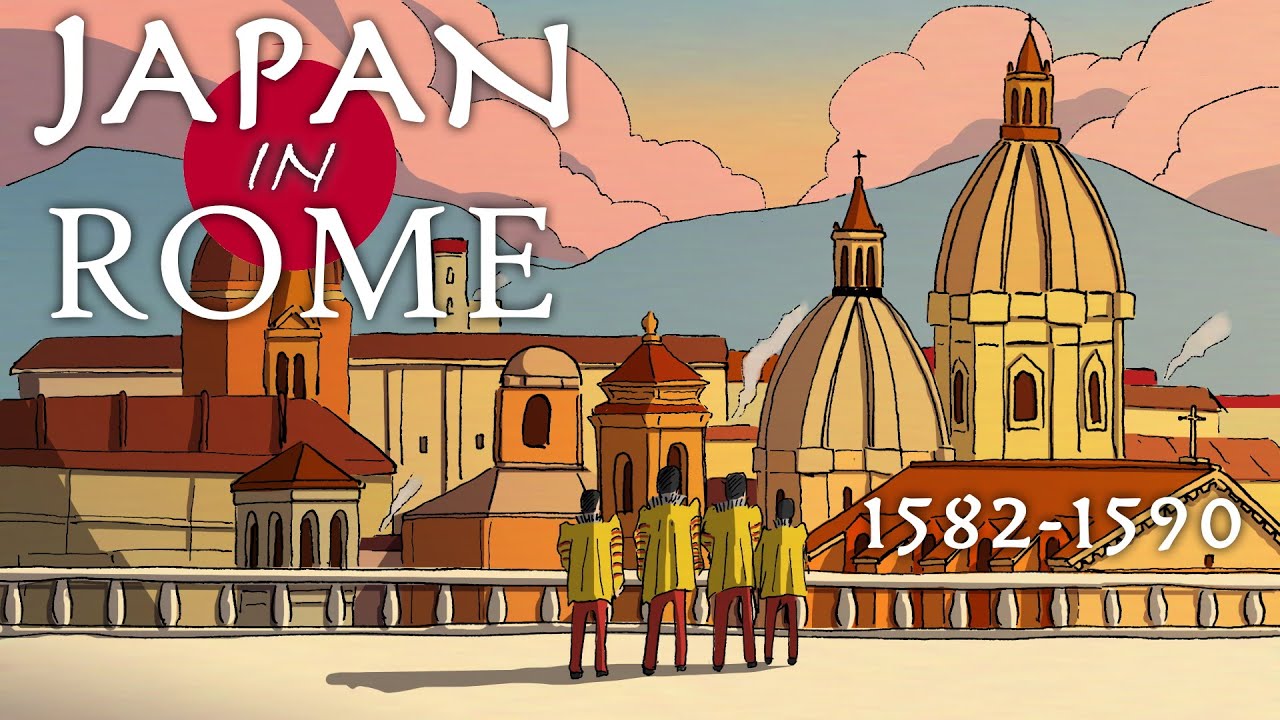
Kur led a Japanese delegation on a diplomatic mission to Europe to try and establish commercial and religious ties they cross the Pacific Traverse Mexico and finally arrive in Europe in Rome hakura is baptized as Felipe Francisco and becomes a temporary celebrity he meets with King Philip III of Spain and Pope Paul v he's presented letters from his Doo de masamune and requests trade agreements and missionary support hur's mission is quite the cultural exchange highlighting Japan's open openess to foreign ideas and religions during this period the portrait of hakura painted during his visit to Rome and
his honorary Roman citizenship are promising signs of a growing relationship between Rome and Japan but it's kind of all for nothing because back in Japan the Tokugawa shogunate is tightening its grip on power Christianity is deemed a subversive Force fiate trampling banishments executions torture all that stuff we just talked about when hakura returned in 1620 Japan was no longer the country he had left the Shogun at Crackdown on Christianity is in full swing in hur's efforts to establish a lasting connection with Europe ultimately fail he died in 1622 just before the really was about to
hit the fan for the Portuguese and [Music] Japan the Shima bar Rebellion kicked off in December 1637 in kushu it's caused by a combination of factors famine economic stagnation and of course the religious persecution of the Japanese Christian population yushu is ruled by the matsukura clan at this time who have a nasty tendency to throw Christians into boiling hot springs like any good Christian Uprising the rebels need a messiah figure and they found one in a 16-year-old boy named aakasa Shiro who's been baptized and taking the name Jerome he goes around carrying out Miracles healing
people saving people not sure if he's turning water into wine water into saki maybe anyway shirro turns the Rebellion against the matsukura clan into a crusade against the ENT entire Tokugawa Shogun it the rebels start ransacking Buddhist in Shinto temples shrines and decapitating Buddhist statues the rebels about 20,000 Strong by this point eventually amass outside shimabara castle and force the Castle's Defenders to shut themselves inside but then Tokugawa reinforcements arrive the rebels are forced to retreat to nearby harac castle and they're the ones who shut themselves inside and bunker down the Tokugawa didn't mess around
though they brought 120,000 men and besieged the castle the Rebellion is stamped out like a fumier image when all is said and done over 30,000 Rebels and their supporters have their heads removed and any of the remaining Portuguese either meet the same fate or are banished from Japan for the next 200 years Japan will become a Hermit country it looks Inward and cuts off trade the era of the Portuguese in Japan and of Christianity in Japan is finished except not really after the shimabara Rebellion some Christians go underground practicing their faith in secret they are
the Kare kirstan or the hidden Christians they continue their faith using Japanese cultural substitutes and their ceremonies like rice for communion bread remarkably this underground Christian Community survived for over 200 years and emerged only when Japan lifted its ban on Christianity in 1873 after the fall of the Tokugawa Shogun it a few hidden Christians are still around today though they no longer have to hide they sing in Latin practice a religion that had only about 40 years to develop before it was Stamped Out it's a weird weird relic of a volatile time a reminder that
if things went differently some Japanese could possibly be speaking Portuguese but it's probably for the best that this never happened thanks for watching don't forget to like subscribe ring the bell and all that good stuff to stay up to date on all the Nutty stories from Humanity's past and present