In 1928, an English mathematician and theoretical physicist by the name of Paul Durac published a work entitled the quantum theory of the electron. In this publication resided the now famous Durac equation which connected special relativity and quantum mechanics. The Durac equation had an interesting characteristic that came with it though that some scientists at the time believed to be a mistake.
Durac couldn't emit negative energy states from his equation. But this didn't discourage him from developing his theory. Durk insisted that instead of the equation having a mistake, there existed for every type of subatomic particle, an oppositely charged antiparticle to pair with it.
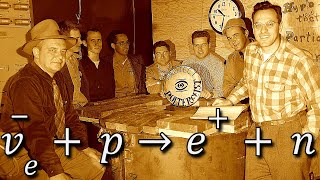
These pairs upon collision would annihilate with one another and release a tremendous amount of energy. The concept of antimatter sprung into theoretical possibility with Dak's equation, and the search to find antimatter experimentally was on. Four years later, an American physicist by the name of Carl David Anderson would be the first to do so, discovering the posetron, the antimatter equivalent of the electron.
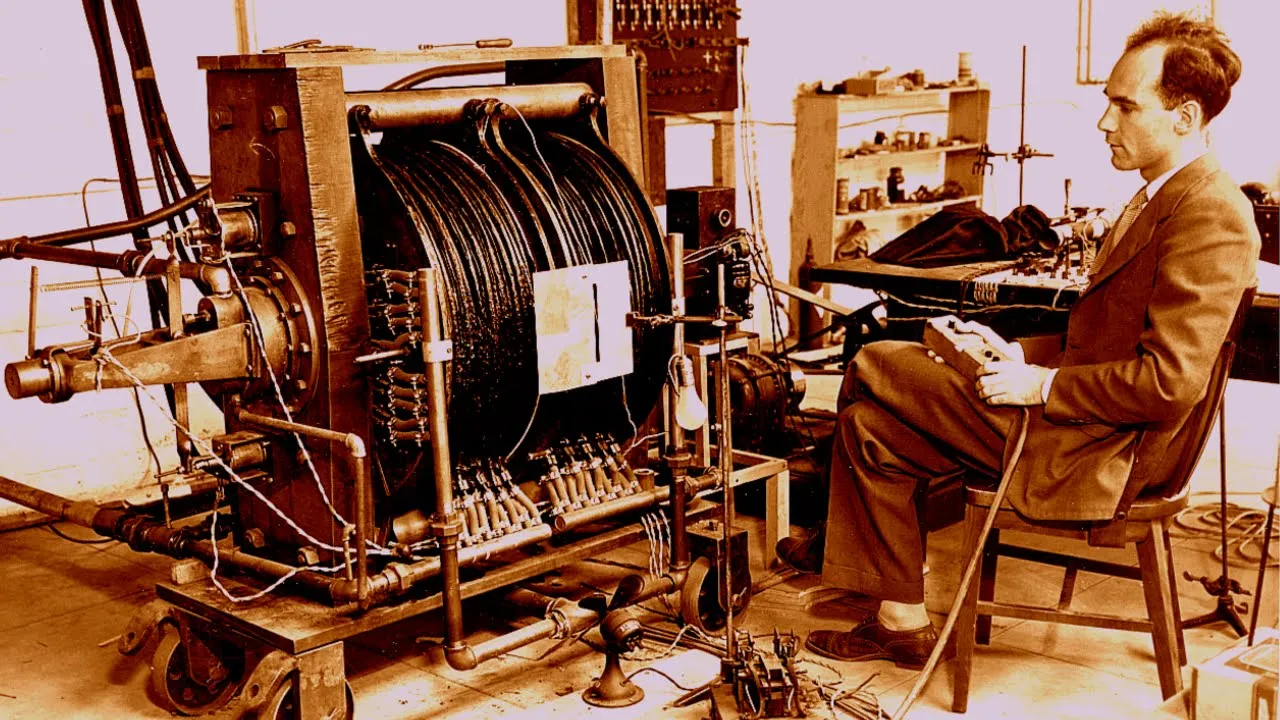
Carl David Anderson was born in 1905 in New York City, the son of Swedish immigrants. The entirety of his advanced education was at Caltech, studying physics and engineering there. He received his bachelor of science in 1927 and his doctorate three years later in 1930 with a thesis entitled space distribution of X-ray photoelectrons ejected from the K and L atomic energy levels.
After his education, he remained at Caltech as a research assistant under the esteemed physicist and Nobel Prize winner Robert Milikin. Anderson's main field of study during this time was in cosmic rays, a form of radiation discovered in the years 1911 through 1913 by Austrian American physicist Victor Hess. Hess discovered that there was a second form of ionizing radiation in Earth's atmosphere.
He made a series of flights in his personal hot air balloon and found that after dipping slightly, levels of ionizing radiation in the atmosphere increased significantly as elevation increased and therefore this ionization must originate in outer space. Anderson was highly intrigued by cosmic radiation and wanted to determine its nature. to actually physically observe cosmic rays.
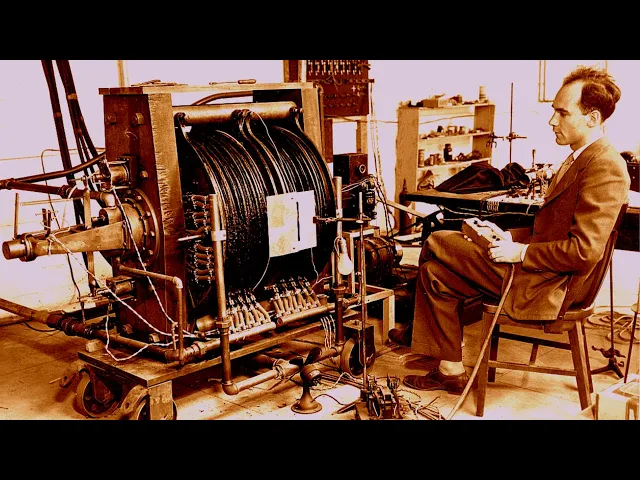
He among others used a marvel of technology, the cloud chamber, invented in 1911 by Charles Thompson Reeves Wilson. This device worked by essentially taking advantage of super saturated water vapor. Once the concentration of vapor exceeds the equilibrium solubility state of the air in the chamber, the vapor will condense on anything that crosses its path.
When cosmic rays enter the chamber, they ionize atoms of gas, allowing vapor to condense on them. This condensation creates a trail of water vapor that follows the ionizing radiation as it passes through, ionizing all particles it comes into contact with. The combination of cosmic rays with the usage of the cloud chamber is what allowed Anderson to make his breakthrough discovery.
In 1932, Anderson, under the guidance of Milikin, set up his experiment to test the nature of cosmic rays. In the summer of 1931, the cloud chambers they used were actually balloons filled with instruments, including a strong electromagnet and super saturated water vapor. The purpose of the electromagnet was to measure the deflection of these particles so that their charge could be determined.
Once sent high into the atmosphere, the equipment and the balloons took pictures of the inside every 15 seconds. Upon observations of these photographs, Anderson found several tracks of what seemed to be particles with very high energies. Furthermore, not only did he observe particles deflecting in one direction when encountering the electromagnet, but he also discovered some particles deflecting in the opposite direction of the other particles, indicating that there were both negatively charged and positively charged particles passing through the chamber.
They also seemed to exist in about the same quantity and also seemed to originate from around the same location. The first conclusion Anderson and Milikin came to from seeing this was that there were both electrons and protons passing through the chamber. It wasn't until they calculated the mass and charge of the positively charged particles that they realized that this particle was actually way too small to be a proton, for it had relatively the same mass and charge as an electron.
This shocking revelation led to much further testing by the two physicists, but their testing only further confirmed the existence of positively charged extremely light particles. Anderson published his findings on their work in March of 1933 entitled the positive electron. In this paper, Anderson explained not only the behaviors of the posetron, but also offered an explanation as to why the positive and negative tracks always seemed to exist in pairs.
He hypothesized that some of the cosmic energy turns into electron positron pairs and then quickly collide with one another and annihilate. But in their experiment that was prevented by the electromagnet splitting their paths before even giving them a chance to annihilate. It was a radical proposal at the time and Anderson knew this but it was a proposal supported with strong experimental evidence and further confirmations of the existence of antimatter would surface in the coming years.
The very next year in 1933, English physicist Patrick Blacket and Italian physicist Jeppi Okiolini together at the University of Cambridge further confirmed Anderson's discovery of the posetron through their experiments with the cloud chamber. They found 14 indistinguishable tracks of the antiparticle in their experiments and were also able to pick out electron positron pairs spiraling in opposite directions, further supporting the pair production theory. By this point, the posetron's existence seems to be undisputable.
The work done by Anderson had led to the very first known form of antimatter and confirmed the accuracy of Durax equation in full. Anderson won the Nobel Prize in physics in 1936 for his discovery of the posetron, sharing it with Victor Hess for his discovery of cosmic rays. Anderson is also credited with the discovery of the muon in 1936 together with his first graduate student Seth Netdermire.
Anderson spent the entirety of his academic career at Caltech, reaching full professorship in 1939 and holding the position until he retired in 1970. After the existence of antimatter was confirmed, a budding new branch of physics, high energy physics, began to incorporate antimatter into its field of study. The first particle accelerators were starting to be built around the same time as Anderson's discovery.
Examples being the cyclron in 1929 by Ernest Lawrence and the Cochroft Walton voltage multiplier in 1932 by John Cochroft and Ernest Walton. These accelerators were firstly aimed towards firing protons at elements in attempts to split the atom. But as time went on, these accelerators gained an additional use.
Artificial creation of antimatter. Many subsequent discoveries in particle physics such as the discovery of more types of antimatter, the development of the standard model, and the understanding of the strong nuclear force can all be traced back to Anderson's discovery. He is a significant figure in particle physics as he opened up an entirely new field of study and experimentally expanded quantum mechanics into even greater complexities than ever thought to be possible.
If you enjoyed this video, please consider liking and subscribing. Click here if you want to see more scientific progress made during this time period. Thank you for watching and I will see you in the next video.