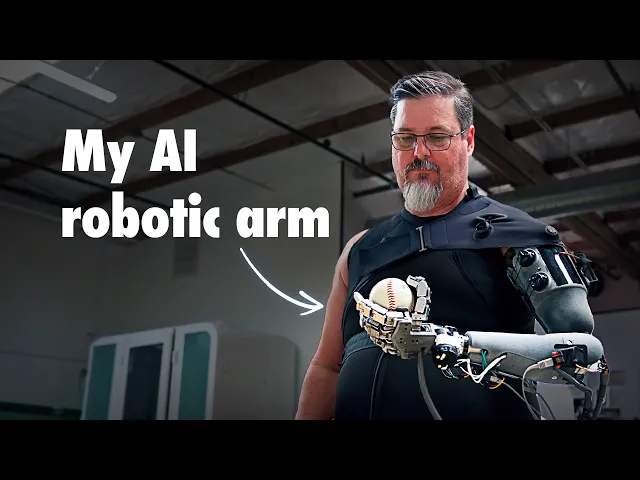
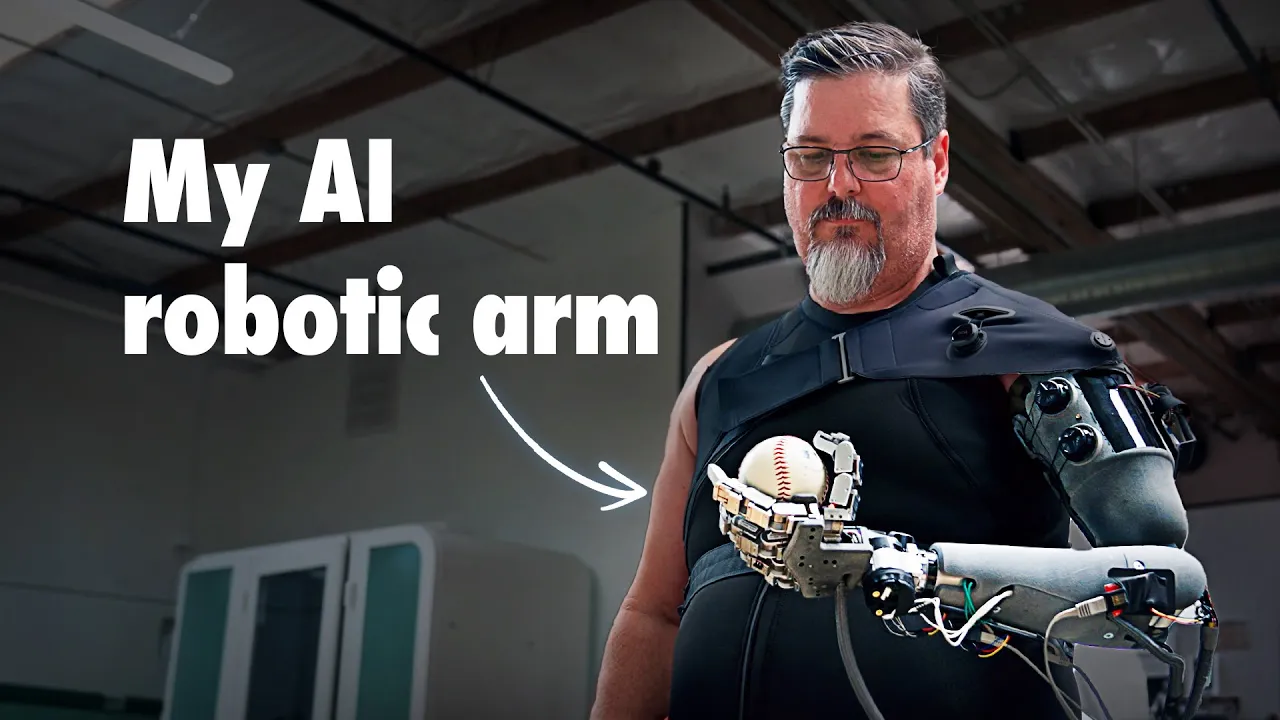
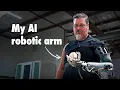
Jason meet Jason this is Jason our Flagship test user so we're building mind controlled robotic arms all the problems I was having with my Prosthetics they were already thinking about in addressing so the goal for today is to find out whether this works whether it all comes together and it behaves exactly the way we plan the opportunities are endless that I see here we're just scratching the surface of what's there now and I think that there's going to be opportunities all over in how we replace parts of the body or either that life or extended
life man's age-old dream of flight becomes a reality one Z all welcome to Eric's crib this is the MTV funh house one big playground for us honestly I will say that and then T us this is just one big lap like that that was the [Music] ideas my name is Tyler Hayes I'm co-founder and CEO here at Adam Limbs and at Adam limbs we are making artificial limbs for the most part what that actually means is we're basically making mind control robotic arms that people can wear my name is Doug Sater I am the chief
design officer for Adam limbs my at Adam limbs is a connection to the person the human understanding human factors um the biology the people and the aesthetic and the appearance of how people engage or interact with the arm 96 apple called me and asked me to come back out my role at Apple was in The Design Group as a designer but my focus was on all color all materials and all finishes from a design perspective early 97 Steve Jobs came back and and the design team became his closest relationship at Apple and it was probably
the best working relation cuz his honesty and being so direct it was there's there's no sort of other agenda Steve is always about get the work done do the right thing I grew up as the infinitely curious kid um I was a kid who took everything apart you know if I got bought a toy for Christmas the next morning it was taken apart that kind of thing and I always had this dream of something I designed or something I built being in some 's hand that led me to Apple in a very long career developing
consumer products and mainly the products I've worked on have been mobile they're in people's hands you have to wear them or carry about them Adam limbs is just really a continuation of that and I'm still learning here at Adam limbs my background before Adam limbs has been a career of 20 years in the technology industry and I moved out to San Francisco after I graduated college and in college I studied psychology wanted to be a psychologist or a neurosurgeon so I have a deep appreciation for Neuroscience as I've spent in the last 20 years about
10 years in the healthcare industry now the idea of delivering a solution for such an underserved Community I couldn't imagine where I could take my career and my experiences and my resources to add to that opportunity to build something this great yeah so who are Adam limbs for Adam limbs are primarily for people who've lost their limbs so these are people who've gone through trauma who Liv through cancer maybe had diabetes and they've lost part or all of their arm so it might be your hand it might be below your elbow it might be your
full arm all the way up to your shoulder so the two biggest barriers for people today is one that the arms don't do that much and two that they're unaffordable so what we're doing for people is pretty simple we're making an arm that is not only breakthrough capability so there's more functionality you can control more parts of the arm you have more degrees of freedom more range of motion it's lighter it's easier to wear it's also more affordable than these state-of-the-art my electric arms today which are typically around $200,000 so we're aiming for a price
point that's much much lower basically an order of magnitude lower so around $25,000 which is the price of a hook arm that someone would get today so because no one can afford these today no company is willing to put in the R&D Bill to actually develop a better product what we basically decided was we don't care we're just going to do it anyway and the hypothesis here is well if you can make something that everyone can use rather than just less than 5% of people now you can get real scale which means you can bring
the cost down you bring the price down the the solution that you get today is sort of cobbled together by a bunch of different folks there's no single person accountable or single entity accountable for the final product solution put it all Under One Roof get it to the point where you actually hit the Tipping Point of scale and the costs become pretty straightforward for us and it's it's still you know a reasonably profitable business and all that it's not a it's not a not a money play for us this is an impact project obviously each
of the subsystems were developing here at Adam limbs be it the wearable the control system or the actuators need a deep level of refinement you'll see a lot of examples of prosthetic hands and arms on YouTube that are great Endeavors but they don't have the level of refinement that's necessary to achieve the speed so we designed everything you see in the arm whether it's the actuators the interconnect the actual assembly itself so what that means is we can effectively sort of remove any part of the arm and it can still function the rest of it
so if we want to make a hand today what would we have to do we would have to develop not the actual actuator themselves those are done not the neural interface that's done not the attachment fully cuz we already have this shirt that we've designed that we'd have to modify it for something like a forearm it really comes down to where do you put the Power and how do you make it lightweight and comfortable all day we have three big challenges here at Adam limbs first we have to design a product that is wearable is
comfortable on the human body all day the second is we have to make it small and lightweight we have to develop actuators that fit in the form factor of a human hand that's just something that just hasn't been done before and we have to control it we have to control it in a way that's very natural very usable to an amput kind of want to have a one does all product it's typical to have a system attached to your body with compression and a strap that goes across your chest most people who have been wearing
them that use them can wear them for about 2 hours our goal is to to say four is a limit six is is best a would be amazing right to get as comfortable in a system that would allow you to to rebalance your body and have a system that you can wear all day all right let's go meet Jason so Jason meet Jason hey this is Jason our Flagship test user hey how you doing my name's Jason Morris um I was born in Michigan but I've lived here in California for the last 40 years I
became an amp in 2012 from a work accident and I'm here at Adam liims now and we're just testing out the greatest of Technologies what we do is we sense muscle activity on the skin of the user and that is known as EMG or Surface EMG we translate those EMG patterns through machine learning into commands that command our actuators those actuators can be grouped as one command like a hand closer can be an individual actuator it's really up to the user on how that's programmed so what we do is we take muscle activity convert it
to commands we call those users commands and then there's a control system that runs each actuator and that control system can interpret those commands and output those as motion for the user now there's more that there's a little bit more to it than that the user also needs feedback the user can see typically what their hand is doing but the user needs needs a sense of touch so we have four sensing resistors on each of the fingertips so the user can sense if they're touching or gripping something we we have macros built in that are
like grip mode things like that that are keep the grip sticky so the control system in Bare Bones is a EMG in and actuation out but there's a lot more to that in closing the loop if you will and that's kind of our secret sauce this is like a 10year leap that we condense down into maybe two or three and now we have that ability to optimize I'd say on a the typical four to six week Sprint that you see and today you're seeing a 3we Sprint this is some stuff that's commercially available and we
developed our own um this is just kind of showing you a little bit of an evolution and this is it integrated into what we call the cuff but the real trick is you got to integrate this cuff into the socket we started with sensors on a band to allow us to get it on we did some these here were uh sort of moisture tests to see if moisture on your skin would cross different sensored points we started building these inside for us to see how to get it integrated into a system on your arm with
as many as 16 but most recently we build These Cuffs have compression in them so they're more comfortable this can be used to operate uh a virtual version of our arm so instead of this being integrated into a socket a user could take this hel and practice on what might look like a video game experience basically a a virtual arm 3D arm and because of the flexibility of of the socket that flexibility allows us to either build it into the system or what we're doing right now is they have a cuff on the arm first
and then when it's on the arm it goes in here and then Jason will tighten this down to the compression he likes all the problems I was having with my Prosthetics they were already thinking about in addressing it was really exciting to me to see that and then I walked over and looked at the arm and they're showing me the fingers I'm like wow this this hand looks so natural compared to what's out there in the public I really was excited to see that they're working on Independent finger control the wrist move in more than
just a rotational pattern and these are all things I'm like I wish they had in current Prosthetics and they just didn't to have all this integrated into one arm and not having 15 different companies building your one arm that have to integrate it together that that becomes frustration on my as an enduser uh so they're working on integrating all that into one arm and it's just going to I think it's working together because it's so far with all the testing I've gone through it's just been amazing and just see the progression it's a product that
scales with the skill of the user so as a user improves their experience improves as well I wouldn't call it a learning curve as much I call it like stepping into more features like if you buy an iPhone you might use only a few apps the first the first time and you might be using 20 apps by uh in a couple weeks very [Music] similar we treat this as a Lessons Learned exercise every time a user comes in so we will sit down evaluate the performance we'll evaluate the video that we took and we will
decide like what are the next steps that we want to take in either speed functionality that we want to add we've architected for far more functionality than you see in these videos today a lot more and so it's what what do we integrate in what order what's the right order of execution if you will as we as we progress and I think we're kind of now at the point where the Technology's proven now it's about optimization about refinement and again that's what make products great there are a lot of great products out there but what
makes them great is a level of refinement it's the people and their passion if you want to get the best people in the world you really just need to pick the most challenging problem for the most part you know the most talented people in the world want to work on the hardest problems in the world and it was kind of a wakeup call for me as a CEO you know as my third or fourth time doing this and uh you know there's a lot of people who have a lot of talent who could spend a
lot of their time and a lot of really amazing companies so what would make them want to join this and it was really the mission which kind of led to the second thing I've learned which is you can't move fast and break things when you're dealing with limbs that you put on people and there's a certain speed you can run at for sure but I think what I learned is that it's less about speed and it's more about communication and I think a lot of us have heard this but it's really become acute over the
last few years what it means to plan to organize to strategize ahead of time when you have to deal with a massive amount of change from actuators to code to soft goods you kind of can't just do this stuff on the Fly you you really do have to plan it ahead of time and fortunately we have an amazing team who's done this you know for decades that's able to uh pull that off every time a user uses our product it makes my hair stand up straight up some folks have never even experienced this type of
motion or control so it's even more special when the user walks in kind of on the blind like like just having no idea what my electric control is capable of doing going through some simple training in maybe five or 10 minutes and fitting them up and actually having use of a limb again is is is that's a non-ordinary [Music] experience I think the thing that excites me the most about the future is we're going to deliver solutions for more and more amputates or more and more opportunities for human war and Robotics we've started with one
of the hardest things that transhumeral and as we present it to you we're looking at below elbow and partial hand additionally we'll get into legs but then also there's going to be a point where we have to go invasive where we actually have direct connection from the arm at the end of the day what matters the most is seeing smiles on people's faces I think that people who've lost their limbs or were born with limb difference for basically all of human history have never had a moment where they thought we could actually potentially restore you
know a lot of if not all of what we've lost and we're not there yet but I think that's our mission that's what we got to do over the next 10 to 20 years you know immediately over the next 6 to 12 months what matters most to us is one clinical trials so we want to show insurers that this is you know efficacious product two FDA authorization Prosthetics uh do require FDA clearance and three beyond that just going to Market we have just over 11,000 people on our wait list right now pre-registered to buy one
of these arms and we was immediately want to be getting these to them as fast as possible you know they've been waiting for a couple years they've largely lived their lives without these for you know decades sometimes we're just scratching the surface of what's there now and I think that there's going to be opportunities all over and how we replace parts of the body for either a better life or extended life and I think that better life is the the initial it's like how do I get to a point where I can be more like
I was or when people were born without a limb how do they get to a point where they first time be able to use things and that's even more exciting so even though they haven't trained or they don't have any just neuropaths that have been trained over a period of time like an MPT surprisingly we're seeing them have the opportunity to actually use it when they call me and they tell me they're like hey we want you to come up and do some testing for their arm I'm just I get all giddy and excited because
I love coming up here and seeing the advancements I love working with all these guys around here they're just everybody I'm in my eyes is a genius here and there's at top of the level on every field and see them working and making their advancements and it's it's been wonderful [Music]