Crisis, just to hear these words, for many people, they automatically associate with pain, suffer, drama. And this is absolutely true. Crisis is one of the most complex, because it can come from a natural disaster.
It can come from war. It can come from something that is deeply unexpected and creates a surprise to all of us. You know, many people associate crisis with risk, and it's not at all the same thing because risk is a natural fact.
When we are doing projects, when we are managing initiatives, there is a probability that something goes wrong. And if this happens to happen, It can create a positive or a negative impact. Crisis is when something already happened and something that is completely out of your boundaries, of control that requires to you an absolutely unique and different approach.
Because in a crisis there is no good end. In a crisis, there is just the bad and the worse. So what I want here is to explain to you the six steps I use to manage a crisis.
When I'm facing a crisis, which are the steps I move forward in order to mitigate its impact and to recover as fast as I can. Let's see them now. The first thing that is, it seems to be super easy, but it's not at all.
The first step it's called awareness. Awareness. The first thing, you need to accept you are in trouble.
Many times the first thing that people do, wrongly, when they are facing a challenge or a crisis is the denial. No. Nothing happened.
Nothing. Look. When there is a big accident people die.
The society was affected. The worst thing you can do. It's denial.
The first thing is to make yourself, your company, the leadership of your company aware that something went wrong, deeply wrong. And these awareness must be done, as fast as you can. As fast as you can.
And this is hard because when we think about the change in process, people do not want because people are in shock and they don't want to recognize, look, there is an accident and my company was responsible for that accident. Or there is something that went deeply bad on my project that affected the society, that affected suppliers or that affected, for example, financially, that my company is now at risk of bankruptcy because of poor decisions. After this step of awareness, you must evaluate.
Is the second step. You must evaluate, okay. How severe is this crisis?
Is it an existential crisis? It means it's, it's a crisis that puts everything at risk, including the existence of my company. It's a localized fact.
It's a fact. How deep is the effect of this crisis in the society. Employees.
Workforce. Finance. So this is the time that a crisis committee usually between these two is when you create a crisis committee.
It's the senior team that takes the ownership of the crisis and manage that crisis like we manage a project. That manages, that makes the decision where communication becomes everything. After you evaluate, you must drive yourself to a decision.
And what is a decision? It's how we will approach that crisis. Many times between this moment and this we're talking about few hours.
We are not talking about here day one. and here it's day 100. Not at all.
Maybe this is 5 p. m. This is 7:30 p.
m. . As fast as you move from here to here the best will be your chances to stop, I don't want to I don't want to use this word, but it sounds like stop the bleeding.
You know, stop that absolutely chaotic drama and lack of control. And on this decision, you decide what would be our approach. How do we plan to respond?
What kind of quick wins and immediate actions we are putting in place now? Not, not tomorrow now. Exactly now.
One of the decisions is to inform we have a crisis committee. We have a crisis team that is able to do that. Let me give you an example, because many, many of us, we faced that with COVID.
For COVID, of course, for governments and everybody, that moment between February, March, April of 2020 was a deep crisis. So what many companies and governments did Awareness. Evaluate.
Create a committee and a decision. This is when W. H.
O. said we have a pandemia, a pandemic, and companies, countries had to start making decisions. Close this airspace.
Holidays, public holidays, people should stay home. Right? So this was a crisis response.
And why a crisis? Because none of us expected that to happen. This was not part of planning, the planning of any organization.
Say, okay,January, we have our budget meeting and then February we have COVID. It doesn't exist that way. So that was absolutely, if you are, I would say younger than 80 or 90 years, you have never seen such a big and impactful moment globally speaking then the initial months of COVID.
And this was exactly what should have been done by governments and entities. And then after the decision, we come to our next step. But the next step is not one step.
It's a set of different things you should do that I will call them action. So awareness. Evaluation.
Decision. Action. The first action is containing.
What is containing. It's deeply stop the bleeding. It's what we can do to contain and not let this to spread.
And containing is the actions on COVID. Something like everybody stays at home. We close supermarkets, We close airspace.
We close traffic. What are you doing? The virus is already there, but you are trying just to stop that area.
So you start locking cities and say nobody coming from this country, nobody coming from this region. So you start isolating. This is what we call containing.
And this is the first action. For example, if you have an accident in your project and I'm saying not a normal accident, but a big accident, what is deeply important that you do, you need to contain. It's not the time here to to say, oh, what happened?
How will we prevent this in the future? You know, this will all be discussed. But now, I don't care about that.
It's how I contain. For example, if there are many victims and usually in big crisis, you have this this kind I'm saying, natural disasters and so, what do you do? You you try to, okay.
How I can find people that are still alive. So I need to start rescue immediately. Contain, block.
No access to that area. To reduce, for example, the human to the damage or the risk for the community around. Remember all crisis, they are deeply related to the behavior of the society.
Because, for example, when you have a crisis that is contained to your own company or that is contained to your own business, I'm not saying it's not a crisis. But this is very different from a leakage in in one oil platform that could put in risk the lives of thousands of hundreds. This is a very different game, very different and very different approaches required.
So you do the containment, you stop that as fast as you can. Again, I'm trying to to be didactical here. But between this and this, I'm talking about hours.
Okay. Few hours from this to this. It must be lightning speed.
The second one is recovering. So the first action containing the second one recovering, it's, how do I recover, for example, if it's a critical operation? Absolutely critical operation.
For example, if there is a massive crisis, for example, a hacker that invaded the air traffic control. Of, for example, the United States. Just, just to give the first thing awareness, crisis, decision, containing no plane can take off.
In the US airspace. What you are doing? Are you solving the problem of the hacker?
No. But what you are doing, you are containing that crisis. Because if no plane is flying, you are reducing the risks of accident and tragedy.
Then recovering and say, how do I recover the backup? Is there any way I can do a turnaround on that? Is there any backup site that I can start immediately?
That can recover the process. I'm not still I'm not solving. But I need to recover.
Remember, after the 9/11 attacks, when Wall Street opened a few days after the attacks and what they did, they did a backup. Of course, they closed to contain at the beginning, but they want to recover. And that recovery is also a message because all of this is underlining by communication and by the perception, by doing the recovery, it means, look, we are moving.
We are moving. We are recovering. We are, for example, resuming normal operations.
For example, if you are a bank and you have a massive hacker attack, you contain to stop loss. But then you say, no, we are recovering and people can restart trusting the bank, for example. And the third one part of the action, it's called improving.
Okay. Then it's a it's a whole different game here. And then proven it.
What I can do to avoid that problem, to stop that problem from happening tomorrow. So here is to contain. But here it's okay, how do I avoid?
And this is the time that you say what happened, What truly happened? So you start doing actions of containing, actions of recovering, actions of improving. The best you can.
For example, if there is a blockage on the road. So you contain so people don't get to that region that was affected that could harm their lives. Then you say, is there any way I can make a detour so people can can continue moving to that road?
I'm talking a major, for example,natural disaster. And the third one, it's how do I avoid this from happening again and how I can improve that to normalize. So on the containing, I'm stopping the traffic, but at the same time, I don't want a civil unrest on that area.
So I need to find ways of feeding the people that are here, giving shelter to these people. For example. I have a good experience on that during my time at the UN, because at the United Nations I had to do this so many times.
You get used to that. And during that time it was, you know, during the time of the Islamic State and all of that. So you need to quickly do that because otherwise if you do not act, let's suppose you stop here and you are paralyzed.
There is a massive chance of civil unrest. In all sorts of secondary risks. I always talk about primary risk and secondary risk.
When this happens, you take actions to reduce these primary risks. People dying from the cause of the crisis. Or people losing their money because of the debt crisis.
But immediately you need to find ways of recovering this, otherwise people will get truly mad. And then comes the secondary risk. For example, if you see the financial crisis with the Madoff craze case in the US.
So at that time, hear that Madoff was arrested, people in the front of Madoff office that lost everything. People want to to truly burn the building. Everything.
So if you are not able to do that extremely fast and effective, you create just more chaos, more. It starts with a crisis and then it becomes a crisis, a crisis even bigger, bigger that could just create a paranoid state on everything. So many things.
If you see a war, this, everything starts sometimes small. Then there is this big initial crisis. And these initial crises create all sorts of related crises that only improve.
This is why it becomes critical that these team, when they start happening, comes here and go back and receive feedback and see how things are? How things are? Are these actions containing or rcovering?
No? New decisions must be made immediately. New decisions.
I'm doing this. Is this working? No, new decisions.
Is this working? No, new decisions. All the time, all.
And this here, it's 24 times seven because we only have 24 hours in the day. Because if the day was 30, it would be 30 hours. Because remember, you are not in normal conditions.
You are not at all. So your action must provide this feedback here. And this is like an infinite loop here.
Many, many, many times a day. Until things become at least less bad than they were a few hours ago. And the last but not least at all, that is very related with this improving.
Is Learning. Learning. Learning.
Oh, my God. This is a nightmare because. People think the process is here.
When you receive a feedback and things are okay. I'm more relaxed. People don't learn.
So you need to understand that every single feedback here is an opportunity for you to learn and say, how do I avoid this to happen again in the future? How can look? Because there is no more dramatic way of learning than through a crisis.
There is no don't tell me, Oh, I want the most expensive way of learning is through crisis. But at least please. Learn something, because if you don't learn, it becomes pointless because.
Again, you will not have awareness in everything collapse again. And tomorrow will be a crisis. And then it's not the management of a crisis, but you are managing by crisis means you only leave to manage crisis and it's not.
And for example,at the time at the UN, one of the biggest things, it's for example, when you talk about disaster risk reduction, it's what we call build back better. It's how do you okay all the tragedies there, you know, and and you need to be aware of that, that the human tragedy that comes. But how do I avoid that's something that happened in Haiti with the earthquake does not happen again.
What can be done in terms of building back in order to avoid the human tragedy again? This is learning. But one, two, three, four, five,six.
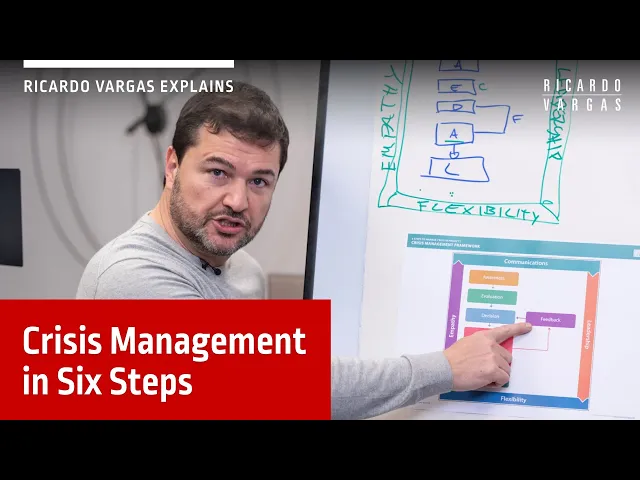
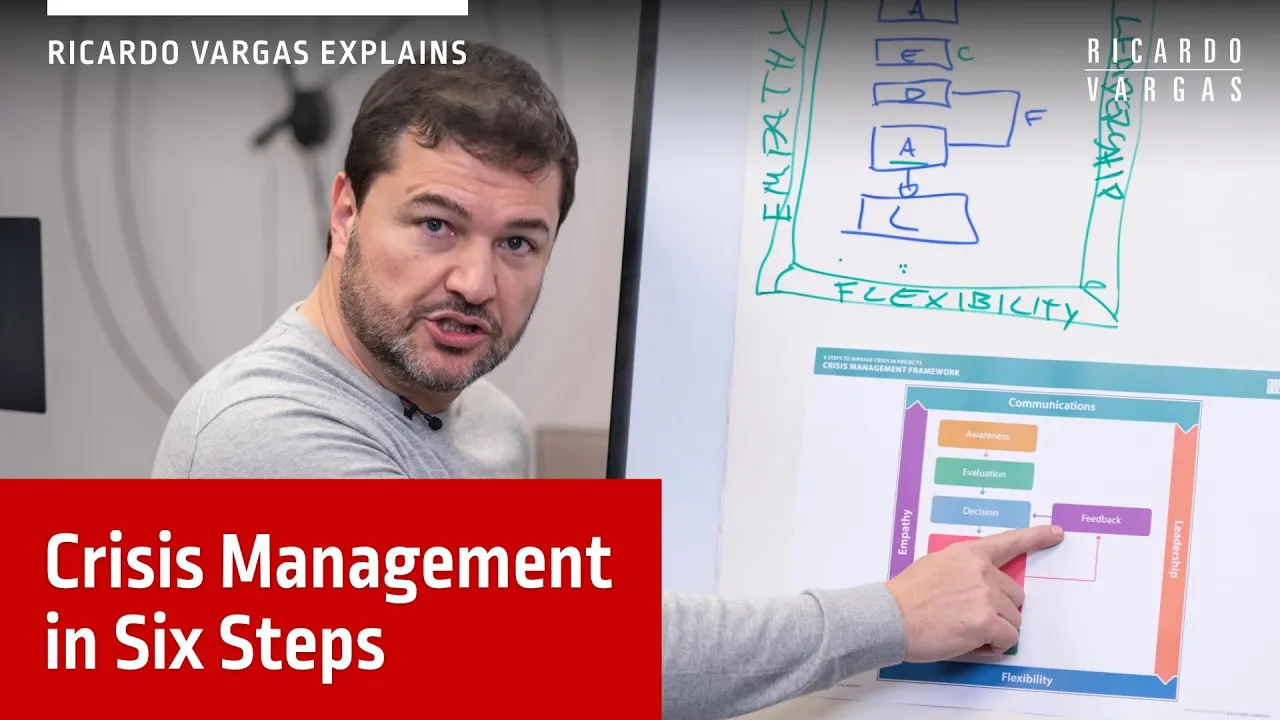
And you think, okay, these are the six processes, but there are four processes that are not part of any of the six. Imagine here. Okay.
Awareness. Let me put it small, Evaluation. Decision.
Let me put a little bit bigger here. Action. Then I put here.
Feedback. And learning. Okay.
So this I just explained. But this is inside deeply. Into four things.
There are four things that are shaping this here. Like a frame in the wall. First thing.
Flexibility. This is just a framework. You must have flexibility.
Flexibility to adapt to be fast. To see this does not work. The committee is not working.
Change it. Change it. Fast.
Flexibility is something that must be in the DNA of any organization or any project leader,program leader vis a vis a crisis that happens. The second one is empathy. Empathy.
You and your company, when there is a crisis and people die and people are suffering. Or people lost all their belongings, or their loved ones. The minimum you must have is empathy for the suffering of the others.
You know, it becomes irrelevant the amount of money your company lost in this. If you do not understand that your company and your organization operates in a context of a society and you must show empathy, you must show truly. It's not just show saying, oh, we are sorry for the loss.
You know? It's not that. It's truly demonstrate empathy for the tragedy and the suffering of other people So this is a human process.
It's not just a business process. Empathy for those who lost the money in the Madoff Ponzi scheme. For those who lost the money in a massive financial crisis.
For those who lost their loved ones in an airplane accident. Or for those who lost their loved ones because one project that was supposed to be ready was not ready on time and there was an accident. This is important.
If you don't have empathy, nothing of this will work. The third one is communication. Communication.
This is all communication and action. You must communicate in times of crisis communication is look, communication is critical anytime. But during this time, did you see when something happens, a crisis or something, what happens to everybody?
Everybody wants information, right? What is going on? What is going on?
What do I need to do? What is happening? And this is why communication.
You never lock yourself in the room and stop talking to people. Because if you do that, you are not showing empathy. You are not showing your ability to take action.
And you were just destroying. And remember one thing, in times of crisis, when you do not communicate It's imagine a funeral here. If you do not feed the information, people will feed with fake news, with everything.
People will will fit, that's for sure. Remember, in your company, when your company is in crisis. For example, a big crisis, what happens?
You know, you go to, to the, to, to have lunch in the canteen. What happens? What is the topic?
There is people feeding. You know, there is the CEO is leaving the company or, you know, they don't have money to pay the salaries. You know, we will not receive the, you don't know.
This is why communication is so important on every single step of your journey. And last but not least. This is the time for you, if you are facing this, or for you as a member of this committee to show leadership.
Oh, God, this this is the time. Because you know, to be leader during your end of year reception, talking to the people with, you know, champagne flute in your hand. Saying, look, I'm happy and proud of you.
I'm here to support you. I want you to lead here. Okay?
This is different. This is different, because leadership in peaceful times, leadership in nice, relaxed times, it's one thing. Leadership in the middle of the chaos with people suffering and everything.
It's the time for you to show real leadership. So these four parameters are the parameters you must keep in your mind always when leading a crisis. And what I did, I prepared for you.
You can download on the link above this here. That is just because my handwriting is not the best one. So I prepared this.
You can. This is just a simple, very simple framework to help you with awareness, evaluation, decision. Your three actions, the learning and the feedback.
Retrofitting here with communications, empathy, flexibility and leadership. So this is just for you to understand. This is a framework you must put in place almost immediately if you plan to manage your crisis and avoid it to become something that is even worse than what it is now.
Think always about that. I hope you enjoyed. I hope honestly, that you don't need to use this, but if you need, use it well.
Because a lot of people in the society, they are expecting you doing that, okay. And if you enjoyed this video, please join us and subscribe the channel. I talk always about project management, risk management, crisis management, transformation, some aspects of technology and everything we need to put in place to transform ideas into results and bring success and leverage the society.
Thank you.