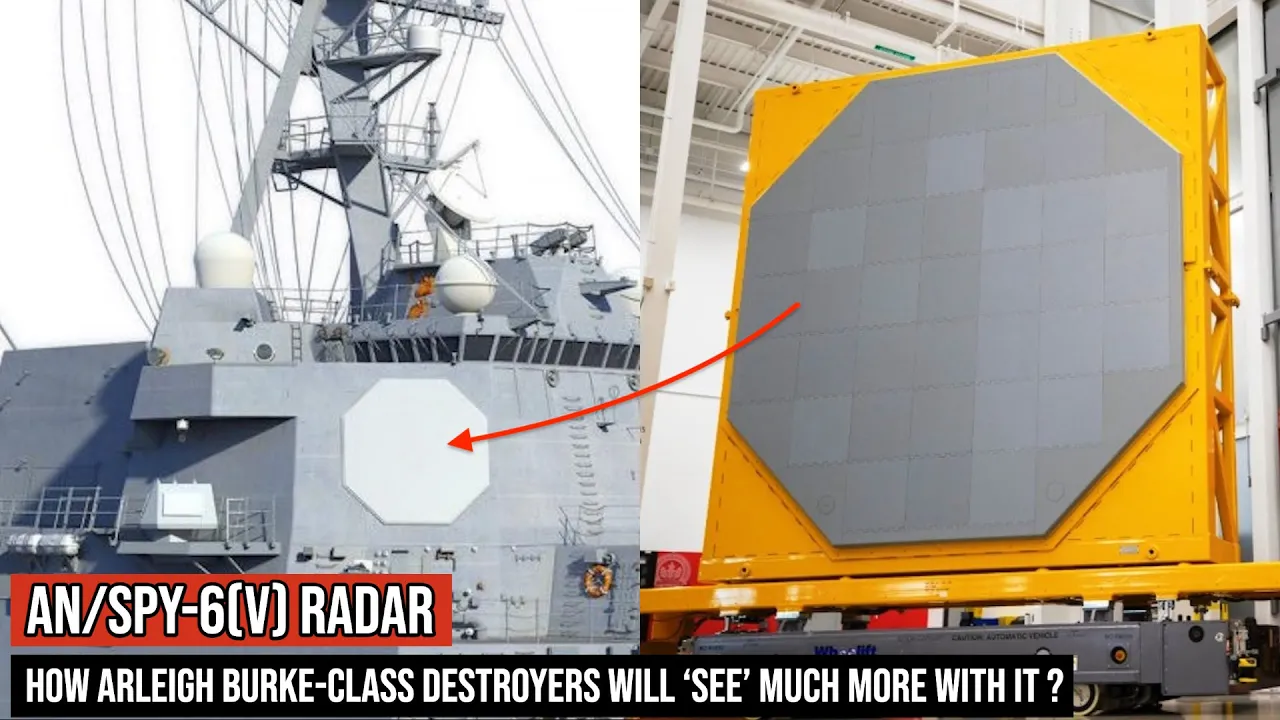
The US Navy has awarded Raytheon Technologies a $619m contract for the production of AN/SPY-6(V) radars. Importantly, this will see the first Flight IIA Arleigh Burke-class destroyers to be modernized with the upgraded radar apart from Flight III variants. The exercise of this option signifies the second instance from the hardware, production, and sustainment contract of March 2022, which has a maximum value of $3 billion spread over a period of five years.
As per some reports, it is expected that by 2029, the program's total value will reach $5. 9 billion. In this video Defense Updates analyzes how Arleigh Burke-class destroyers will see much more with AN/SPY-6(V) radar ?
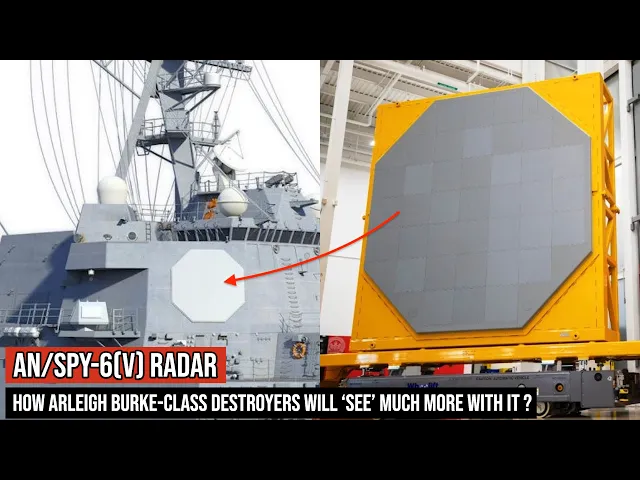
Let's get started. The AN/SPY-6 is an active electronically scanned array 3D radar developed for the United States Navy (USN). It is designed to provide integrated air and missile defense for Flight III Arleigh Burke-class destroyers.
Variants are also developed for retrofitting Flight IIA Arleigh Burkes and for installation aboard Constellation-class frigates, Gerald R. Ford-class aircraft carriers, and San Antonio-class amphibious transport docks. The SPY-6 radars integrated into integrated to Aegis Combat System can help defend against ballistic missiles, cruise missiles, hostile aircraft and surface ships simultaneously and provide several advantages over legacy radars, including greater detection range, increased sensitivity and more accurate discrimination.
It will enable Arleigh Burke warships to shoot down incoming threats by using missiles like SM-6 more reliably. SPY-6 has scalable and modular radar arrays that reduce cost and sustainment needs while meeting the mission requirements of seven classes of ships. The US Navy has secured contracts from Raytheon for the SPY-6 Radar half a decade, receiving contracts as far back as 2018.
The SPY-6 system consists of two primary radars and a radar suite controller (RSC) to coordinate the sensors. An S-band radar is to provide volume search, tracking, ballistic missile defense discrimination, and missile communications, while the X-band radar is to provide horizon search, precision tracking, missile communication, and terminal illumination of targets. The S-band and X-band sensors will also share functionality, including radar navigation, periscope detection, and missile guidance and communication.
SPY-6 is intended as a scalable system, with each sensor array assembled from Radar Modular Assemblies (RMA), self-contained radar modules The transmit-receive modules use new gallium nitride (GaN) semiconductor technology, allowing for a higher power density than the previous gallium arsenide radar modules. The new radar will require twice the electrical power as the previous generation while generating over 35 times as much radar power. The SPY-6 was not originally designed to perform electronic attacks, but it may have the capability to do so using its AESA antenna.
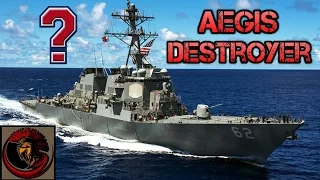
The contract will see two variants being integrated into Arleigh Burke-class destroyers. 1. AN/SPY-6(V)1: Also known as the Air and Missile Defense Radar (AMDR).
It is a 4-sided phased array radar, each with 37 RMAs. It is estimated to have a 15 dB sensitivity improvement compared to the previous generation AN/SPY-1 radar, or capable of detecting targets half the size at twice the distance. It is meant for Flight III Arleigh Burke destroyers 2.
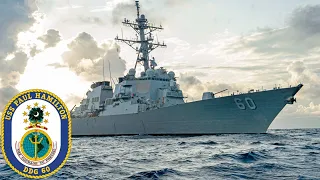
AN/SPY-6(V)4: A 4-sided phased array radar with 24 RMAs. It is designed to be retrofitted to Flight IIA Arleigh Burke destroyers: Arleigh Burke-class destroyers are multi-mission surface combatants designed to operate in high-threat environments. The modernization will enhance their air and missile defense capabilities while enabling them to support a wide range of other missions.
One of the ways, an opponent could potentially defeat Arleigh Burke is by attacking it with a large barrage of missiles to overwhelm it. This is where the AN/SPY-6(V) comes in. AN/SPY-6(V) is approximately 30 times more sensitive and can simultaneously handle over 30 times the targets of the existing AN/SPY-1D(V), allowing it to counter large and complex saturation attacks.
President of Naval Power at Raytheon Missiles & Defense, Kim Ernzen said, “Integration into the US fleet is well underway with SPY-6 operating on the US Navy’s first, new Flight III destroyer. This contract enables the Radar to be added to more ships including the first of existing Flight IIA destroyers that will be modernized” It is clear that this radar integration is a significant upgrade for Arleigh Burke-class destroyers.