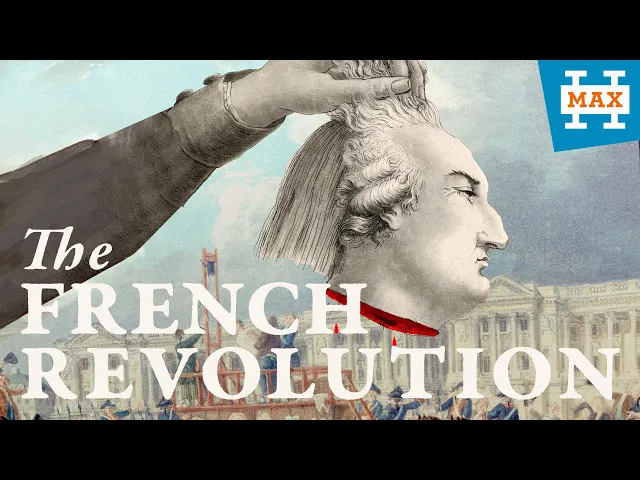
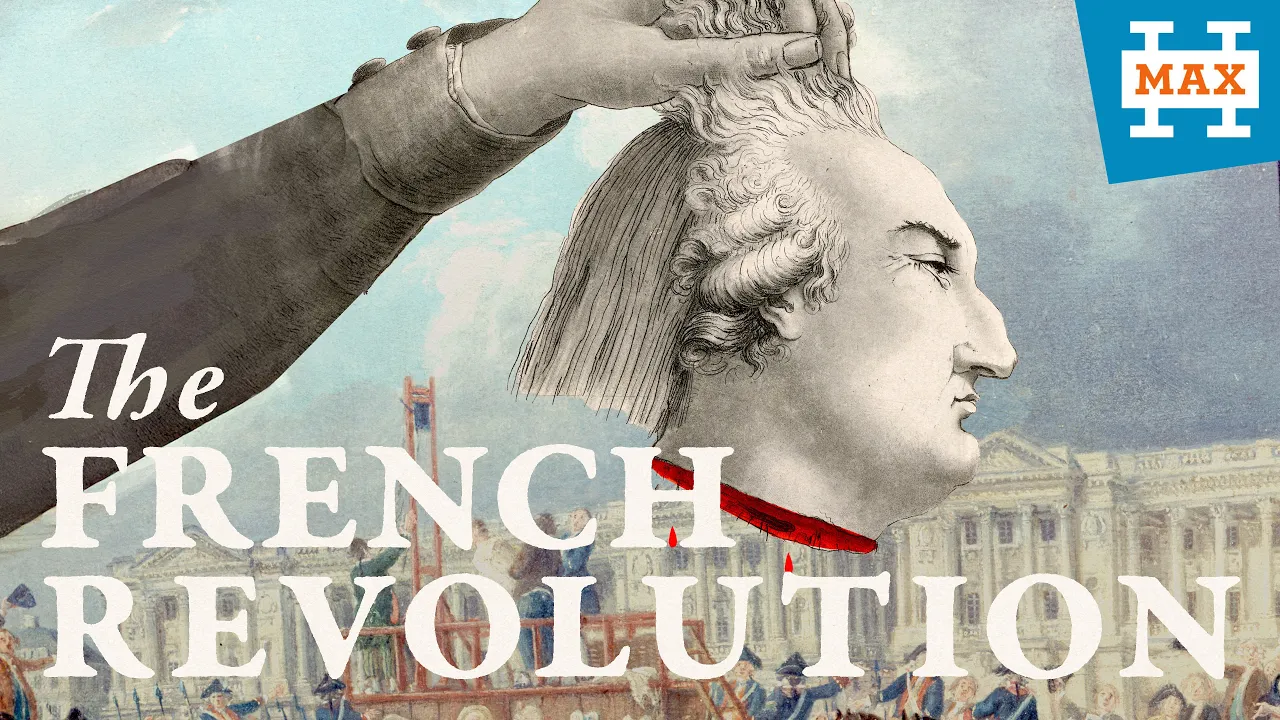
The French Revolution is one of the most significant, but also chaotic events in world history. Over the course of just 10 years, the most powerful king in Europe was dethroned and guillotined. A republic was declared, which then descended into terror.
And a young general named Napoleon Bonaparte seized power and crowned himself emperor. You're watching History Matters, and this is the story of how the French Revolution began, how it spiraled, and went so violently wrong, told in 10 minutes. Welcome to the Palace of Versailles, the center of power in pre-revolutionary France, so-called Ancien Régime.
The régime is centered around France's absolute and unquestioned rulers, King Louis XVI and his Austrian wife, Queen Marie Antoinette. Just beneath the crown are the nobility. In feudal times, these were the warrior classes whose job was to keep the peasants in check.
But now these aristocrats are simply leisure-loving landowners. Next, there's the church, still a rich and powerful institution in France. Again, in feudal times, the church had acted as the king's administrators.
But now there's also a large secular state bureaucracy made up of non-noble lawyers and civil servants. Of course, there are also tradesmen, merchants, urban workers, and most of all, rural peasant farmers who make up over 80% of the population. But as serene as things might look from Versailles, Louis XVI has a problem, which is that his ever-expanding Ancien Régime states of the king, the nobles, the church, the army, and the state bureaucracy is all very expensive, and Louis >> [music] >> is broke.
In recent years, it's war that's been costing Louis. The French have just lost Canada and parts of Louisiana and the Caribbean to the British. And although Louis has taken his sweet revenge by providing money, guns, troops, and ammunition to help America win its independence from Britain, this has all turned out to be a bit of an own goal for Louis.
Not only have the Americans now shown the world that a nation does not need a king, but funding their revolution has left Louis almost bankrupt. And the big problem he's facing is that raising taxes isn't an option. The trouble is that although 40% of all of France and its wealth is owned by the nobility and the church, both are legally exempt from paying taxes.
So, who does pay all the taxes? Well, almost all the tax in France comes from the poorest section of the population, the peasants. And they don't just pay taxes to the state, they also pay tithes to the church, and even regular payments to their local lords, their feudal dues.
This is obviously a problem for the peasants, but increasingly it's also a problem for the French state because the impoverished French peasantry are already being taxed far beyond their limits. And Louis knows it. To sort out the mess of his finances, Louis brings in finance whiz kid Jacques Necker, who quickly realizes that the only way to save the French state from financial ruin will be to start taxing the lords.
>> [music] >> But unfortunately for Louis, powerful nobles refuse to play ball. Louis is running out of options. So, in a final attempt to force through his reforms, he calls a meeting of the Estates-General, a kind of ancient parliament representing France's three great estates, [music] or classes.
One by one, the representatives of each estate arrive in Versailles. The first estate is the church, the second the nobility, the third estate the commoners, or in other words, everyone other than the nobility and the church. But don't imagine these third estate deputies belong to the 80% of the population who are peasant farmers.
Most of them are lawyers and magistrates. Bear this in mind because it'll become important later on. Anyway, the commoner third estate arrives in Versailles only to find themselves snubbed, insulted, and outvoted by the aristocrats.
It seems once again that reform isn't going to happen. So, in protest, furious deputies from the third estate break away from the Estates-General and form a National Assembly, which they declare to be France's true government. Louis locks them out of their meeting hall, so they retire to a nearby tennis court and take the famous Tennis Court Oath, demanding a new French constitution.
Louis completely fails to see the gravity of the situation. Rather than listening to the revolutionaries' demands, Louis starts assembling troops around Paris. He dismisses Necker and cancels the reforms, but the cat is already out the bag.
Furious peasants attack noble residences and burn feudal records. On the 13th of July, Parisian citizens form a new volunteer militia, the National Guard, whose sole purpose is to defend the revolution. The following day, they march on the prison fortress of the Bastille in search of weapons and ammunition.
And after hours of fighting, the crowd enters the fortress, takes its weapons, frees its prisoners, and captures and kills the prison governor, whose severed head is then paraded on a pike through Paris along with that of the mayor. It's already clear that the revolution has unleashed an unusual level of violence. Yet Louis's army refuses to intervene, and in fact, many of them defect to the revolutionary National Guard.
Which means that it's here on Bastille Day that Louis finally loses control of France. From here, the National Assembly can set to work dismantling the Ancien Régime. On the 4th of August, the Assembly abolishes feudalism.
On the 26th, they adopt the Declaration of the Rights of Man, establishing for the first time in French history the principles of liberty, equality, and the rule of law. But Louis, still holed up in Versailles, refuses to sign the declaration. So, in protest, a large crowd of market women and National Guardsmen march on Versailles.
They storm the palace, kill the guards, and force Louis to sign the declaration before dragging the royal family back with them to Paris. With the king now effectively their prisoner, the National Assembly takes control of the country. And the big question facing them is what to do with the king.
At this stage, the radical republicans who sit to the left of the Assembly are outnumbered by the centrists and the monarchists on the right. And it seems to all that France is heading towards a democratic constitutional monarchy, like in England. But in June 1791, Louis and Marie Antoinette make a catastrophic mistake, which will change the course of the revolution and doom them to the guillotine.
Louis and Marie break out of their palace prison and attempt to flee France. But right at the French border, the royal is spotted, arrested, and brought back to Paris. In response, Louis's foreign allies invade France.
In the minds of the revolutionaries, Louis has now betrayed his country. It's clear that he never had any intention of accepting his new role as a limited monarch. >> [music] >> Parisian radicals enter the city's prisons and slaughter over a thousand inmates suspected of harboring royalist sympathies.
Next, they storm the royal chambers of the Tuileries Palace and drag Louis and his family to jail. This is dubbed by the radicals the Second Revolution. It is the end of the monarchy and the birth of the republic.
The king is put on trial for treason in the Convention, formerly the Assembly, found guilty and sentenced to death by majority vote. Louis XVI meets with his family in his cell at the Temple prison in Paris. They will not see each other again.
The following day, on the 21st of January, Louis is executed by guillotine. Marie Antoinette follows him a few months later. Time for a quick break because we're making a board game about, you guessed it, the French Revolution.
It's called The Terror, a historically accurate board game of blood and conspiracy where players attempt to survive the darkest days of the revolution by forging alliances with revolutionary factions and condemning rivals to the guillotine. Click the link or head to our video description to find out more. And back to the video.
After Louis's execution, the king's former supporters are denounced as traitors, and the radicals take charge. They seize control of the Paris Commune and the National Guard and establish the ruthless Committee of Public Safety to eradicate both foreign and internal enemies. Maximillian Robespierre and the radicals are now free to implement their utopian vision for France.
The aristocracy is outlawed. Traditional titles like Monsieur or Madame are banned in favor of the egalitarian citizen. The Catholic Church is effectively outlawed, too.
Catholic priests are forced to either marry or face the guillotine. And Robespierre's Cult of the Supreme Being is adopted as state religion. In the name of reason, they even introduce a decimalized system for counting time, a 10-day week with each day divided into 10 hours, each hour into 100 minutes, each minute into 100 seconds.
A new revolutionary calendar renames the months after seasons and harvests. But surprisingly, it seems that many of these reforms aren't quite what the people of France had been after. In the Vendée in northwestern France, a major peasant uprising has broken out against the revolutionaries.
The issue is that although the revolution had promised the peasants the abolition of feudalism, most of them are still paying their much-hated feudal dues, the very same taxes that had brought about the revolution in the first place. But why, four years after Bastille Day, are they still paying them? The answer is quite simple, because the deputies in the National Convention still aren't peasant farmers, but the cream of the third estate, bourgeois landowners >> [music] >> more concerned about the potential ramifications to their property rights than ending these ancient injustices.
The irony is though, that with the revolutionaries' tax base in revolt, the régime in Paris finds itself facing the same problem Louis had. But rather than calling an Estates-General, their solution is to print money. And they print a lot of it.
But of course, the more they print, the less it's worth. It's not long before inflation sets in. Bread prices soar.
Hunger and poverty stalk the streets of Paris yet again. The radicals respond by introducing the Maximum Law, setting a legal limit on the price of bread. A nice idea, but in practice, the fixed prices are often below the cost of production, leading farmers to stop producing altogether.
The government solution is to send troops into the countryside to take grain by force. While they're there, they also decide to start the process of de-Christianizing the countryside, which inflames the peasantry even more. As France descends into civil war yet again, the economy sinks even further into chaos.
Inflation soon becomes hyperinflation. The radicals introduce the new Maximum Law, not just on food this time, but on every other product. As a result, production stops entirely.
By the summer of 1793, the economic situation is even worse than it had been under Louis. Rather than rethink policy though, the radicals decide that the best way to enforce order is violence. Members of opposing political parties are purged.
The régime blames food shortages and economic chaos on hoarders and counter-revolutionaries. So-called economic crimes like selling bread for above the legally prescribed limit now carry the death sentence. On the 5th of September, 1793, Robespierre declares to the nation that [music] the only way to save the revolution is to rule by terror.
Under the infamous Law of 22 Prairial, it is now punishable by death to insult morality, to speak ill of patriotism, or to mislead the people. By 1794, the rebellion in the provinces has largely been crushed. To finish off any stragglers, so-called infernal columns of soldiers are sent out to burn villages and purge the countryside by shooting, drowning, and of course, the guillotine.
In the Vendée alone, more than 100,000 peasants are killed. In Paris, the Revolutionary Tribunal sends thousands more to the guillotine, often on the basis of nothing more than slurs or denunciations. The violence of the terror is now completely out of control.
No one is safe. Even many radicals like Georges Danton are now calling for an end to the terror. And for that, of course, Danton is guillotined along with countless others.
Finally, in the coup of Thermidor, Robespierre himself is denounced in the National Convention. He shoots himself in the jaw in a failed suicide attempt before eventually being taken to the guillotine. After Thermidor, the terror ends, but not before a final white purge of the radicals.
The infamous Maximum Law is abolished. Within a few years, France's vast army, assembled by the revolutionaries themselves, hands dictatorial power to Napoleon. France soon has an emperor.
And then again, a king. The revolution is over. Almost all its leading figures are dead.
And whether all this bloodshed really got them anywhere is still far from clear.