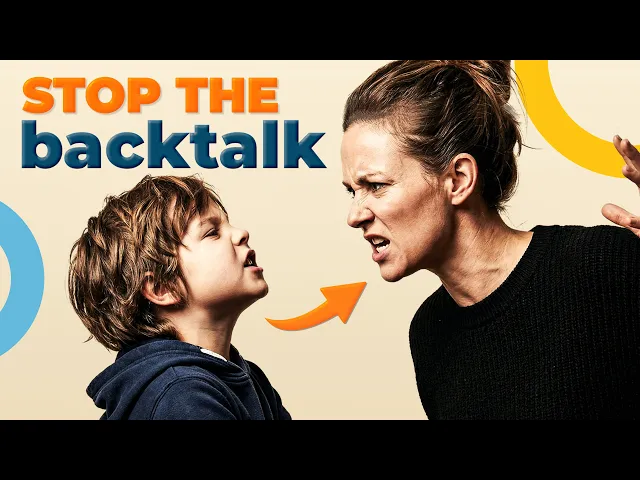
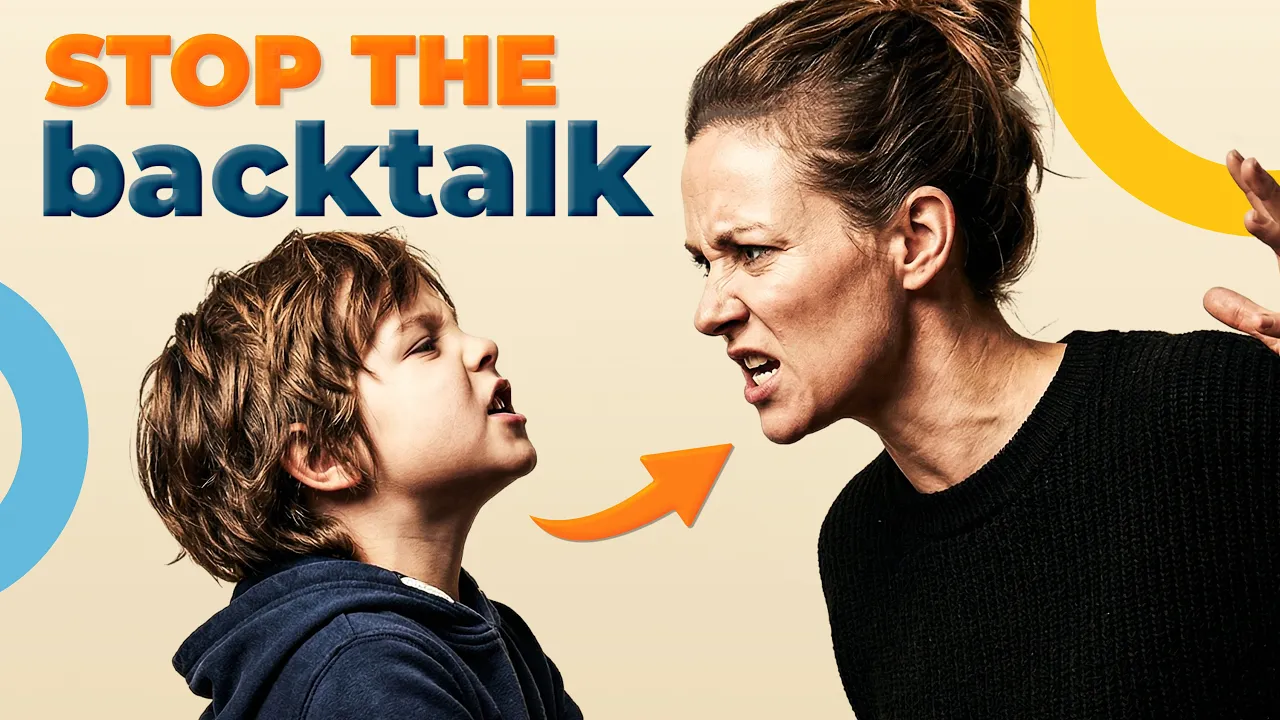
When your child rolls their eyes and says whatever after you've told them no, you probably feel your blood pressure rise, you want to correct them immediately to make them understand why that's disrespectful. But what you might not realize is that the moment you launch into an explanation, you're actually training them to talk back more. There's a 3-second response that stops back talk almost instantly.
[music] And it's the exact opposite of what most parents instinctively do. Now, I get it. [music] When your child says whatever or you never let me do anything, it doesn't just feel annoying.
It feels personal. It feels like disrespect, like defiance. Like everything you've tried to teach them about respect and gratitude is just gone.
Here's a scenario that plays out in countless households. A parent tells their 8-year-old no screen time before homework. [music] The child huffs, crosses their arms, and says, "You're so mean.
Everyone else gets to. " The parent feels that surge of defensiveness, the urge to explain everything they do, to remind the child they're not everyone else's mom, to make them see how unfair they're being. So that's exactly what happens.
Explanation, justification, defense, and the pattern, the back talk gets worse over the next few days, not better. Here's why. Every time you engage with the back talk, every time you explain yourself, defend your decision, or match their emotional intensity, you're signaling to your child's brain that back talk is a conversation starter.
Without meaning to, parents signal to the child's brain that if they push back hard enough, they get full attention. They get a debate. They get an emotionally activated response.
And that's exactly what keeps the pattern alive. [music] I know you're not trying to reward the behavior. You're trying to correct it.
You're trying to teach them that their tone is unacceptable, but your child's brain isn't processing it that way. So, let's talk about what's actually happening in these moments. And if you recognize yourself here, if you've done every single one of these things, you haven't done anything wrong.
These are the most natural human responses in the world. They're nearly universal among parents. Here's what happens.
Your child says, "This is so unfair. " And you immediately think, "They need to understand my reasoning. " So, you launch into this whole explanation.
Well, honey, the reason I can't let you go to that party is because there won't be adult supervision and you have a big test Monday, and we already talked about this, but here's the thing. When your child is emotionally activated, their thinking brain is offline. Your perfectly logical explanation doesn't land.
It just sounds like Charlie Brown's teacher. Wah wah wah wah wah. They aren't processing your logic.
They're just reacting to your volume and intensity. Or maybe your child says, "Everyone else's parents let them. " And you can't help yourself.
You respond with, "That's not true. " And even if it where I'm not everyone else's parent, now you're in a debate. And even if you win the argument, even if you can prove logically that you're right, you've lost something bigger.
You've taught your child that if they push back hard enough, rules become negotiable. Or here's another one. Your child says, "You're the worst.
" And you feel that sting, sharp and immediate. So, you respond with, "After everything I do for you, I work so hard to give you a good life, and this is how you talk to me. " Now, you're trying to make them see your perspective, feel your hurt, understand your sacrifice, but all they hear is more intensity, more emotion, more evidence that their back talk got a reaction, and then there's the lecture.
Your child mutters something under their breath, and you deliver a 5-minut speech about respect, gratitude, [music] and how they need to change their attitude right now. But every word you say past the first sentence is just noise. And the longer you talk, the more disconnected they become.
Now, I'm not saying you're wrong for doing these things. You're doing what every caring parent does. You're trying to teach them.
You're trying to make it click. But what you might not realize is that the length, the tone, and the emotional charge of your response is actually working against you. Now, here's where this gets really interesting.
Because once you understand what developmental neuroscience tells us is happening in your child's brain during these moments, the solution becomes completely obvious. When your child talks back, their emotional brain has taken over. The amygdala, think of it as the brain's alarm system, is fired up.
The prefrontal cortex, the part that handles logic and self-regulation, is essentially offline. It's like when you're really angry at your partner or stressed about work. Someone tries to give you rational advice in that moment and you can't even hear it.
Your emotional brain is too loud. That's what's happening with your child. And here's the crucial part.
When you respond with a lot of words or with emotional intensity or with a tone that matches theirs, you're keeping their emotional brain activated. You're not helping them calm down. You're actually escalating them.
You're essentially throwing gasoline on a fire and then wondering why it's not going out. Your child's nervous system is mirroring yours. When you're calm, they regulate down.
When you're activated, they escalate up. This co-regulation pattern is well documented in developmental psychology. Now, this doesn't mean you ignore the back talk.
That would teach them that disrespect works. But it also doesn't mean you engage with it as if it's a conversation worth having. Because here's what's actually happening in their brain.
When you explain, argue, or lecture, their brain interprets that as this is working. Not consciously. They're not sitting there thinking, "Great, I've got mom engaged.
" But subconsciously, their brain is learning. Back talks equals attention. Back talk equals power.
Back talk equals a reaction. And that's exactly why short responses work. When you keep your response to 3 seconds or less, meaning you speak only one short sentence with no emotional charge and no justification, you do something incredibly powerful.
You show them that back talk doesn't get them anywhere. It doesn't start a debate. It doesn't get them your attention.
It doesn't change the outcome. It just hits a wall. And when their brain realizes that back talk is a dead end, that it leads nowhere, the behavior starts to fade.
Not overnight, but consistently, predictably. So, here's the 3-second response, [music] the one that actually works. And I'm going to give you the exact words to use.
[music] But first, I need you to understand something. This is going to feel wrong at first. It's going to feel too simple, too short, [music] like you're not doing enough.
But that's exactly why it works. When your child talks back, you pause just for a beat. Not a long dramatic pause, [music] just enough to regulate yourself.
And then you say one short neutral sentence that sets a boundary without engaging the content of what they said. [music] Let me show you exactly what that looks like. Here are the exact words.
[music] If they are just giving you attitude or sass, simply say, "Try again respectfully. " That's it. [music] Short, neutral, no lecture.
However, if they are actually yelling or crying, if they are too upset to try again, you need a [music] different phrase. You say, "I'll listen when you're calm," or simply, "That tone doesn't work. " Or if they are just nagging you to change your mind, asked and answered.
Now, here's what this is not. It's not sarcastic. It's not cold.
It's not a power move. It's not meant to shut them down emotionally or [music] make them feel small. It's a calm, predictable boundary that doesn't feed the pattern.
And here's why it works. First, it's short. You're not giving [music] them anything to argue with.
There's no content to debate, no explanation to pick apart, no emotional reaction to escalate against. It's a verbal dead end. Second, it's neutral.
Your tone is the same whether they just said whatever or I hate you. You're not matching their intensity. [music] You're modeling what calm authority actually looks like.
And third, it's consistent. Every time they talk back, they [music] get the same response. Their brain starts to learn, "This doesn't work.
This doesn't get me anywhere. [music] I need a different strategy. Now, after you deliver that 3-second response, [music] you don't keep talking.
You don't wait for them to apologize. You don't explain [music] what you meant. You just stop.
And if they're ready to try again respectfully, you engage. If they're not, you walk away or redirect to something else. So, what does this actually look like in [music] practice?
Let me show you exactly what this looks like in real life. Let's say your 9-year-old asks if they can have a friend over. You [music] say, "Not today, buddy.
" Their face immediately falls. They cross their arms. That's [music] not fair.
You never let me do anything. Now, here's what every fiber of your being wants to say. That's not true.
You literally had Mason over last week. And I said, "No, because we have family plans tonight, [music] which you know about because we talked about it this morning. " But here's what you actually say.
[music] Try again respectfully. And then you stop talking. You don't [music] explain.
You don't defend. You just stop. Your child stares at you for a second, like they're waiting for the rest of your sentence.
Then they push again, but everyone else gets to have friends over whenever they want. You're so mean. Every muscle in your body wants to respond.
Your jaw tightens. You can feel the words forming, [music] but you don't take the bait. I'll listen when you're calm.
And again, you stop [music] talking. Now, here's where it gets interesting. Your child might storm off at this point, stomping feet, maybe slamming a [music] door.
And that's okay. Let them go. They're not ready to talk and [music] that's fine.
Or they might stand there for a moment, breathing hard, eyes still flashing, trying to figure out their next move. And then maybe a minute later, they take a breath and say, "Can I please have a friend [music] over this weekend instead? " If they try again, even if their tone is still a little off, even if you can hear the frustration in their voice, you acknowledge the effort.
Thank you. That's better. The answer is still no for today, but let's plan something for this weekend.
And then you move on. Here's what just happened. You showed them [music] that back talk doesn't work.
That calm communication does. That the outcome doesn't change based on volume or emotion. And over time, that becomes the pattern their brain learns.
Now, you're probably thinking, "Okay, but [music] what if they just keep going? What if they don't calm down? What if they escalate even more?
" Great question. Here's what you do. You follow through.
You say, "I can see you're too upset to talk about this right [music] now. We'll try again later. " And then you disengage.
You aren't giving them the silent treatment or ignoring their existence. You remain present, but you are pressing pause on the argument. You're showing them that you are available to them, but back talk doesn't earn them a debate.
[music] Let me show you what this looks like with teenagers. A 15-year-old asks to go to a concert on a school night. [music] The parent says no.
The teen immediately fires back with, "This is ridiculous. I'm [music] 15. I should be able to make my own decisions.
" The instinct launch into a speech about responsibility and trust and readiness for independence. [music] Instead, the parent says, "I hear you, but that tone isn't going to change my answer. " The teen huffs and goes to her room.
20 minutes later, she comes back and says, [music] "Can we talk about this? " And that's when the actual conversation happens. Now, here's another thing parents worry about.
Won't this feel cold? Won't my child think I'm dismissing them? And I get [music] why that feels concerning.
You don't want your child to think you don't care about their feelings. But here's the [music] thing, and this is important. You're not dismissing their feelings.
You're dismissing their delivery. And that's an important distinction. After they calm down, you can absolutely [music] have a conversation about why they're frustrated.
You can validate their disappointment. You can even negotiate if it's appropriate, but you're teaching them that disrespect doesn't earn them that conversation. Calm communication does.
[music] And here's what's crucial, consistency. This only works if you do it every single time. If back talk gets a debate on Tuesday, but hits a wall on Wednesday, their brain doesn't learn the pattern.
But if every single time they talk back, [music] they hit the same calm wall, the behavior fades fast. So, what actually changes over time? This is the part that makes all of it [music] worth it.
In the first week, you'll probably see testing. Psychologists actually call this an extinction [music] burst. Your child will push harder and get louder because their brain is confused.
[music] Think of it like a vending machine that swallowed their money. They push the buttons harder and shake the machine to [music] see if the mechanics are broken or if the rules really changed. This spike in behavior is normal.
It actually means the [music] method is working. Stay consistent. By week 2 or three, you'll notice something shifting.
The back talk starts to decrease. The eye [music] rolls become less frequent. They might still test occasionally, but the intensity drops, [music] not because you've lectured them into submission or scared them into compliance, but because their brain has learned that it doesn't work anymore.
[music] But stick with it. Whether it takes 2 weeks or five, depending on your consistency. Eventually, here is what happens.
Your authority [music] returns. Not through control or fear or exhausting power struggles, but through calm predictability. [music] Your child starts to trust that you mean what you say, that your boundaries are real, that emotional escalation doesn't change outcomes, and that becomes the foundation for real respect.
Remember that child from the beginning who rolled their eyes and said whatever. Imagine 4 weeks from now, they ask for something, you say no, and they [music] pause for a second, then say okay and walk away. No drama, no argument, no negotiation.
[music] Or they take a breath and say, "I'm really disappointed. Can we talk [music] about why? That's not a fantasy.
That's what happens when you stop feeding the back [music] talk pattern. So, here's what you need to remember. When your child talks back, pause.
Deliver one neutral sentence in 3 seconds or less. And then stop talking. No explanation, no defense, no [music] lecture.
Just calm, consistent authority. And over time, you'll notice something remarkable. The back talk [music] fades.
Your authority strengthens. Your relationship improves. Not because you've controlled them into submission, but because you've shown them what respectful communication actually [music] looks like and prove that it's the only path that works.
Now, unfortunately, there's one mistake that undermines all of this. [music] Something parents do that actually teaches children to be disrespectful, even when they think they're teaching respect. It's counterintuitive.
[music] It's incredibly common, and most parents have no idea they're doing it. [music] I break down exactly what this mistake is and how to fix it in my this video.