Hi friends. I'm Teacher Luke, and recently, a lot of you have been reaching out to me to get help with some of the more challenging question types on the Duolingo English test. So I'm here to help you with those.
This is the first of a four part series where I'm going to dive into some practical tips and strategies to help you ace the toughest questions on the Duolingo English test, and, of course, boost your overall score. The first challenging question type we're going to cover is called listen. Then speak.
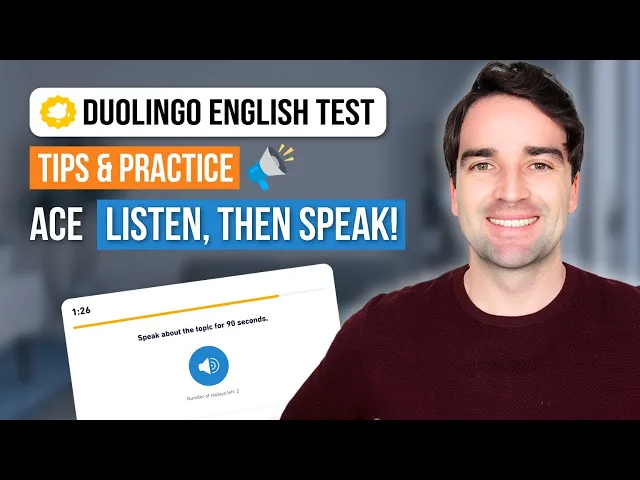
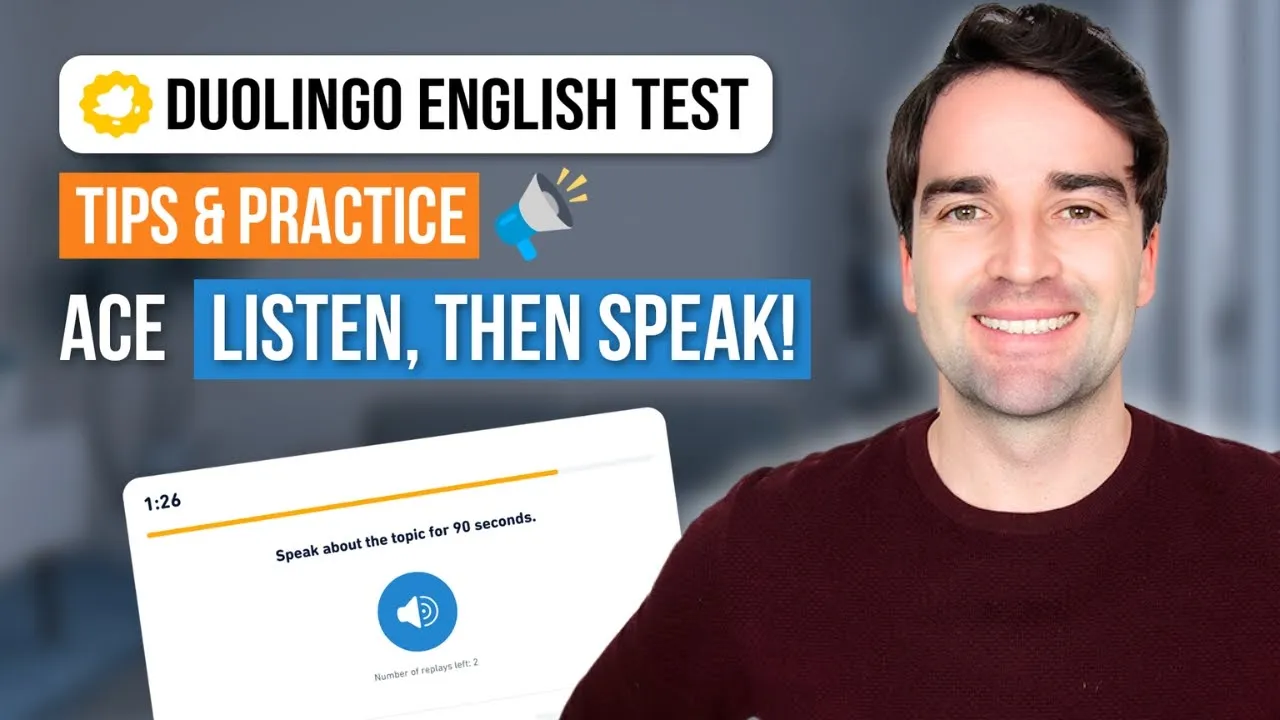
It looks like this on the test, discuss some tips for a successful negotiation. So why is listen then speak so challenging? Well, it's a speaking question, and you have to speak for 90 seconds, which, of course, is tough on its own.
But beyond that, this question also tests your listening skills. You have to listen to the question prompt and understand it before you begin speaking, for this question type, you will not see the question written down. You have to understand it fully through listening.
And to make it even more challenging, you'll get this question type twice on the exam. So it's a really important one to master all of these factors make the listen then speak. Question Type one of the most daunting on the test for a lot of test takers.
So if you're one of the people who find it difficult, don't worry, I've got you covered, because in this video, I'm gonna go over three reasons why so many test takers struggle with this question type, and of course, I will share some strategies to help you overcome these challenges. Okay, well, let's get right to it. Not understanding the question.
The first common pitfall is failing to understand the question prompt. Remember, for this speaking question, you can only listen to the prompt. You will not see it written down, which means you need to understand it fully just through listening.
And this can be a sticking point for many test takers. So what can you do to overcome it? Firstly, you should know that you are allowed to listen to the question prompt up to three times, so definitely take advantage of that on the first attempt.
You should try to understand as much as you can, but if you found it too difficult on the second and third attempts, just focus on catching the topic words or the content words. Basically, even if you don't understand everything, if you're able to identify the key topic, you can still try to give an answer about the topic in general, which is not perfect, but it's better than not speaking at all. Let's try this example from the d, e, t, practice test.
Talk about environmental pollution in the place where you live. What causes it and what are the effects? How can it be controlled?
Were you able to understand the entire question? Well, if you were not, try again and try to catch the main topic and come back and tell me what it was. Talk about, environmental pollution in the place where you live, what causes it and what are the effects?
How can it be controlled? So what was the main topic? Well, it was environmental pollution.
So even if you miss the other parts of the question, like causes and effects or how can it be controlled, you can still speak about the main topic, which, like I mentioned, is a lot better than not answering at all or talking about a completely random topic. Of course, if you are able to understand all parts of the question, that much better not being able to come up with ideas. The next problem is not being able to come up with ideas to talk about.
And in my experience, so many test takers over complicate this. You need to know that there is no such thing as an impressive or perfect score idea you do not need to think about difficult concepts. When answering this question, my advice is to use ideas that are relevant to the topic, easy to think of, and, importantly, easy to speak about.
Keep your ideas simple, but explain them with lots of details. The det examines your vocabulary and sentence structure, so use lots of words and different grammatical structures, and it also assesses your task relevant, so your ideas need to be related to the topic. So aim to show a range of vocabulary and grammar and keep your answer understandable and on topic.
For example, let's go back to the question about the causes and effects of environmental pollution. What are some simple ideas you can use here? So here are a bunch of really simple ideas for causes of environmental pollution.
We have littering, car fumes, plastic use or. Dump in sewage in rivers or oceans, and the effects dirty streets, air pollution, ocean or river pollution and harm to animals and plants. These are pretty simple ideas, right?
There's nothing complex here. Your ideas and your answers do not need to be complex. Let me show you a quick answer.
I live in the UK, and sewage is one of the main environmental issues we have. Sewage is often released into the oceans, which, of course, has several negative effects. For example, people are often advised not to go into the sea because the water is contaminated and simply unsafe for activities like swimming or surfing.
So remember to keep your ideas simple. Now, once you've got your simple ideas, there is another issue that a lot of test takers come across, and that is not being able to speak for long enough. A lot of test takers struggle to speak for the full 90 seconds.
So if that's you, here are a few tricks to help. Firstly, you can talk about your ideas in the present, past and future. This will obviously help you to speak for longer, but it will also demonstrate your ability to use different grammatical tenses.
So this is the same question we looked at earlier, and now I will answer it using this past, present and future approach. In my city, people tend to litter a lot, which does lead to more waste and environmental pollution. As a result, the streets are often covered with trash, making the environment look messy and unpleasant.
Here I'm talking about the present, but we can expand this by adding when I was younger, people seemed to care more about our city and didn't litter as much as they do now, I hope that soon the government will create stricter laws to stop littering and reduce overall pollution. Of course, these are just examples, and you should try to expand and speak for longer about each of these points. Another strategy is to tell a personal story, because sharing a personal experience is an easier way to speak for longer, because you don't have to think of any complex concepts.
You're simply just recounting a story you already know. For example, in my city, people do tend to litter a lot, which does lead to more waste and environmental pollution, and as a result, the streets are often covered with trash, which makes the whole environment look messy and simply just unpleasant. I actually have a personal memory related to this.
I remember when I was younger, maybe six or seven years old, I threw an empty water ball out of my dad's car window, my dad saw me, and he was absolutely furious, and just expressed how disappointed he was in me. I remember feeling really ashamed at that moment, and it made me realize the importance of keeping my city clean, and since then, I've been much more conscious about not littering. Okay, so of course, strategies like this are super important, but another important thing to consider is your mindset.
So let's take a look at some mindset strategies right now. One, focus on fluency, not perfection, for this and all the speaking questions. Don't worry too much about making mistakes.
Rather, focus on speaking fluently and clearly. Remember minor errors won't matter as much if you maintain good fluency and coherence. Two, don't memorize please, please, please, stop trying to memorize your answer.
This is simply just not allowed on the exam, and your exam might not get certified. Instead, try to speak naturally and share your real thoughts and opinions. This will make your answers sound a lot more authentic and engaging.
Okay, so far, we've looked at different strategies to help you answer this listen then speak question type and also mindset tips to get you ready. Now you need to practice. So if you look down here somewhere in the video description, you'll see a PDF I made, which you can download completely for free with lots of listen then speak question types on there.
This is an interactive PDF, so you can click the button and listen to the question. I recommend you go through each of the questions on there and speak for 90 seconds using the strategies we covered in this video. Another thing you need to do right now is click on this video right here, because it will help you with the speak about the photo question type, which, of course, is another speaking question on the Duolingo English test.
So I'll see you here right now. You.