before the break we talked about the iccpr and the icscr which together with the universal Declaration of Human Rights comprise the international Bill of Rights we talked about the historical gaps between the two treaties and the the ways in which these historical gaps have narrowed over time now uh these three instruments are important but they are not very important part of the picture but they're not the full picture and over the years many other treaties have been concluded the convention on the elimination of all forms of racial discrimination the convention on the elimination of all
forms of discrimination against women the convention Against torture and other cruel human or degrading treatment or punishment the convention on the rights of the child the convention on the protection of Migrant workers the convention on the protection of persons of all persons from enforced disappearances and the convention on the rights of persons with disabilities now these treaties all all of them are concluded at the U.N level and applicable potentially globally by the way some of them adhere to by almost all countries in the world the convention on the rights of the child is the most
popular convention in the world with only one country the United States that had not ratified it um still they did ratify some of the protocols some some of the site agreements concerning this convention together I mean these uh instruments what they do is they basically take the universal declaration and the two covenants and provide another degree of specificity they detail in sometime in in a very in a very elaborated manner the very precise obligations that states have with regard to specific rights such as torture or enforced disappearance which is a form of attack on on
the life liberty and the Dignity of individuals but also with regard to specific populations that are in situations of vulnerability or our historical targets of abuse and discrimination such as children women persons and this with disabilities and the like and together this Corpus that actually uh renders international human rights law a very rich source of norms which often goes far beyond the Norms that you find within domestic law this may have to do uh partly because uh there is a lot of shared experience in the international level that allows to pull together expertise and to
identify Norms that would give uh effect in ways which are quite comprehensive and and quite Justified to various human rights so that experience is sometimes more available at the international level and the domestic level but frankly it may also have to do with the weakness of the enforcement Machinery at the international level that results in that states are often more more more keen or more susceptible to adopt an international instrument about human rights which they know is likely to be enforced in a somewhat loose manner or in a somewhat less than robust manner than to
adopt within their own constitutions and law the same standards which their own domestic courts could then go to enforce but over time I would say that even those Norms that have not been robustly enforced in the beginning over time did have a lot of impact on the discourse and on the way rights are understood and eventually also internalized now beyond the the international level Beyond those treaties all in all nine treaties that have been adopted at the international level and the universal declaration we also have very important developments in this field of international human rights
law taking place at the regional level So within a regional organizations that are intended to enhance cooperation on a political or economic level at the regions we are seeing from 1950 onwards the emergence of Regional Human Rights mechanisms that often go uh farther and faster than what we have seen at the international level uh partly because it's easier to reach an agreement within smaller groups of states and partly because the uh these states are relatively more homogeneous in their culture in their language in their historical experience also sometimes in their Democratic systems and therefore there
are more uh they're able to move faster and to engage in deeper cooperation and agreement around human rights issues so the paradigmatic system that we have in in in in in on a regional context is the Council of Europe which is an organization for cooperation among 46 European member States before Russia was was spelled from the organization it had 47 members and that the Council of Europe in 1950 had adopted the Human Rights Convention a human rights a convention on human rights and fundamental freedoms uh which became the uh a prerequisite for accession to the
Council of Europe so almost all European countries today with the exception of Russia and Belarus are members of this convention and that convention not only created treaty Norms which largely mirrored the iccpr or in fact it predates the iccpr so you could say that the iccpr mirrors the European convention but it also has a a stronger enforcement Machinery than what we have at the international level at the global level because there is a European code of human rights which is located in Strasbourg which enforces through binding judgments the provisions of the European convention we also
have Regional systems slightly less robust in terms of their actual power and influence in two other regions in the America in the in Latin America we have a regional treaty which is called the American convention on human rights adopted in 1969 under the auspices of the organization of American states it does include most Latin American countries it does not include the convention nor the court it operates under the convention it does not include the United States or Canada the third system that we have is the African system which is the newest of of the of
the three the African Charter exists from 1981 onwards it is again a treaty which has both iccpr type Visions but also a few icscr type Provisions the charter has been for many years implemented only by a commission whereas the European and American systems also have a court but in in recent years uh at the very end of the 20th century a court was established and it started functioning in the first decade of the 21st century it does not have many cases but potentially it is expected to grow in its business and in its influence on
top of these major regional instruments there are also like we see at the international level there are also some more specific Regional instruments such as the European social Charter which focuses on economic and social rights a European convention on torture an American convention on disappearances or on eradication of violence against women and these Regional treaties contribute further to the Corpus of Internet natural human rights law of course they're mostly relevant for countries within those regions now is it uh how should one look at this interplay between the international and the regional so by and large
uh it is uh the the general view in international human rights law circles about this uh overlay of regional and international is that this is a positive development because it provides individuals with another set of protections so there are more safety nets so it's a more than the more the merrier kind of uh Vision uh so an individual can seek protection inside his own domestic country his or her domestic country in a regional system but also in an international system and individuals can often choose between systems and they even sometimes can try to go to
one system after they have not succeeded obtaining uh what they wished for in the other system although there are some rules regulating the ability to have uh um to have repetitive litigation of the same case as I said before Regional systems are also positive in the sense that they could go farther and faster than what we see at the international level and we have seen this quite dramatically within Europe which went before the International System for instance in outlawing the death penalty and also in recognizing rights of lgbts Etc and in that respect the the
regions were sometimes in the lead and the universal systems were following that lead in specific cases we have seen the other Dynamic taking place where our regional developments are sometimes less positive or could be could give rise to concern is where you have Regional standards that explicitly deviate from International standards in ways which dilute protection so for instance under the African Charter states have much more leeway to restrict freedom of expression than they have under the iccpr and the concern here is that states would feel somewhat empowered or legitimized in restricting speech that they cannot
that they cannot do Under the iccpr by invoking original treaties such as the African Charter on human and people's rights specifically with regard to implementation again we will see this these different layers at the original at the universal level but even within the universal level it is important to draw a distinction between two sets of enforcement mechanisms that are very important in the life of international human rights law one set of bodies we call the charter bodies and the other set of bodies we call the treaty bodies now what are the charter bodies the charter
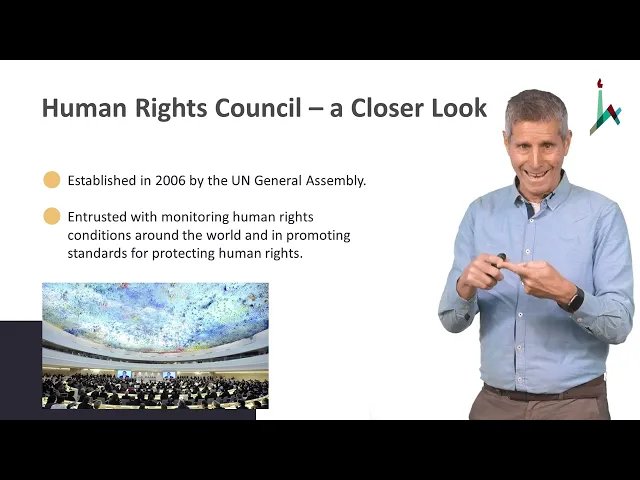
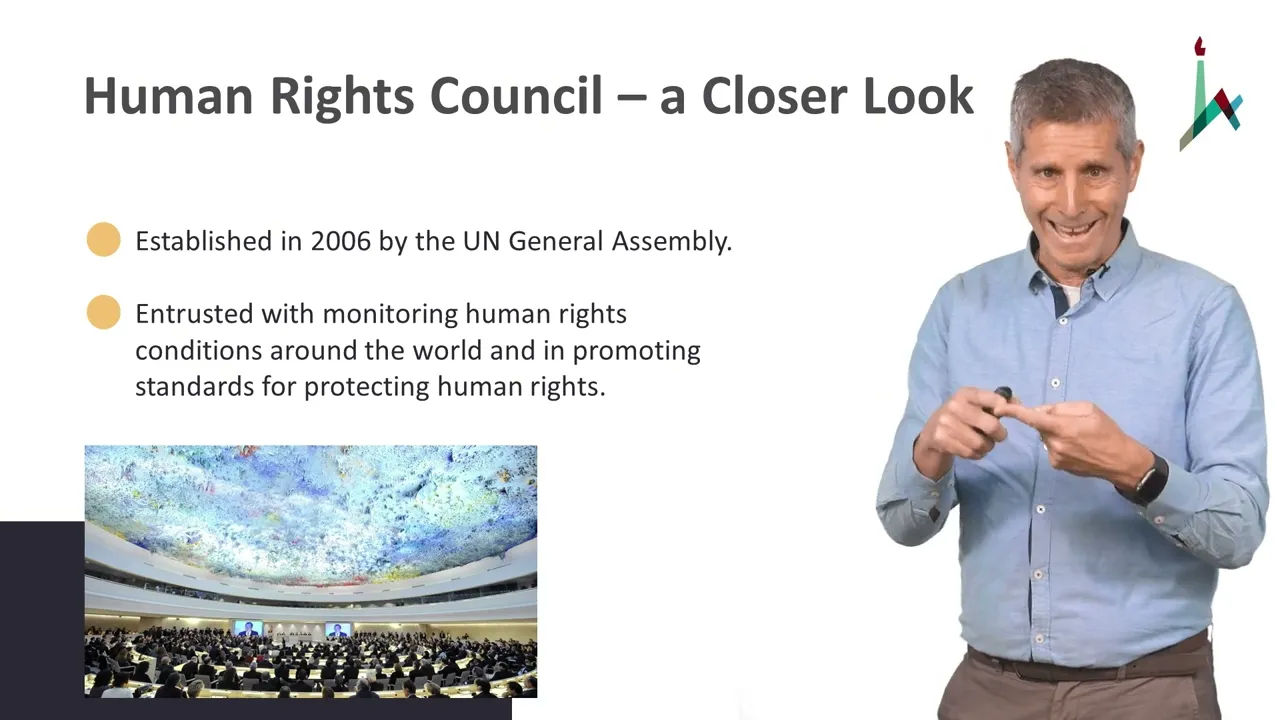
bodies are essentially political bodies that have been developed out of the U.N Charter and this is why they're called Charter bodies so they would include the the general assembly the economic and social Council which is one of the sub one of the principal organs of the United Nations but also subsidiary bodies that have been established by these principal organs so the general assembly has established in 2006 a Human Rights Council which is entrusted with monitoring uh uh conditions human rights conditions around the world and in promoting standards for protecting human rights before that we had
a Human Rights Commission which I've mentioned in this unit a few times which was uh developed as a subsidiary body of the economic and and social Council uh the the council is a political body it's important to to emphasize it has 47 member states this is the Human Rights Council and these member states convene in Geneva several times a year to discuss human rights conditions around the world and also to uh Embrace standards for instance in 2021 the council recognized a new right a right to a safe healthy and sustainable environment so this is a
political process which is aimed to uh recognize a new internet National human rights and it's a very important development the council is often also involved in in examining conditions in specific countries which gets somewhat tricky and controversial in the sense that because this is a political body the considerations for uh singing singling out a specific country situation tend to be not only professional not only based on the severity of the human rights conditions in that state but they also often derive from political considerations and calculations and some countries including Israel have been very bitter about
the frequency in which their situation is raised and discussed by the commission by the Human Rights Council this was also true I should say for the previous commission and they have accused the commission and the Council of selectivity and for politicizing the work of Human Rights and I think it is fair to say that in many in many on many occasions the council did engage in in work which was highly politicized but in other country situations or in other standard setting exercises the council did make a positive a positive contribution to the field so its
work record is somewhat mixed maybe I will say on the council to two more things which are uh which are important one as I said before the council not only reviews country situation on on a on a on a changing uh basis on the basis of information about specific violations in those countries it's also a reviewing systematically human rights conditions in all countries of the world through a process which is called UPR Universal periodic review and that process allows criticism including criticism raised before the council from Civil Society groups to uh be aired in an
international fora and to uh generate some degree of public shaming for states that violate human rights so in that regard it's an important process which is uh which is applied more or less the same rural countries and then another process which is important for the work for understanding the work of uh of the Human Rights Council is the appointment of expert bodies and experts to assist the work of the council by providing research on specific situations or on specific standards and these experts are either called rapporters or working groups or commissions of inquiry and they
tend to be uh professional experts some of them quite well known and highly regarded and and the work is a valuable contribution to uh promoting human rights standards and raising Awareness on human rights situations of course here too there are some controversies about uh politicization in the appointment process which occurs from time to time the other cluster of enforcement bodies that we see at the at the international level are the treaty bodies that operate under the auspices of the nine major human rights treaties the way these 3D bodies have been configured was that for each
treaty one would have an expert body that would monitor the implementation of that treaty I mean those expert bodies tend to be independent and professional they are not manned unlike the Human Rights Council which is man by diplomats they are comprised of independent experts that convene again a few times a year in Geneva and what they do they consider state reports about human rights conditions in in their own countries but they juxtapose these reports against alternative reports which have been put forward mainly by Civil Society organizations ngos and the like and they invite states to
appear before them state delegations to appear before them in Geneva and they question them about very specific discrepancies between the state's version of events and the alternative information that has been brought before the committee and then the issue recommendations and this is again a mechanism that does encourage states to provide better explanations and occasionally introduce reforms in the human rights practices so as to minimize criticism which could be direct acted against them there is also an element of persuasion that is taking place in these specific contexts what those treaty bodies also do for those who
are authorized to do so and most treaty bodies are authorized to do so these days they can review individual Communications that are brought forward by victims of human rights violations and each year thousands and thousands of victims submit uh complaints to the office of the High Commissioner for human rights which is the administrative agency of the UN that uh that supports the work both of the Human Rights Council and also of the treaty bodies uh the the Committees review those Communications they also of course receive information from the state about the allegations and in the
end they they produce a decision which although not legally binding it is uh drafted as if it was a judgment and it often carries a person invasive effect and I wouldn't say that in most cases they are implemented but in a good number of cases they are implemented well these treaty bodies also do uh some engage in country visits for instance the sub-commission sub sorry the subcommittee on torture which uh operates under the auspices of the convention Against torture alongside with another committee the Committee Against torture so the torture convention actually has two treaty bodies
that operate one in Geneva and one moving around the world doing country visits and looking at conditions in prisons some of the Committees also generate what are called General comments which are interpretive statements about the provisions some engaging country inquiry where there are indications that a country is facing systemic problems in the implementation of a specific convention standards etc etc so on the whole the treaty bodies whereas the charter bodies tend to be political uh For Better or Worse with more political influence but less perhaps faithful application of legal standards in a way the treaty
bodies are the mirror image of this they they have less political clout but they have more professional clout on the regional level we have uh both we used to have in every Regional system a commission and a court now the European system only has a court which handles a very high volume of cases tens of thousands of cases every year the inter-american system and the African systems still rely on a filtering commission that reviews applications and in appropriate cases advances these cases to the court sometimes the victim himself or herself can approach the court after
they have visited the commission uh the the European court is also distinctive for the uh not only for the volume of the work but also for the quality of the judgments and also for a major contribution to the development of human rights in fields relating to civil and political rights including rights really at the edge considering issues such as gender identity technology euthanasia Etc the European court is also distinct in the sense that it does since it works side by side by domestic institutions of well-established democracies in many in most in many cases it does
provide domestic institutions with a margin of appreciation when engaged in balancing of of Interest or balancing of Rights and therefore it is somewhat less interventionist in borderline cases than some of the other institutions the inter-american court has had a more difficult experience given the fact that many of its clients States so to speak were not Democratic in in large parts of the period in time in which it had operated but still it made very important contribution to the world of Human Rights especially on issues such as the fight against enforced disappearances and it rendered the
first major decision in that area of international human rights of Velasquez Rodriguez but also has been very active in protecting the rights of indigenous peoples to conclude international human rights law is is still in a process of development in the sense that we still have while we have many many standards there is still a chronic gap between law on the books and low as it actually applies moreover uh since uh uh Society changes and the needs and interests of individuals and groups change human rights continually involved in order to face these changes so uh one
area in which from the 1960s we have seen increased attention to by human rights bodies and mechanisms has been the rights of of groups be that peoples who are striving for self-determination or minority groups that are seeking minority rights protections or indigenous peoples who are seeking some forms of self-determination and control over resources over land over uh their culture we are also seeing increasingly uh involvement of Human Rights bodies in challenges such as the fight against climate change and its human rights implications the fight against aggression and its human rights implications and also the need
to adjust just human rights to a more different technological reality where digital rights are more at play although we have made a lot of progress in in the sense that there is Broad acceptance of many International standards there is still an issue of cultural relativism uh the the the claim that human rights are not really Universal or that not not all human rights not all human needs and interests are Universal in nature and that sometimes domestic culture have to be given domestic cultures have put to be given some space in shaping values and in shaping
rights of individuals this is a very important and Central tension which still exists within the human rights movement and going forward the success of the human rights movement or failure would hinge on its ability to strengthen its enforcement Machinery its ability to rise up to New challenges but also its ability to find a middle course Between the pressures of universalism and cultural relativity I thank you for your attention