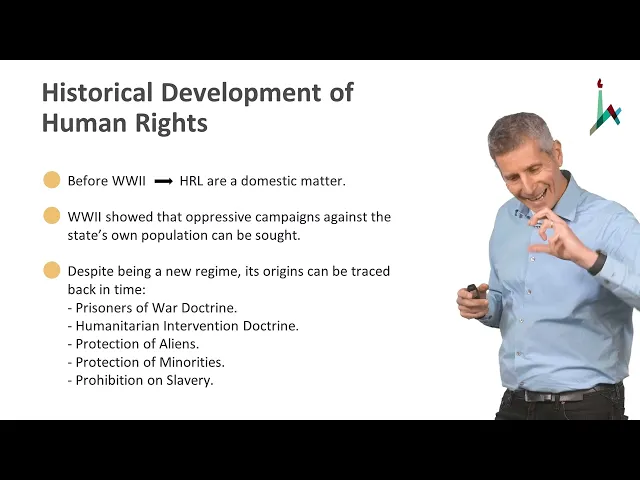
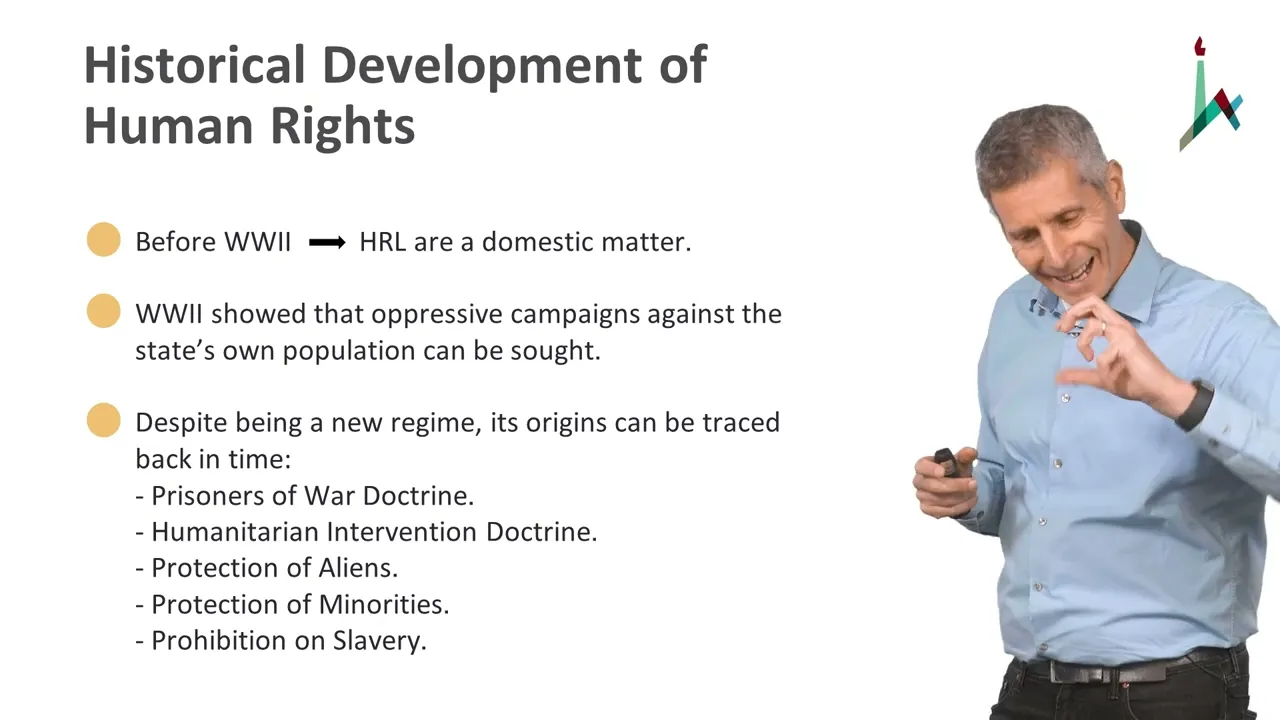
the next unit is going to focus on international human rights law it will also be divided into two lectures the first lecture is going to discuss the origins of human rights law the role that human rights law plays within international law and some of the major principles that have governed the development and operationalization of human rights law the next lecture will deal with specific Norms of international human rights law and the manner in which international human rights law is being enforced now it's important to to appreciate that human rights law is in some respects a very exceptional part of human right of international law because international law has been traditionally developed as an interstate body of law governing relations between states and not inside States producing rights and obligations for States and not for individuals this relationship was sometimes metaphor to a billiard ball a billiard table which is the world on which there are billiard balls which are the state and international law was deemed as the body of law that governs the interplays the interactions the clashes between the different ball both never actually looking inside the balls and here uh we we see um a body of law a branch of international law that focuses predominantly on relationships inside the state and predominantly protects their rights of not of states but of individuals and this is a concept which is very revolutionary and one could say is really maybe is indicative of the transformation of international law from an interstate body of law which is largely horizontal in scope to a global uh universal law which has constitutional vertical features and we can see this as a body of law that redefines the relationship between states and international communities changes the nature of international law and pushing international law in the direction of becoming something more akin to constitutional law within States in many respects for example the human rights committee which is a body of experts that implements a specific treaty which we will be discussing extensively uh in this presentation and in the next part of the presentation the international Covenant on civil and political rights the iccpr the human rights committee was confronted in the last decade with a number of cases and also other interactions uh involving the state of Ireland which does have which used to have until recently a very restrictive legal regime on abortion which is a very loaded question of domestic law it also has to do with religious law it has to do with morality under exist under the law as it existed until recently in Ireland abortions were not permitted legally permissible in fact they were a criminal offense unless they fell inside a very small exception of protecting their lives or health of of women overex uh who are pregnant and even that there were some obstacles on the way of invoking the exception uh and and many women in Ireland who wanted to have an abortion had to travel overseas and have abortion in in another country the human rights committee has taken the position that this regime in Ireland while it is uh although it is anchored in the Irish Constitution it runs contrary to uh international human rights law into a principal respects one it does not uh create reasonable exceptions for women in particularly stressful situations such as uh women who are victims of sexual offenses or women who are carrying an unviable pregnancy and secondly the solution that the Irish state has uh has has selected for these women or offered these women which is to travel overseas does really doesn't really cater to their health needs and also to their emotional needs and is in itself a form of humiliation and as a result the human rights committee came to the conclusion that the Irish legal regime on abortion violates the prohibition against cruel inhuman and degrading treatment under human rights law and also also constitutes an un an unjustifiable limitation of it of the right to privacy given that regulation of pregnancies is a is is a very private matter which involves control of women over their body and at least with regard to some extra sensitive cases it's an unjustifiable limitation of pregnancy and also uh sending people uh women away uh is a problem it raises questions of discrimination given the fact that this is a this service or this operation is unsubsidized by the state and therefore women who are um worse off economically would face additional obstacles on the path the end result of this intervention has been that Ireland has changed its Constitution and has changed its laws and is now allowing a relatively Broad uh abortion regime at least in the first term uh the first trimester of pregnancy so you do see here uh international human rights law playing a role which is quite akin to a Roe v Wade uh decision by the U. S Supreme Court which oversees the ways in which the state of a federation apply an international a national Constitution so it's much more Akin in this respect to a constitutional law in its operation and its outcome than it is to a classic international law another more recent example involving the European Court of Human Rights is a decision from 2021 criticizing judicial reforms in Poland as falling short of the notion of judicial Independence and therefore holding that certain decisions disciplinary decisions that were taking by the judicial system in in Poland meet short of international standards so again there is a review by a European Court which is an international Court in this case of a constitutional reform as to whether it meets or not International standards the development of this new body of law which has these dramatic features starts in Earnest only after World War II and it is very much linked to the historical lessons of World War II so if before World War II there was a general idea that there is no need to protect human rights under international law because human rights were were a domestic matter and states were basically protecting human rights through their constitutions and through the domestic laws and there was no real reason to believe that states would oppress their own citizenry uh in in an Age of Enlightenment and in an age of constitutions uh this of course became apparent as as really a a proposition which is unreal and doesn't really uh work in in the real world where you did have uh especially in Europe in the first half of the 20th century uh very obvious regimes that took power sometimes through Democratic means and then they went on uh on very um oppressive campaigns against their own population resulting even in the extermination of some of that population so the idea uh that I think when the U. N Charter was established in the U.
N organization was created uh it was deemed that it would be too important to leave States in in exclusive and absolute control over the right of their citizenry and it was also believed that there would be a there is some relationship between the uh autocracies and the oppression inside countries and the threats to International stability in order that we have seen in the interstate context so states that are more oppressive internally are more likely to be aggressive externally and we have seen this around World War II and we may be seeing this also in the early 2020s in connection with events in Eastern Europe so uh the charter as we will see is really where this starts having said that although human rights law are a relatively new institution in international law and post-world War II institution there have been some historical precedents that even in a way trace the way or trace the path towards the development of human rights law and they are still to some extent they sell these Notions still are influential in the world of human rights law they influence thinking about human rights law so for instance IHL which we mentioned in another unit is really stands behind the proposition that if international law requires states to uphold the humanitarian interests of enemy soul of enemy soldiers and enemy civilians that it only stands to reason that states would be required to give at least as much protection to their own citizens so if they're prohibited of torturing an enemy soldier they would they should also be prohibited from torturing their own domestic citizen uh humanitarian intervention is another Doctrine which has been developed in international law already in the 19th century we mentioned it briefly in the unit on the use of force and there the idea is that sovereignty should not be a shield against a wide-scale atrocities so when a state is actually massacring a minority within the state this is an issue of international concern because there is some general notion of solidarity across States and also an atrocity in one place could generate instability throughout the region and sometimes even the world so this is another area where old precedents have generated new insights there is also there have also been Norms before 1945 when still exists till this very day about protecting aliens so uh we are talking not about out of space aliens but we are talking about uh foreign citizens and states are required not to harm the basic rights and interests of enemy citizens so they cannot be killed arbitrarily they cannot be tortured arbitrarily they cannot be denied due process in all of these circumstances we are already seeing in the 19th century a notion that a state has an interest in protecting its citizens who are located physically in another state and that is another stepping stone on the path of looking at sovereignty less of as a physical matter but rather as a legal uh form of relationship and once international law has created an exception for uh foreign citizens this exception could be gradually expanded also to cover all citizens at some point in time uh other uh quickly historical precedents that have been instrumental in developing human rights after World War II have been the inter-war system of minority protection where some new states have uh taken upon legal obligations to protect National minorities within their territories so these are these treaties look like human rights treaties although they were limited to some states in some contexts but they are were an important president they were also supervised by the League of Nations which is an interesting precedent because today human rights are often supervised by the United Nations there were also early treaties for inhibiting slavery which which actually indicated that international relations could be sustained not only on the basis of State interests but also on the basis of deep moral Notions such as the Moral Moral Republic repugnance from slavery and we have seen in the early 20th century also the idea that labor conditions should be harmonized across States through the international labor organization and that is again an idea that some coordination between states in humanitarian matters could be mutually beneficial the upshot of all these exceptions and precedence is that they did puncture Halls within the billiard ball Theory so they introduced inside the state some International norms and some International supervision and they paved the way in that respect for the creation of international human rights law it's important to know that these presses accidents were interesting and important but they are not human rights law mostly in true respects they were never Universal in their scope they applied to certain States in certain contexts and in many cases the the motivation was not purely humanitarian so uh even even the the international fight against slavery had some economic competition Dimensions 1945 is a year zero for human rights because the first treaty that upholds human rights is concluded in that year and this is the United Nations Charter so this is quite an upgrade so from a from an institution that did not exist before we find human rights law now part and parcel of the most important treaty that we have which some regard as the constitution of the world Community which is the U. N Charter and the U. N Charter does refer to Human rights law in international human rights in a number of places some of them quite prominent including the preamble of the charter and the Article 1 3 of the charter which prescribes the main purposes of the United Nations organizations and they include achievement the achievement of international cooperation in solving International problems and in promoting and encouraging respect for human rights and for fundamental freedoms for all without distinction as to raise sex language and religion why do we see this in the charter we see this in the charter because as I said before there was a sense that the war the wars of 1940 39-45 and previous Wars have been to some extent uh facilitated by the lack of respect of states to Human Rights within their territory this is very much in line with uh kantian with the kantian notion of Perpetual peace being premised on an adherence to civilian Republic values so that there is a connection between enlightened and Democratic conditions within the state consent of the governed within the state and International Peace and security but there was also a sense that the United Nations organizations is a is a is a is a tool for uh for uh World governance it's a new institution and like a domestic Governor a government that often has to justify its establishment by uh promising by conveying to the governed that they intend to rule through adherence to Human Rights Norms that would be beneficial for the entire polity the U.
N organization the Uno has also uh in a way part of the cell of that Organization for new states and new peoples has been this is an organization that is committed to promote universally uh universally desirable values and namely human rights having said that it may be remarked that upon its completion conclusion the U.