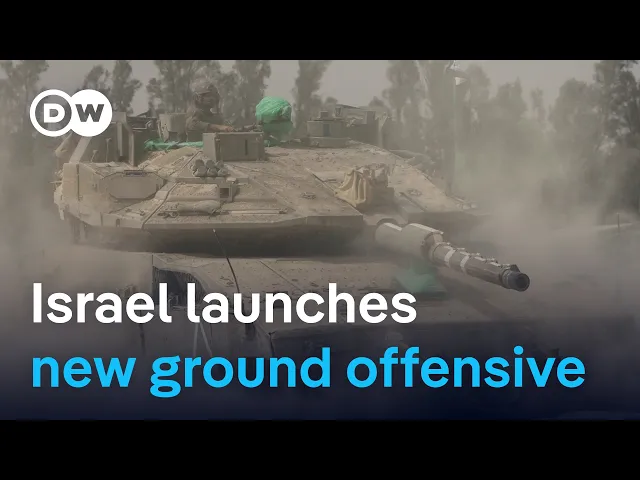
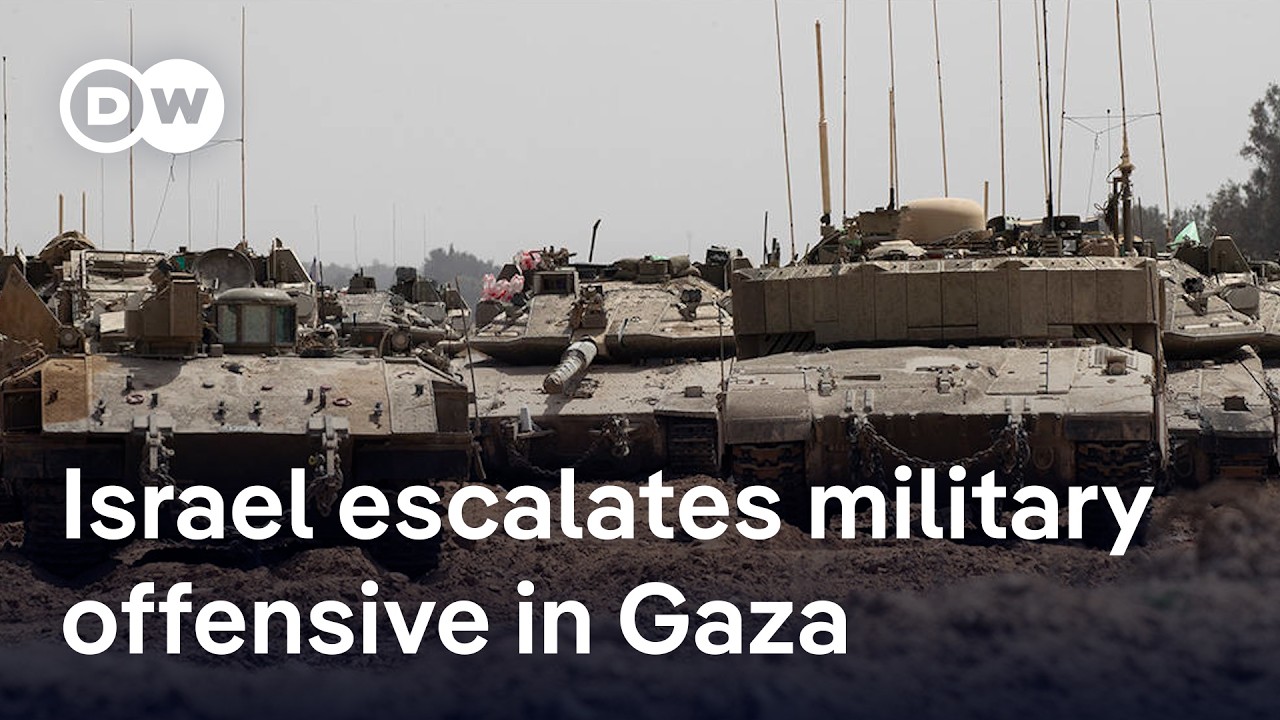
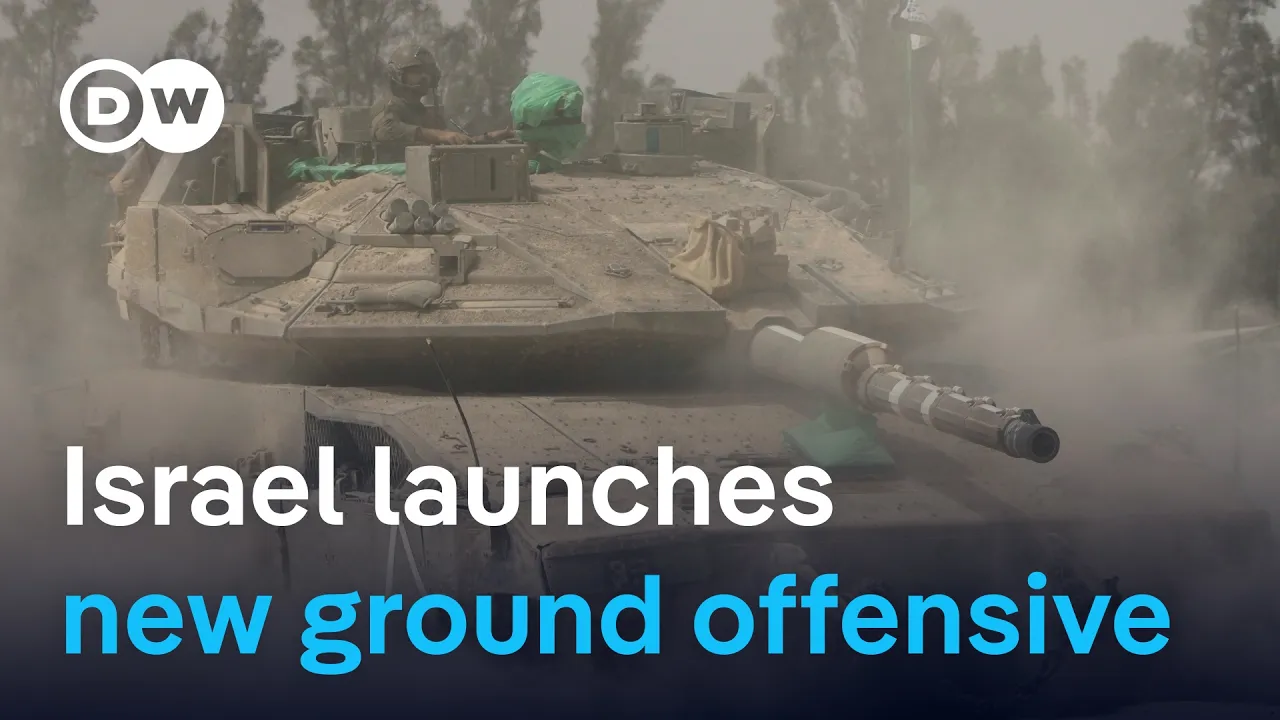
Israel has launched what it calls extensive ground operations in several areas of the Gaza Strip. This follows days of deadly air strikes on hundreds of targets. Israel's defense forces say ground troops are now operating in northern and southern parts of the territory.
Israel says it aims to free the remaining hostages and to eliminate Hamas. Let's bring in DW's Tanya Kramer who joins us now from Jerusalem. Tanya, good to see you.
Um, what more can you tell us about this latest phase in Israel's ongoing offensive in Gaza? Well, the military announced this afternoon basically that they had launched a new ground as what they describe a new ground operation in multiple areas in southern and northern Gaza. Now the statement itself was uh a bit vague on the operational details but uh the IDF spokesperson from the Israeli Defense Forces uh explained uh tonight that basically five divisions are now operating in uh Gaza.
He also talked about uh that they will increase and expand uh operational control uh by dividing uh the strip. They have laid the groundwork uh for this with those corridors that are running from the east to the west. uh and also to move uh the population.
And this comes of course after a government decision some uh weeks ago uh uh that stated that uh Israel will invade Gaza in certain areas and will hold territory, occupy a territory and forcibly uh displace the population there. Now, the statement also said that in preparation for this, the air force carried out strikes on over 670 targets, what they call terrorist targets over the past week. And this is, you know, what we're hearing from people in Gaza that there's an intense air massive air campaign going on.
Uh people have been again displaced mainly from areas also from the north. I've been talking to people who've been telling me, you know, they left everything to just move back into Gaza city towards the west. And on top of that, they have been telling me there are almost no supplies.
Uh, one father told me it took a bag of flour because it's became so expensive and there's no bread at the moment in many areas. Uh, in Gaza also the clinics, those who are still working hospitals are overwhelmed. uh uh and also we are hearing from the civil defense in Gaza saying uh you know that they cannot respond to many calls anymore and we've been seeing this also on video footage that many people are trapped under the rubble you know people are digging them out with their bare hands and meanwhile Tanya we're hearing that across Israel there have been mass protests demanding a deal with Hamas to get the hostages released how do Israelis feel about this expanded offensive in Gaza?
Is there public support for it? Well, I think I mean most of the the protests that we are seeing uh every week, I mean they they're very clear in their demand, especially in recent weeks, they say the hostages need to be brought back. Um and then you know you the the war needs to end for now and then you can uh deal uh with Hamas.
And you know there has been a a shift I would say in the mood uh when you're talking to people here and also we heard from a lot of people in the security establishment uh many reser retired uh security officials who've been questioning uh the government's strategy of maximum uh pressure uh on Hamas. uh they are saying basically this is rather harming uh the hostages and this new offensive could actually harm them. Although we heard uh tonight again from the army spokesperson that they will do uh everything not to harm the hostages but there is a sense here that this is not helping uh the hostages that remain in Gaza and also that most of the hostages were actually released through negotiations.
uh but so far uh the government is not listening to them. That was DW's Tanya Kramer for us in Jerusalem. Tanya, thank you so much for your reporting.
We can now speak to Fawazes. He is a professor of Middle Eastern politics and international relations at the London School of Economics. Welcome to DW.
So, Israel's latest offensive in Gaza is actually taking place just as a new round of ceasefire talks get underway in Doha. And we are hearing that Hamas has said these talks are now without preconditions. What exactly does that mean?
Uh what it means is that Hamas is willing to consider all proposals uh with an open mind. Uh Hamas is desperate uh for a ceasefire because Hamas is under tremendous military pressure by Israel and also Hamas realizes the catastrophic humanitarian situation of the Palestinian people for the past 9 10 weeks. Israel basically has used starvation and as a weapon of war.
No food, no water, no electricity. So, Hamas is willing to have a ceasefire, but it wants a comprehensive uh ceasefire, releasing all Israeli hostages and ending the war um in Gaza. Right.
Well, I do want to ask you uh about what each side wants, just how far apart are the two sides, and what are the main stumbling blocks? Hamas wants the end of the war. It wants a comprehensive settlement.
While the Israeli prime minister and his coalition, they want all the hostages back, but they want to continue the war. They want Hamas to surrender. They want Hamas to lay down uh its arms.
They want to expel Hamas leaders from Gaza. And they want permanent military occupation of Gaza. So you as you could imagine uh there's a huge divide between Hamas on the one hand and the Israeli government on the other hand and that's why this tale and that's why I doubted very much whether there will be a ceasefire.
It really will take it would take a political miracle to bridge the divide between Hamas and Israel. Well, as everyone is watching this, there are growing international calls for a ceasefire in Gaza. And we should also mention there are massive protests inside Israel itself demanding an end to the war.
But is any of this having an impact on the Israeli government? It very much. Israel does not really care what all of us say.
you and I and Germany and France and the United Kingdom. Uh, Israel could do whatever it wants. It cares only about Donald Trump in the White House.
Donald Trump is the only leader in the world who could exercise influence over the Israeli Prime Minister Benjamin Netanyahu. He could only Donald Trump and the war. But of course, so far, Donald Trump has not really exercised any influence over Benjamin Netanyahu.
And that's why Benjamin Netanyahu now is launching all out another invasion of Gaza and basically preventing any humanitarian aid to reach 2. 3 million Palestinian population in this threat. And I do want to ask what kind of impact this growing offensive, this Israeli military offensive in Gaza is actually going to have on these ceasefire talks.
Um what Benjamin Netanyahu is trying to do, he's really pursuing a two parallel tracks. He is on the one hand um I mean launching a ground invasion trying to occupy the Gaza strip trying to depopulate Gaza trying to expel the Palestinian population that's what Benjamin Netanyahu and his extremist coalition have been saying I think the talks in in the dha and forgive me for being cynical is a way for Benjamin Netanyahu to try basically address the domestic pressure by the families of the hostages and their beloved one. What he is really trying to say is that he's doing his best to bring the hostages home while at the same time he's really escalating militarily because Hamas has been saying, "Well, look, Hamas is desperate for a comprehensive deal.
It wants to release all Israeli hostages, but it wants to end the war. " And we know that Benjamin Netanyahu has made it very clear he will never accept an ending the war in Gaza because he wants a permanent occupation of the Gaza Strip and he wants freedom of action in Gaza in the same way that he has in the occupied West Bank and East Jerusalem. That was Fawaj, a professor of Middle Eastern politics and international relations at the London School of Economics.
We appreciate all of your insights. Many thanks for your time.