open aai just released their latest Flagship model 01 it is September 12th 2024 and they just released it today I learned about it while I was at work and I was reading about it on my break at work and it seems to me from what everything that I've read and the videos they've posted to their website that it has a unprecedented ability to reason for a model of its kind I'm not entirely sure how it does that but apparently it takes its time and thinks about problems before it actually answers them one of the lines
that really excited me was when it said in our tests the next model update performs similarly to PhD students on challenging Benchmark tasks in physics chemistry and biology we also found that it excels in math and coding in a qualifying exam for the international mathematics Olympiad GPT 40 the previous Flagship model correctly only solved 13% of problems while the reasoning model scored 83% and they go on and on about how great it is and they even have these videos of different Professionals in like genetics and like uh economics I think they have someone in quantum
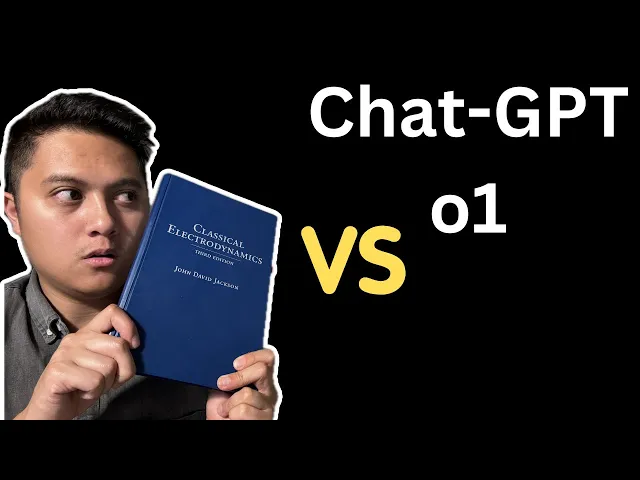
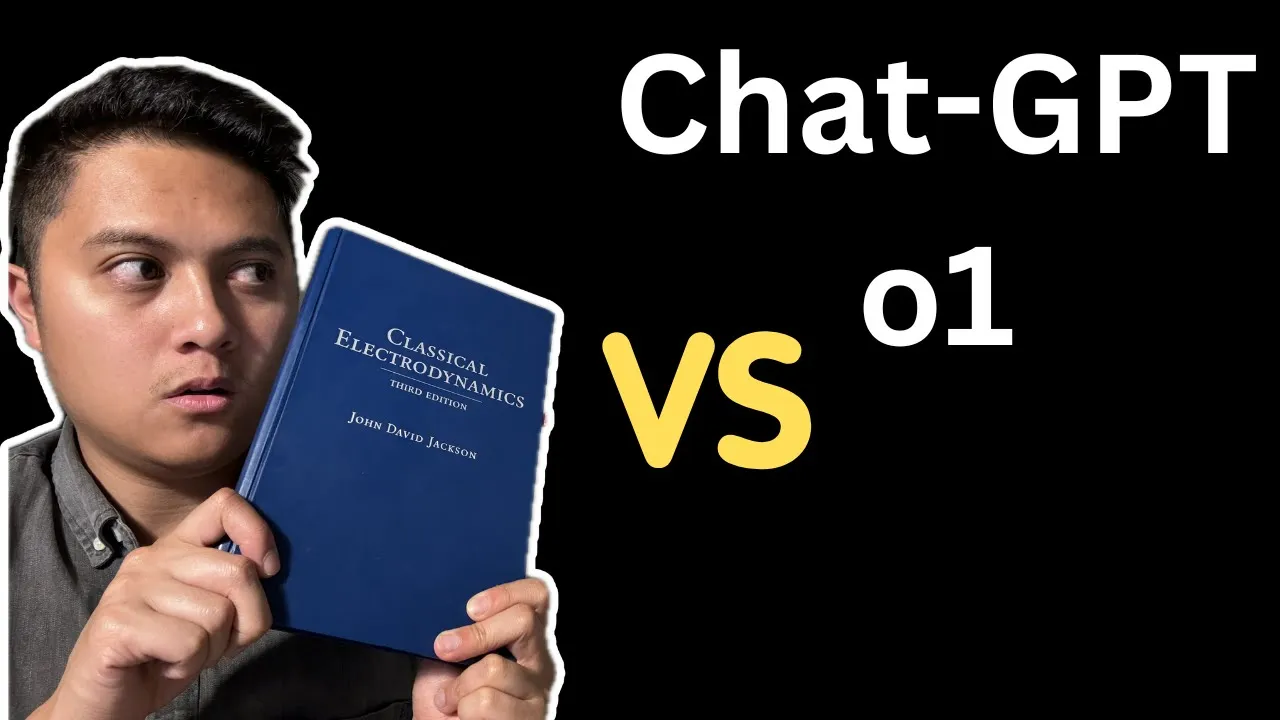
physics there's cognition they have all these different domain experts saying how this 01 model has benefited them and so I had a bit of an idea apparently it's so great it's a PhD level you know PhD student level of cognition ability on physics and math and whatever so I was like okay why don't you take on the most infamous physics textbook that any physics graduate has ever experienced and that is classical electrodynamics by John David Jackson anyone who has studied physics at an advanced level either for their masters or their PHD has heard about this
legendary book because this book is Infamous the problems are hard the material it's not very explanatory kind of assumes you just know everything and uh it's it's pretty much a meme at this point in the physics community and even so much so that there's this famous document famous in the physics realm uh that's called everything I needed to know in life I learned from Jackson Electro Dynamics so there's it's just a funny post that talks about lessons and realizations and I love number eight which talks about how one Jackson problem takes an average of 1
and a half weeks to finish and gives you a breakdown of just how solving a Jackson problem goes and so I want to challenge 01 I want to see how it does against Jackson if it's so smart and I haven't used it yet because I wanted to use it for this video and see how it would perform on some problems from this Infamous legendary textbook okay so I picked out three problems from Jackson three different problems and they were all just like mostly the first part and these are all problems that the answer is known
because I want to be able to assess did it get it right so I won't be able to maybe break down every line I haven't done Jackson electrodynamics myself in years but I wanted to see can it get the correct answer for these three problems that the answer is actually known you can just derive you know all the math to get to this point so I really wanted to know and I wanted to find out and you're going to find out with me so let's begin I picked out three problems from the beginning middle and
end chapters of Jackson so it kind of spans a range of difficulty in my opinion so the first problem is I think from chapter 2 or from chapter 3 it says here two halves of a Long Hollow uh conducting cylinder of inner radius B are separated by small length wi gaps on each side and are kept at different potentials V1 and V2 show that the potential inside is given by this expression and so forth so okay we are going to give it this problem and you can't give it images that's why I actually had to
type this thing all out so I am just going to go ahead and copy this I'm not going to tell it anything else but this problem and we're going to go see how it does I'm very curious to see if it will derive this so we're just going to paste that in there that latch looks good hopefully it can understand that and uh oh wait we go let's see it's thinking all right let's see how well you think setting up the problem okay mapping Solutions reflecting on symmetry analyzing boundary conditions all right all sounds good
to me it's considering a 4A series okay deriving average and coefficients breaking down the intervals wow this is this is pretty in-depth calculating BN coefficients uh oh I don't know about this this seems maybe like connecting series to functions oh wow is it is it actually doing it I can't tell like is it actually getting it I can't wait for it to oh it's changing my Approach oh it looks like it didn't get it oh it doesn't I think it got it wrong the first time so it's backtracking here this is interesting so it may
have made a mistake the first time but it sort of double backed okay confirming a standard identity I really want to see this this process oh oh my gosh it's oh wow I am looking at the process oh oh wow we can actually see all that so what happened here wow I don't think it got it I think it's it's it's it's kind of doing the grad student thing you kind of like it you it's following this right like you figure out like in day one and two why is it not working where the missing
factors into it uhoh Chad gbt looks like you got some work to do uhoh uhoh uhoh what no way oh my goodness it looks like it got it we have derived the potential inside the cylinder as this so let's see here oh my goodness it how did it do it okay oh it's off for 2 minutes 2 minutes I mean the average Jack problem for a human is 1 and A2 weeks so one and A2 weeks and it was done in 122 uh seconds so wow um physics grad students we can start crying now that's
uh that's an exponential speed up if I ever saw it um let's take a look at its process here it it obviously tried multiple ways of doing it and I just want to see if it has an approach that would look anything like I would have attempted it so first things first you got to set up lus equation cylindrical makes sense because the potential has to satisfy the L equation okay so it's using a cyal coordinates uh okay separation of variables that's standard you got to solve the angular part and the radial part right okay
so yeah you're assuming it's a product um oh wow it need to get rid of this term because it would blow up at the origin wow okay applies the boundary condition s and just a Foria series how would you just know that I would not know this x the N / n sin n 5 is equal to this I would never have gotten that but it's just pretend I would have gotten that uh then we use this identity and wow okay I mean it's just the first problem it's just the first problem that was the
easy one that was the easy one okay that was the easy one um good you got the first one all right so let's let's see now let's see how it will do on problem number two okay problem two again it's Midway through the book we're moved on to like the magnetism chapter now uh and so perhaps this one will be a little bit more of a challenge for it so let's copy that and uh let's let's pop that in here and bang all right Off to the Races let's say it let's see how it does
here breaking down the mutual inductance starting by driving the mutal inductance involves expressing complete elliptic integrals okay wow I like how it's able to sort of backtrack when it you know finds an approach that oh my goodness it just did it wait what holy moly wait a minute expression uning neutal okay case 1 d oh my gosh trend of case summary Mutual coax Loops is this answer an expc expression is this with Cas simplifies to what I don't know if that's right or not but it got that first part right what that's insane oh my
goodness um oh my goodness where was this when I was in grad school all the grad students are coming after me you guys you don't know how good you have it now especially 21 seconds it did it in 21 seconds oh my goodness 21 seconds that is that is ridiculous oh my okay so again I'm not I'm not being the professor in grading this but just from glancing at the fact that it got to this part at the end here which is the uh correct answer according to Jackson you know where we're taking Jackson's word
for this uh it sounds like it got it right so okay um the last challenge uh is the third problem and it's a two-parter right it's a part A and A Part B so maybe this is where it get stop this is from like chapter 10 deep within the bowels of this book it's all the way back like like here okay this is where things just get really ridiculous so maybe maybe it will meet its match in this problem but honestly after what it's shown me so far I am not so sure anymore I I
thought honestly I was like ah this thing's probably get stopped right here but on the first or second problem but oh no oh no no no but we're going to give it the two-parter let's see if it can reason through this uh efficiently so here we go oh that's a that looks like very messy to me but uh nevertheless we're just going to go all right here we go thinking let's see its thought process here test with deriving two expressions for the scattering cross-section per scatter scatterer modeled as right circular cers okay it's thinking what
do you mean you're thinking how are you thinking tell me machine how how do you think how is it possible that you're thinking you're thinking about the differential scattering cross-section how polarization factors might alter this for electromagnetic waves I'm digging in why is it saying I'm digging in that's like such a human thing to say I'm digging into this what kind of human talks like this not human sorry what kind of machine model talks like this machine learning model I'm getting all flustered here bezel functions okay yeah we are we doing bezel function work working
through the integral of this simplifying to that working through the differential cross-section I'm rethinking how are you rethinking how do you do it how are you storing this knowledge and like going back and forth in your your head or your brain I don't know why am I anthropomorphizing you it's almost too easy I'm piecing to what is it the Rel the relationship to angles between vectors and unit vectors is becoming clearer it's like I've seen the light like yes I've mapped out the solution now oh no oh no oh no okay yeah so that's what
you needed to do did you actually do it so it just reiterated to me what it had to do uh let's see here applies the first born approximation okay compute scattering amplitude volume integral becomes that integrade over the as athal angle integrate over the radial angle okay oh my gosh I like to pretend that I I know what's going on here but you know it lost me a while ago what it got it oh my gosh it got the first part did it get the second part okay you can approximate this because of the the
bezel function Behavior and the the limit that Ka is less than one the averages do an integral change the variable interal becomes that uhhuh uh-huh simplify and by do we can approximate for small Supply the expression wait we can supply that oh my goodness we have successfully derived oh my gosh um I need a sip of water really quickly well um it just did that it uh just sliced through those three Jackson problems um kind of like it was not really a huge deal I mean it did it in like a combined total of less
than five minutes three problems in like five minutes when you know grad students have been struggling to finish one problem in like a 10 days um okay I believe your report now um open AI I believe it okay I believe it I don't I don't I don't uh I don't uh doubt its I don't want to say intelligence but its ability to solve these kinds of problems now because I I'm honestly really shocked so what are my big picture thoughts on this first of all I want to say I'm still in a little bit of
shock after seeing the results of this session I mean how can I argue with what I just did I I mean it's uh perhaps maybe I could have given it a more open-ended problem one that I did not actually have the answer to to sort of shoot for but then I wouldn't be able to evaluate its accuracy without doing the problem myself so uh nevertheless it was honestly phenomenal I think in its explanations and just showing all of its steps and I think if you were a professor or someone grading a student's work and they
turned something like this in I think you would be very pleased to see that kind of effort at least if I was the greater and so I I'm not going to doubt open ai's claim that it has that sort of PhD level PhD student level ability to solve and reason through these kinds of complex problems what it means moving forward I don't know I mean I think it's very exciting that more people are going to have access to a tool of this kind of capability I think it's going to be an awesome study partner I
mean I wish I had this in like the 20 plus years I was in school this would have been just such a accelerant to my education and uh I I also concede the argument though that this this could just be the ultimate cheating device right to to students and so in some ways I'm kind of happy I didn't have this in school because I guess then I would assume everyone's just going to be using it I mean I don't know how universities and high schools are going to prevent this uh I'm I'm very curious to
know how they are because it's obviously going to wipe the floor with anything maybe like a high school you know exam or homework assignment uh can give and so in terms of bigger picture I also think that professions are definitely going to get improved and we will definit become more efficient with these tools and that perhaps we'll make more discoveries and Innovations I know the big thing about AI these days is that people haven't really seen the monetary benefits of what it's been proclaimed to be able to do uh there's been a lot of investment
and like V venure capital and stuff like that and all these different uh AI startups but there hasn't really been a uh noticeable return on the Investments yet but I don't know I I I can't see how this won't lead to some I don't know revolutionary change in the way we go about our at least our daily boring tasks we have to do if we do like an office job right um but even in fields like computer vision right like with autonomous driving cars and robotics I mean think about the tasks those things would be
able to do if it had this kind of reasoning ability out in the real world um and it can be scary I mean we always have to consider the negative aspects of any tool that is developed a tool especially this powerful I mean you can imagine just how someone could use this 01 model to uh give a very detailed blueprint to do something very bad right I'm not going to get specific with that but you can imagine and so I'm excited to have it and use it I think it would be great to get my
hands on it uh when it's it's actually fully uh operational which is also the scariest bit this was the preview like this was the preview of 01 this wasn't even the full model and it mopped the floor with these Jackson problems and so so it's it's uh a very exciting time to be alive for sure it can also be a very scary time but I think that whether we like it or not we're going to have to get used to these things being around us more and in my opinion it would do as well if
we all get a little bit more comfortable using these things because they're going to be with us so anyways I think I've talked enough I think I got the point across that this shocked me this absolutely surprised me I did not believe that I could do Jackson electrodynamics in 5 minutes uh but it did and so thank you for watching uh if you want to see more videos like this please like comment and subscribe uh come back to my channel for next time and uh I will see you all later