Quick perception after sketching out the problems faced by these accounts i shall be i shall try to recreate one elaborate argument given my abnormal good against the analogical argument for our knowledge of other minds to the effect that even in another's body one can feel and recognize one's own self By means of an imaginative perceptual process in the recent excitement in neuroscience centering mirror neurons accounting for newborn children's mimicry successful imitation of adult facial gestures one may be tempted to see the corroboration of the almost innate mind reading ability of humans of course pays A
lot of attention to the performance of the vocative sambodram in addressing the other as a you um [Music] the otherness of you does not take away from the second person's subjectivity in that sense justice every second person to whom one could speak is first a person she's also a first person Even as i regret i do not know exactly what for example my closest friend right in front of me is now feeling even if i regret philosophically that i cannot quite feel that i must have some general access to the subjective experience of that other
person for otherwise and in essence this last part of my sentence is the tagline which summarizes my Entire lecture today which is inspired by wittgenstein and abhinav otherwise what is it that i feel so painfully to be missing not feeling to use nyaya terminology if i am apprehending an absence of the direct subjective knowledge of what she is feeling without knowledge of pretty yogi an absence cannot be apprehended so i must have got some vague Maybe a gyana peculiar awareness of the precise feeling that i feel that i am missing i shall try to recreate
one argument to the effect that even in others body one can feel and recognize one's own self if one is able to address that embodied person as a you and thus perhaps our most primitive grasp of the notion of myself Is as a you of you you and i we could perceive and transact with objects and events in a common world outside by what davidson calls strangulation only thanks to our being two distinct centers but of one and the same subjectivity still even at the emotional level the i is always in trouble and so far
as it at once embraces and repels a you cannot This is khan's language immanuel kant's language cannot bear the other person but cannot bear to be without her that great mentor of european modernity emmanuel kant gave voice to this logical emotional conflict of desires by calling it the unsocial sociability of man it is well known that solipsism is one view that can neither expect endorsement from A fellow solipsist nor acknowledged disagreement with another because there is no other mind according to solipsist there's a funny incident related in barton russell's autobiography after he wrote an article
defending that i and my ideas are only things that exist in the world solipsism an American learned lady wrote him a letter you are a solid cyst i am a solid sister and russell wrote back i am very disappointed yet in spite of such logical awkwardness each of us independently of the use of the first person singular pronoun at least in certain pensive situations feel imprisoned in a solitary bubble and yet In other situations feel courageably tolerably assured that we know exactly how the other person is feeling conflict again now the analogical argument from john
stuart mill in 1872 he wrote this argument in his book called examination of sir william hamilton's philosophy and backtracking the dharmakeet Do i know that another person is overjoyed or outraged amazed or afraid the classical answer repeated by dharmakirthi is the argument from analogy and this is seventh century buddhist epistemologist says in a nutshell in his major epistemology text pramana vartikam chapter 3 verse 68 this is parathan month it is well Established that two means of knowledge are available for our knowledge of other minds to promote us the existence of the feeling of others is
proved in the utterance of words in the word in a vowels of sentences i send sentences like casey pandey just now used i am very afraid i am feeling fear that's one so we know from the praman And from their actions how he behaved or how they behave basically the claim is that the external world realist in first conscious awareness in others by noticing voluntary actions preceded by a cognition kriya action the same reasoning could work with the idealist doctrine of consciousness only as well here i'll skip a long part This argument and refute it
so i'm skipping i'm keeping the refutation and the argument for later but to come back to zoom into the current scene in 21st century between theory of mind theory and simulation theory and how that is kind of mediated by a sort of contemporarized version of marx shellers direct perceptual empathy Theory of perception is an ongoing tussle between two competing theories of our apprehension of the second person's mind the first theory continuous with the analogical inference account we have rejected above is the theory of mind theory according to this theory mental states are theoretical posits like
electrons and magnetic Fields are equally unobservable the sanskrit technical term would be nithyanan never to be perceived they are always to be inferred which becomes a problem because everybody claims like only russell that we have a set of other explanatory conditionals connecting current behavior with future or past current behavior or mental states And this is called in called the folk psychology the fourth theory of mind that all of us have for example a theory of mind would consist of conditionals like the following if she's so red in the face she's going to cry or if
he came back from the door he must have forgotten to take his keys okay or if she got up in the middle of Dinner she must have needed to use the toilet hundreds and thousands of such conditional interpretation rules constitutes the child's pre-theoretical rough and ready theory of mind one major rift within the theory of mind can is between embraces such as structure who claim that a folk psychology is entirely learned confirmed and corrected like an ongoing Ragbag scientific theory by the child from its human environment which seems eventually to take the question since experience
never yields any of those inference rules since the other's mental or neurosurgical property to be inferred is inaccessible to experience that's my criticism and there are others within the theory theory camp who are energists such as Characters who argue that unless the child is born with a core theory of mind it would not pick up more such law-like connections by observing and interacting with its similar ones and spiritually a very strong candidate is simulation theory you know it's what i'm saying still intelligible in the functional sense Am i reading too fast no no it's okay
sir thank you against theory theory a very strong candidate is a simulation theory simulation theory claims to be a heart against a cold theory of mind reading it makes mind reading not a propositional intellectual job but a more touchy feely and participatory act of immersing oneself in a make-believe Role-play in order to come up with a war empathic mind reading the core idea is enshrined in the popular idiom of oneself getting into someone else's shoes in order to figure out how she feels and this is can often be done by imitating as it were imitating
um the situation and participating in it if a notices be in a certain Condition and understands that b is nervous actions are embarrassed the steps of stimulation simulation not stimulation simulation imitation are supposed to be one a observes b in what appears to be uncomfortable position with certain bodily changes b number two a imagines himself in b is bodily contextual Position and imagines having such overt changes a simulates pretends impersonates that he is being like suppose somebody's a father has first pastor and you go in the morning in the family or the house of the
believed person and you imagine automatically not by explicitly saying i shall now imagine that you imagine what it would be like If your father passed away or your what it was like when your father passed whatever next step in the role of v in the pretend role of being a undergoes some feelings experiences beliefs desires etc as if there is own and then like we've been saying here in the on the distant remote meetings then he goes offline delinking these mental states From his own ego involvement okay as it were like emily dickinson a says
i am nobody but there is this mental state without an ego oh not less the outputs of this simulation process finally are then taken and tagged on ascribed to be thus he has a nose or has some justification to Believe that b is feeling afraid anxious embarrassed etc ignoring the big and small internal differences within this camp what is the most vital distinction between these two accounts of mind let's focus on that it seems that they have split between themselves the two insides that originally prompted chronological Inference view that view was rooted in the idea
that we need to figure out or use some general premise to infer the current mental states of another and that in the process our sense of possibly being in a similar position similarity analogy has some role to play now theory theory seems to have taken the inferential figuring out part very seriously but ignored the analogical What if i were you part thus there is no need to look within and feel the emotions that one is going to ascribe to the other for a folk psychologist who is completely uninvolvedly almost like a behaviorist giving a theoretical
explanation of why the other is running away or why the other is shedding tears in the form she would not have cried if She was not upset she would not have run away unless she was afraid the mind reader of the theory theory does not need to introspect or play in this account but simulation theory mind being similar to you my pretending i am in your position is absolutely crucial let's see what i would have felt Had i been in a similar position in a spontaneous mimicking way to the extent i can make you myself
in this make-believe reenactment the rest of the inner story is supposed to follow 21st century the most popular victim among public scientists and philosophers of mind was a bunch of the two views this is known as interaction theory Inspired by the work of on empathy originally done by max sheller he did stein and the work done by simon baran cohen on autism by sean gallagher and evan thompson and have to have all come up with this integration of the best elements of both tt theory theory and st simulation theory incorporating Evidence of the neonatal imitation
of others interpreted although controversially by andrew meltzer and peter marshall in that 2014 and again 2019 papers uh the discovery or allergic discovery of mirror neurons in the human brain is supposed to have boosted or added support to this kind of overall empathic theory knowing of all of other Minds i want to at this point share my screen and show you guys original evidence of a belt soft early early 90s paper let me see if i can do that i hope sharing screen is allowed is my screen visible visible professor human infants this is to
use their abstract are prolific imitators and look at how You know pictures from atlea is this experiment was done on a baby is one week old they actually start doing it earlier and it's not a particularly gifted thing so when the adult sticks out his tongue with a little bit of fidgeting the babies does you can see what it is doing when the adult opens up his mouth like a yawn the baby does that When the adult puckers his face and screws up his mouth the baby tries to do that okay from this it was
inferred decent results show that at the infant new rhythm in the brain which is detected by an electro encephalograph okay is desynchronized during action execution as well as action observation current Work is elucidating properties of the infant new rhythm and how it may relate to pre-linguistic action processing and social understanding the baby by doing that figures out what is what is being done it's like those of us who you know get deeply into classical music whether we can or not in our head and sometimes In undertones we try to imitate a particular dan that this
singer is doing and thereby understand what she is doing here we consider this neuroscience research in relation to developmental psychological theory particularly and look at this word like me framework which holds that one of the chief cognitive tasks Of the human infant is to map the similarity between the self and the other we elucidate the value of integrating neuroscience findings behavioral studies of infant imitation and the reciprocal benefit of examining mirroring mechanisms from an oncogenetic perspective okay i want to stop sharing now Of course there has been a backlash against such interpretation of neonatal imitation
and cognitive scientists have protested that the treatments from the formula neurons is at best genus and at worst has nothing to do with adult humans social cognition of others feelings okay so the total theory would be that our natural process of mind reading Consists of all the following its operations innate facial and muscular mimicry and emotional contagion eye direction protection shared attention mechanism joint attention mechanism says reading cues as in theory theory theory deployment and simulation that is imaginative role playing or role reversal perhaps we should Propose a newly recognized but linearly used knowledge source
primary empathy which is a mixture of all six of these let me now and speak off to to be no good in spite of the emergence of such a synthetic view the basic conceptual issue which i call the trouble of the i Within you still remains unresolved how can i directly and subjectively experience your pain and anger or desire without making it my pain anger desire this is where i would like to derive new insights from the 11th century indian phenomenologist of emotions and consciousness the kashmir shaiva philosopher abhinav prasad reconstructs the magician's version Of
the analogical inference for the existence of other one that's this is what i promised it would be said that in myself i observe voluntary actions such as utterance of words uttering of words invariably pervaded by a wished of the sami of the form let me speak that is before i speak i always find a desire to speak in me by self-awareness i have established the connection Between my will and my action on others i kind of action another person i can now infer back a will outside the stream of my consciousness because this speech which
i am hearing is not preceded by my desire to speak and yet it cannot be uncaused and simple speeches like that are always caused by desire of some kind and it is not my desire Therefore it follows by the argument from residue that it must be their desire like a parishioner therefore the existence of another stream of consciousness is easily easily established we and here i'm translating here one who infers this other mental others mental state has two types of experience Of uttering some words at the time of establishing the rule of universal concomitants the
drawer of the inference correlates the experience of phenomenon describable as i am now uttering words when i hear my words i can also feel in my vocal cords how the words how it feels so it is a first person experience of uttering words Even if the auditory experience is like hearing somebody else but it is never like hearing somebody else with the subjective experience it is correlated i have a desire to communicate preceding these utterances which is unsevered from one's own self-awareness subjectivity but in applying the rule of japanese to the case of the other
body he at best has the experience or the sense data That other body is emitting words that's an auditory experience of an external world phenomenon now this new phenomenon that body is making some noises severed from the objectivity of the one who draws the inference is quite distinct from the hate or the sign prover sign which has been established as concomitant With an inner desire since the sign was by utterance of words the first person calls my inner desire could explain the occurrence of the first person effect my utterance how can it explain the distinct
type of third-person effect his utterance but if i know that what i have to infer from your utterance is not my inner desire but your desire to speak Then i must have already formed the concept of you as another person capable of having desires and the whole influence to the existence of another stream of consciousness is rendered redundant if anybody wants to check this is to be found under janadika fifth verses four and five so is threatening the classical Analogical inference with a dangerous destructive dilemma either the sign hitup or premise of the inference or
telling of words by another body is inconclusive and i can't think of because it has no pre-established general connection with the inner states of wish etc being based in one's own case the inductively generalizable sign would have to be uttering of words by me Connected to my wish to making something the alleged inferential sign emission of what sounds by that other body is entirely unlike the felt first person phenomenon of my attending the words so the inference fails or alternatively one has already learned to treat key others worlds as a special case of i utter
words said with an eye which is a mere place marker for General subjects any speaker any karta or speaker in which case one has already established the existence of a first person itself in the other body and one does not need this kind of analogical inference so the so-called [Music] foreign i'll dissect the most crucial section Wittgenstein's reductive abstract argument against the analogical influence and how we know gupta's welcoming the alleged absurd consequence ishtabat wittgenstein also attacked the analogical argument which privileges the first person feelings and then gets stuck trying to ascribe the same feelings
to others on the basis of behavioral cues in an unpublished number manuscript Number manuscripts sometimes called the big manuscript bitkenstein wrote why do i call to take my toothache when i say of someone else she has to think i mean with to think as it were a part of what i normally call my to take the question is can i ever take the my part out of my concept of toothache i cannot because the only two thing i Know is my toothache in philosophical remarks philosophy einstein comes up with a reductive sudden or personal argument
against the analogical inference theory if i have an inductive generalization that whenever someone is screaming ouch and putting their hand on their cheek they must be feeling what i feel when i do that which is my toothache if that is the argument then the Analogical argument will warrant the absurd conclusion that if professor rastoni is screaming ouch and touching his cheek with his hand then professor rastogi must be feeling my tooth because that's the sadhya property with which my making this bodily gesture has been connected by invariable concomitants of japanese very simply I know what
it means that i have to break and when i say that he has too thick and this is wittgenstein i'm quoting him again from the manuscript very simply i know what it means that i have to think and when i say that he has to take then i mean that now he has what i had done in a manuscript from 1932 this is expressed very clearly instead Of saying the other is in pain we say his tooth does ouch but you don't want to deny that the other can have what you have surely not if
i have gray hair the other person can have gray hair if i have a bad tooth then the other person can have bad tooth also in the case of bad teeth but when i apply this concept in case of pain never come From my personal subjective pain to his pain but always from my pain in my truth to my pain in his truth but can i have my pain in his tooth that's the best case scenario for the analytical article what is most surprising in abhinav gupta's style of argumentation here is that while he would
go along with wittgenstein's criticism That as an inference the analogical argument from my own case is worthless peter strawson called it an inductive generalization from a single case namely my own case he would challengingly ask at the end what is to absurd if i ascribe my pain to others in the sense that for a feeling of pain or any other emotion or even cognitive State to be subjective is to be felt as what it is like for me to feel it so when i see and say that rajesh chandra is angry a rubrica is ashamed
of indian males condonement of rampant raping of talit women i'm ascribing anger to rakesh and shame to do breaker then i am ascribing my anger and my shame to them Why not this dialectical move called ishtapakti welcoming the absurd result in indian logic of debate is affordable by abhinava gupta because of his ultimate embrace of a single center of all our subjectivities this is not an avenue available to late wittgenstein though in the tractators he did say the unsayable this world Is my world even in the blue book when it talks about this problem of
ascribing mental states to others he toys with the possibility of somebody feeling a pain acute pain maybe in a battlefield where there are dead bodies through all over but she is feeling his pain in a fellow soldier's hand not in his own hand First cartesian thought not only finds the problem of other mind hard to solve it also ends up finding the very presence of the other as extension the you to be a foundational middle reality between the pure self and the external world in contrast and community with which the self discovers its own playful
he insists That even if we try to look upon the other person's body as a mere physical object the moment that inert body over there is addressed in communication even when we say such dramatic things as listen use stones shreluta listen mountains it is completely enveloped with the i feeling of the address Every speaker subject is ultimately the eye which is a secret name of paramushi that this which is called the mundane object man the third person he or she or they as nowadays kids say that is not and then when the nara is addressed
as a you it becomes a i this and that's called Shakti the feminine power this tantric principle of deriving the second person through making an eye out of this is beautifully reflected in the transformations of the german verb to be the east das hist of the third person when immersed in the ich bin of the first person joining the east and the bin it becomes best do beast taking out the contrasting M from asme and the contrasting the second person shakti only retains what is common between shiva and nara which the principle of addressing demands
when i say hey you standing there i mean that just as i stand and i feel my cognition will action manifest itself as standing you are standing too that's assimilating your business Into my highness and together creating an uninterrupted relishing of subjectivity the sense in which and here is this is the quotation from paragraph the sense in which the addresser and the addressing though different become one in the addressing activity is indicative of a goddess whose characteristic is identity indifference And i say and i feel my dear friend you indeed am i through linguistic acts
such as addressing and speaking of oneself as another such as in look at me this is myself by the way [Music] there's a beautiful book that analytic philosophers should read because it has a lot of analytic philosophy By paul ricor is supposed to be a continental philosopher terminologist and the book is called oneself as another through a chain of subtle reasoning that when one suffers from let us say um guilt or repentance look at me this is myself fire on me take mom we as it were turn the eye into into it into a you
into a diet So both are done but here is obviously a very subtle argument to overcome even the basic otherness between my myself and you first that my own consciousness is known to be directed i know what it is like to be self-aware and aware of outer objects from in here and if say in the context of effort and empathy with a friend i feel acutely that i am not feeling This friend's own emotions the beginning of sensitivity is not perfect empathy is feeling that why am i not being able to feel even in an
embrace with another person even in a warmer handshake what is beyond the frontiers of the skin as a missed feeling don't i have to subjectively be aware of those emotions in however inadequate Fashion don't i have to know what is it that i am failing to feel in that sense couldn't the unfelt pressures and pains of another person become objects of my first imaginative and then direct awareness as what i fail to feel just as a remembered event is experienced by the same experience as what is not now happening Observable actions of sentient beings are
quite distinct from mere physical movements in the ishwara vijayanam everything we machine have in our comments that even when we are inferring from external movements the internal states of somebody in that in that abductive inference otherwise it will be inexplicable kind of inference the going of the living being Is not like the movement of a storm neither is the motionless sitting by a person similar to the motionlessness of a stone so when sitting is used as a p predicate what strassen used to call a personal predicate not as the sitting of a statute it is
different everywhere it is undeniable that we notice the actions of others as An action enlightened by the sense same self-sensation sentient that i feel us in myself thus even others actions are observed by us to be shimmering tingling with the same subjectivity as i feel behind my own voluntary actions this was once in a discussion it came out beautifully i didn't know i Mean but straws was explaining to me that even when somebody's sitting silently doing nothing if they are sitting that's not like the cup is sitting on my on the tape not like that
and he put it beautifully he said because the cup is cheating the statue is just sitting but the person has sat down which is a voluntary action when we are just Directly aware of the power of activity in others we see that it's not as this body that body but as a you anyway anticipating all the arguments about robots and zombies i wouldn't even translate but abhinav gupta says in the long passage under the commentary of faith he says When the person says look at me other person the other body emits the sound i am
going to speak so i have to infer that there is a desire to speak which is mental [Music] so mindless without any mind without any desire they are hard of hearing but his speaking is different from the speaking of a yantra which is a machine Which talks a machine doll a mechanical doll in order to be able to infer that wherever there is speech there is a desire to speak the speech has to be distinct from the speaking by a zombie just speaking by a mindless machine and this is precisely the words used by finally
to summarize the immense capacity of self-consciousness Emotion i'll translate that i will not subject you to the sanskrit the power of self-consciousness devotion can do everything okay can do everything remorse us to serve it can turn the other into its it can identify the two and it can leave aside and ignore even this unification of the cells and the other and this self synthesis is nothing other than inner dialogue A speech that is not ruled by artificial semantic conventions but is an uninterruptedly self-relishing use of natural signs like inward noddings the non-dualist takes the lesson
from this debate between external world realists and idealist buddhists the southrankers whose denial of a permanent in any in any case is unacceptable to the shame but the Lesson he takes is that the other subject the other self can only be established when the other's action is perceived both by him and her in the form i am running i am speaking i am spitting i am dancing and i cannot resist the temptation here which first of sharing with you an amazing set of examples that abhinav gupta gives here in the discussion of How the subtle
eyeing of the other goes on even in fights and debates and he says when two people are fighting the street okay they are they want to make a public display of it so the word they are shouting at each other and they are so angry in this example that they are spitting a other okay they're spitting at each other so he says here i'm spitting at you and then he Spits and the other person also says something against and he gives names to these people he says but then positive example if somebody is dancing in
joy he says he's dancing three people are dancing together beloved woman foreign in front of us So we perform many of our voluntary actions implicitly for open viewing okay like in a play some soliloquies are uttered so that people can hear okay and he says this is what i'm doing so he's speaking let them see that i want to speak i'm doing it because i want to do it the world my own subjective representations Are about would not be an objective world unless it is a shared world and in order to shape the world i
need other equally active conscious eye users to share my most private mental states would not be objectively in the vehicle sense unless they were inter-subjected to be available because to be objective Is to be an object of prevalence independently of whether it is my awareness of others so absolute solipsistic privacy makes my mental skills non-existent because to exist to be here is to be in principle [Music] if there is any appears to be the following the final quote of any philosophical dispute And pragmatic transactions go on really among many conscious active persons while constructing the
transcendental argument from the otherwise inexplicability of this common public practice we must first note that any attempt to base our knowledge of other people's minds on logical inference giving a certain unique priority to a limited first person in our states Will that kind of influence will never take off our perception of other active expressive beings spontaneously takes them to be alive they're alive and to take something else as living is to use a country and turn of faith to recognize their action as capable of being smeared with an i think and i see i intend
to do what they are to me as imitation Intention as continuous with what souls that soul subjectivity that i am in touch with of a universal special temporarily indivisible original now most probably not a shaver but if i talk in some with practice comments the common sense position this person is other than myself i am cannot stay in conflict even for a moment Against the oneness that we are arguing for we cannot even assign otherness to the other as long as the other is not served beautiful sentence here okay must have been is if the
thought no one understands what another person wants to say cannot be put into a public language It is not even a thought and that's why in some moments of anger sulk depression sadness feeling understood when we feel that nobody can understand then we go out to a friendly and remember in the philosophical investigations wittgenstein says beautiful sentence meaning is like going up to something so i go up to a friend and we tell that friend Even you my friend do not understand but we say that that at least thank you so much i would like
to say in certain kinds of suffering i feel so alone in the world that i have to befriend others just to confide in them that i have no friends this may sound incoherent at best deliberately paradoxical but the basic trouble Is that i understand you best when i stand next to you in your troubled times and confess to you in all humility that i as long as i remain distinct i fail to understand your feeling i somehow open myself to your wound just when i feel lost acutely and painful that it does not hurt me
quite the way It hurts you even to feel your separateness from me thus i need to imaginatively try to fill up the hollow of your foreignness with the kernel of my subjectivity and face you as if i am facing myself emptying myself from my own limited exclusive first personness and to make with professor rastaki's permission A totally imaginative speculative different kind of use of a technical term if i can empty myself from my first personness then i become a s to you because that eye is not right yours is such which is called thank you
very much simply wonderful this is the word which i can attend at this moment mesmerizing talk by professor as we are Expected to him to deliver so i take this opportunity to thank you sir thank you so much for coming and delivering this wonderful lecture this has inspired all of us to proceed further in our searches so now if it is uh possible to ask some questions then uh knows lisa to come and Deliver his top those are no genius [Music] is will be later on [Music] foreign [Music] foreign foreign foreign [Music] foreign [Music] foreign
foreign [Music] foreign foreign [Music] [Music] foreign foreign [Music] foreign Foreign foreign foreign [Music] foreign foreign foreign [Music] foreign [Music] foreign foreign Foreign um i would like to extend my heartfelt thanks to uh uh professor rajeevan and stokie our guest of honor for his incredible immigration now with this let's uh proceed to the uh ceremony of short giving i would like to uh call upon messenger uh to uh hand over the short to professor diana i would like to listen to inakshi's Prepared whatever she was going to say about the theme of the conference because partly
my part we have moved away from wittgenstein to completely global um maybe after after your talk okay okay okay thank you am i order yes i think we should i should make myself i guess in actually i am getting an electronic shock Uh ms please come on stage to hand over a shot to professional and also miss ankita to hand over the shawn and the kid back to professor just taking videos uh now with this i would like to invite dr thank you everybody i'm really abash to say anything you know after this you know
kind of fascinating talk by professor chakravarthi Uh i have always thought about privacy and i particularly privacy has been a very favored notion favorite notion of uh my uh field of interest with virginia and i i was always impressed that later wittgenstein the way he was uh trying to say the salvation said private is it doesn't have any ontological correlate but it's a paradigm of you know constructing or reading Organizations as recoiled into one's exclusive body space or one's own perspective and along with this since it is a paradigm it also i didn't realize that
emphasizing on it as a paradigm also implies that apparently you can have an alternative paradigm justice you can uh recoil the outer into the inner similarly you can also disperse the Inner into the outer and this was exactly what professor chakravati had been doing and with parallelly with with with uh you know gupta about trump i didn't know anything and i have never thought in that way i've thought that you know it is possible to disperse the inner but the way he had done it you know i was really mesmerized and i have two questions
which i'm you know Trying to you know import here that how would uh this view of generalizing the generalizing the subjectivity how would it handle the proper character of india's i mean the the touch and the the touch and the and the skin yeah the skin and the taste the juba the proper character of this how that would be handled by this generalizing the subjectivity another is that We there is always you know some kind of incurable notion of our body schema there is though those space is unreal of course space is unreal the talk
of impenetrability of space also we are learning how to be we know how to grow out of it but still the fact that you know the objects or our feelings or whatever it gets condensed around our body Exclusively condensed around our body how will this be addressed so whether professor chocolate addresses these questions or not that's a different point but i may be thinking aloud and i took this opportunity to place those questions anyway now to go back to you know my concept uh sorry it's the theme of the the theme of the conference uh
just i will say a few things which had Already been written in the concept note first let me start with by the time how much time do i take professor panties 10 minutes 10 to 12 minutes yes so yeah uh i would like to since there is always a tendency to uh to discard any possibility of parallel engagements within indian and western systems i'd try to uh like to start with the Davidsonian confidence that to post two styles of thought as being mutually untranslatable is of course uh at the same time placing them on a
common durable platform but uh given the theme of our society and particularly the the theme of this year we we have to operate within certain uh precautions like uh we know that for both early and later wittgenstein uh he would not have any pre-linguistic Point of origin of knowledge and he as far as i can understand if i'm not mistaken it is none of his systems none of his earlier later visas phases would be having room for difficult practice or or any kind of cognition of the swallows so any time of particularly with later virginia
and any talk of foundation of knowledge uh or of meaning Uh they have been thought to be ruled out though in different manners of course in the two uh periods uh specifically in later philosophy we find that any perpetually semantic primitive they themselves demanded interpretations the so-called memory images as if with a claim that look we are we are you know importing fastness into ourselves that didn't have any sense for Wittgenstein so that's really the talk of smriti as revival of sanskaras that had to be problematized then was the foundationalist program of knowledge to found
knowledge on certain uh or certain basic beliefs this was you know kind of handled differently because his hinge propositions very interesting huge propositions [Music] Like the earth exists things don't systemically disappear when we are not looking if someone's head is cut off the person will be dead and not alive human being trees do not gradually change into men and men into trees i'm a human being i four beers these they are explicitly constructed only as hindsight and they do not have any fixed propositional content they can only Flesh out bit by bit and completely through
our ongoing applications so overall later vacation believed in the privacy of action that we all do and his style of thought also did not accommodate a systematic construction of epistemology that you know you have different kinds of cognition and you have different kinds of pramadas and incidentally you see Uh british times scholars they need to develop i don't know whether this has been developed to the fullest extent but you know full-fledged account of sense perception you know which we find uh in this philosophy of psychology and also substantially in philosophical remarks i do not know
whether this has been developed adequately this needs to be done in order to have a meaningful To run meaningful parallel thoughts between the in uh with each other approach to sense perception and the indian theories of science perception nature of the sense organs what would be british time stand stand upon the nature of the essence occurrence or motor organs book uh a quotation from pr which is already given in the concept note that shows that you know how indicates that albert stein's view of same species Perception had been radically radically inactive or proprioceptive and uh
yes and uh i also some uh wikishine commentators they have said that bitterstein's inactive view of perception was rich enough to accommodate the neurological theories which were you know contemporary to his time like he is his view of perception was Adequate enough to accompany david mars neurological developments now uh and in this perspective i think that uh given this elected nature recognition we can reflect that how we would differ from the causal model of the naive asylum shakers for instance that in reactive any custody giving rise to pratyaksha brahma and uh it would be interesting
to note That how actions that constitute the very ontology of perception cognition in uh wittgenstein uh and uh which was actually thrown out as a peripheral anyata city in uh in naive theory of cognition and perception in particular it was thrown out as anya said and it was given uh a status of a different category as karma so that is interesting uh One field to study so in this connection one can also look at uh the vishoshika theory of samaritan which and when we realized that though there is a pragmatic orientation in viktor translate later
philosophy but it does uh that it rules out inferring the validity of the cognition uh from the samantha prabhati janaka the wittenstein's the style of thought would Not allow that so here it would be a relevant question to uh ask that uh the the resources from which we can infer the validity of uh cognition but how would it compare with british styles against action and we say that explanations come to an end this is what i do would the nayakas be prepared to say that So uh one of the very original insights of native education
as we all know and the very provocative insight of bitten style is that this internal relation between language and reality and it comes up particularly in later thoughts as language being a sophisticated extension of our non-verbal behavior so our non-verbal behavior our primitive behavior Professor chakravat had been talking about the simulated behavior of infants that already has a conceptual orientation that has a way of carving out the stable unstable structure within each object and tracking non-repeatable individuals across different special locations so this kind of special configuration or this kind of conceptual mobility or distributability is
all right there are behaviors that That itself you see uh you know thickens out into so-called verbal language and naturally that all of course shows us the key to to to uh discard uh privacy private language and uh if i'm not mistaken i just researched to compare uh that the linguistic ubiquity if i may use this term the linguistic ubiquity of wittgenstein versus the linguistic ubiquity of Of of uh karanas for example i don't know much about i don't know anything about the but whether you know the linguistic indicator that both of them hold whether
they can be compared meaningfully and whether we can find out a common route through which both of them would be countering the nayaka resistance to this uh you know this this uh you know puberty of shankar Uh with this backdrop you know we the different routes of comparison come up uh like uh i was always thinking that british has rejection of sense of reference in different ways in both his early period and the later period and how we can bring in the notion of sense and reference in the indian uh you know theories of meaning
in the in the in the in the topic about shakti and whether the tussle that we have regarding shakti Et cetera which these can be run together then uh british explosion of resemblance a resemblance analogy did come up in sir's lecture and i also find you know a few uh at least one presentation which talks about i think sad rishi or resemblance in the nayaka system as compared with you know british air system later vikken stein's approach then analysis of negative Propositions it is there a power absence that is there in in both coming presentations
notion of i notion of self uh you know which is the chakra and given the fact that it was ineffable in uh in practice and it became a kind of paradigm or a super referring game of i you know in the in the in the pi then uh treatment of memory Of course i i i will be trying to handle a bit of it then uh certain other things which i don't see but which i we could expect them to come in the forthcoming year years like uh proposition treatment of propositions about a number sankhya
how we can compare it with whitney stein's approach to number then um Yeah uh bridgestone's treatment of elliptical sentences uh versus the anvita vidhanbada and the notion of this can be another provocative area given the fact that the comparison and similarity uh and we see many other fascinating uh topics coming up like uh various areas of comparison with buddhism knowledge and justification between Himself has brought up the notion of you know uh this certainty the issue of certainty comparing it with jantar moore uh jainism uh interesting paper i see like uh episting of epistemic operators
and wittgenstein socially extended cognition you know here we uh can relate with uh professor what professor chuck had been talking about like generalizing the privacy generalizing the Subjectivity and many many others and i think that you know we are going to have a very interesting and very stimulating uh sessions ahead and i hope we can carry it on for the next years as well so with that i you know i wind up my talk thank you um now before i call probably any other apologize i would like to uh pass on the mic to professor
chandra For his insightful views [Applause] thank you very much for this opportunity [Music] the end was absolutely overwhelming as is usually uh in all his papers and his presentations and i could almost feel that it was a big section from monday monty as it were This whole kind of opening yourself and the vulnerability of the self to the other and in the context of a dialogue or a mountain viewer in the idaho context in the others um indeed very very grateful to doctors for his absolutely fantastic educated paper i am quite sure that we'll have
very soon the paper to read there were three very small things which I just wanted to put before the audience and also to professor chakravarthi for some clarification for my own benefit one was that towards the end when you said that this idea of subjectivity as it were universal subjectivity as it were is being the preconditioned as it were for conversation of the in the dialogue That may be well taken as a precondition but then the subsequent question that whether i have got you right in those conditions it is difficult to know in a specific
context so how do i know the other person as well the second would be the same kind of a person to myself whether i have got my own uh right in this particular statement would that be done This would not be sorted out just by the acceptance of the general subjectivity framework as it were in terms of conversation because that i think is the general framework of all communication retention theory theory the other difficulty which i uh keep on wondering is that when we now take the huge scope of the neuro linguists uh as well
as the artificial intelligence people as Well as the psychologists and the philosophers and the aestheticians together i find it a little uh worrisome uh that what would be the methodological position that we take as philosophers because as we were trained at one time where our discipline in its own modesty would be an a prior discipline which would not venture into imperative inquiry not because it's inferior but because we are not prepared And we do not wear with all the beauty with that now in this scope what do we bring from ourselves and you were taking
very expensively uh from theory of people to the simulation theorists to the uh autistic theory uh empirical investigation all of that together with the good old khan and the third thing which i was Wondering and again i think you would be the best person to tell me how to take that the first critique of kant does give us the transcendental unity of our perception as a presupposition it also gives us the necessity of having an external substance in space and time as a presupposition of understanding but in the first critique to my mind the other
subject is almost absent there is no account from In the first section or the second section or the third section that there is the other of course well my colleague dr randy shalasana and the others were telling me that you know the second and the third critique would not be possible under the other but it was pretty it doesn't seem impossible so how do we do that that seems to be one uh big question that we have and the fourth question which i think is That what does bridge time bring to uh our understandings of
theories of language in the indian context whether in the anaerobics can the max learn something from the kids time can the uh the uh the amino story learn something from vietnamese time or maybe the other way around that maybe he would have because you said that in certain cases he does not have that Resource with the indian finger because again from early beginnings trying to take it any time there is one oversimplified word where we say that you know from formal synonyms he moves to the more conversational information [Music] and then the remarks uh that
we have in which we try to read almost everything in the world definitely Said that he also said that so i was wondering that what do we learn from that of course what i'm commenting is asking for two main things but nonetheless uh this general feeling i rarely always have that if we take the conditionality of cosmic subjectivity as a framework of reference for conversation it is absolutely well founded and it Takes care of many things but it does not then answer the further questions on which the nyx and the anthony mansions have given a
great detailed account that how to interpret another person's correct statement about their self-reporting and the others because the first person singular infallibility will not come from the acceptance of a General subjectivity and the framework of reference for a language theory but i think it's a pleasure it's a great pleasure and i am extremely unhappy that we are not face-to-face absolutely a great pleasure to listen to you always thank you so much uh i would like to very briefly respond to and then take your leave because it's getting late i Have to cook and make dinner
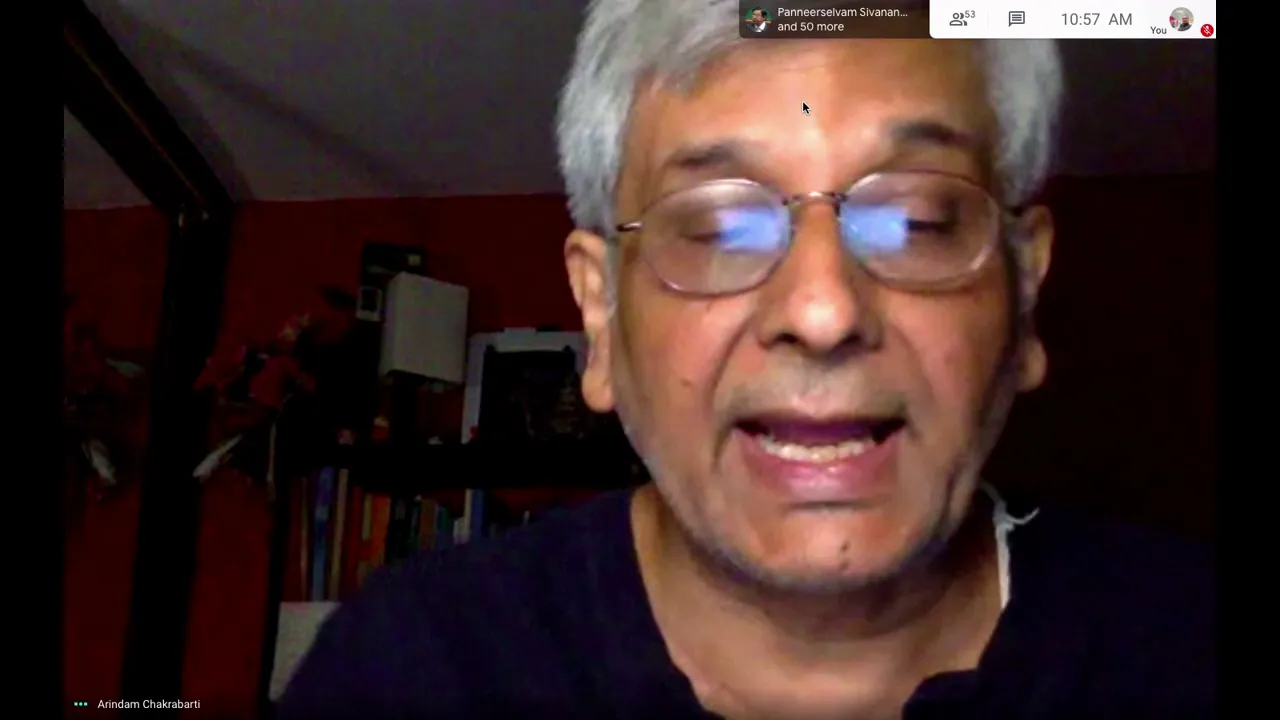
and have a going to be 10 o'clock soon but um this um i have looked at all the abstracts and all their great and all uh let me start with brackish's point um but can i can i worry i should have taken permission to do that can i can i go ahead and respond to the two of them Listen listen yes okay yes if universal subjectivity is a necessary precondition the way it is he gives a transcendental argument his agenda is to prove that there has to be a single self but it's a very subtle
way of doing the single self because the variety of the different embodying patterns is not denied it is not an illusion as In shankarazad right we don't see the oneness we can only transcendentally argue that the only condition under which successful communication is possible across distinct actors and responders and as you very importantly said not just everything reaction is taken as an action which is meaningful only in the mixes of possible responses From others so there will be important and then rakesh this typical uh deepening of a question has also i think suggested how can
i even be sure that i have got myself right both of these questions at least can be opened up but you know gupta is not saying that is that the last word okay he's more like later wittgenstein than like mahabharata and earlier attracted Us that all the problems of love must be unsolved you know whatever is elsewhere whatever is not here is nowhere it's not like that he himself at the end of his largest book university says you can tap onto this resource which is the source of all successful communication and the practical life of
transaction Journalistic look of your heart you can know the truth for yourself that's how we end the book and he calls this i have improved their view but somebody can improve my view too i mean this most important is i have to accept a lot of my opponents explicit research brief answer to the question how do i correct my mistakes in interpreting others Answer conversation so here is a little bit of my sort of gambian interpretation of the possibility of conflict and conflict resolution never to stop dialogue with oneself correct it is significant that when
it comes to addressing oneself when it comes to addressing others but when it comes to talking [Music] Because there is one subjectivity i am not supposed to say i am everything i got everything right what i say is the truth with my constant self-correction and by constant dialogue with others so that's my delineation of the first rocket race many other points which i would not even try but i wish that all the wittgenstein scholars go deep into wittgenstein And find responses to that and i'll just give two examples of that uh from inakshi's question and
actually you know that we don't study too much but when i talked for the last 20 years wittgenstein i make them do and some of my phd students have worked on this wittgenstein uh in a collection now available in English the role put this lectures and gave these lectures which are called lectures on um language of sense data and private experience notes by rashtris you can find them in that very easily available um package book called philosophical locations so there you will see wittgenstein Trying to struggle with the concept of different sense organs and untouchable
and just to give one answer to how potentially explosive this research direction can be and and in akshay's i'm very proud of her because instead of asking uh with kinstonian questions to indian philosophy she is asking as we should indian Philosophical questions to witness to understand him better not to question him you know is he as sophisticated as but the way to best understand is not to get bogged down into secondary literature you know of course bacon hacker we should read we should read plans we should read you know forgetting we should read all the
wittgenstein scholars and But we should not also forget to read gangapatria because of his book on the the introduction to the track jitters so here is the explosive suggestion which which i will end inakshi has asked what about eukary okay she has asked many questions like is wittgenstein okay how would he explain you know the indian philosophical issues of Anvita vida but one question what is the concept of sensor does do sense organs go out and get do they have an active or are they passive like guns in you know translated aesthetic this the sensibility
is completely passive and receptive but you are right since concepts and the tools for understanding Are part of the faculty of activity in current and vidcon it's very elusive about this but it has become clear to me now that like me abhinav gupta also denies non-conceptual perception which surprises us because all the mystical interpreters have said ultimately it is a difficult perception but ordinary perception of objects Even nameless non-linguistic any sensory activity has to be harnessed with some grits of conceptual requirement in this sense senses have to be active and he can say this easily
because of an esoteric tantric doctrine which is also a vedic toxin and upanishadic doctrine that once they are generalized sensory faculties are devatas they are our divinities and sensory Faculties can teach us in fact they can teach us reasoning so the big reason experience dichotomy is busted it is collapsed and lifted away household because of inaudible and this is where mirror neurons that's how i got into thinking about them in the context of not so much about other minds but abhinav gupta has this doctrine Seeing touching smelling hearing tasting especially tasting they all function by
mirroring and one absolutely earth shaking thing that he urges us to notice that in every mirroring something is reversed like in visual mirroring left and right is reversed similarly he says nobody can passively taste sweetness of or bitterness Unless something is returned by the tongue which he calls salivation so we returned back he said unless the auditory nerves and he doesn't say nerves he said unless i was traveling our sense organ of hearing had some mirroring device and he calls the echoing returning the sound by the sound no sound can be grasped unless the counter
Return sound is offered back no color can be seen unless the visual organ itself returns the color before rushing to compare it with neuroscience we have to first understand what he's saying there is a mirroring active theory of sense data reception it is not so since the word datum means that which is given nothing can be given unless something is given back That's his theory of sin sort and i think wittgenstein would be happy to consider that so thank you sir thank you for uh delivering such a wonderful response to questions and we are grateful
to you sir and we request you to thank you so much okay