[Music] thank you okay all right so hello everyone so i'll start sharing my screen so that you know we can have a clear understanding of okay all right so today what we are going to discuss about is impacting arguments and effectiveness of examples so the way that i would want to structure this particular session is talk quite a bit with regard to how i have come across this impacts of arguments is something that has been talked about to a certain degree at some point of time but hasn't really been given when a lot of empha
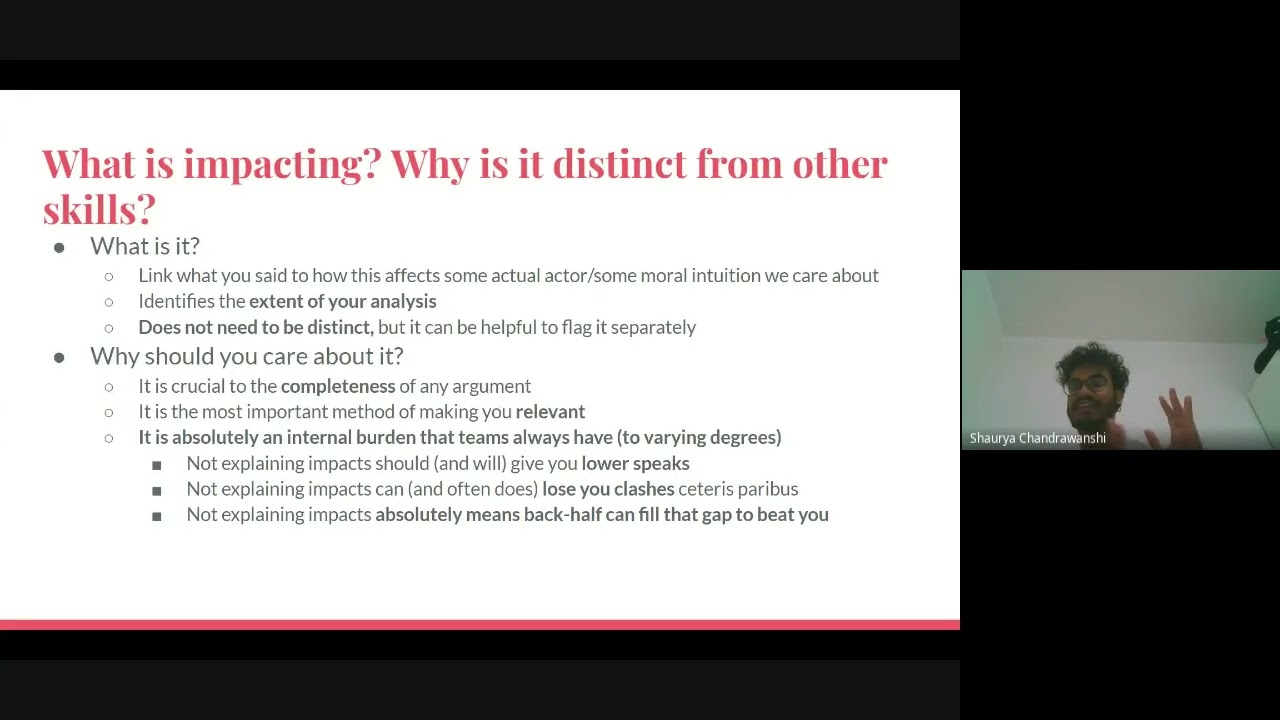
and that is the reason why i sort of uh you know when she really stole about this section i thought of coming up with please it's a disclaimer that all the contents and material that i will be discussing experience that have gathered over time being associated with debate for a few years to the impacts first so we'll be talking about in terms of questions so this what i've always realized is if i if we try and discuss in question format it actually helps us okay so what essentially is impact of an argument normally whenever we
talk about an argument we say that we give the claim that we have that okay this is going to bring about this change this is going to have this impact this is going to make effect in the lives of people in this way we often at times do not really explain the impact it sort of hampers the way we want to put forward the ideas that we have so in order to ensure that the impact that we're explaining that sort of helps us to further our cause to explain what we are trying to put forward
so impact essentially is how a particular action is going to have an outcome or what would be the result of something being done that is what we normally identify as an impact why do we need to consider the impact of a claim that we're making an argument so and our argument of from the times or there would be certain economical changes or let's say the economy of a country is going to be affected but if we did not explain the effect that is taking place or we do not show the likelihood of the change to
take place then often at times the effect on an adjudicator that often at times is not to the degree or extent that we would actually want i will definitely be able to explain further whenever you all of you would probably have any questions in the q a session or the q a part of this particular session so the reason why we need to consider the impact is because it helps us to complement the argument and also give a more approachable extent or degree of effect on the educator to convince or to persuade the judges in
front of us that okay this is why and how we can actually show that the effect that we are claiming it is likely to happen and be there as well what is likely to happen we do not show when we are not showing the impacts of a claim what it essentially ends up doing is the degree to which an educator can relate with the idea or let's say an adjudicator can actually go forward and understand the idea that reduces or that decreases and we don't want that we want to ensure that whatever ideas we're explaining
that has adequate effect on the age indicator and that is definitely enhanced if we are showcasing or indicating the impact of the claim that we are making all right so how can we explain this let's look at a motion this house would force all universities to make their courses free and available online so i'll be explaining it through this particular motion as an example now this is essentially a policy motion what is a policy motion that means you have to take a step this house would force all universities so you are trying to suggest that
you need this action to be taken and when this action is taken there would definitely be certain outcomes there would definitely be certain results that would happen and whenever you are explaining these results or whenever you're explaining this outcome it is particularly important for us to show a few things what are they first is why do we need to do this the need and necessity portion second is how the intended objectives that we want to achieve by making this happen why are these likely let me give you a better explanation of this let's say you
want to improve or enhance the accessibility of education so the normal basic way of approaching a debate that the problem that we see in the status quo is how not everyone is having adequate access to quality education there is disparity between the quality of education provided by different universities so in order to sort of standardize or let's say making sure that the access to education or learning material is of a certain standard or let's say there's a certain degree of standardization that happens we need this action to be taken here how does impact come into
consideration what we need to realize is by taking these steps that this would force all universities to make their courses free and available online what changes are we making here the description of the changes is not that essential why because the wording of the motion or the resolution is very straightforward that you have to force whom all universities to do what to make their courses free and available online by taking these steps or by making this happen how are you impacting the different stakeholders this is where the stakeholders come in you are talking about the
universities because universities have a huge stake because they are investing they have their faculties they have their infrastructure built how are they affected how or how are they impacted how are the students affected because here there has to be a mutual gain for the universities who are providing the education and the students who are sort of are being benefited from the education that they are acquiring or they are receiving from the respective universities as well by taking a step as such or by taking an initiative as such how are you making changes for the universities
how are you making changes for the students the explanation of the changes would essentially be your impacts that how are you impacting the life of a student are you giving him or her a better opportunity to learn are you providing these individuals better learning uh you know platform or let's say better quality of uh learning materials available to these people how would it change their way of going about how would it help them to make uh their lives better how would you affect them economically let's say they can they can now have better skill sets
at their disposal and this is going to allow them to have better working opportunities or this is going to help them have better uh you know job prospects this explanation is often at times not given as much focus and this is the reason why i feel that impacts come into consideration for us that you know when you are able to showcase to the educator that okay by making these courses free and online we think we will be able to provide further access to the students which will eventually lead towards them getting better quality of education
which would then result in them being you know more competent making them having or let's say allow them to have better scope of learning available which would help them to be more equipped and have better skill sets that would help them to be nurtured and contribute in the economy so this economic this you know impact on the economy or this impact in the society because they would now be more learned they would be more uh you know informed they can have better understanding at their disposal of the different ideas that perhaps they were unable to
understand beforehand so under these circumstances why and how these are beneficial if you're in the opposition making these uh you know courses free and available how would they be implicating negatively is is there enough motivation and incentive for universities to invest heavily because we all understand how much these universities are spending money how are they spending money they're spending money by you know employing better quality professors by employing better faculty members by providing good quality of infrastructure do we still incentivize these universities to provide these courses and again free and available so you have to
ensure that the cost is reduced you have to ensure that it is accessible by greater maturity so from the opposition on the negative side we would have to try and justify again if you look at here this is a good example for us to understand how these impacts if you're able to describe them if you're able to focus on them and emphasize on them it definitely helps your cause to make the educator understand that this is something that would definitely be persuasive and compelling to the educators all right so this was the example of how
impacts can be utilized and optimized in a motion as such whenever whenever we'll be going back to the q a you are more than welcome to refer back to any of the explanation that i have provided i'll be more than happy to explain it so uh this sort of covered the impact portion of this particular session now in order to showcase the impact okay if you saw here examples are essentially critical because they help you to form or create a bridge between the claim that you have and the explanation that you want to provide and
for the judges or the judge to understand so examples essentially often at times uh they become the premise of the argument so here you need to sort of strike a balance what do i mean by this often at times when we are thinking of arguments examples come to your mind that okay we want to show dictators are bad okay these are bad dictators right let's give examples and on the basis of the examples we showcase okay fine here the individual was really bad thus we can make a claim that okay these are bad dictators so
dictatorship is bad or these are good dictators those dictators or dictator dictatorship isn't really as bad so we often at times base our arguments on examples and what it does is it often at times sort of shifts the focus from the explanation part and when that happens what it essentially ends up doing is it does not really credit the actual essence of the example that it tries to portray what do i mean by this whenever an argument is being explained you need to recognize that if you do not have an adequate balance of the explanation
that you have in mind and the example that you're providing then you will not be able to convince the adjudicator okay so we need to have this certain balance without examples often at times it is difficult to understand why and how the argument that you're saying is relatable why do we need examples uh visual perhaps intent to achieve or let's say what prepare for a world where lying is not possible so if you give example that okay true it might be hypothetical example it can be a real life example both are possible whatever sort of
enables you to reach out to the educator and that the examples are appropriate and the examples are definitely suitable for the you know crowd that you're trying to reach out to okay another uh problem that i often observe is examples should be as much global as possible what do i specifically mean by this you belonging from a certain background would have exposure for example i i i belong from bangladesh so now i have moved to canada so in canadian circuit if i try to give the examples that are more or less uh you know highly
prominent in developing world it is going to be difficult for those ideas to be you know presented properly without the examples being presented so the examples essentially help the judges to relate with the ideas that you're going to explain here so examples help you to portray the ideas in a more understandable manner so we need examples for the judges to be able to relate with the idea that you're trying to explain and as i said we often at times assume that since i know an example which perhaps is you know more common to me because
i belong from a developing country might not be as easily relatable for someone who might not be from a background of let's say developing countries so in those circumstances it becomes absolutely imperative for us as debaters to make sure that these examples are tailored or these examples are explained in a manner that is understandable for a global audience so please do not restrict yourself with examples that are more uh you know polarized to your background or let's say the the environment that you are more familiar and accustomed with yes there are certain in a more
uh global understanding what do i mean by this let's say the understanding of poverty or the understanding of uh you know lying per se these are more universal but there are certain examples that we often at times bring about that you might be very easily uh understand or connect with but that might not be the case with the adjudicator in front of you so please kindly bear this mind whenever you are going with your debates so the need for examples is to make the judge relate with what you're trying to explain what is likely to
happen we do not provide examples it goes back to the impact when your examples are not relatable it ends up making the judge not thoroughly convinced or compelled with the ideas that you're presenting and it hampers the you know overall effect that the argument has on the judges so if you do not provide examples the judge might not be able to connect or relate with the ideas that you're explaining so it sort of ends up reducing the effect on the judges and we don't want that we want our exam we want our arguments to have
adequate effect on the judges and examples definitely would help to enhance that and further that cause of yours sample motion this is regrets the rise of social media a very common uh motion that we have often at times i have at least come across so by regretting the rise of social media we need to explain a lot that okay how has the social media impacted the society how has the social media impacted the economy how has the social media impacted the behavior of people whenever you are making claims such that okay it has affected negatively
or it has affected positively these claims can only be sort of explained properly or let's say can explain clearly when you have provided the appropriate examples if you do not provide the examples that you know you're what you're trying to mean here the possibility for an adjudicator to connect with what you're trying to present here or connect with what you're trying to explain here that essentially decreases okay so what we need to understand here is whenever we say the economy of a country or let's say the economy is impacted or affected due to social media
give examples and again as i said the example should not be only exclusive to your background or your country not like try to provide as much of you know global examples or let's say examples that are more prominently familiar okay i think you all of you are well aware that for energy for an educator it is assumed that the agenda in front of you is an average reasonable individual who has certain degree of understanding of what is happening around the world okay so whenever you are giving these examples make sure that these examples are somewhat
relatable to an individual who follows the news at an average rate not someone who knows extensive details but is someone who you know sort of tries to follow through what is happening around the world and can go about accordingly because what i've often also at times observe is especially for prepared motions at different competitions especially at school level not at universities per se that whenever the prepared motions are you know sort of take into consideration the students try to narrow the motion in their favor yes you have the opportunity to do that but we still
need to make sure that the examples that we are providing are definitely relatable by individuals from different background and this background can be in multiple fold what do i mean by this they can be from different uh you know country background they can be from different religious background they can be from different academic background as well so let's say if you're trying to explain the economical impacts and effects which is perhaps understandable to a student of economics major is not really a good way to go we try to ensure that the samples or examples that
we're providing they are easily relatable for someone who might belong from different backgrounds you don't your arguments or your examples should not be specific to backgrounds of individuals who are specialists in these areas okay for example the law emotions oftentimes i've seen that law students uh tend to you know give a lot of explanation that are very law of academic background or academic knowledge focus what it ends up doing is it does not give adequate opportunity for an educator to connect and relate with your ideas and whenever that happens it becomes less convincing for any
debate to be you know argued with adequate explanation or adequate emphasis i think it becomes really essential that we understand that okay we want to explain how our claims are going to affect how our claims are going to make these people understand what we are trying to portray in front of them and this is where the suitability of the examples come in whenever we are preparing uh our arguments let's say the preparation time that you have at your disposal that 15 minutes or that 30 minutes or that one hour for wsdc it is important that
within that timeline we prioritize the impacts that what is this essentially going to uh you know have as an outcome why the outcome is likely to happen because if we do not just we just say okay we think this will happen but don't really show that why is it likely to happen or what are the reasons for us to sort of you know make a claim that yes this is more or less likely to happen you will not be able to convince the judges right in terms of examples as well as i said that until
and unless the examples are relatable until honestly examples are understandable for the guys because we need to recognize that examples are essentially helpful for you to make sure that the judge gets to relate with your idea the explanation that you're making it is supposed to be complemented by your example if you if you base your entire argument on example that is doable but like my personal experiences it might not work out you know in a certain way all the time it happened to me as well you know when i had an example and then i
you know sort of based an entire argument on it and it did not really fly through and you know did not did not convince the judges as much as i would have you know wanted it to do so so uh in order to avoid these sort of circumstances uh you can definitely learn along more with examples and as i said you can give personalized or examples as well but then again the personalized examples that okay in my family this certain thing happens they should not be you know absolute outliers they should not be so uh
you know out of the spectrum that the judges or the opponent teams are simply not able to relate okay because those exclusive arguments might not be able to convince the general populace so whenever you are uh considering an example it is absolutely necessary that you try to understand and analyze the greater maturity of the audience being able to relate with it specifically the judges all right so that's sort of uh you know i i wanted to make this entire session quite short because i would want to focus on any specific question that there might be
on examples in debates when two teams start clashing on the example and not the principal core argument that the team is trying to put forward so how do you deal it how do you deal with this as a speaker as and as an ad do you count that example or so i had a question related to when routines don't carry forward the principal argument but start debating upon the example instead okay so when this happens it is a bad approach because examples essentially it will not really help you to convince an educator the the authenticity
of the example at times if they're debating on that then it's just uh not a good approach because the main focus for any team or for any debater or any educator is to evaluate the merit or the persuasiveness of the idea that is being debated here okay the example is secondary the example essentially helps the teams to make the judge relate with the idea that the teams are trying to explain here and for an adjudicator i i do not think that an educator is required to give much of a focus or let's say a much
of an emphasis on the examples that are being contested if that is happening uh i would probably say that the you can give this as a personal feedback that the the excessive extent of you know bantering on the examples did not really help the cause in convincing you as an adjudicator i think that's that's something that i've probably put forward as a personal feedback okay shruti have you been able to answer your question you're welcome no problem okay next [Music] yes no problem teams use wrong examples for example capitalist and social so do you as
a speaker but not something absolutely detrimental that would you know it shouldn't be you know given that importance of a value okay all right shruti okay next so whenever you all are easy example and this is something that i have observed on on quite a few applications is whenever we try to explain on execution where we don't really know of exactly you know go ahead and uh apply in terms of our methods in those cases we often try to give relate and connect them so that they are explained in a manner that is accessible and
understandable by the educator as well so in those circumstances you might not know about a certain country you might not know about a certain issue that is happening but given the context of what it is or let's say given the context of certain degree of knowledge i hope there isn't a case as such where you have no idea whatsoever about the topic that has been given for you to debate on uh then then you are in a pretty bad mess but other than that i think you can definitely go ahead and draw similarity and then
present your arguments on that basis again it might work out might not work out because something unless you have a decent degree of knowledge about or any specific event that is happening for example uh the myanmar conflict okay so how do conflicts go about in general and given the nature of the motion this is something that i was practicing with some of my students very recently where they had to justify the economic sanctions on myanmar now you might not know in detail about what has happened in myanmar but over the course of time there must
have been some debate that you did on civil war or let's say military intervention or with regard to how economic sanctions work and operate so you try to draw similarity from those instances and bring them as principles or understanding or explanation to the teams and that that hopefully would help them to understand what you're trying to explain okay so that's also something that i feel can be optimized whenever you're asked using examples okay so is there any more question you can also like refer to the expansions that i provided on the impact if there is
any any area that perhaps it was unclear or you would want me to focus on a bit more i'll be more than happy to do that as well