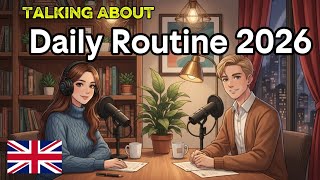
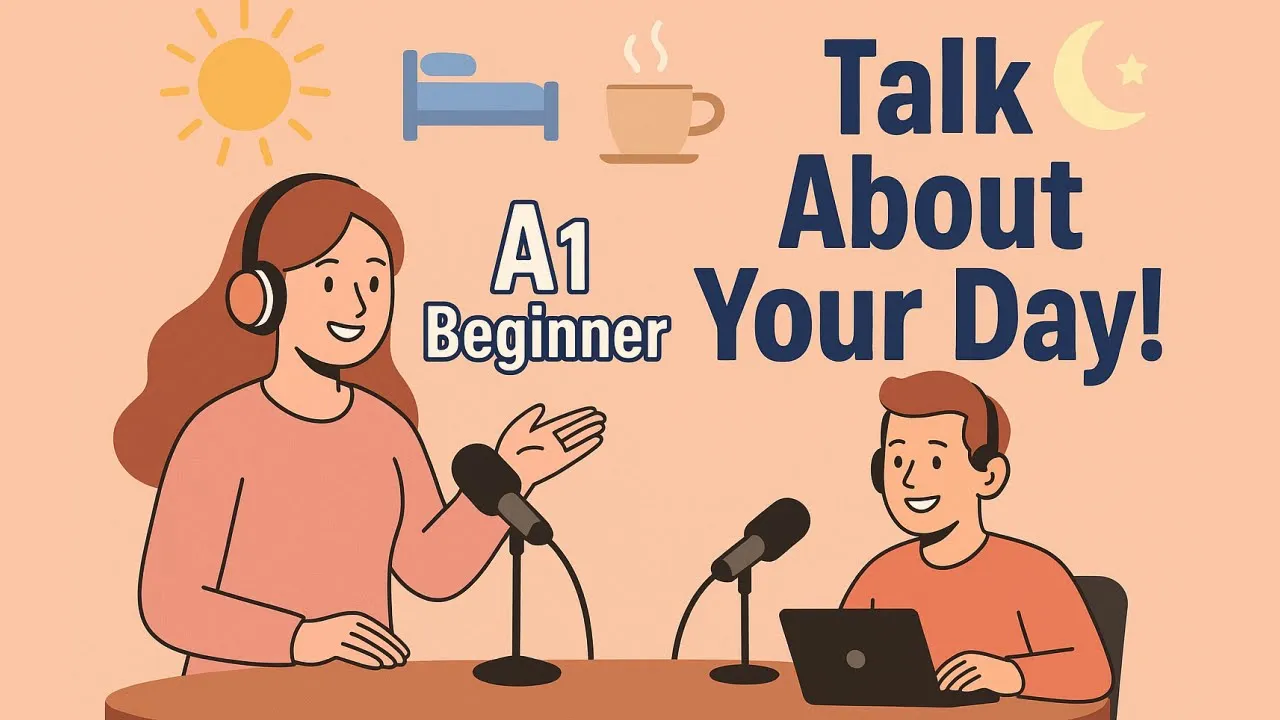
[Music] Hello everyone and welcome back to Mr English Channel. I'm Emily. Hi Emily.
Hi everyone. It's great to be here again. It's wonderful to have you back, Paul.
And to all our amazing listeners, thank you for tuning in. Today we have a super simple and useful topic for you beginners out there. That's right, Emily.
We're going to talk about our day. You know, the things we do every day. It's a fantastic way to learn some basic verbs and vocabulary.
Exactly. Before we start, if you enjoy learning English with us, please remember to subscribe to our channel, share this episode with your friends who are also learning, and give us a thumbs up. It really helps us a lot.
Yes, please do. We love hearing from you, too. So, feel free to leave a comment about your day or anything you're learning.
Okay, Paul, are you ready to talk about what we do during the day? Absolutely, Emily. Let's start with the morning.
What do you usually do in the morning? Well, the first thing I do is wake up. I usually wake up around 7:00.
7:00? That's a good time. I sometimes wake up a little earlier around 6:30.
Wow, you're an early bird, Paul. After I wake up, I get out of bed. Me, too.
Get out of bed is a very important phrase. That's right. After that, I go to the bathroom.
I brush my teeth and wash my face. Brush my teeth and wash my face. These are also very common actions.
That's right. After that, I go to the kitchen. Ah, the kitchen.
What do you do in the kitchen in the morning? I usually make breakfast. Make breakfast.
What do you usually have for breakfast, Emily? I often have coffee and toast. Sometimes I eat fruit, too, like a banana or an apple.
Coffee and toast. Simple and delicious. I usually have tea and some cereal.
Nice. After breakfast, I get dressed. Get dressed.
That means you put on your clothes. Exactly. I choose my clothes for the day and put them on.
And what do you do after you get dressed, Emily? Well, if I'm going out, I might put on my shoes and my coat. Put on my shoes and put on my coat.
Very good. Then I usually leave the house. Leave the house.
Where do you usually go when you leave the house in the morning? I usually go to work. I work in an office.
Go to work. I sometimes work from home, but sometimes I also go to an office. That's interesting.
So Paul, what do you do in the morning? Can you tell us about your routine? Sure.
I wake up around 6:30. Then I get out of bed and go to the bathroom. I wash my face and brush my teeth.
After that, I go to the kitchen and make tea and have cereal for breakfast. Then I get dressed. If I need to go to the office, I put on my shoes and maybe a jacket.
Then I leave the house and go to work. That's a great morning routine, Paul. We used a lot of important verbs there.
Wake up. Get out of bed. Go to the bathroom.
Brush my teeth. Wash my face. Go to the kitchen.
Make breakfast. Have breakfast. Get dressed.
Put on shoes. Put on a coat. Leave the house.
Go to work. Yes, those are very useful verbs for beginners. Let's talk about what we do during the day.
Emily, what do you do at work? At work, I usually sit at my desk and work on my computer. I answer emails and write reports.
Sit at my desk, work on my computer, answer emails, and write reports. These are all things many people do at work. That's right.
Sometimes I also have meetings with my colleagues. Have meetings. Meetings are when people get together to talk about work.
Exactly. What about you, Paul? What do you do during the day?
Especially if you work from home. If I work from home, I also sit at my desk and use my computer. I might write articles or prepare lessons.
Sometimes I have online meetings. Write articles, prepare lessons, and online meetings. Very useful.
Yes. And then usually around lunchtime, I have lunch. Have lunch.
What do you usually eat for lunch, Paul? I often have a sandwich or a salad. Something light.
A sandwich. A salad sounds healthy. I sometimes bring my lunch from home or I go out to eat.
Go out to eat. That's nice. After lunch, we usually go back to work.
Yes. Back to work until the end of the day. What happens after work, Paul?
After work, I usually go home. Go home. That's a great feeling.
What do you do when you get home? Well, sometimes I relax on the sofa and watch TV. Relax on the sofa.
Watch TV. That sounds nice and relaxing. It is.
Sometimes I also cook dinner. cook dinner. What do you like to cook?
I like to cook pasta or sometimes I make a simple soup. Pasta. Soup.
Delicious. I also like to cook dinner. Sometimes I try new recipes.
That's fun. After dinner, what do you usually do, Emily? After dinner, I often wash the dishes.
Wash the dishes. Not my favorite activity, but it has to be done. Me neither.
Sometimes I read a book or talk to my family or friends. Read a book, talk to my family, talk to my friends. These are all great evening activities.
What about you, Paul? What do you do in the evening? In the evening, I sometimes go for a walk.
Go for a walk. That's good exercise. Yes, it is.
Or I might listen to music. Listen to music. What kind of music do you like?
I like many kinds, but often I listen to something relaxing in the evening. That sounds lovely. Then before going to bed, what do you do?
I usually brush my teeth again. Brush my teeth. Good habit.
Yes, it is. And then I go to bed. Go to bed.
What time do you usually go to bed, Paul? I try to go to bed around 10:30 or 11:00. That's a good time.
I usually go to bed a little later around 11:30. So to summarize our day, we talked about waking up, getting ready in the morning, going to work or working from home, having lunch, finishing work, going home, relaxing, having dinner, and going to bed. Yes, Paul, we covered so many useful everyday actions.
Let's quickly review some of the key verbs we used. Wake up. Get out of bed.
Brush teeth. Wash face. Make breakfast.
Have breakfast. Get dressed. Put on shoes.
Put on a coat. Leave the house. Go to work.
Sit at my desk. Work on my computer. Answer emails.
Write reports. Have meetings. Write articles.
Prepare lessons. Have lunch. Go home.
Relax. Watch TV, cook dinner, wash the dishes, read a book, talk to family, friends, go for a walk, listen to music, go to bed. That's a fantastic list, Emily.
These are all things that everyone does regularly, so learning these phrases is super helpful for beginners. Absolutely. And remember, you can use these phrases to talk about your own day.
Try to think about what you do from morning until night and say it in English. That's great practice. You can even write it down.
Writing can help you remember the words and phrases better. Yes, that's a wonderful idea, Paul. And don't worry if you don't know all the words yet.
Just try your best and you'll learn more and more each day. Exactly. Learning a new language takes time and practice.
Be patient with yourself and celebrate your progress, no matter how small it seems. That's such good advice, Paul. Well, I think we've covered a lot about our day today.
Hopefully, our listeners found this helpful. I hope so, too, Emily. It was fun talking about our daily routines.
It was, Paul. And to our listeners, thank you so much for joining us today on Mr English Channel. We really appreciate you being here.
Yes, thank you. And if you enjoyed this episode and found it helpful, please don't forget to subscribe to our channel so you don't miss any future lessons. That's right.
And please share this episode with anyone you know who is also learning English. It would mean a lot to us and we love to hear from you. So, please leave a comment below telling us about your day in English or any other topics you'd like us to talk about in the future.
Yes, we read your comments and appreciate your feedback. So, until next time, keep practicing your English and have a wonderful day. Bye for now everyone.
Goodbye.