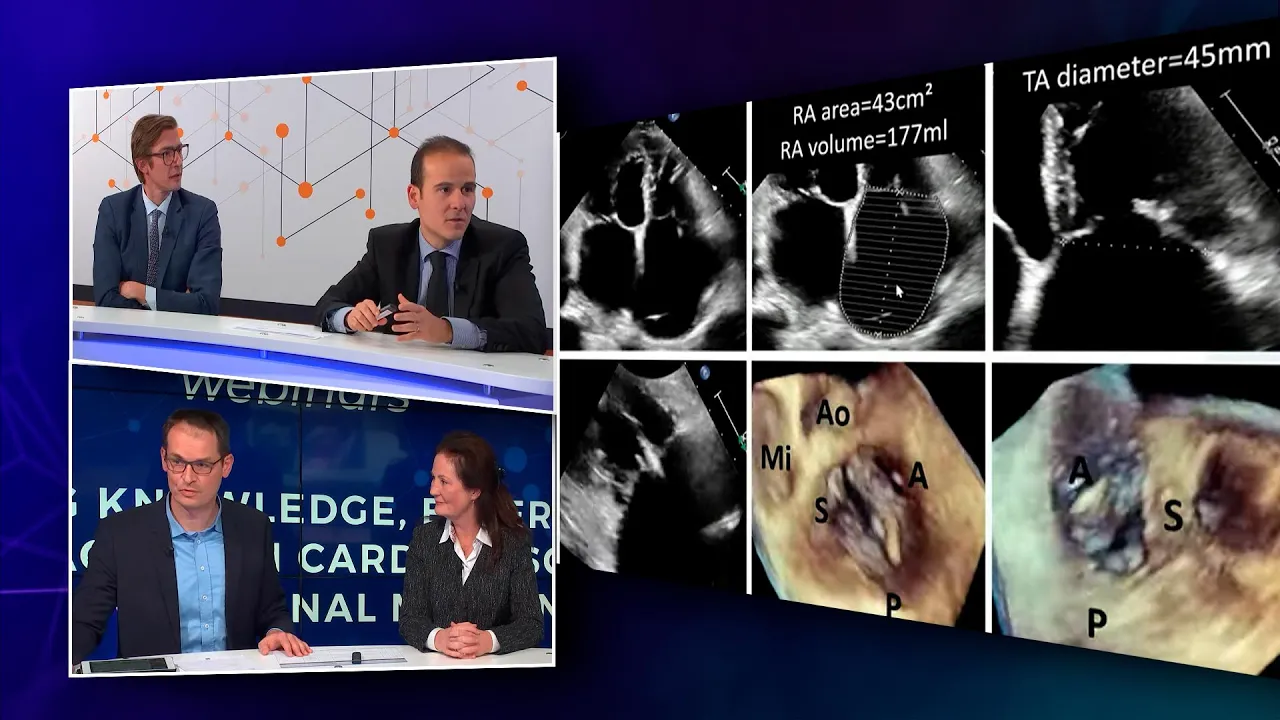
Dear colleagues, I'm excited to welcome you to today's PCI Tricuspid Focus Group seminar, in which we want to discuss the results of the recent Tri… TRISCEND II trial. And we really want to dive into the question how this trial will affect our future clinical practice. My name is Volker Rudolph, from the Heart and Diabetes Center in Bad Oeynhausen, Germany, and it's my great pleasure to introduce you to a outstanding panel of speakers to my left.
There’s Alison Duncan from Royal Brompton. She's our imaging expert today, and in her talk, she will touch on the anatomical aspect of patient selection. We have Julien Dryfus from Paris in France.
He added a lot to our field in looking into the progno… how to find out about the prognostic benefits of the procedures that we do, and therefore, he will show us a case and touch upon the clinical aspects of patient selection. And then, last but not least, we have Philip Lurz from the University Heart Center in Mainz, who was the European PI of the TRI- SCEND II trial, and he will review the latest results of this trial today. These are our learning objectives today, and before we actually start, just a brief reminder to really make use of our chat today.
We are very happy to address all of your questions, to make this seminar the best possible experience you can get. And, so let's not talk any further. Let's pass on to Philipp to look at the results of the trial.
Thank you. So dear participants, we all agree about the detrimental effects of tricuspid regurgitation: having TR is just a very bad condition. Also because of that, this great excitement about the interventional field, of treating tricuspid regurgitation, and this field made great progress, but still some limitations remain.
And there is the hope that with transcatheter tricuspid valve replacement, some of these limitations could be overcome. And the first study analysing a transcatheter tricuspid valve replacement system in a randomised fashion is the TRISCEND II trial. And this is why we came together today: to discuss this trial.
The system used is illustrated here. It's the EVOQUE platform, which comes now in four different sizes, ranging from 44 to 56 mm. And it's a transvenous femoral system.
The TRISCEND II trial applied 2:1 randomisation scheme, as illustrated here. And the endpoints were assessed at 30 days, 6 months and one year. But patients will also be followed up to five years.
Here you can see that overall, 400 patients were enrolled – 267 in the replacement group and 133 in the control group. And beyond the usual reasons for dropouts, there was adequate data completeness at one year, as demonstrated here. These are the baseline characteristics of the patients enrolled into the trial.
And there's a lot of information, but I will guide you through. An elderly patient cohort with a mean age of around 80 years. There was a female predominance.
Most patients were clearly symptomatic with about 70% in NYHA Class III or IV. And a very low KCCQ score of about 50 points. The vast majority presented with A fib, and there was also a previous history of ascites in 20% of patients, so this is clearly a more advanced stage, disease stage cohort, and what's also relevant to mention is the high frequence, the high incidence of patients with pacemakers, so leads across the tricuspid valve.
The valve could be implanted in 95% of patients, and the median device time was a bit less than an hour, and the conversion to surgery during the procedure was 1. 2%. Here, you can see the safety outcomes, separated for first early events within the first 30 days, and here we can see clearly more events in the treatment group, cardiovascular mortality in the replacement group of 3% and severe bleeding in about 10%.
And most importantly, the necessity for new pacemaker implantation in 24%. But interestingly, if we compare the events between the two groups after the initial course, then we see no differences: 4. 2% and 3.
9% in the later course, after 30 days and up to one year of follow up. Now, importantly, and this is why replacement was performed, not only to reduce, but in the vast majority, really abolish TR, and this was really also achieved, as illustrated here in the treatment group. At one year, there was almost no patient with relevant TR left and very much different to what has been seen in the control group.
Here is the summary of the analysis of the primary endpoint, which was a win-ratio analysis including all-cause mortality, tricuspid valve reintervention, heart failure hospitalisation, and then the improvement in KCCQ, NYHA Class and 6-minute walking test. And the last number in these tables, on the left and on the right, indicated that there was significantly more wins in the TTVR group than in the control group. The win ratio was 2.
02, and this was clearly significant. Now, importantly, the win of TTVR over control was a quite uniform signal across all different types of subgroup analysis and more specifically, also when separating patients who had a history of previous heart failure hospital, hospital hospitalisation, but also the, the win for TTVR was independent of the baseline TR severity. With respect to hard clinical endpoints, numerically less in the TTVR group, but no statistical significance.
And this is also true with respect to the incidence of heart failure hospitalisation, However, and very much different, a very strong, strong and clear signal with respect to improvements in KCCQ, so in quality of life in the TTVR group. And this improvement was far beyond what's been considered as clinically meaningful, which is indicated at this MCID. Five points for KCCQ and 2.
5 points for SF-36. And it was also across different domains, physical, mental, but also the ability of these patients to participate in social activity. So in summary, the TRISCEND II trial clearly met its primary end- point in showing clear superiority of valve replacement as compared to control.
The EVOQUE system led to almost complete abolishment of TR, with almost all patients having mild or less TR at 1-year follow up, and that reduction in TR was very much associated with improvements in quality of lives. There were some procedural risks, which, in the future, needs to be balanced against the very strong and clear signal in terms of quality-of-life improvement. Thank you very much, Philipp.
Philipp, what is your main takeaway if you look at these results? I mean, on the one hand, we don't have positive results on the hard endpoints, which we are so used to look at. On the other hand, we have a treatment now for a very sick patient population, which we could not treat just a couple of years ago, which by this therapy have a, a large symptomatic benefit.
I couldn't agree more. I think we have, we have seen that we can treat very complex anatomies, not only reduce, but in the vast majority really abolish TR, we have the very strong signal in terms of quality of life. But this is the first analysis.
It's not the end of it. There will be many subgroup analyses and more in-depth analyses of the study, and I'm very confident that they will eventually also inform on where we see signals for hard clinical endpoints improvement. Julien, we have now two therapies that are approved to, to treat … TR, for which we have two large trials.
and of course, the question for all of us is when to use which, which therapy. So can these trials help us to, to maybe figure this question out? Of course, we have to look at the benefit and the risk of each type of intervention.
If we look at the two randomised trials that we have – the TRISCEND II for the replacement technique and the TRILUMINATE trial for the edge-to-edge repair technique – we can see in the one hand that replacement is associated with significantly higher rates of, in-hospital and 30-day mortality, of new pacemaker implantation, and more severe bleeding. On the other hand, with transcatheter replacement, we have shown that this technique was able to significantly reduce TR, and in more than 95% of patient, you can have a mild or lower residual TR, while after edge-to-edge repair you will achieved a mild, mild TR only in 50% of patient, knowing that residual TR after transcatheter intervention impacts the mortality, so we should achieved the lower amount of TR after any intervention. Well, thank you so much.
So, I mean, maybe we can pull up the poll question as there's a little bit time that we prepared. I mean, you saw now all the results from randomised trials that we have available, and, I think, really the question is, in two years from now, what, what would you think, which percentage of patients will be treated with tricuspid valve replacements? Can we maybe see the poll questions?
Thank you. You have to help the audience now, to, what, what would we, be your guess? So, I think that, obviously, there, we have, we are on a learning curve for transcatheter tricuspid valve replacement.
We've got a lot more experience with edge-to-edge intervention. And as Julien said there, we have predictable elimination of trans, tricuspid regurgitation with an implantation device. And it does seem to be that this has clinical benefits, having no tricuspid regurgitation than leaving some residual tricuspid regurgitation set against the balance of the procedural risks that also includes bleeding and potentially a degree of afterload mismatch in the right ventricular function.
So it's a very hard beast to compare it against because the safety profile of edge-to-edge intervention is so good, and the experience of this procedure is becoming much more understood and manifest that, for sure, there will be a place for transcatheter tricuspid valve replacement in the future. We, we need to have, as is commonly said, a toolbox, so we have got options for individualised patient care. But whether transcatheter tricuspid valve replacement will overtake edge-to-edge intervention, I'm not sure.
But for sure it will have a space for itself in the future. So maybe, it looks like we can give you more time to think about this, and we will move on to our next case, but we will come back with this question, probably at the end of the session. So it's my pleasure now to, to again hand it over to you, Alison, and, show us the case you prepared for us.
Well, sure. So I just wanted to spend a little bit of time talking through the ideal candidate for transcatheter tricuspid valve replacement. And the case that I wanted to show you is a 71-year- old female who presented with a 3-year history of breathlessness on exertion, with two previous admissions with right- sided heart failure to hospital.
In her past medical history, she has permanent atrial fibrillation, has undergone one previous failed cardioversion attempt, and she's got some mild coronary athe- roma, a previous transischaemic attack, and she's slightly overweight, with impaired glucose tolerance and cardiovascular risk factors of hypertension. She's also known to have asthma. In her lifestyle, she's an independent lady who lives at home, she's a predominantly sedentary lady, and when she came to us, she was at NYHA Class III, with a reasonable blood pressure, her JVP was not elevated, she had good bilateral air entry on chest auscultation, but mild swelling of her ankles.
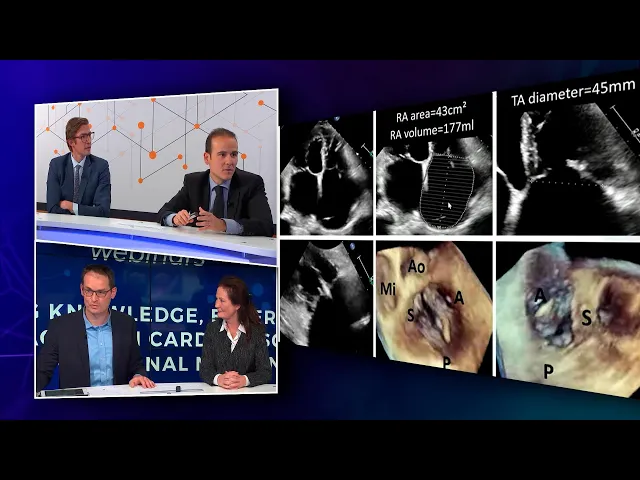
In her medical therapy, she was taking ap… a NOAC for her long- standing atrial fibrillation, and she was on appropriate heart failure medication for heart failure with preserved ejection fraction on bisprolol, dapagliflozin, and furosemide 80 mg a day. So this was her baseline transthoracic echo, and you can see already from the moving loop that her right atrium is significantly dilated and her right ventricle is not overly dilated, but it is, there is some mild impairment, the fractional area change comes out to be about 51, but the longitudinal function is impaired and the free wall strain is slightly impaired at –16%. She obviously has a very dilated right atrium with tenting of her mitr… tricuspid valve leaflets and a very significant tricuspid regurgitation, with pulmonary pressures in the low 30s and significant tricuspid regurgitation even on 2D quantification with an EROA of 1.
3 cm² and a regurgitant volume of 120 ml. So we performed a bloods on her. She was not anaemic.
Her BNP was significantly raised at 280 – the normal is less than 20. Preserved renal function and preserved liver function with an INR of 1. 1.
We performed a right heart catheterisation, which showed a mean right atrial pressure of 15, a RV pressure of 32 peak, a PA pressure of 34 peak. The wedge was increased, going along with her heart failure with preserved ejection fraction, a mean wedge of 23 with a cardiac output preserved to almost 5. 6 litres per minute, a cardiac index of over 3.
5, a transpulmonary gradient of six, and a PVR of 1. 1 Woods Units. So in summary, this was a 71-year-old lady with symptomatic heart failure hospitalisations, despite being on guideline-directed medical therapy for right-sided heart failure.
And her TRI-SCORE, as explained by Julian, was high, at 8 over 12, with a predicted in-house mortality, in-hospital mortality of 48%. So she went on to have a trans- oesophageal echo. And you can see biatrial dilatation, mild impairment of her right ventricular function, with reduced longitudinal function.
And we like to do some quantification of right ventricular function, so we performed an analysis of her right ventricular stroke volume, which came out to be reduced at 48 ml. She obviously had severe – more than severe – central tricuspid regurgitation with a vena contracta of 14 mm in orthogonal dimensions. And looking at the motion of the tricuspid valve leaflets, they are not restricted.
They are, have got good mobility with no calcification, no subvalvular thickening, and the leaflet lengths are more than 14 mm. But when you look at this valve in trans- gastric, you can see it's a very complicated valve with multiple scallops. There's two scallops in the anterior leaflet and two scallops in the posterior leaflet.
And while it might be difficult to see that there's two scallops in the septal leaflet, it's very difficult to see the anterior end of the septal leaflet. And this then results in a very complicated jet of tricuspid regurgitation that goes out into these multiple scallops with a coaptation gap of 9 mm in the centre of the valve. We also look at the subvalvular apparatus.
We can see that there are papillary muscles that are more than 2. 5 cm away from the tricuspid valve annulus, and on 3D quantification of the tricuspid regurgitation, it came out to be 0. 98 cm², which puts this in the range of massive tricuspid regurgitation.
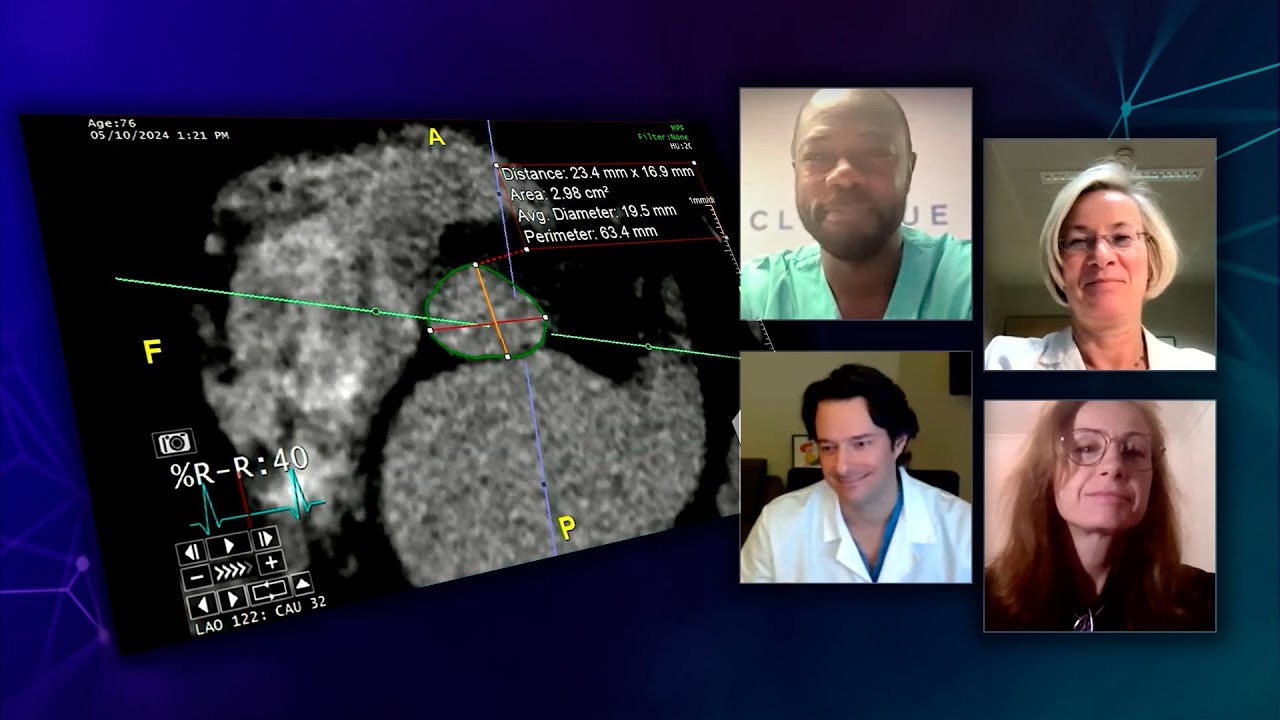
We then can perform multiplanar reformatting imaging to get an idea of the size of the tricuspid valve annulus. And in this particular case, the annulus was measuring 47 by 43 mm, with a predicted … tricuspid annular perimeter of 144 mm. But we need to do other imaging in our screening for patients for potential tricuspid valve replacement, and so patients undergo a CT scan which confirmed that the annulus measurements were very similar to that found on transoesophageal echo, with an annulus size of 47 mm and a perimeter of 146 mm.
And this predicted that we could use an EVOQUE device with an optimal size of 52 mm with a degree of oversizing that meant that the procedure could proceed safely. We also have to perform other imaging modalities for the CT scan – it’s just to check we've got enough working view to manipulate the the guide cath in the right atrium – and this lady’s right atrium was dilated at almost 10 cm, so no problem with working view there, and the fluoroscopic angle, should we have gone to implant, would have been 29, with no significant offset of the interventricu… the inferior venus, vena cava with the tricuspid annulus. We’d confirm on a 3D spin of the … CT scan that the device, certain that sorry, the the tricuspid leaflets are very complicated with multiple scallops.
We've got two anterior scallops. We've got two posterior scallops and the leaflet lens are reasonable with some mild tethering. And the distance of the posterior of the papillary muscle from the annulus was within more than 12, 2.
5 cm from the annulus. So away from the annulus without causing some ill effect. So essentially, this lady proved to be anatomically suitable for transcatheter tricuspid valve replacement with a 52 mm device, and she may have been suitable for transcatheter edge-to-edge, but the degree of complexity of her multi- scalloped tricuspid annulus meant that we underwent tricuspid valve replacement for this lady successfully with, as Julian explained earlier on, and Philip also complete elimination of her tricuspid regurgitation.
All right. Thank you very much. This was a very nice case of a candidate that's really suitable.
Philipp, what, what are still things that are bothering you when, when you select patients in a, from an anatomical perspective? What are things you think of? The first step is to get to the valve.
So an access, access site and venous anatomy could, could be of consideration. It's probably less of an issue than what we are used to from TAVR. But there is a huge variety of different venous anatomies – in some patients the, the veins are closed, and sometimes one has to switch from the right to the, to the left side, and there are also some not very common but possible instances where you have venous anatomical tortuo- sity, which might make it difficult for the system to be advanced.
And I think we have an example of this. Yes. Actually we do.
You’re right. It's not very common. But in this particular case, we do have an example of a patient who did have venous tortuosity, but also had, had some, spinal fixation devices that actually impeded onto the venous system.
So while it is obviously very important to screen the chest, it is also incumbent on us to also look at the venous access to make sure that we've got a decent enough size with a reasonable trajectory and access to, to the heart. But of course, this is one of the sort of minor reasons why people screen fail. The most common reason patients screen fail for transcatheter tricuspid valve replacement is the morphology of their tricuspid annulus, their right atrium, and sometimes their right ventricle.
So for example, in this patient it's a very quick and easy way to see that this patient would screen fail for transcatheter tricuspid valve replacement, even on transoesophageal echo before CT, because their right ventricular annulus is 57. This is out with the, the, the, the highest size for the currently available devices in Europe. And of course, you would then verify this with multiplanar reformatting imaging on a TOE or on a CT scan.
But of course, the other reason, Occasionally, is the patient who has, if I can get this to move, so in the working view of this particular patient, we can see that actually despite tricuspid regurgitation, the patient did not have a very dilated right atrium. So we need the right atrium to be more than 50 mm, and in this case, it's just a little bit too small to guarantee that we would have enough working room for the device to be able to be manipulated into the, in the right atrium, with the right trajectory down to the valve. So maybe we have our questions here from the chat.
And I think this brings us back one step now to the initial question whether to do TEER or replacement. And the question is, considering the complex anatomy of the tricuspid valve, will patients need repeat interventions, I think in TEER, and if so, how manageable will these be? Julien, I mean, now that we have these two therapies available, how would you answer this, this question?
I would say that ideally you should perform only one intervention. And at the end you should achieve a good results. So if you are not expecting a good results with edge-to-edge repair, maybe you should consider replacement.
But only one time. And it's not easy, but with experience, with learning experience, we should be able to predict that we are going to get a good result or bad result. We have many red flags to say that the patient is probably not a good candidate.
And so for this patient, probably we should consider replacement. And sometimes we are very optimistic and at the end, we don't have the final results that we were expected. But I hope that in the future this represent only few number of patients.
Maybe. Philipp, you personally, how do you decide when you no longer want to do TEER, when you say, okay, this is where, sort of difficult question, but where sort of the limit where you say, okay, this is above here. Whenever I'm not confident that I will end up with a good result.
And these, the typical scenarios, it used to be more the gap which, which is still of an issue, obviously, but less so because we can do independent Grasping, but leads indicate that the result might be not, might be suboptimal, anatomies with more than three leaflets, of course we can do TEER, but it is more complex and it's very hard to predict the outcome. And, as said, once you've done a TEER, it's very difficult to to improve the result later on. And these are the typical scenarios where I would go for replacement now.
And obviously there are many, many patients with more than three leaflets. There may be the occasional patient where you have got someone, a patient with significant right ventricular dysfunction, that you may have some concerns about complete elimination of tricuspid regurgitation in 1 or 2 cardiac beats with your concern about potential afterload mismatch. And it may be this is maybe a, more of a soft sign, but maybe those patients might be better off served with an, an edge-to-edge device if their tricuspid anatomy would serve that.
I agree otherwise with Philipp. It’s, if, the more complex the, the, the anatomy, the more scallops, the wider the gap. You know, you may not be able to achieve even enough reduction to even induce afterload mismatch.
I think you touched on a very important point here when we talk about replacement right ventricular function. So, Julien, any insights into this difficult topic? When, when do you get nervous with right ventricular function when you plan to do a replacement?
It's difficult to formally answer, but usually we consider a patient with, significant impairment of LV function should not be the good candidate for any intervention. As we know, after correction, effective correction of TR, the LV function is going to decrease, so if you have a bad LV function before, it will be even worse after. So usually CV dysfunction should not be considered for any intervention.
And one thing I would like to add that we are here in a very comfortable situation where we get the results of a randomised trial very early on in the experience, and in many other instances, the randomised trial came much later, which also means that the learning is … is still to be done. But on the good side, it means that I'm very confident that we will see a better safety profile in the future because, when we look at what has been done in the trial, there are already some, some, some differences we now do, which improves already the outcome, like not changing the anticoagulation scheme, leaving every patient on the anticoagulation scheme. The patient was at baseline before the procedure and that, in my experience, already reduce the risk of bleeding.
So we can be confident that we will see a better safety profile in the very near future. Yeah, I think very important points. There's one more question from the chat, which actually directly leads us to the case of Julien.
Which patient populations would benefit the most from this intervention? So I think this is what you would be talking about. I think there, there are two important parameters.
The first parameter is, are we able to achieve good results, what we have mentioned. And we should try to achieve the lower amount of, of TR. That is the first point.
And the second point is the fact that we should try to treat the patient as early as possible. And that's why we are currently working to raise awareness about this disease. So the patient could be referred earlier and treat them earlier.
What has been shown is that when you effectively treat patients, it seems that you will improve the quality of life of any patient. And if you are going to treat patient early in the course of the disease, you may also improve survival and heart failure. And I think you also brought us a case, so… Yeah, so I'm going to present the case of an 80-year female with chronic atrial fibrillation and a permanent pacemaker.
The patient was severely symptomatic, as she was in NYHA Functional Class III, presented with right-sided heart failure signs and elevated NT-proBNP despite 80 mg per day of furosemide. Transthoracic echo showed a severe tricuspid regurgitation with a mixed mechanism showing a first, an atrial functional tricuspid regurgitation with right atrial and tricuspid annulus dilation, but also TR induced by the pacemaker lead that seemed to be attached to the anterior leaflet. The LV was dilated and LV function seems to be no or mildly, impaired.
The transoesophageal echo confirmed the location of the pacemaker lead at the level of the anterior leaflet, and the 3D images nicely showed that it seems to move with the anterior leaflets for the entire cardiac cycle. The coronary angiogram was normal, right heart catheterisation showed postcapillary pulmonary hypertension. The 6-minute walk test was 250 m.
The case was discussed in the Heart Team, and as the patient was 80 years old with an intermediate surgical risk score and required a replacement, we suggested a transcatheter tricuspid valve replacement with the LuX device, which features a unique, anchoring system at the level of the interventricular system. And, to ensure the stability, there are also two lateral rabbit ears. So the CT showed that the patient was suitable, the anatomy was suitable for the LuX intervention, showing the jugular axis, but also, very importantly, the angle between the tricuspid annulus plane and the inter- ventricular septum for the anchoring of the device.
As the mean diameter was 47 mm. we chose, 50 mm size. And the CT also helped us to define the appropriate projection angles and could also simulate the implantation of the device.
So we perform the intervention with DrNejjari, and first we insert the, the delivery system into the jugular vein, up to the right ventricle. And the goal is to have a delivery system that is perpendicular to the tricuspid annulus, then, open, deploy the rabbit ears. So there is, there are two rabbit ears, one anterior, and that should be just below the interleaflet, and one posterior, that would be just below the posterior leaflet.
Then we deploy the prosthesis, check that there is no significant, residual periprosthetic TR, and then, and it’s a critical moment, we have to check the alignment of the blade to the interventricular septum, and we have to look it, at it with a biplane view to be sure that we will insert the needle just perpendicularly into the interventricular septum. Then we will release the system, remove the sheath, and look at the final result with no significant TR, and we can even see the pacemaker lead that is now laterally positioned. And, just after the check-up with the transthoracic echo that showed an excellent result with a good position of the prosthesis, a good anchoring of the device at the interventricular septum, no infraprosthetic or periprosthetic TR, and very interestingly, we can see the path of the pacemaker lead, with no residual TR at this level.
So an excellent final result. Okay. Thank you.
Thank you very much. So, maybe after this case, one question from, from the audience, which we have not addressed it. Maybe I can address this to you and, and I know we have discussed now two different valves, and maybe we can also respect this.
So the question was, which gradient do we expect to have at follow-up When, and this request refers to the EVOQUE valve, it will be a be a bioprosthesis 28 mm on the right side. So what, what is normal? What do you expect, and what are things you, probably, may be scared about?
So, I mean, in terms of gradient, you really wouldn't expect any gradient. The circ in the circular is a 28 size circular circumference, so you shouldn't have really any gradient at the end of any transcatheter tricuspid valve replacement implantation. You may have increased velocities because of residual right ventricular impairment, but it wouldn't be a gradient across the valve itself.
Okay. So, Philipp, in your experience have you encountered increased gradients? Is thrombosis a topic that, that is of concern?
Was it of concern in the, in the trial? It wasn't a, a major concern. It, there are some reports – it can happen.
That's why it's certainly wise to monitor for the gradient and compare the gradient throughout follow-up with the, with the gradient immediately after the implant. When the gradient goes up, it might be due to thrombosis, which then can be normally nicely visualised both on echo but also sometimes on CT. I personally had one case which could very nicely be treated with low-dose lysis, thrombolysis.
And this, that thrombosis completely resolved. And then the patient ended up after the thrombolysis with a completely normal valve function. So yes, it could, it can occur.
It's something to look for during follow-up. But it's, it's … rare Right, so Julien we, something that, that we saw in all the data is patients with, with pacemakers. Is it still a problem?
How prevalent is it in the patients that we treat? So most patients that are treated currently are treated for atrial fibrillation. And we can see that most of them have not most of them, but many of them, have a pacemaker, so it is a very frequent situation.
And if we look at both registries and randomised trial, we have between 16% and 38% of patients who are currently undergoing a transcatheter intervention and that have a prior permanent pacemaker implantation. Interestingly, we can see that those rate are significantly higher in the transcatheter replacement group compared to the transcatheter repair group because it is frequently considered as a main issue with transcatheter repair to achieve a good result. While it seems to be less an issue with transcatheter replacement.
Okay. So, maybe, Philipp, you have a lot of experience with these replacement systems. What, what, what things do we have to look for to be prepared for a more difficult post- interventional course?
What are things that that can complicate the postinterventional course? Well, acute AV block, obviously is something one, one needs to be prepared for. We are not very good at, in predicting it at that point in time, but one needs to have a strategy when it occurs, obviously, ideally a good relationship with the EP colleagues.
because you don't want to, to, to place… Acutely, you can place a pacer across the valve, but then you need a long-term solution, which could be Micra, which could be coronary sinus lead, but yeah, something you need to prepare in advance. And then the other issue is is the right ventricular function, right ventricular failure, as touched upon already. Again, some with bad RVs do very well after the procedures, but in some there is a certain risk that they might develop RV failure.
As a start, when you start the program, I would recommend to treat patients with, with normal or only mildly reduced RV function first, because in, in a good RV I've never seen RV failure after replacement. So that's, that's where I would start. So, thank you.
Thank you. So, Alison, we, we talked about the gradient. and of course, we talked about bleeding risk.
How, how do we do anticoagulation in these patients today? So, I mean, this is something that's obviously very important. So, the majority of patients are already in atrial fibrillation, so they often come to us on an anticoagulant already.
For sure, there is, and the combined difficulty of atrial fibrillation and a low cardiac output state, particularly even if you, if they've had significantly impaired right ventricular dysfunction, and the device is fairly big, so I do think that it is important to anticoagulate the patient post- procedurally if they weren't already on anticoagulation. I don't think we know yet, because of the data, and Philipp was saying that that we're all on a steep learning curve at the moment, but I think certainly you would advocate at least 6 months of formal anticoagulation. Personally, in our centre, we would probably advocate lifelong therapy with anticoagulation unless there was a bleeding risk.
And as I said, the patients are nearly always in atrial fibrillation already in any case, so they're already on an anticoagulant. I suppose the more the question is, is which type of anticoagulant? Both of the cases that we showed were on a NOAC.
Whether that would be sufficient, I don't think anybody really knows just yet if you were concerned or worried, particularly about low cardiac output state, maybe you would want to go on a Coumadin or warfarin-type anticoagulant. But I just don't think we really know yet. One thing I would like to add is that, initially we, we, we changed from NOAC to warfarin in many of these patients, and in doing that course, we had bleeding events and thrombotic events.
And I think now there is almost agreement, common agreement that patients should stay stay on whatever they are and they can also stay on NOAC. And that early experience indicates that we have less bleeding and less thrombotic events. As one would expect.
Well, thank you. So, so maybe now we have technologies too. I mean with an increase in the techniques that we get, we can treat all morphologies, and this becomes better and better.
But of course this somehow raises the question, when is a patient too sick to do this? When, when is it futile, the treatment? Is there something like futility?
And if so, when? When? How do we decide this nowadays?
It’s, it's a very difficult question, but as we, we mentioned, first we have, we are facing a very elderly population, meaning that when you have a patient with very short life expectancy, a patient who is bedridden, patient, honestly, you don't have any benefit from any intervention, while for the other patient, if you think they could benefit from correction of TR, then you can do this intervention, measuring the benefit and the risk of, of any, any intervention because you want your patient to be alive after the intervention, then what has been shown is that if you significantly reduce TR, you will improve the quality of life. And that may something very important. And if you want to, to, to improve also hard endpoints such as heart failure or death, you should treat those patient earlier.
But we need more studies to perfectly define who are the patient that will have the, the higher benefit from intervention. So we will have more patients, and we will see it in in randomised studies, but also in the real-world studies, because we are treating much more patient and we are treating less selected patient because in randomised studies there are very selected patients. So we will see it in in the upcoming years.
Yeah. This almost summarises our session. And we are sort of at the end of our session.
So, I hope we could bring you this aspect of this particular therapy nearer. We, we saw a summary of the TRISCEND II trial. As Philip pointed out, this is great that we have randomised data at such an early state, and in a, in a very dynamic, rapidly developing field, so I think there's, there's definitely, more to come.
We don't yet see hard endpoints, but this, I mean, I think I'm, I'm sure it will come in the future if we will be able to follow these patients over a longer period of time. But what we see is that we get a dramatic symptomatic benefit from this therapy. As we have learned from the great cases that that we have seen, patient selection is obviously the key at the moment.
And this is, I think, the field where we have to learn most at the moment. And if we learn this fast, I think we can retrieve ever better results, and I think it should always be a two-step consideration: on the one hand, the technical side; on the other hand, the patient side, really, the judgement, taking into consideration the pulmonary circulation, right ventricular function. We don't have yet clear numbers, clear cutoffs to make this decision.
So we need a multifactorial approach, but we hope we, we sort of, could bring this nearer to you. And, with that, I think, very happy to conclude the this session. Was, was fun to, to, to do it together with you.
Great talks. Great speakers. Thank the audience for actively participating here.
And, yeah, we are looking forward to see you at PCR London Valves or maybe, in one of the next webinars.





![[Clinical Webinar] Lung Cancer Screening in Germany and the Role of AI software](https://img.youtube.com/vi/Df0N9e0eThU/maxresdefault.jpg)