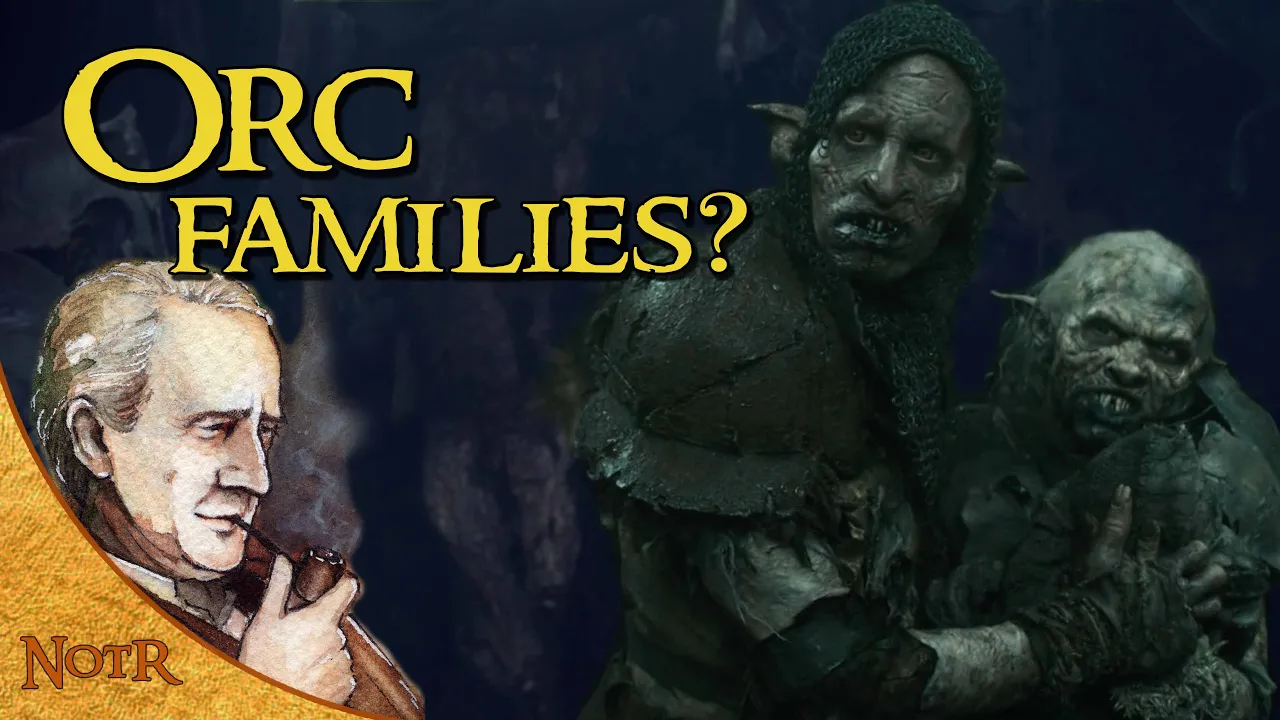
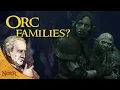
Hello again, everyone! I thought we’d do a quick deep time into a very specific topic. I’ve seen a lot of chatter online and in comment section about the orc family depicted in the 3rd episode of The Rings of Power’s second season.
There’s a lot of conflicting info and misconceptions going around, so I thought we’d take a look at how Tolkien developed the idea of where orcs came from, how they reproduce, what hints we get of their society, whether there’s validity from the lore or not in the Rings of Power depiction - and I’ll give some of my thoughts on the choice to have this in the show. The first indication we get from Tolkien regarding the possibility of orc families comes in 1937’s The Hobbit. There, we meet Bolg - the chieftain who leads the army of orcs in the Battle of Five Armies.
Gandalf tells Dain Ironfoot that Bolg of the North is coming - whose father Dain slew in Moria. That father is Azog, himself a chieftain which we learn more of in the appendices of The Lord of the Rings. This tale of Azog and Dain outlined in Appendix B is a great story of the latter getting revenge for the death of the dwarven King Thror.
Now, we don’t get any sense for what the relationship would have been like between orc father and son in these books. One thing that is apparent is there was a line of succession, as Bolg takes leadership of the orcs of the Misty Mountains after his father’s death. But this is just the beginning of Tolkien’s writings regarding the orcs.
As we dive deeper into the incredible History of Middle-earth series published by his son Christopher, we find the concept of how orcs are created changed over time. In the Book of Lost Tales, we read: “. .
. for all that race were bred by Melko of the subterranean heats and slime. Their hearts were of granite and their bodies deformed.
” This comes during a time when Tolkien planned for Morgoth (here with his earlier name of Melko) would create the orcs himself. Elsewhere we get great lines like "the hordes of Orcs he made of stone, but their hearts of hatred". And "yet the Orcs were not made until he had looked upon the Elves, and he made them in mockery of the Children of Ilúvatar".
In the end, Tolkien would decide against the idea of Morgoth being capable of truly creating anything himself, for only Iluvatar, the god of Tolkien’s world, could wield the flame imperishable and give things life. From this, we get the various potential origins of orcs - the most commonly referenced of these being corrupted elves: Yet this is held true by the wise of Eressëa: that all those of the Quendi that came into the hands of Melkor, ere Utumno was broken, were put there in prison, and by slow arts of cruelty and wickedness were corrupted and enslaved. Thus did Melkor breed the hideous race of the Orkor in envy and mockery of the Eldar, of whom they were afterwards the bitterest foes.
Morgoth’s Ring However, this was far from the final ideas Tolkien had. One such concept is that they were soulless beings - like the great eagles - who were taught speech and made to be loyal to evil, much like the eagles were made to speak and were loyal to the Valar. There was also the idea that they were corrupted men, rather than elves.
Whatever their origin, it is clear that Tolkien envisioned orcs being creatures somehow twisted by Morgoth. But what of this idea of orc children as we see an orc baby in Rings of Power? In the simplest terms, Tolkien made it quite clear that orcs did reproduce just as men and elves, saying “For the Orcs had life and multiplied in the manner of the Children of Ilúvatar; “ I’ve been rather surprised at the number of posts I’ve seen of people claiming that orc women and children are not a thing at all, which is quite simply not remotely true.
No doubt a common source of the confusion is from the excellent Lord of the Rings trilogy of films, where we see birthing pits being the source of Saruman’s Uruk-hai. Now this has given rise to the belief that there are no orc women. And that orcs simply spring out of holes in the ground!
Tolkien himself responded to a reader back in 1963 - long before any of the previous few notes were published - answering the question about whether orc women existed… "There must have been orc-women. But in stories that seldom if ever see the Orcs except as soldiers of armies in the service of the evil lords we naturally would not learn much about their lives. Not much was known.
" To their credit, the films also have Gandalf saying that Saruman is breeding Orcs and Goblin-men to create his army, though most only remember the birthing pits. Going deeper into the concept of Saruman’s most vile deed, we get a chilling passage in Morgoth’s Ring that speaks to Saruman’s experiments as he sought to, and eventually succeeded in, creating his Uruk-hai. Finally, there is a cogent point, though horrible to relate.
It became clear in time that undoubted Men could under the domination of Morgoth or his agents in a few generations be reduced almost to the Orc-level of mind and habits; and then they would or could be made to mate with Orcs, producing new breeds, often larger and more cunning. There is no doubt that long afterwards, in the Third Age, Saruman rediscovered this, or learned of it in lore, and in his lust for mastery committed this, his wickedest deed: the interbreeding of Orcs and Men, producing both Men-orcs large and cunning, and Orc-men treacherous and vile. So, looking at Tolkien’s text, we find that there were orc women, that orcs reproduced just as humans, and orcs definitely had children and lines of succession.
But what of the idea of orcs as we see in The Rings of Power, where they’ve been portrayed in a much more sympathetic light that fans would naturally expect? There is some measure of precedent for this idea, though there are also writing which seem to refute this as well. And, I’ll save this to the end, the question of whether this is a concept that should be explored in an adaptation of Middle-earth.
In a Letter written in 1954, Tolkien intentionally stops short of calling orcs irredeemable: They would be Morgoth’s greatest Sins, abuses of his highest privilege, and would be creatures begotten of Sin, and naturally bad. (I nearly wrote ‘irredeemably bad’; but that would be going too far. Because by accepting or tolerating their making – necessary to their actual existence – even Orcs would become part of the World, which is God’s and ultimately good.
) While Tolkien certainly leaves the door open for orcs to be redeemable, we never see examples of orcs going so far as to seek such redemption or do any good actions. In fact,in the same letter, he speaks to the theological issue that could arise from a race so under the sway of Morgoth and Sauron: That God would ‘tolerate’ that, seems no worse theology than the toleration of the calculated dehumanizing of Men by tyrants that goes on today. There might be other ‘makings’ all the same which were more like puppets filled (only at a distance) with their maker’s mind and will, or ant-like operating under direction of a queen-centre.
Now, it’s no secret that the orcs do not serve Sauron out of a love of their master. And within the very pages of The Lord of the Rings, we find orcs who talk about a desire to live outside Sauron’s control: ‘I’d like to try somewhere where there’s none of ’em. But the war’s on now, and when that’s over things may be easier.
’ ‘It’s going well, they say. ’ ‘They would,’ grunted Gorbag. ‘We’ll see.
But anyway, if it does go well, there should be a lot more room. What d’you say? – if we get a chance, you and me’ll slip off and set up somewhere on our own with a few trusty lads, somewhere where there’s good loot nice and handy, and no big bosses.
’ ‘Ah! ’ said Shagrat. ‘Like old times.
’ Years after both The Lord of the Rings and his letter about orc redemption, in an essay on Orcs, Tolkien talks specifically about Sauron’s taking over control of the orcs - and the period of time when the orcs were without a dark lord at the beginning of the Second Age: But he had also inherited from those days difficulties, such as the diversity of the Orcs in breed and language, and the feuds among them; while in many places in Middle-earth, after the fall of Thangorodrim and during the concealment of Sauron, the Orcs recovering from their helplessness had set up petty realms of their own and had become accustomed to independence. Nonetheless Sauron in time managed to unite them all in unreasoning hatred of the Elves and of Men who associated with them; while the Orcs of his own trained armies were so completely under his will that they would sacrifice themselves without hesitation at his command. So we’ve taken a look at what Tolkien has said when it comes to the orcs - a bit about their creation, how they reproduce, and their potential for redemption.
And we come to the big question - is the depiction of orcs in Rings of Power a valid interpretation? Showing orc women and children is obviously valid - Tolkien makes it abundantly clear that there were orc women and orcs reproduced like men and elves - ergo, there are orc babies. And we do see the orcs would show some measure of desire for independence from their overlords.
For me, the biggest question for Rings of Power comes down to whether this concept, and the more sympathetic nature its presented in here, is something worth exploring in an adaptation. I think perhaps my thoughts on the orcs go hand in hand with further quotes we read from Tolkien’s later essay on the creatures: They were indeed so corrupted that they were pitiless, and there was no cruelty or wickedness that they would not commit; but this was the corruption of independent wills, and they took pleasure in their deeds. They were capable of acting on their own, doing evil deeds unbidden for their own sport; or if Morgoth and his agents were far away, they might neglect his commands.
They sometimes fought [They hated one another and often fought] among themselves, to the detriment of Morgoth’s plans. Tolkien makes it clear that orcs were not evil in their origin, but that they may have become irredeemable (at least in the eyes of elves and men), because of the corruption of Morgoth. When it comes to depicting orcs on screen, I think the choice to show orcs who wish to be free from Sauron’s control is both valid and interesting.
However, I also think it could end up being a rather fruitless exercise. At the end of the day, the orcs will serve Sauron and will be among the villains of the series. Hypothetically, orcs could have a desire to be free of his control, but we also know they are beings who take pleasure in doing evil deeds - doing so for their own sport.
It’s also worth mentioning that every time we encounter orcs in Middle-earth tales, they are unquestionably servants of evil and doing evil deeds. While it’s an interesting philosophical topic, I think the idea of orcs being loving families who just want to live in peace - basically anything beyond the point of evil creatures who just don’t wish to serve under Sauron, probably ceases to be productive in telling the story at hand. Even now, within the show itself, after all the sympathy they’ve sought to build within the show’s story - there’s no question who I will root for if any of these orcs meet someone like Elrond on the battlefield.
In the end, the orcs will be instruments of evil, who take pleasure in evil. They will attack Eregion and seek to kill the heroes of the show. Like showing a repentant and/or sympathetic Sauron in Season 1, I think it’s something that makes for an interesting conversation piece, but doesn’t serve to tell the story of The Rings of Power, the Fall of Numenor, the Last Alliance, or any of the Second Age with efficiency.
And honestly, in my mind, there are far better candidates for showing antagonists in a positive light. The Haradrim, those we met in the films who ride the Mumakil, would be a terrific choice. Not only does Sam bring up the very idea of Haradrim not wishing to go to war, but in the Second Age, the Haradrim begin as friends to the Numenoreans.
The men of Numenor teach the Haradrim many things they had learned from the elves. But as Numenor descends to become more and more evil, they start oppressing and enslaving the Haradrim. If you wish to reframe how audiences feel about villains in Middle-earth, I can’t help but think your mileage would be greater with the Haradrim or even the Easterlings - who we know had people among them who opposed Sauron.
While the idea of sympathetic orcs makes for great philosophical conversation, I just don’t see this being as effective as the show likely hopes it will be. Still, it’s worth repeating that the inclusion of an orc family is not some obvious lore breaking story element. Moreso, I just question whether it will end up being a fruitful one when it comes to this Second Age story.
But these final thoughts are obviously just my opinions when it comes to this specific depiction so far - what do you guys think? Is the orc depiction in Rings of Power something you find resonates with you? Or do you find trying to give villains of this caliber of evil these different shades of morality misses the mark?
Let me know in the comments.
![The History of Sauron [COMPILATION] | Tolkien Explained](https://img.youtube.com/vi/8IqAN1Of70k/maxresdefault.jpg)