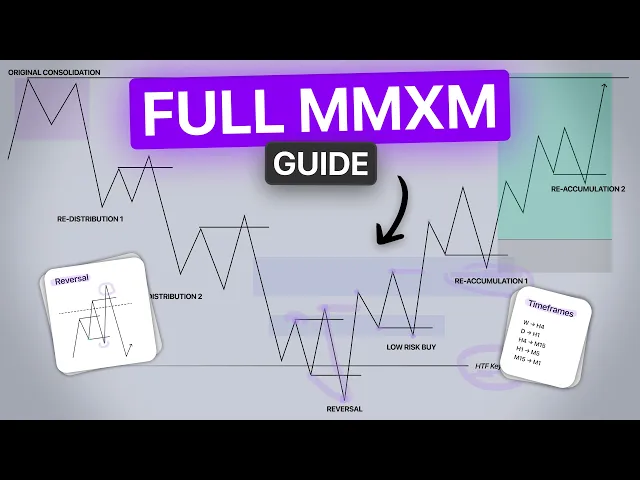
What is good, guys? Welcome back to the channel, and today I will give you a deep dive on how to actually trade different phases of a market maker buy or sell model. In the last video, I talked about that you also should journal the different stages of a market maker model you are trading, and you guys have been asking me in the comments if I could elaborate a bit more on that topic, and that's exactly what we will do because out there is a bunch of BS about the market maker sell models or buy models, and a bunch of people don't even know how to properly trade a market maker model.
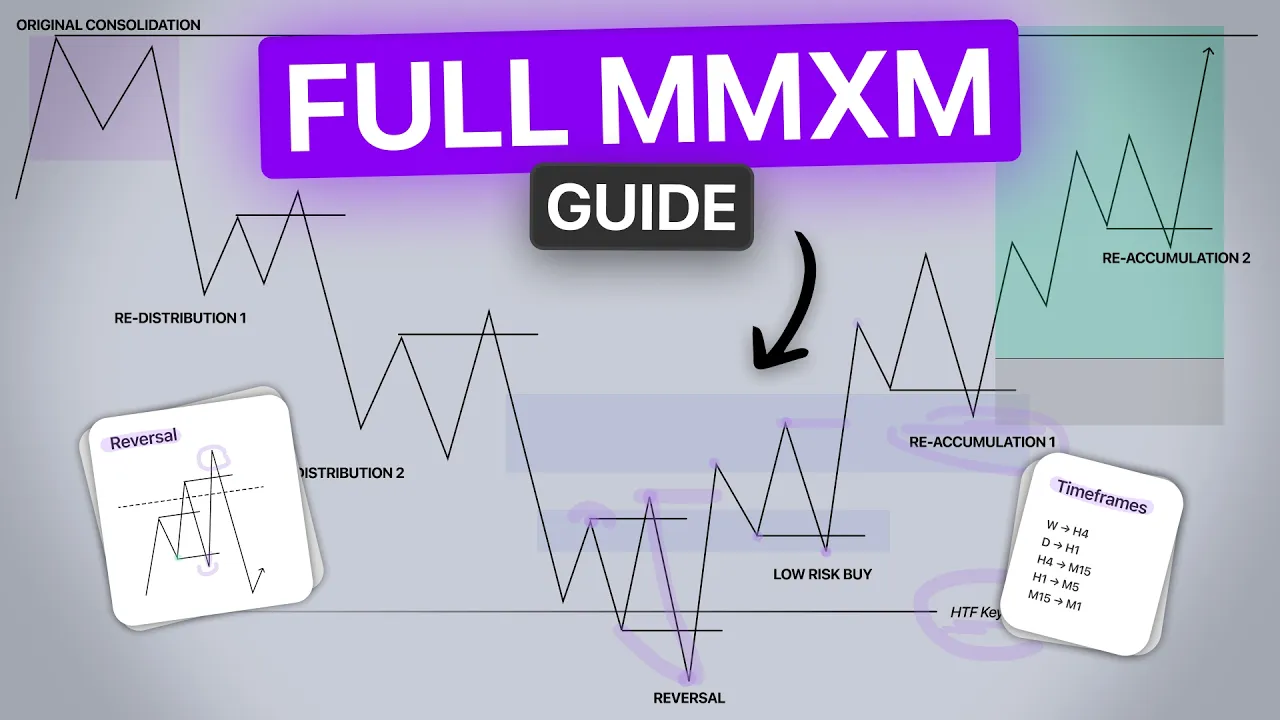
So, let's get straight into it. Now, first of all, we have to understand the different stages of a market maker model. So, in this video, I will showcase everything based on a market maker sell model, but the same applies on a market maker buy model, just the exact opposite side way.
So, first of all, the first thing you have to look out for is always your higher time frame biases and narrative. You don't simply go into the market and look for pattern with those different stages. That is actually one of the last steps.
The first step always to identify what is my higher time frame biases, and then you want to look for your higher time frame key level. And that's the first thing you always want to watch out for. You want to know what is my bias, what is the higher time frame key level I want to see price to retrace into, and then based on that, I will look for a market maker model, in this case, a market maker sell model to form from that higher time frame key level.
So, the first thing is determine the higher time frame key level. And then the next step you have to be aware of is the time frame of that key level because the time frame of the key level, that will determine the time frame you have to look out for for the reversal to be confirmed on. And the time frame alignment matrix you want to use for those reversals to form is as follows.
If we have a weekly key level, you want to look out for an H4 confirmation in form of an H4 reversal to print from that weekly key level, right? How a reversal will form, that's what we're going to talk about next, but for now, we just keep in mind the time frame alignment of the key level and then the reversal. So, for daily time frame key level, you want to use an H1 reversal.
Then for the H4 key level, we can use the M15, and for the H1 key level, we can use the M5, right? And I myself I don't use anything for the H1 as a key level, but if you trade on a lower time frames, which I wouldn't recommend on Forex, then the following time frames would be for the M15, you can use then the M1. So, that's the time frame alignment of the key level with the reversal time frame.
Now, the first phase of a market maker sell or buy model is always the reversal. We have initially the left side of the market maker model, in this case, that's the buy side before we then transition into the sell side. On the buy side, you will see price forming here a consolidation.
That is the original consolidation, which then we will target once price has confirmed the reversal, and then the sell side has then initiated. Usually then, on the way up, you will see either one or two phases of reaccumulation. That is where price will pretty much consolidate, meaning reaccumulate, and then expand into the higher time frame key level.
The same on the sell side, we either will have one redistribution, or we will have a second redistribution. Both can happen. On the buy side, it's called accumulation, on the sell side, it's distribution.
Doesn't really make a big difference. You just have to know that we will have those two different stages on the buy side and the sell side. Now, typically, you don't want to trade a reversal, especially if you're a beginning trader.
Trading a reversal is quite tricky. Now, what typically will happen at a reversal time frame, you will see often times a double sweep or SMT with a double sweep to form. Now, what is a double sweep?
As you can see in that small schematic up here, typically, if we hit the key level for the first time, and we sweep like an old high into a key level, for example, we sweep that old high for the first time right here, and then you see price initially giving you a bearish rejection from that high. That rejection will then run the last low which led to that initial move up higher, which took out the high, this higher time frame high. Now, what happens most of times before we actually form the true reversal, price will run below this low, take out all the sell stops resting below that low, and then run up one more time to run above this high.
As you can see here, we initially run the high first, come back one more time, run this weak low, which led to the initial sweep, and then price is pushing up one more time to take out all the early shorts which have piled in on the initial move lower. And if you reverse engineer reversals of a market maker buy or sell model, you will see quite often that this double sweep will occur before then price gives the true reversal. You can also see, once price then breaks below again this low, this time it broke through a strong low because this low has taken the liquidity resting on the initial weak low.
And if price breaks through a strong low, that is always a higher probability indication of a true reversal than if price breaks through a weak low. So, you always want to watch out for that second sweep. It doesn't always happen, but it happens quite often.
Also, on the second one up higher, you often times will see an SMT forming between those two highs on the initial sweep. Meaning, often times you will see price run this low, come back up one more time, and then, for example, if you're on pound, you might see on euro that price runs this high, but pound doesn't, or the other way around, and then you have also your SMT at your key level. That's also where you'll find SMT to form quite often.
Now, how can you trade a reversal? I would recommend to always skip the reversal. There are ways to trade the reversal, for example, by looking for a lower time frame double confirmation, but I will talk about that in a different video, so I won't go into detail.
So, what you want to do, we ideally always want to wait for price to confirm the reversal by breaking through that strong low and closing below, right? And that is then here the indication that price has confirmed the reversal. Now, does that mean once the reversal has been confirmed that we can go in and just blindly short the market?
No, it does not. Because the next thing that is forming is the low risk sell. And the low risk sell is in a market maker sell model the first opportunity to look for your first sell position.
Now, this doesn't mean you have to take it all the time, but you have to go in with the same risk as usual because that is typically the second riskiest entry opportunity you will get in a market maker sell model. How you want to trade this low risk sell is as follows. >> [snorts] >> If this market maker sell model is aligned with the higher time frame order flow, meaning, for example, we have daily bearish order flow, then hourly is retracing into this daily key level, and then the hourly order flow is again realigning on the reversal with the daily order flow, then that's a really high probability framework, and you can be more aggressive with trading low risk sell.
Now, what does that mean? If that's the case, you can already look for a turtle soup entry on the low risk sell. Typically, you want to see price to engineer a weak high in this newly formed bearish range, which we formed after the reversal, meaning we have our new dealing range with a range low, a range high, that is retracing, engineering this weak high, and then price runs this high one more time, and then you see the first phase of expansion.
Now, again, if daily and H1 order flow are aligned, we can look to turtle soup this entry, validation being as the reversal, so something like that. Entry here. Invalidation would be then at the reversal.
And we can target then the internal liquidity, and also, obviously, the external being the original consolidation. That will be the first entry opportunity. Now, if, for example, this stop size is way too large because the distance to the reversal is too big, then it's better off to wait for a new confirmation above this weak high.
Meaning, we drop down to the lower time frame, wait for price to run above this high, and then give us a new lower time frame confirmation. That's also one opportunity if price is aligned with the H1 and the higher time frame daily order flow in this example. Meaning, you wait for price to run above, give you confirmation in the lower time frames, and then you look to short, and then in this case, the validation will be, obviously, the lower time frame validation.
Right? And same thing here, target internal and external for the last partial. If, for example, you trade against daily order flow, meaning, daily order flow is, in this case, bullish, but you still want to look for an hourly bearish sell model inside this daily bearish order flow, which you can also do, but it's not as high probability as if you're trading with daily order flow being on your side.
So, what I typically do in that case is I wait for price to break again this low, right? Because then this tells me price confirmed the low risk sell. So, if price runs above this high, sometimes we also won't engineer a high here, and price will immediately just retrace, and then sell off.
But often times, you will see price also engineering a high, sweeping the high, and then selling off. As mentioned, in the case of daily and hourly order flow not being aligned, what I want to look out for is price to break below this low. Right here, we make a new low, but it's closing below this last low and forming here a new bearish dealing range.
Again, strong high, new low, price forms a new dealing range. And then I look to trade this new dealing range. Meaning I want to then wait for the first redistribution.
And that's also my favorite stage of the market maker buy or sell model, the first stage of redistribution of the buy model, then the first stage of reaccumulation. Why? Because price already confirmed being bearish by confirming the lowest sell after the reversal.
So you kind of two confirmations. And second of all, price is still trading in a premium. You can see right here those quarters.
You have the lowest quarter, the two mid quarters, and then the upper quarter. The most high probability entries always form in this quarter here, right? The second quarter from the top.
So you always want to look to position yourself, ideally, in this zone. You can also look to position yourself in the quarter below, in this one, but you want to avoid looking for entries down here, right? That is low probability because we're already trading in a deep discount of this market maker sell model.
So the most high probability entries you will always find in this area. Now, also, what you want to watch out for in a market maker sell model is always inversion levels, right? That was for me a game-changer when I implemented inversion levels into my market maker models.
And what do I mean by that? You want to look out for old bullish PD arrays, which formed on the way up, and price has been using to reaccumulate. For example, if we have a fair value gap here, which price used to reaccumulate, then run higher.
Once price closing below and also forms on the sell side a bearish key level, bearish order block, or bearish imbalance, and you align both the inversion key levels with the newly formed levels on the sell side, and if they both align, that's a really high probability key level to look out for a retracement and then a continuation. And same thing here, if there's, for example, here a bullish imbalance, which price used to expand higher previously, and we now come back lower, initially respected, sweep the high, and then close below. For me, also ideally a bearish imbalance on the sell side.
Then you know, this zone right here is your high probability key level, and it's also in the second quarter from the top. All right? Then you know, that is my high probability key level.
What do I want to see next? I want to see price to engineer here weak high, and then I want to look for a manipulation of that weak high, and then I can look to enter. Now, what entry models can I use in this phase?
That is where you can be most aggressive with your entries. You can use turtle soup. Invalidation would be again the recent strong high.
Target the low. And you can also use a confirmation again, same as with the option. Wait for price to run above, gives you a lower time frame confirmation, and then look for your entry, right?
Something like this. And you can combine also both entries. You can get initial entry here, and then if you get a confirmation, you can pyramid into that setup by adding a second position, and then modifying the stops of the initial position, all right?
That is my favorite phase of a market maker sell model or buy model if it's accumulation. All right. Now, you can see here we have one more redistribution.
That's also something you can trade, but again, only if the entry forms in this third quarter from the top. You don't want to look for an entry if this would have formed somewhere down here because that's way too deep in a discount. And same thing here, you can apply the same entry model as here, turtle soup and a lower time frame confirmation, but only if it is still forming inside this third quarter.
And now let's take a look at an example of a market maker sell model we have seen on pound forming last week. So we have here our higher time frame daily key level. That's a daily opening gap.
And daily order flow also has been bearish on pound. So we know, okay, the hourly is here retracing into our daily bearish key level. And then we know, daily time frame needed hourly confirmation of the reversal.
So what can we see here? Price runs to the key level. We have here this weak low, which price runs, runs up higher, and then again runs into the key level.
This time, we failed to run this high, but we had here an SMT with EUR/USD. Meaning euro took out that respective high, but pound failed to do so. Then once that happened, we see this displacement lower, and price is breaking through that low.
So at this point, price is confirming the reversal. This candle confirmed the hourly reversal. The next thing we want to look out for is the lowest sell.
In this case, you can see we have not engineered another high to then get swept. We immediately retrace and then sell off without engineering here another previous high. So the lowest sell, again, in this case, I did not trade that because there was no high to sell above.
So I can't trade this move. But as you guys know, my favorite entry is anyways the first stage of redistribution or the second stage of redistribution. So also we have the quarters.
We have the high, the low with the initial consolidation, and you can see the different quarters here. All right. Now, what do we do?
We wait for the redistribution, and you can see here we redistribute here around the mid range. Also, we have here this bullish fair value gap, which price used to reaccumulate previously, sweep below, expand higher. And what you can see here, price couldn't close below with candle bodies, and then we close below here.
And now also watch what happens on the sell side. On the sell side, we form right here a bearish fair value gap. So there we have the alignment of an inversion fair value gap and a bearish fair value gap forming on the sell side.
Now, what do you want to look out for? A sweep of a high into that key level. And we have the high engineered here, and then price comes up one more time, sweeps the high into the key level, and then sells off.
So in this case, we can sell this high, and also look here for lower time frame confirmation to then trade the expansion. So first entry would be up here, either turtle soup or a lower time frame confirmation to then add another position. Now, what we have here is second phase of redistribution.
You can see here, this time we formed redistribution two in the third quarter from the top. So we can still look for an entry here since we're not trading here in the lowest quarter. So in this case again, we do the same thing.
We short above this high. Invalidation, the recent strong high. And then target consolidation.
And again, we could look here for a lower time frame confirmation, but this happened here in the Asian session, so I would avoid the lower time frames. But this would have been another valid turtle soup entry of the second redistribution. And that's pretty much all you have to know on how to trade market maker sell or buy models.
If you learned something new, leave a like down below, and also don't forget to check out the free 12-hour course down below. That being said, guys, see you in the next video.