hi in this video i'm going to show you how to transcribe a recording in literally before we begin here are some things to know you will need to use the chrome browser on a laptop or desktop computer to complete an application the transcription interface does not work on other browsers nor does it work on tablets or smartphones we recommend that you use headphones for this work since some of the recordings you receive will have poor audio quality and finally it's very important that you read all of the instructions on our website carefully in addition to
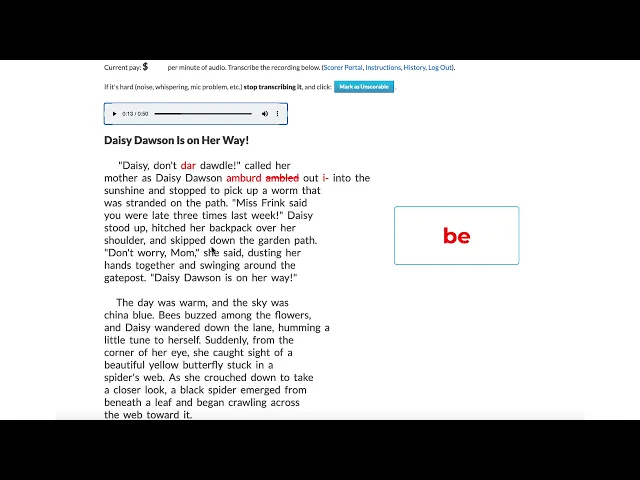
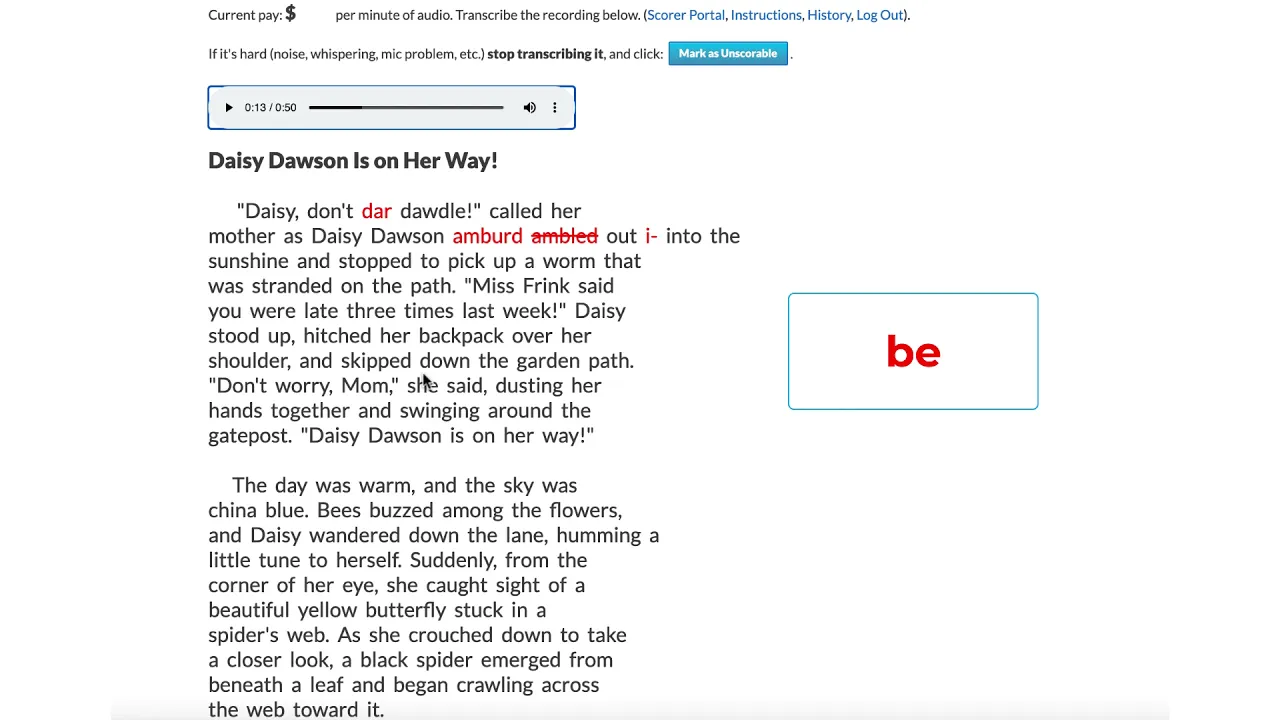
watching this video let's now switch gears and look at the recording you'll notice at the top of the page that there is the audio player so i'm going to start by pressing space bar and that will start the recording daisy don't dar dawdle called her mother so you'll notice that right off the bat the student says dar dawdle dar is not in the text so we'll need to insert it it's also not a word so we need to transcribe it phonetically if you go back to the instructions you'll notice this link to the phoneme chart
which you can see right here we recommend saving this chart or printing it out for quick reference the vowels are on the first page and the consonants are on the second page for dar i hear the d sound followed by the r sound which is ar so d-a-r to type this into the transcript we'll want to hover over the space in front of dawdle and press a we'll type dar into the box hit return and this will insert the dar into the transcript daisy dawson amber out next we hear the student say amber instead of
ambled so we need to transcribe that phonetically according to the phoneme chart this is an a followed by an m followed by u r which makes the er sound and ending with d for d this one's a little tricky because you might be tempted to use er for er since we see this spelling a lot in words but the actual phonetic transcription of this is ur you'll notice that in the phoneme chart generally the letters for the phoneme make sense and match up with that phoneme but there are some cases where you'll need to be
careful especially with the vowels another example is that the letter c does not exist for the sound we'll need to use k instead so it's very important that you look over the phoneme chart carefully and double check it as you're working now that we know how to transcribe amber we're going to want to hover over the word ambled and in this case we can actually press s and this will both mark the word as not being said and allow us to insert the replacement so amber let's actually go back a little bit in the recording
and re-listen a little bit which i can do with the left arrow called her mother as daisy dawson ambered out into the sun and here you'll notice that the student says it so we want to use the a key to insert this notice that i've placed a hyphen after the eye the hyphen indicates that this is the sound rather than the word i any time that you insert a sound that also looks like a word that's pronounced differently you will want to use the hyphen to make clear that you're referring to the phoneme as another
example of this imagine that the student says be as in the first part of best if you insert b e this is going to look like the word b so you'll want to insert hyphen so that we interpret this as that let's keep listening and shine and stop to pick a worm uh here the student omits the word up so we'll use d to mark this as unread that was stranded on the path ms frink said that you were late i hear that here so let's use a to insert it three times last week daisy
stood up hitched the backpack her backpack over her shoulder for this part you might be inclined to mark her as unread and insert her backpack here but notice that the student actually corrected herself in the recording and said her correctly so we wouldn't want to do this instead we'd want to insert the backpack in front of her backpack so let's go back and listen to that part again daisy stood up hitched the backpack her backpack over her shoulder and you'll notice that the recording matches the transcript here exactly and skip down the path here we'll
press d to delete garden since she did not read this word don't worry mom shh she said and here she inserts a sh sound which according to the phoneme chart is sh so we'll use the a key to add that dusting her hands together and swinging around here the recording stops after the student says arow she doesn't read anything from around onwards so i can hover over the word around press e and this will mark all the words from there to the end of the passage as not said it's like pressing d over all of
those words i also want to make sure to insert a row right after swinging and using the phoneme chart a row would be u for a r for uh and o w for ow so let's use the a key to insert a route now i want to go back listen to the recording again and make sure it matches my transcription exactly daisy don't dar dawdle called her mother as daisy dawson ambered out into the sunshine and stop to pick a worm that was stranded on the path miss frink said that you were late three times
last week daisy stood up hitched the backpack her backpack over her shoulder and skipped down the path don't worry mom she said dusting her hands together and swinging around so my transcription matches the recording exactly so now i'm done and compress the equal sign to submit my transcription if this is a training recording then it will look over my transcription and find any differences between what i transcribed and what the correct transcription is we encourage you to look at the answer keys and use that information to improve upon your transcriptions of future recordings before we
wrap up here are some other important rules to keep in mind as you're transcribing if the reader attempts to read the title you should transcribe their attempt before the first word in the text you shouldn't use punctuation except for apostrophes that are part of a word like in isn't you can choose to transcribe exclusively in lowercase or to capitalize in the usual way the one exception is that you should always capitalize proper nouns and if a student inserts a real word we would prefer that you transcribe the actual word instead of the phonetic transcription although
both are correct for example if a student inserts the word clock you can insert the word clock or the phonetic transcription k-l-o-k both are correct but we would prefer the real word this list is certainly not exhaustive so please review the instructions page for a full list of rules and accompanying examples