In Ontario, is there a law regarding the usage of seatbelts? A yes B No. See only when driving on a non urban highway.
D Only when driving within a city, Oregon town. Right answer is a yes. When are you required to wear a seat belt?
A. Wearing a seat belt is optional. B.
Only drivers are required to wear a seat belt. See only passengers are required to wear a seat belt. D All drivers and passengers are required to wear a seat belt and be properly buckled up.
Right answer is D All drivers and passengers are required to wear a seat belt and be properly buckled up. In Ontario, there is a seat belt law. A Yes.
Be. See only when driving on an open highway. D Only when driving within a municipality.
Answer is a yes. Drvers will receive a fine up to $1000 and two demerit points for not wearing a seat belt. Drvers must ensure all passengers under the age of 16 are properly buckled up.
Unbuckled passengers 16 years and older can be fined. If you're being tailgate, what is the best course of action? A.
Change lanes when it is safe to do so. The reduce speed slightly to increase the space in front of your car. C Pull over to allow the tailgater to pass.
D All the above. Answer is D all the above. Answer is B.
You will be docked 6 demerit points and find up to $1000. It is illegal not to stop behind a stopped school bus with alternating flashing red lights. If you do not stop, what can happen on a first offense?
A. You can be fined 40 to $200. 00 and get 2 demerit points.
B. You can be fined 400 to $2000 and get 6 demerit points. C You can be fined 4000 to $20,000.
D You will not be fined for the first offense. You will only receive a warning. Answer is B.
You can be fined 400 to $2000 and get 6 demerit points. When do you stop for school bus if there is a median? A.
Whenever you approach and see. Be never, because they will stop for you. See whenever they stop.
D Only if you are behind a stopped bus which has its upper red alternating lights flashing. Answer is D only if you are behind a stopped bus which has its upper red alternating lights flashing. School buses also have flashing stop signs that swing out from the driver's side, notifying vehicles to stop.
Stay back the required distance. If there is no median, how far in front and behind a school bus are you required to stop when its lights are flashing? A.
At least 20 meters behind and far enough in front for children to exit the bus and cross safely. B. At least 20 foot behind and far enough in front for children to exit the bus and cross safely.
See at least 10 meters behind and far enough in front for children to exit the bus and cross safely. D At least 10 foot behind and far enough in front for children to exit the bus and cross safely. Answer is A at least 20 meters behind and far enough in front for children to exit the bus and cross safely.
Only pro ceed when the bus lights have stopped flashing or the bus has moved. When a car has stopped to allow a pedestrian to cross the street at a marked crosswalk, what should you do? A pass the stopped car on the left.
B. Sound horn for the driver of the stopped car to drive on. See past the stopped car to the right.
D Not pass any car stop to allow a pedestrian to cross. Answer is D not pass any car stop to allow a pedestrian to cross. When driving in heavy fog, you should use a parking lights.
The low beam headlights. See parking lights and high beam headlights. D High Beam Headlights.
Answer is B. Low beam headlights. Never change lanes in traffic without.
A. Give proper signal and looking to make sure the move can be made safely. B.
Decreasing speed and giving the correct signal. See Looking into the rearview Mirror only. D Blowing your horn and looking to therear.
Answer is a give proper signal and looking to make sure the move can be made safely. What documents may a police officer require a motor vehicle owner to produce? A.
If the motor vehicle is insured, A liability insurance card. B. The motor vehicle ownership.
See if he is operating a motor vehicle a valid driver's license. D Any of the above. Answer is D any of the above.
What are you required to do if a police officer signals you to pull over? A. Slow down safely pull over in the left lane and come to a complete stop.
B. Slow down safely, pull over in the right lane and come to a complete stop. C Slow down and stop in the lane you are in.
D Signal and stop at the next intersection and wait for the police officer. Answer is B Slow down safely pull over in the right lane and come to a complete stop. Do not get out of your vehicle.
Wait for the police officer to come to you. Answer is B Move drivable vehicles off the road to enable traffic to move freely and exchange information. As long as no one is hurt and damages are less than $2000, move drivable vehicles off the road safely to allow traffic to flow.
Then call police services, not 911, and obtain the closest collision reporting center to report the accident. If you are in an accident with no personal injuries but damages are over $2000, you should. A.
Exchange information with the other party and leave. B. Call police and give them information about the accident and damages.
See leave the scene as no fault insurance handles this. D All the above. Answer is B.
Call police and give them information about the accident and damages. Provide as much information to police about the accident as possible, giving them information about vehicles and damages. Also obtain witness contact information to give police.
When driving in low light conditions, you must use your vehicle's lower beam headlights when following another vehicle. Within what distance? A 30 meters, 100 feet.
Be 60 meters, 200 feet. C 120 meters, 400 feet. D This only applies when approaching another vehicle.
Answer is B 60 meters , 200 feet when lights are required. Drvers must use lower beam headlights when following another vehicle. A.
Within 30 meters, 100 feet. Be within 60 meters, 200 feet. C within 120 meters, 400 feet.
D This only applies when approaching another vehicle. The answer is B within 60 meters, 200 feet. Use low beam lights when you are less than 60 meters behind another vehicle and within 150 meters of oncoming vehicles.
Never use parking light for driving. They are only for parking. When using high beam lights, when do you have to switch to low beam lights?
A within 150 meters of oncoming vehicles. B. Within 50 meters of oncoming vehicles.
See. You do not have to switch. D If the oncoming car puts their high beams on, you do not have to switch.
Answer is a within 150 meters of oncoming vehicles. Use low beam lights when you are less than 60 meters behind another vehicle and within 150 meters of oncoming vehicles. Never use parking light for driving.
They are only for parking. How far away must headlights and rear lights be seen? A.
From 50 meters away. B. From 150 meters away.
C from 1150 meters away. D They must be seen clearly in the dark. Answer is B from 150 meters away.
You must also have your rear license plate illuminated with white lighting when headlights are on. Ensure headlights are on 1/2 an hour before sunset and leave them on for 1/2 an hour after sunrise. While traveling on a highway, the driver of a motor vehicle is not permitted to carry in a house or boat trailer.
A. Firearms. Be flammable material.
See persons passenger. D Pets. Answer is see persons passenger.
You must also have your rear license plate illuminated with white lighting when headlights are on. Ensure headlights are on 1/2 an hour before sunset and leave them on for 1/2 an hour after sunrise. If towing a trailer that is 2.
05 M wide or less, what must it have? A. Too far apart, red reflectors at the back, a white license plate light and red tail light.
The flashing yellow lights at the rear. See flashing red lights at the rear. D None of the above.
Answer is a too far apart. Red reflectors at the back, a white license plate light and red tail light. Can anyone tow a trailer with a gross weight of up to 4600 kilograms?
A. As long as you have a valid GG 1G2 or higher driver's license. B.
As long as you have a valid GG 1G2 or higher drivers license plus a trailer plate and permit. See, as long as your trailer has trailer plates. D Only if you have your commercial vehicle license.
Answer is B, as long as you have a valid GG 1G2 or higher driver's license plus a trailer plate and permit. A trailer requires a special permit and plates that you need to obtain and a one time charge from a vehicle license issuing office. The two second rule provides a minimum safe distance between vehicles.
In what situations might you need to increase this distance? A In clear weather conditions. B.
When following motorcycles or large trucks. C when carrying a light load. D when driving on a newly paved Rd.
Answer is B when following motorcycles or large trucks. A trailer requires a special permit and plates that you need to obtain and a one time charge from a vehicle license issuing office. How much space should you have between you and vehicle you are following?
A. No rule applies and you will not get a fine or demerit points as long as caution is used. B.
There is a rule of 20 seconds, but it is for motorcycle drivers only. See at least 12 seconds so you can see around the vehicle ahead and also have enough time to stop. D At least 2 seconds so you can see around the vehicle ahead and also have enough time to stop.
Answer is D at least 2 seconds so you can see around the vehicle ahead and also have enough time to stop. If driving conditions are not ideal, add more space, especially if driving in bad weather or following larger vehicles, motorcycles or when you have a heavy load. Use markers on the road to help determine correct following distance.
If there are no posted speed limits, what is the maximum speed in areas outside of cities, town and villages? A 60 kilometers per hour. The 70 kilometers per hour.
See 80 kilometers per hour. D90 kmh answer is C 80 kilometers per hour where no speed limit is posted. The limit is 80 kilometersper hour outsidethese areas.
Unless posted in cities, towns, villages and built up areas, the maximum speed limit is. A 40 kilometers per hour. Be 50 kilometers per hour.
See 70 kilometers per hour. D80 kmh answer is D 80 kilometers perhour . Where no speed limit is posted, the limit is 80 kilometers per hour outside these areas.
What is the maximum distance a motor vehicle driver should maintain when passing a cyclist where practical? a meter. B 1m.
C 2 meters. D3 meters. Answer is B 1 meter when passing a cyclist, as a best practice allow at least 1m between your vehicle and the cyclist.
Whenever possible, you should change lanes to pass. Do not follow too closely behind cyclists. How much room do cyclists need on either side of themselves as a safety zone?
A4. 3. C2M.
1M. Answer is D1M. Failing to leave the required amount of space could result in a fine and two demerit points.
Also, opening a door of a parked vehicle into the path of a cyclist or traffic could result in three demerit points and a fine. When you approach a busy intersection on a main road and it's blocked with traffic, you should not stop if a there is no stop sign. It is an uncontrolled intersection.
See you are turning left or right. D You must stop and wait until the traffic ahead moves on. Answer is C You are turning left or right.
When you approach an intersection on a main road and the intersection is blocked with traffic, stop before entering the intersection and wait until the traffic ahead moves on. This does not apply if you are turning left or right. If you approach an intersection on a main road that is blocked with traffic, what should you do?
A Stop before entering the intersection. B. Move up so cars behind you can move forward.
C Slowly proceed through the intersection. D Turn left or right to avoid the heavy traffic backup. Answer is a stop before entering the intersection.
Only proceed after stopping and when the way is clear. Do not allow yourself to be stuck in the intersection as the light turns red. When you are approaching a green light that's been green for a while and you are too close to stop safely as it turns yellow, what should you do?
A stop in the middle of the intersection. B. Reverse to the start of the intersection.
C Continue through the intersection with caution. D Speed up to beat the red light. Answer is C Continue through the intersection with caution.
If the light has been green for a while, be prepared to stop when it turns yellow. However, if you are already so close that you cannot stop safely, drive through the intersection with caution. What do all railway crossings on public roads in Ontario have in common?
A. They are marked with large red and white X signs. B.
They have flashing signal lights. C They use gates or barriers to prevent drivers from crossing. D They have stop signs posted.
Answer is A. They are marked with large red and white X signs. When approaching a railway crossing at which an electrical or mechanical signal device is warning of the approach of train, you must stop not less than 1.
5 meters, 5 feet from the nearest rail. B. Increase speed and cross tracks as quickly as possible.
See. Stop not less than 5 meters, 15 feet from the nearest rail. D Slow down and pro ceed with caution.
Answer is C Stop not less than 5 meters, 15 feet from the nearest rail. When you come to a railway crossing and there are flashing signal lights, what must you do? A.
Continue slowly because flashing lights are only a warning to drive slow. B Stop and then pro ceed slowly across the tracks. See Stop and wait for the signal lights to stop flashing.
D Drve around the gate or barrier to avoid getting stuck on the tracks. Answer is C Stop and wait for the signal lights to stop flashing. Stop at least five M back from the nearest rail gate or barrier.
Only cross tracks once gates rise and light stop flashing. If you are driving behind a stopped school bus with its upper alternating red lights flashing, you should. A stop at least 20 meters away.
B. Pass the bus on the left hand side. C Drve closely behind another vehicle to pass the bus.
D Honk your horn to alert the bus driver. Answer is a stop at least 20 meters away. If you are coming from behind the bus, stop at least 20 meters away.
Do not go until the bus moves or the lights have stoppedflashing. A school bus with red signals lights flashing is stopped on a highway that has no median strip. What does the law require you to do when meeting or overtaking the bus?
A does not matter, provided you should horn. B. Stop until the bus proceeds or the signal lights are no longer flashing.
C Wait for approaching vehicles to pass. D Reduce speed and pass with care. Answer is B Stop until the bus proceeds or the signal lights are no longer flashing.
If you are coming from behind the bus, stop at least 20 meters away. Do not go until the bus moves or the lights have stopped flashing. If you don't stop, you can be fined $400 to $2000 and receive 6 demerit points for a first offense.
If you are convicted a second time within five years, the penalty is a fine of $1000 to $4000 and six demerit points. Under what condition can you make a right turn at a red light? A.
Only when there is a sign permitting it. Be under no circumstances. C after coming to a complete stop and ensuring the way is clear unless a sign prohibits it.
D At anytime, regardless of signs or traffic. Answer is C after coming to a complete stop and ensuring the way is clear unless a sign prohibits it. Unless a sign tells you not to, you may make a right turn facing a red light as long as you first come to a complete stop and wait until the way is clear.
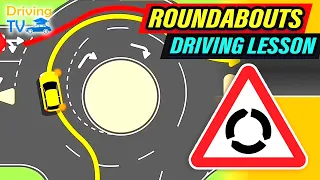
Remember to signal your turn and yield to pedestrians and others using the road. What should you do if you are in a roundabout when an emergency vehicle approaches? A stop in the roundabout to let the emergency vehicle pass.
B. Continue to your intended exit and pull over after existing the roundabout. C Slow down and pull over on the right side.
D Slow to 20 mph below the posted speed limit and stop. Answer is B Continue to your intended exit and pull over after existing the roundabout. If you are in a roundabout when an emergency vehicle approaches, exit at your intended exit and pro ceed beyond the traffic island before pulling over.
If you have not entered the roundabout yet, pull over to the right if possible and wait until the emergency vehicle has passed. What is The only exception to the rule against driving in reverse on a divided Rd. with a speed limit over 80 kilometers per hour?
A. If you missed your exit. B if there is no other traffic.
See if you are trying to help someone in trouble. D Under no circumstances. Answer is C if you are trying to help someone in trouble.
It is illegal to drive in reverse on a divided Rd. that has a speed limit of more than 80 kilometers per hour. This applies to the traveled section of the road and the shoulder.
The only exception to this rule is if you are trying to help someone in trouble. Before making AU turn, what is the maximum distance you must be able to see in both directions? Or to make AU turn, you must be able to see how far in bothdirections.
Answer is B-150 meters. Never make AU turn unless you can see at least 150 meters in both directions. When you are deciding whether or not to make AU turn, you first consideration should be to check.
A Traffic regulations. The presence of trees, fire hydrants, or poles near the curb. C Turning radius of your car.
D Height of curb. Answer is a traffic regulations. U turns are not allowed anytime a traffic sign, EG a number U-turn sign, prohibits them on curves, hills and freeways in weather conditions where you are not able to see clearly, such as in rain fog.
What should you do if you hit a deer or a moose? A. Try to move the animal off the road so other vehicles will not hit it.
B. Sound your horn to ward off other animals from coming onto the roadway. C Report the incident to the Ministry of Natural Resources or local police.
D Do nothing But Dr cautiously as more animals may be in the area. Answer is C Report the incident to the Ministry of Natural Resources or local police. If you hit a deer or moose, report it to the local police service, Oregon, the Ministry of Natural Resources.
Do not try to move an injured animal as it may increase your chances of being hit by another animal. What should you do if your cell phone rings while you are driving and you do not have a hands free device? A.
Pick up the call as it might be urgent. B. Let the call be redirected to your voicemail.
See View the caller ID before deciding whether to answer. D Pick up if you are in red light. Answer is B.
Let the call be redirected to your voicemail. If the phone rings, don't answer it unless you pull over to a safe spot or let a passenger answer the call. Or let the call be redirected to your voicemail.
If convicted, the penalty you face depends on the kind of license you hold and how long you've been driving. Under what circumstances are cell phones not allowed while driving? A.
When you use your cell phone to text. B. When you use your hand held cell phone to chat.
See when you use your cell phone to check and send emails. D All the above. Answer is D all the above.
Convicted drivers face fines, demerit points and license suspension. Novice drivers face suspension and cancellation. How can driver distractions be advised?
A. Plan your trip in advance and know where you are going. Be eat before driving to avoid the need to snack.
C Preset CD players, radios and other controls before driving. D All the above. Answer is D all the above.
Avoid distracted driving charges, suspensions, and demerit points by avoiding all driving distractions. What is the legal requirements regarding following distance from a fire vehicle responding to an alarm? A.
Maintain a minimum distance of 50 meters. B. Maintain a minimum distance of 100 meters.
See Maintain a minimum distance of 150 meters. D There is no specific requirement. Answer is C Maintain a minimum distance of 150 meters.
Do not follow. It's illegal to follow a fire vehicle or ambulance responding to a call within 150 meters. What should you do when you hear bells or sirens or sea flashing lights?
A Slow down move to the far right of the roadway and stop when it is safe to do so. Do not block the shoulder if on a freeway? B.
Slow down and move to the far left of the roadway, but do not stop. C Come to a complete stop wherever you are. D Speed up and keep the movement of traffic going.
Answer is a slow down move to the far right of the roadway and stop when it is safe to do so. Do not block the shoulder if on the freeway. Remember to check your mirrors in blind spots and use your signals to move to the far right safely, then stop.
Do not follow within 150 meters of emergency vehicles. Going so fast that your stopping distance is farther than what you can see with your headlights is called. A over speeding at night.
Be overdriving your headlights. C Stopping distance. D following distance.
Answer is B over driving your headlights. You are overdriving your headlights when you go so fast that your stopping distance is farther than you can see with your headlights. This is a dangerous thing to do because you may not give yourself enough room to make a safe stop.
What does the term overdriving your headlights mean? A. You are leaving your low beam lights on too long at the risk of burning out the bulbs.
B. You are leaving your high beam headlights on too long at the risk of burning out the bulbs. See you are driving slower than your stopping distance allows you to see.
D You are driving faster than your stopping distance allows your to see. Answer is D You are driving faster than your stopping distance allows you to see. Slow down while driving at night to ensure you can see a head far enough to stop approximately.
What is the threshold breaking technique? A. Pump the brakes quickly and repeatedly.
B. Apply steady pressure on the brake pedal without releasing it. See.
Break as hard as you can until a wheel locks up, then release pressure slightly before reapplying. D Use the emergency brake for maximum stopping power. Answer is C Break as hard as you can until a wheel locks up, then release pressure slightly before reapplying.
Threshold breaking should bring you to a reasonably quick, controlled stop in your own lane, even in slippery conditions. This technique is generally practiced in a vehicle that is not equipped with ABS. What is the rule regarding passing, moving, snow, plows?
A. Always pass on the right. B.
Pass with caution. See Do not pass under any conditions. D Pass only if the snow plow is moving slowly.
Answer is C do not pass under any conditions. Snow removal vehicles on public roadways are equipped with flashing blue lights that can be seen from 150 meters. Do not try to pass between them.
This is extremely dangerous because there is not enough room to pass safely and the Ridge of wet snow can throw your vehicle out of control. What vehicle has flashing blue lights that can be seen 150 meters away? A.
A school bus. Be a tow truck. See a snow removal vehicle.
D An ambulance. Answer is see a snow removal vehicle. Snow removal vehicles on public roadways are equipped with flashing blue lights that can be seen from 150 meters.
Do not try to pass between them. This is extremely dangerous because there is not enough room to pass safely and the Ridge of wet snow can throw your vehicle out of control. A flashing blue light mounted on a motor vehicle indicates.
A. A motor vehicle carrying explosives. BA snow removal equipment.
See a snow removal vehicle. DA Police emergency vehicle. Answer Answer is see a snow removal vehicle.
Snow removal vehicles on public roadways are equipped with flashing blue lights that can be seen from 150 meters. Do not try to pass between them. This is extremely dangerous because there is not enough room to pass safely and the Ridge of wet snow can throw your vehicle out of control.
When is passing not permitted in relation to a pedestrian crossover? A within 30 meters. B.
Only if a vehicle is stopped within 50 meters. See if you are driving slower than current traffic. D If the traffic signal turns green just before you arrive.
Answer is a within 30 meters. Do not pass any vehicle within 30 meters of a pedestrian crossover. Never pass a vehicle that has stopped to allow pedestrians to cross the road.
When a car is stopped to allow a pedestrian to cross the street at a marked crosswalk, you should a pass the stopped car on the left. The sound horn for the driver of the stopped car to drive on. See past the stopped car to the right.
D and not pass any car stop to allow a pedestrian to cross. Answer is D not pass any car stop to allow a pedestrian to cross. Do not pass any vehicle within 30 meters of a pedestrian crossover.
Never pass a vehicle that has stopped to allow pedestrians to cross the road. What must drivers do at pedestrian crossovers and school crossings? A stop and wait until the lane you are in is clear.
B. Stop and wait until all pedestrians, including school crossing guards, have completely crossed the road. See, stop and wait until all pedestrians have almost crossed the road.
D Slow down and proceed with caution. Answer is B. Stop and wait until all pedestrians, including school crossing guards, have completely crossed the road.
Drvers who do not come to a complete stop and yield the entire roadway at pedestrian crossovers and school crossings where there is a crossing guard present displaying a school crossing stop sign, will be fined $500 and get 3 demerit points. What method can be a good practice when opening the driver's door? A.
Using your left hand. B. Using the Dutch reach method.
C First use your left hand, then your right hand. D Check the mirror, then use your left hand. Answer is B using the Dutch reach method.
It's called the Dutch Reach and it encourages drivers to use their right hand. Passengers should use their left hand to open their doors. The crossbody motion forces you to turn towards your blind spot, helping you see oncoming traffic, including cyclists.
When getting out of your car on a busy St. you should open your door A after making the proper signals. B.
When you turn on your four way flashers. See when you are sure that it can be done safely. D It does not matter.
Answer is C when you are sure that it can be done safely. What should you do if your vehicle is not parallel to the curb during parallel parking? A.
Drve backwards to straighten. B. Drve forward to straighten.
C First drive backwards, then forward to straighten. D In this case, you should not park. Answer is B.
Drve forward to straighten. When parking on a hill, which direction should you turn your wheels when facing uphill without a curb? A.
Towards the curb or right shoulder? B towards the left or Rd. C Sharply to the right off the road.
D Keep them straight. Answer is C sharply to the right off the road. Turn the steering wheel to the left so the wheels are turned towards the road if you are facing uphill with a curb.
The tires will catch the curb if it rolls backward. When facing uphill without a curb, turn the wheels sharply to the right. If the vehicle rolls, it will go off the road rather than into traffic.
Always set the parking brake. When parking uphill with a curb, what should you do? A.
Turn your tires to the left to catch the curb if your vehicle rolls backward. B. Turn your tires to the right to catch the curb if your vehicle rolls backward.
CMake your tires straight and parallel with the curb. D The direction of your tires does not matter as long as you set the parking brake. Answer is a Turn your tires to the left to catch the curb if your vehicle rolls backward.
Turn your tires to the left and set your parking brake. Always do both. When driving in city, how far ahead should you be focusing?
A. Constantly move your eyes, scanning the road ahead. B.
Look ahead to where you will be in the next 15 to 20 seconds. See as far ahead as you can see. D Only focus on the immediate road ahead.
Answer is B. Look ahead to where you will be in the next 15 to 20 seconds. Who is permitted to use HOVLANES on a provincial highways?
A. A driver traveling alone in a car. BA motorcyclist without a passenger.
See a car with a driver and at least one passenger. D Emergency vehicles only because hooves lanes are open 24 hours a day, seven days a week. Answer is CA car with a driver and at least one passenger.
High Occupancy Vehicle HOV lanes are designated lanes that can only be used by vehicles carrying two or more people or other specific types of vehicles, such as licensed taxis and motorcycles. Which group of people are at greater risk of collisions due to drowsiness? A day shift workers.
B. People with diagnosed and treated sleep disorders. C Shift workers and people with undiagnosed or untreated sleep disorders.
D All the above. Answer is C shift workers and people with undiagnosed or untreated sleep disorders. Studies also indicate that shift workers, people with undiagnosed or untreated sleep disorders and commercial vehicle operators are at greater risk for such collisions.
What should expect regarding the stopping distance of your vehicle when using anti lock braking systems? ABS. A.
The stopping distance will be significantly shortened. B. The stopping distance will remain the same.
C The stopping distance will be longer. D The stopping distance depends on the road conditions. Answer is C The stopping distance will remain the same.
If you like our video, please subscribe, share and do not forget to comments about your G1 license experience.