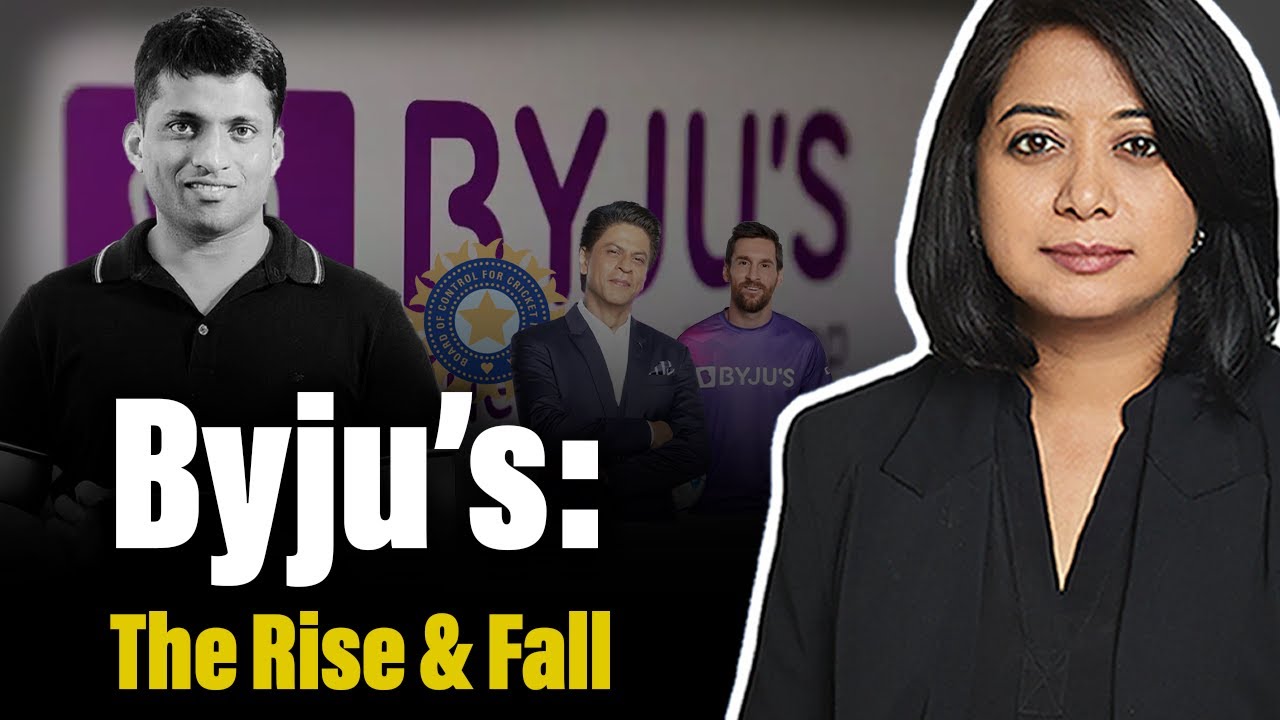
hi everybody in 2011 a company that just started with 25 students went on to become one of the most valued startups in Indian history in just 10 years by 2021 not just Millions but hundreds of millions of students were using the resources the greatest star in the country was endorsing them and within no time it became an epitome of the booming edtech industry of India this company as we all know is by the Corona virus pandemic has disrupted education AC across the world there some families are struggling to adjust as the Corona virus crisis grows online education platform over the last so many years we are touching 150 million students across the world our lead story tonight is about B one of India's most celebrated unicorns today it is a startup engulf in a crisis BYU continue to be in focus a month after firm's investor forus resigned from BYU's board BYU is under the radar for alleged violation of India's foreign exchange laws in the last two years B has seen a dramatic downturn the Press has gone crazy about their functioning the company is dealing with investor troubles an auditor and multiple board members have left they've laid off thousands of employees and most importantly they've been bleeding with thousands of crores in losses BYU posted a loss of $327 million the company saw a loss of over 4,500 CR rupes the losses have gone up more than 15, times to come in at 4,564 CR and during this time their valuation has dropped from $22 billion in 2022 to below $3 billion today this is because Baus took some bold steps that did not pay off as much as expected so if you're a business leader regardless of the domain you belong to listen to this case study very very carefully because the lessons from this case study will help you escape a miserable failure so in this episode today let's do a deep dive and try to understand what what is the story of Baus what are the challenges that they are facing and what are the lessons that we need to extract from the operations of this giant edtech company but before we move on I have an important message about health insurance for all of you so listen to this very carefully guys people in this big bad world the insurance industry is designed to make a fool out of you and there is nothing more painful than paying your premiums on time only to realize that when you actually meet with an accident your insurance company does not even cover half of your expenses only to realize that your insurance company has fooled You by using terms and conditions that nobody can understand and the worst part is by the time you realize you have the wrong health insurance it's already too late so the burning question is whom can you trust for honest transparent and unbiased advice well thankfully ditto is here to help you out ditto has the most trustworthy Insurance advisory team that will will help you pick the best health insurance for free Yes you heard that right they do it without charging you a single penny and the best part is that the ditto team doesn't just stop with sales they will also help you with everything from documentation to even claim settlement and I am endorsing dto not just because they sponsored this episode but also because my own family members have taken their advice and it was smooth and amazing so even if you already have health insurance or if you want to buy health insurance please spend a few minutes time and have a call with a ditto adviser these few minutes will save you tons of money Hassle and most importantly a ton of stress during claim settlement so use the link below and schedule a call with dto today and stay stressfree regarding your health insurance and if you're worried about spam calls don't worry datto Executives will never call you without your consent and now on with the episode this is a story that dates back to 2011 when a popular teacher named named ravindran and his wife Diva started byes with the goal of preparing content for school students and also wanted to cater to the test preparation market then in 2015 they launched their learning app and in 2016 the company claimed that its app was downloaded more than 5. 5 million times in the last one year out of which 250,000 consumers were paid annual subscribers and from there on their user base kept on exploding by 2019 they had 40 million users by 2021 they had 80 million users and today they have around 150 million users during the same time their revenue had grown from 110 cres in 2016 to 500 cres in 2018 to 2,428 crores in 2021 and as per the last audit it stood at 3,569 crores in 2022 this Revenue came from three sources sale of tablet and SD cards sale of reference books and tution and service fee during this time the valuation of BYU's skyrocketed to hit2 $2 billion and BYU became a benchmark for all et companies to follow B valuated over $22 billion in October 2022 India's most valued startup at $22 billion the golden eyed boy of the Unicorn Club CEO BYU ravindran said in a statement and I quote baiju is now at that sweet spot of its growth story where the unit economics and the economies is of scale both are in its favor but you know what guys while on one side they were killing it with thousands of crows in revenue on on the other side their losses also shot up from 49 crores in 2016 to 2 49 crores in 2020 and then it shot up by 18x to touch 4,588 cror in 2021 as per the most recent filings their fi 22 losses are 2,253 crores so the question is how did this company incur such heavy losses well the first and the most obvious reason of all was their marketing budget their advertising and promotional expenses was their single largest cost cost in fi21 and if you see this table business promotion expenses alone accounted for 32% of their total expenses from title sponsorships in IPL to the FIFA World Cup from bringing Shah ruk Khan as its brand ambassador to even getting lonel Messi it was spending more on Advertising than its own employees and operation in fact in 2021 while they spent 22509 for crores in marketing their revenue itself was 24283 crores now is this bad well well not really because every company has its own way of functioning but is the revenue to marketing expense ratio risky absolutely yes and as we move ahead you will see how this snowballed into a catastrophe for the company this is where their second challenge came in which was their sales practice some parents accused BYU's marketing Personnel of instilling fear in them about their children's future in this highly competitive World these tactics eroded trust and created a negative perception of the company one India's most celebrated unicorns today it is a startup engulfed in a crisis most egregious Act was when customers who bought courses on loan requested cancellations and refunds according to Hindu Frontline sales associates were asked to find leads everywhere they would visit schools malls and even temples to persuade people to sign up this also included the low-income workers from Market sellers to even rsha drivers according to rest of thee world. org even at a local chai stall a s to ask the seller if he had children and if he wanted them to have a better education and a better life if yes then he must sign up for by juice and once users installed the app they were asked to sign up for a 15-day free trial using a mobile number and once byus had this mobile number their sales teams would consistently follow up and they would persuade the parents to buy a subscription now again is following up a problem not at all but furthermore according to Hindu front line employees revealed that BYU put them under immense pressure to make their weekly sales targets of 1 lakh rupees or else they would be fired as a result according to Hindu front line they made misleading statements to parents and frighten them into believing that their children would fail if they didn't purchase a byju course or they would push them to buy a multi-year package now the question over here is even if the salesman was very pushy when the courses cost as high as 1.
35 lakhs for J prep how could people with low incomes offer these courses well as a turns out many people were buying this course by taking out a loan Yes you heard that right people were buying these courses by taking out a loan an investigation by Ken analyzed 110 consumer complaints and they found that 54 of these people were unaware that they were being signed up for loans when they signed up for subscriptions and the problem was that the average ticket size of these purchases was 66,000 rupes and they have to pay interest if they pay in parts now the question over here is how did this lending happen happen so easily because taking out a loan in India is a very big hassle especially if you have less income right then how did these people with less income end up getting loans so easily well this is where Buu's lending Partnerships came in Buu used something called the first loss and deposit guarantee strategy in simple words this is an arrangement between a third party and a financial institution whereby the third party garantees to compens the lender if the borrower defaults in this case BYU acted as a guaran for its customers who borrowed from its financing Partners so if the customer defaults then buus would be liable to make the loan repayments this is the reason why the financing Partners were very easily able to lend money to people even with low incomes this is the second challenge that the company faced where some desperate salesman got over pushy and eventually because of first loss deposit guarantee people started taking up loans to buy these courses but regardless of that from the business standpoint when multiple such cases of forced sales pushy follow-ups and Loan stories came up many customers of BYU started losing trust in the brand so the Second Challenge was loss of reputation and Trust because of their sales methodology now until this point this story could still be discarded as the story of a few handful of customers so for a billion dollar company a few bad customers are not a big deal at all but this is where things go really crazy with their accounting practices the startup which lived the dream and is now in the dumps the CEO Buu ravindran is being blame for mismanaging the firm's growth the one's highflying startup has failed to file its Financial accounts on time investors have accused byj of hiding half a billion dollars which has been troubled by mass layoffs mounting losses valuation cuts and several other issues there are allegations of Foreign Exchange violations by is being probed for this how by has uh not paid attention to business fundamentals in its growth journey us in accounting there is a very simple concept of Revenue recognition and this is called as acrel principle and this principle states three key points number one revenues are to be recognized when they are earned and not when they received for example if think school sells a course to a student on credit in 2021 and doesn't receive payment until 2022 then the revenue would still be recorded in 2021 when the sale was made similarly if the student pays 40,000 rupees for a 2-year course in 2021 with each year of the course costing 20,000 rupes the revenue must be recorded as 20,000 R for 20 20 21 and the rest of the 20,000 rupees must be recorded as revenue for the year 2022 similarly if a business received a utility bill in 2021 but paid it in 2022 the expense would be recorded in 2021 when the service was used and not in 2022 but as it turns out according to money control BYU did not record revenues like this since BYU takes the fees of 2e or threee courses in the first year itself it would record it as revenue of that year itself instead of splitting it in 2 to three years so it's it's like if a customer paid 60,000 Rupees for a three-year course in 2021 to think school then the entire 60,000 Rupees was recorded in 2021 itself now what is the problem with this practice when the investor looks at the balance sheet it inflates the revenue and makes it look like byj is scaling up exponentially this is the reason why deoy asked him to defer 40% of its Revenue that it recorded in 2021 to both 2022 and 2023 and because of this the company had to record significant losses in 2021 on top of that when the covid lockdown ended while many students suddenly chose to leave the course and went back to offline classes many left due to negative reviews and publicity this is when Buu's sales started going down as you can see in this chart Buu's Revenue declined by 38% from 2020 to 2021 in India but at the same time their us business grew by 133% and in the Middle East it grew by 103% and guess what while all this drama was going on BYU went on a shopping spree to acquire companies one after the other you've paid two times sales for white hat Junior uh their annual run rate being 115 million and you've paid out cash of 300 million now agreed you have cash on the books India's Ed Tech startup by is acquired coaching Center Chain Akash do you know for how much close to $1 billion $1 billion so in the past few years Buu went on to acquire companies like Whitehead junor akas Education Services and 17 other companies while whad Junior was acquired for $300 million at EPC was acquired for $500 million and Akash was acquired for $950 million so while they experienced substantial growth in user numbers they also faced increasing expenses on top of that not all these companies were profitable so along with users they also got more losses from their acquired companies this was the third challenge that the company was facing which were the losses from acquired companies now even here we can argue that Bas could easily turn these companies into a profitable Venture because of their distribution and skill but you know what guys this is what brings us to another risk that Buu took up which is something called Term Loan B and this is what made things very very difficult for BYU to tell you about it in 2021 the United States was offering loans at near zero interest rates if you remember this is because they printed trillions of dollars because of which the interest rates in the US touched rock bottom and this was a very very attractive offer for both startups and VCS so with this attractive offer by just took up $1. 2 billion in loan but you know what guys this loan wasn't just any loan it was a Term Loan B in simple words it is a loan which requires small installments and is followed by a large bullet payment at the end now the technical definition of Term Loan B is a little complicated so let's understand this using a story let's say a company called X took a Term Loan B of $100 million let's say the interest rate is set at 5% per anom and the term loan is only for 6 years for Simplicity let's also assume that that the interest is calculated annually so the payment structure of this loan will look like this at the end of year 1 x will pay 1% of the principal which is $1 million plus 5% interest on this principal balance which is 5% of $100 million equivalent to5 million so the total repayment would be $6 million at the end of year two x will again pay 1% on the principal that is $1 million plus 5% on the remaining principal balance that is $100 million minus $1 million which is $999 million so 5% of $99 million gives us an interest of $4. 95 million so the total repayment for year two is $4.
95 million + $1 million equal to 5. 95 million this will go on till the last year and this is when X will pay the company the entire remaining amount of $95 million in one shot and pay the interest of 5% on $95 million this is how the transac action will be complete so you see the installments are small but are followed by a large bullet payment now do you see the risk over here most of the principal payment is done at the end and this increases the risk for the lender because in between this time if the borrower company goes bankrupt then the lender will lose all the money so the risk for the lenders is very very high right this is why to mitigate this risk the lenders do three things number one they demand High rates of Interest number two the banks sell these loans to institutional investors who are willing to take up such high risks and finally they attach some very stringent terms and conditions in baiju's case they were asked to get this loan rated by two Credit Agencies like Moody's or fit they were asked to publish their audited 2021 Financial results on time and several such conditions were applied but guess what this is the timeline of the drama that followed according to Economic Times in November 2021 Baus raised $1. 2 billion of Tom loan B in July 22 BYU said that it will announce its delayed audited financials in August the MCA itself sent Buu a letter over a 17mon delay in filing results and then finally in September BYU announced the results where the investors saw that the losses had risen by 18 times to 4,588 crores Meanwhile they closed $250 million in financing from existing investors then in December 2022 the creditors sought an immediate Term Loan B part payment this is when in March 201 3 BYU offered to pay a high interest on Term Loan B to renegotiate the debt financing so then the lender sought up to 200 million dollar with higher interest from Baus for restructuring again parall Baus raised another 2,000 crores from Davidson Kempner and then finally the creditors pulled out of the negotiations to recast the term loan P then on 6th of June 2023 BYU defaulted on the loan repayments and sued its creditors meanwhile another thing that happened was the Russia Ukraine war and this pushed the interest rates of Western countries so high up that the base interest rate went from 0.
2% to 5.