Okay, so today we're tackling a big one, but don't worry, it's not as scary as it sounds. We're diving into Giorgio Agamben's Homo Sacer. Yeah, I know, it has a reputation for being pretty dense, but trust me, at its heart, there's this one single, incredibly powerful, and honestly kind of disturbing idea that I promise will totally change how you look at the world around you.
So, where does Agamben even begin? Well, he starts us off with a puzzle, a real enigma. He points to this mysterious figure from way, way back in the past, a figure that he thinks holds the key to understanding, get this, our entire political world today.
Think about this for a second. What if someone could be killed and it wasn't a crime? Not an execution, not murder, just a killing that the law doesn't even recognize as homicide.
It's a really unsettling thought, right? And that's the exact question that kicks off Agamben's whole investigation. And this is where we meet the star of our show, Homo Sacer.
It translates to sacred man, but here's the crazy part, the paradox at the heart of it all. This person is called sacred, but anyone can kill them, and at the same time, they're not sacred enough to be used in a religious sacrifice. So, they're outside of religious law, and they're outside of human law, because killing them isn't considered murder.
They're just floating in this terrifying legal no-man's land. Right, so you're probably thinking, why are we digging up ancient Roman law? What's the point?
Well, here's Agamben's big reveal, his bombshell. He's saying this isn't just some dusty old historical fact, no. He argues that the strange, paradoxical figure, that's the secret key, the key to understanding how power, specifically sovereign power, really works, right here, right now.
Okay, so to crack this case, we're going to need the right tools. Our first clue comes from the ancient Greeks and how they thought about the idea of life itself. It turns out they didn't just have one word for it.
So, the Greeks had two totally different words for life. On one hand, you've got Zoe. Think of this as bare life.
It's just the biological fact of being alive. You know, your heart is beating, you're breathing. It's what we share with animals, plants, everything.
But then on the other hand, there's bios. This is what we might call a qualified life or a political life. It's life with a story, with rights, with a role in society, being a citizen, a member of a family, a worker.
It's your identity. And Aristotle really hammered this point home. He said, "Look, the whole reason we create cities, the polis, it isn't just to keep people alive, to help them survive.
That's Zoe. No, the point of politics is to create a good life. That's bios.
" So, from the very beginning, politics was supposed to be about the quality of our lives, not just the raw fact that we're living. So, here's the key takeaway from all that. In the classical world, bare biological life, Zoe, was kept firmly outside the political arena.
It was a private matter, something for the home. You could almost say that politics only started at the front door. What happened inside, just staying alive, that wasn't the government's business.
Okay, so if politics is all about the good life, the bios, then that raises a huge question, doesn't it? Who gets to draw that line? Who decides what counts as a politically meaningful life versus just bare survival?
Who's the culprit here? Well, for Agamben, the answer is clear. It's sovereign power.
And to explain this, Agamben borrows a really famous idea from another thinker, Carl Schmitt. Schmitt said that the true test of a sovereign, the ultimate power, isn't the power to make laws, it's the power to suspend them. It's the power to declare an emergency, what he called a state of exception.
And this is where things get really weird. It's like a magic trick. How does sovereign power deal with that bare biological life?
Well, it includes it in the political world, but it does it by excluding it. I know, that sounds nuts, right? But think of it this way.
For the law to protect you, it first has to be able to decide who isn't protected. By creating an inside of the law, it automatically creates an outside. It's this fundamental mind-bending paradox of how power works.
So, let's break that down. The sovereign makes the rules, but that very act of making rules also defines who is inside and who is outside those rules. And in that moment of decision, the sovereign actually produces bare life.
It creates these figures, just like our old friend the homo sacer, who exists outside of normal legal protection. Their entire existence is defined by the fact that they can be killed without consequence. Okay, let's fast forward.
We've got these ancient ideas. Now, let's bring them crashing into the modern world. Because here's Agamben's big, scary claim.
In our time, what used to be a rare exception is now becoming the everyday rule. The crime scene, he says, is absolutely everywhere. He's building on the work of another giant, Michel Foucault.
Foucault basically said that sometime in the last few centuries, a massive shift happened. Before, politics was about managing subjects, territory, laws. But in the modern era, politics became about managing life itself.
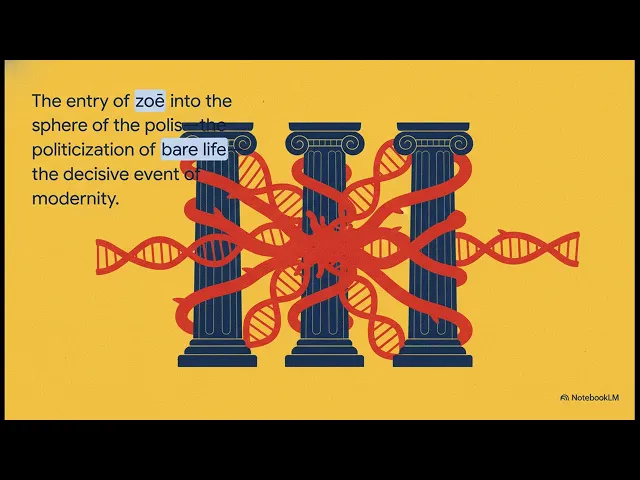
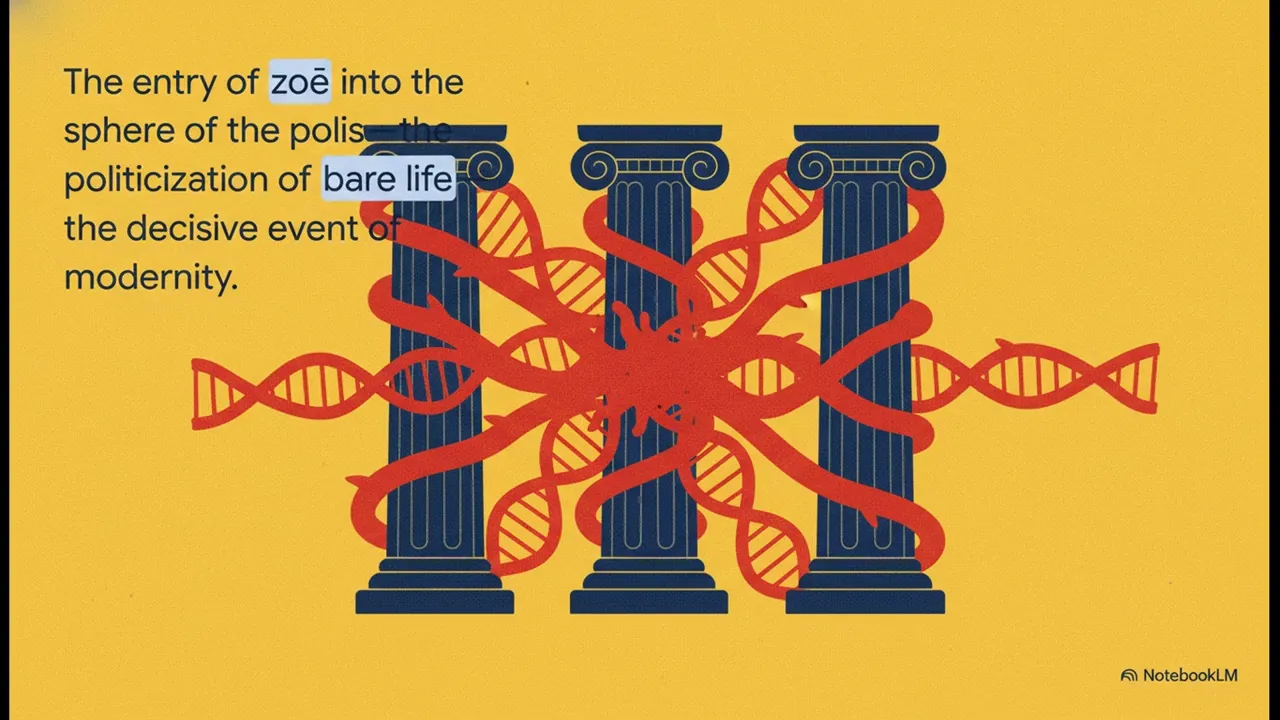
The health, the well-being, the very biology of the population. And for Agamben, this is the crucial moment in modernity. That old wall between the private home and the public square, it just crumbles.
And Zoe, that bare biological life, it comes flooding into politics. All of a sudden, the state is intensely interested in things it never cared about before. Birth rates, vaccination campaigns, public health, how long we live.
It's getting its hands on the biological fabric of our lives. So, you can see the steps, right? First, the state starts to manage the biological life of its people.
Second, that old line between the home and the city gets totally blurry. And third, bare life, the very thing that used to be kept out of politics is now front and center. It's the main target of state power and strategy.
All right, let's recap. We have our clues, the homo sacer, this killable but unsacrificeable man. We have the state of exception, the sovereign's power to suspend the law, and we have biopolitics, the state's control over our biological lives.
Now, let's put it all together. This is the moment of the big reveal, Agamben's shocking conclusion about the world we live in today. So, remember that mystery from the beginning?
Here's the answer. The homo sacer, he's not just some ghost from ancient Rome. He's here now.
Agamben's point is that in a world where states of emergency are becoming the new normal, where our very biology is the subject of politics, every single one of us is potentially a homo sacer. We can all be reduced to bare life. And that leads us to maybe his most famous and definitely his most controversial claim.
He says the defining political space of our time isn't the city or the nation state, it's the camp. Now, when he says camp, yes, he's absolutely thinking of the horrific concentration camps of the 20th century, but he's also thinking about refugee camps, migrant detention centers, black sites, any space where the law is suspended. So, what exactly makes a space the camp?
It's a place where that idea of a state of exception isn't a temporary thing anymore. It becomes a permanent physical location. Inside the fences of the camp, the normal rule of law just stops.
The people are stripped of their rights, their identity, their bios. They're reduced to pure, simple, bare life, to zoe. And this is the really chilling part.
Agamben's big warning is that the logic of the camp isn't staying contained behind barbed wire. It's leaking out. It's spreading everywhere.
All those clear lines we thought defined our world, the line between a citizen with rights and a person without them, between law and brute force, between a political life and bare life, all those lines are getting smudged and blurred. So, I'll leave you with this final, pretty unsettling thought. If the camp is any space where the law is suspended and people are treated as mere biological bodies, where do you see that today?
Think about special security zones at airports. Think about emergency powers enacted after a crisis. Think about how we treat refugees or stateless people.
Agamben's work is a challenge. It forces us to look around and ask a really tough question. Once you understand the logic of the camp, can you find a place where it isn't?