Well then I went say where than I Wednesday shape in the way we teach English webinar course shaping the way we teach English where than I Wednesday welcome to shaping the way we teach English webinar course 15 brought to you by the American English team my name is Curtis Cham part of the American English team based in Washington DC welcome teachers who are joining us from all over the world here you can see the Course 15 schedule today is the second webinar of course 15 during these webinars you will hear but not see the presenter
the way for you to participate is by using the chat box as you are already doing this is where you can ask questions or make comments related to today's topic you will also see myself moderator Curtis and also moderator Heather in the chat box to help you we also rely on the webinar community to help each other your presenter may also Ask you questions in the form of a poll these multiple choice questions will appear on the screen for you to answer some people may experience technical problems unfortunately we cannot fix individual technical issues but
we will let you know if we are having a global issue if you do lose sound a great way to follow along is with the caption pod webinar courses consists of six webinars during the course webinars take place every other Wednesday participants who Attend at least four out of six webinars receive an e certificate from the regional English language officer or local US Embassy to ensure you are eligible for the e certificate we will ask you to submit your attendance at the very end of the webinar we do not submit it before we request it
or it won't be counted for individuals we just need your email address for viewing parties we need only the viewing hosts email address and the number of Participants many of you are familiar with our Ning site but if you haven't registered yet please join this site here you can find resources and discuss questions related to each webinar this is also where you can ask presenter questions after the webinar we also post pre webinar readings and resources and we post the recordings and presentations after each webinar so you can also go back and watch the webinar
again or look at the PowerPoint raise your hand if you Are already a fan of American English at state on facebook we are having a Facebook challenge that we want you to join take a picture that shows why English is important to you then tag your photo with hashtag we love ayee on facebook twitter or instagram and also share the AE facebook page with a friend welcome today's webinar adapting materials to meet your classroom needs brought to you by the American English tea have you Ever found an activity in a textbook or on the internet
that looked interesting but didn't work well when you tried it in the classroom many teachers want to use new activities but due to cultural differences student level and their specific content context they often have problems using these materials in the class through a variety of examples and communicative activities you will learn useful techniques on how to successfully adapt materials for your classroom for This webinar you will need a pen and a piece of paper I'm pleased to welcome our presenters today Roger Cohen and Russell barczak who are both regional english-language officers in Washington DC before
becoming a rillo with the US Department of State Roger Cohen worked at the Defense Language Institute in Texas he also spent five years teaching in Mongolia where he was an english-language fellow he is the author of the book danger in the desert true Adventures of a dinosaur hunter and is a graduate of the school of international trainings MA TESOL program he and his wife to me have an 18 month old daughter Natalie Russell barczak has been an english-language fellow in northern Morocco and a senior fellow in Beirut manama and Ankara and has managed English language
programs in Oman taught univ ii taught university students in germany Mexico Thailand and the US and has worked with teachers in a wide Variety of settings he earned his MA tehsil from kent state university in 1999 he recently joined the u.s. Department of State and lives in Washington DC with his wife thank you for this Thank You Curtis hi everybody glad you can do with us today hello welcome to today's webinar adapting materials to meet your classroom needs I'm Russell bar Chuck and I'm Roger Cohen and Before we jump in here we want to address
some of the Poll questions Russell and I were taking a look earlier and we saw a few comments from the poll that struck us one of them was that a lot of people mentioned in the poll that their activities or the activities from textbooks and materials don't really motivate their students and that's one of the things that we'll be covering in this webinar hopefully you can get some activities and learn a few concepts for when you adapt materials for your class to really help students Communicate we also saw in the polls that the majority of
you who are joining us today use Ministry of Education textbooks some of you use commercial textbooks also so there are advantages and challenges I think to each but there are occasions to adapt those materials as always another poll question showed us that you're all extremely busy people so the majority of you said that time was the biggest impediment to doing more adapting of your textbooks and materials So I think we can certainly relate to that being very busy teachers so let's go ahead and get started with our topic today adapting so uh let's think first
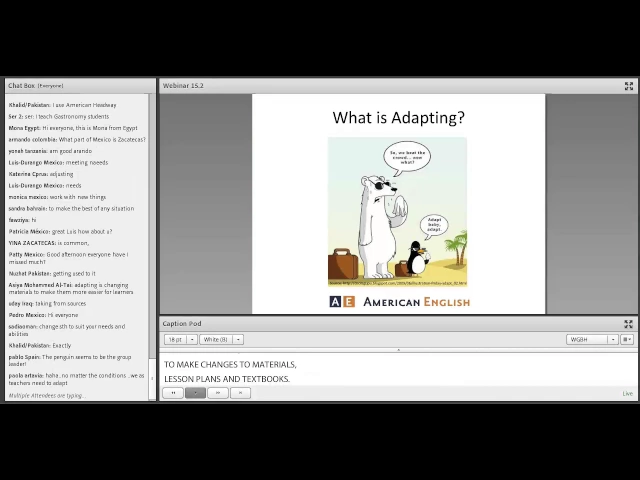
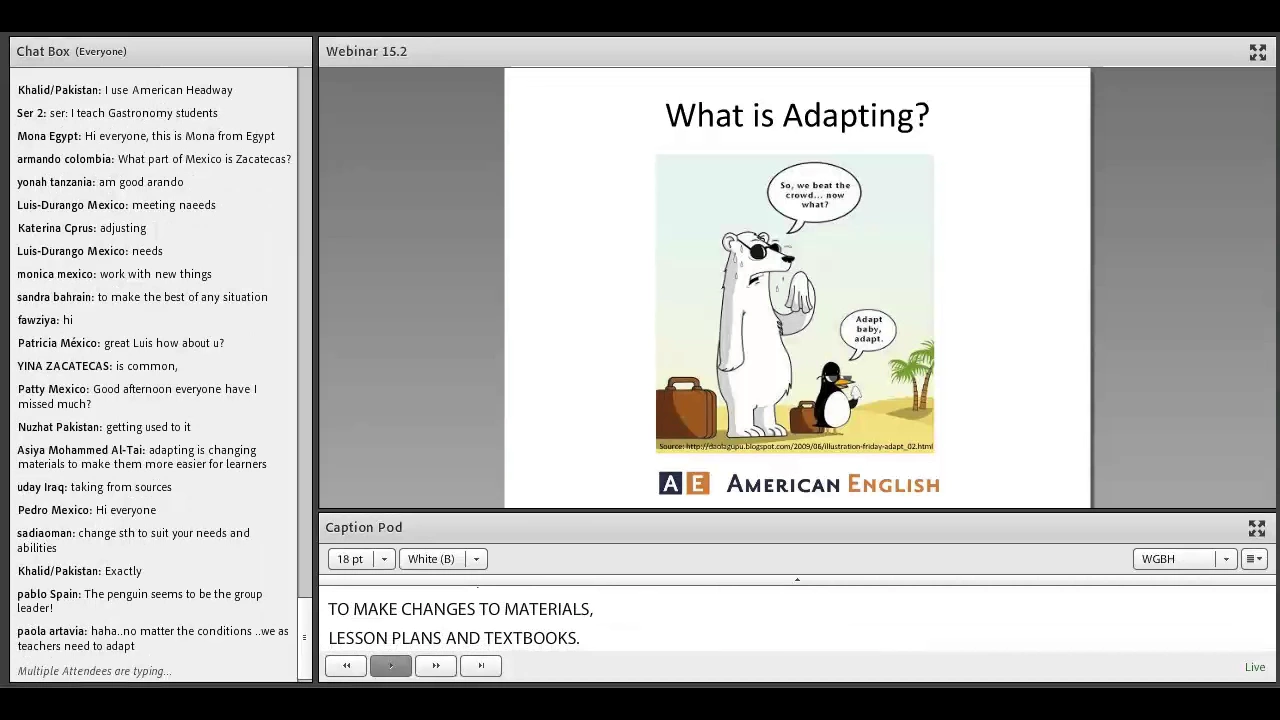
what is adapting have a look at the cartoon here so the polar bear says so we beat the crowd now what and his little friend the penguin says adapt baby add act so they're obviously from a cold climate and not used to the hot weather so they have to make some changes to fit into Their new environment to enjoy their vacation this happens all the time to us english teachers that we have to make changes to our materials lesson plans and textbooks some of these changes we can predict and plan for them and some we
cannot and have to adapt very quickly on the spot so there are a number of things that teachers do and when they start thinking about adapting textbooks and materials and when we're actually contemplating how to use a activity or a Part of a textbook one thing that comes up quite a bit is modifying content and tasks so obviously adapting means changing somehow so when teachers adapt for their own class they have to think about what they're going to change and how teachers also think about adding or getting rid of certain content maybe they really like
something that they would want to use but they don't see it in a textbook maybe they want to take something out that they think is Unnecessary one big thing that comes up is reorganizing content in materials or a textbook for example maybe a certain activity like a grammar exercise might be at the beginning of a unit and teachers maybe think there should be more presentation before that and they should put it later something else is addressing emissions we have to keep in mind that text books were written by a textbook author and written for a
general level not necessarily for your Classroom so there might be certain things that a textbook is lacking that you might want to include and you need to think of these about and how they will meet the needs of your students a little bit better and lastly we're going to talk about how various aspects of adapting materials lends itself to extending tasks for example we might see a great activity and in order to get our students to communicate more or perhaps participate more we need to extend the Activity so we're going to touch upon that today
so what I'd like to do is to start us on to kind of base our discussion today is by taking a look at how we would actually adapt an activity and here's a sample activity on prepositions of time and Russell is going to read it over while you take a look okay so we're going activity of prepositions of time at in and pawn at for a specific time like at seven o'clock in for longer periods of time For example with months and years like in April for in 1974 and on for days and bake so
on monday on january 29th uh-huh now this seems to be the activity write two sentences each for at in and on mmm well the topic seems a bit boring to me Roger it could be there's not a lot of interaction going on in there it might be a little bit boring an activity is fairly typical like this in textbook so what we're going to need to think of some ways of making this work a little Bit better in our classrooms so would that kind of leads to the next slide on why we're going to adapt
activities so as we showed in the last activity a lot of things we come across just aren't really interactive enough they might have good grammar examples or illustrate vocabulary but we need to somehow include something more to get our students really interacting also for the last activity and for many activities there needs to be a bit more Of a context what is the activity attached to is there some type of maybe narrative for the activity or text and I think as someone i just wrote in the chat box students need motivation a lot of times
as teachers you know if we're overworked we don't have a lot of time I know speaking for myself sometimes I would just do an activity in a textbook and I'd say okay so talk to your partner now or do the activity well why why would students do that what is their Motivation to do so and lastly we need to think about integrating skills for example reading writing listening and speaking to really tie the activity together Roger those are some serious problems you just mentioned how should we go about adaptiveness that activity to make it more
interesting and useful for our students well that is the ultimate question that we hope to get at in this webinar and so there are just a few quick things that I'd like to go Over before we really jump in so we mentioned that a lot of activities are interactive enough well obviously to adapt that activity we need to provide something communicative to get students involved if there is a lack of context well how can we create texts that are simple and easily adaptable and of course as teachers around the world you know we don't always
have easy connections to the Internet it's hard to pull out Something for our students so we're going to talk about some easy ways to adapt texts and to create texts for the classroom to motivate students well we can help students get at their interests and this might motivate them and lastly we need to think about designing different tasks for the variety of skills and what just one quick thing I'd like to mention before we continue when we talk about adapting textbooks and materials one thing we should mention is That a lot of textbooks and materials
are very well written they provide really great activities and a lot of times they work really well but what Russell and I would like to point out through this webinar is that we want to really think about how we can teach our learners and our classes instead of just teaching the textbook so how can we will reach our learners in a personal and effective way ok so we've talked about why and how to adapt textbooks and Materials now let's think of some key considerations for when we do adapt so what do you think in a
word or two are some considerations to think about when we're at that thing I've seen some interesting ideas already come by in the chat box ok there's if they do have your comments in the chat box in Peru who suggests feedin needs so something very student-centered that sounds good on the level of the students definitely yes the class size is another big one Erica Lived in Pakistan mentions learning styles it's a great one oh very good no we're getting a lot of ideas culture for sure we'll be touching upon that the reason we adapt okay
so thank you for those I think you got most of the ones yes autos also which was a class size learner preferences which we mentioned student level that many of you mentioned I think teaching the learners and not just the material in a textbook so our approach To the curriculum could be student center a culture I think many of you said and the need to create a communicative classroom as well so these were some of the main considerations we thought of for adapting and we'll use these six points as the framework for the rest of
our webinar today so we'll talk more about each of them starting with the first topic class size let's do a quick poll so you don't need to check your answer but answer the question as a Poll what is your average class size how big we've got teachers from all over the world here so I'm curious to see what the majority of you vote lots I 21 to 30 students sir 11 to 20 how big of your classrooms gonna wrestle excuse me um well I've had some some a few small classes but many of them have
been over 50 students sure sure that can be quite a challenge yeah so can be very difficult with large classes some of you have up to 40 students some more than 40 Students it definitely depends your it looks like most of you between 11 and 30 students that's that's pretty reasonable life that's a good size yeah that's manageable not too bad not too bad okay great well gives us an idea so let's continue talking about class size so if we think about some of the biggest classes we've had why don't you let us know what
do you think are some of the biggest challenges with teaching large classes Controlling the noise definitely keeping the students interested getting attention as giselle in mexico says multilevel that's definitely a big issue Wow classroom management monitoring their work thank you from alumni now we're going to be talking about a lot of these issues you're bringing up here yeah monitoring their work noise is motivation yeah I've had the same issues in my classes these are definitely some of the biggest troubles with large Classes so thank you for that big the biggest challenge is Roger and I
talked about with large classes what were some that you've already brought up so giving the students enough opportunity to practice giving the students enough talk time and allowing for enough time attention and feedback from the teacher to individual students you all said noise so logistically hearing and seeing the teacher or the board or the screen and sharing those resources so if we Have textbooks or handouts the more schemes we have the more resources we need to distribute definitely so some of these we can help more easily and some we can't but let's see one of
them that we can do something about something that is in our control which is allowing for enough student talk time excuse me so let's talk about adapting an activity to give students additional talk time we're going to hear a listing activity about Introductions from a textbook called American headway the directions ask students to fill in the blanks with words from the box so we're not going to do that we won't do that activity but instead i'll ask you to vote on a follow up speaking activity your students might enjoy so we're going to listen first
to a traditional listening activity with fill in the blanks we don't need to to do the activity but imagine it and then we'll see a poll immediately after with Three ideas unit one track to read and listen to Maria complete the text using the verbs in the box hello my name's Maria Guzman and I come from Mexico City I'm 20 and I'm studying medicine at the National Autonomous University of Mexico the course last six years it's hard work but I'm enjoying it a lot I live at home with my mother father and grandmother I can
speak to following languages English and French I speak French because my Grandmother's from France and she always talked to me in French when I was very young I speak English because I went to an english-speaking high school after I graduate I'm going to work for doctors without borders in West Africa because I want to travel and help people okay so now we'll see a poll with some options for speaking activity we can follow that listening activity with mm-hmm how would you adapt this listening activity to create an extra Speaking activity mm-hmm now those are all
great choices Russell I've done number two quite a bit where I use imaginary characters and students can pretend they're someone famous or someone from a movie and that takes a lot of pressure off of them when they make speaking mistakes yeah that would give them a chance to use their imaginations for sure okay still I guess most people find it more useful to have them and introduce themselves but these Are just some ideas obviously there are plenty of others just an example a way to illustrate the idea of extending an activity uh for additional talk
time so let's see a back to the slide show some general recommendations in dealing with an activity like this and considering working with large classes so we could create listening groups with mixed abilities where maybe some of the stronger students helped some of those who need more more help we could shift The seating between listenings in the classroom so the students in the back move to the front and so on we could offer mixed skills activities that are more student-centered like the speaking activity we just saw or we could create a jigsaw listening activity that
we'll talk more about in one minute or develop an information gap which Roger will explain more later so let's see what jigsaw activities look like in case you're not familiar a Jigsaw activity divides up different pieces of the same text for example a story to expert groups like the numbered groups here so they study and understand their piece of the text as a team and then explain it to members of each different group later to put the whole story together like the mixed group a groups and so on it's a very good activity to make
sure each student participates for the short listening text about Maria we can imagine each Expert group here is a sentence or two about her story then shares that piece with the next mixed group to put everything together that they know about her so you can check out the website jigsaw dot org to learn a lot more about this quick and easy technique so now let's switch drew Roger to hear more about the next consideration ok thanks Russell that's some good stuff there I've done a lot of this in my own classes the next issue we'd
like to talk About our learner preferences and I saw that a lot of you mentioned this in the chat box so just quickly what would our learner preferences well obviously we all know that different learners learn in different ways some people might enjoy one way some people might enjoy another way I'd also like to mention that certain activities work better with for certain types of people with certain types of learner preferences which we'll get into in just a minute and the Important issue here that I'd like to go over is that a lot of textbooks
and materials don't necessarily cover this so we want to talk about some adaptations we can do that will help engage people with different types of learner preferences so what exactly are the learner preferences well the first one visual so some people learn better when they're looking at something like for example a picture and we'll get into some Different ideas on that in just a sec here the next one is auditory these people might learn well from dictation 'he's or from classrooms speeches the next one is called kinesthetic this one deals with learners who learn really
well when they can get out of their chair and move around and mix with other students in the class the last one is tactile tactile deals with touch and this learner preference deals with students who enjoy manipulating objects In class maybe when they have something on their desks and they can move something around this works very well for them so I'd like to do a quick poll here I'd like to ask what type of learning do you usually prefer a lot of visual learners there a lot of kinesthetic people yeah one thing I noticed is
about fourteen percent of you say it depends that's a very good comment because yeah often it depends on what type of activity it is what exactly Is happening in the class sometimes sometimes a learner preference might be better suited for a certain type of activity like I mentioned earlier so I'm going to ask my partner here what type of learning he usually prefers well I would say also it depends but in general overall may be tactile okay okay you're you're pretty tactile type of guy way yeah so what we like to do now is take
a look at an actual activity and see how that can tie into these learner Preferences let's get a little hands on here so this activity is from interchange it's a great textbook this activity called word power it asks in Section A to find two other words or phrases from the list that usually go with each verb so some of the examples are the bed a vacation dancing the laundry shopping and then there's a diagram there with the verbs do go have et cetera and you have to make word combinations that go together many of us
Would know them as collocation 'he's and in Section B it asks to circle the things you did last weekend then compare them with a partner for example I went bowling with my friends and had a good time so this is a pretty good activity but we'd like to start thinking about how we could adapt it for different types of learner preferences so Russell actually had a great idea himself so I'm wondering Russell if you were going to adapt this activity for a tactile Learner what would you do well here's an activity that I like especially
with vocabulary like this so we could put the students in pairs and have them write four sentences about their day so something simple using a collocation in each one of these sentences they could cut up the sentences into strips and then just pass them on to the next group of students next to them to piece back together in order so it's very quick and easy and with really no prep time from The teacher you've developed a kind of grammar writing and activity no extra materials yeah I've used this type of thing many times in my
classes it always works really well so right now let's go back to that activity and with you all taking a look at this activity I'd like to ask a question and if you could answer in the chat box please how would you adapt this activity for visual learners by using pictures what would you do with the pictures if You have a video what would you do with the video flash cards flash cards okay pictures associated with words cartoons with PowerPoint that sounds really interesting have them around and leave some gaps interesting you might be moving
also with that ended that's true that's true there's tons of activities uh yeah it looks like some good ones they're match pics with phrases or words yeah you know we've done a lot of these ourselves and we just like to go over Just a couple of quick activities that we've used before that would work for adapting for visual learners the first is partner pictures and I drew that myself thank you very much and that's people going dancing or you could say having a party so basically you could take answers from an exercise and then have
students draw the answer and then you could have the partner guess about what the answer is it's a quick way to tie something visual into the activity Another one that I've used quite a bit is a storyboard and this is a great visual activity because it really combines something with creative um you know I guess you could say artwork not in my case but maybe your students and the visual preference with extended speaking it's pretty easy to do just have students may be divided their papers into four sections and then they could draw their day
or maybe a short story based on the exercise Answers on a piece of paper then they would show their story board to their partner and then they would use it as a prompt to describe the story using the keywords from the text so it's a good extension activity as well so for example I could say something like this work this morning I woke up and made my bed there's an answer from the activity we were looking at and I could say then I went shopping at the store after that I sat down and did my
English homework And finally late at night I went dancing with my friends so it's using those answers from the exercise itself did you draw those yes I drew all of those I think they're yes it's the best I can do um the other suggestion and this one is becoming more popular and not in text books these days or colocation wheels so the exercise has students put word combinations together so to make it more visual than just filling out a diagram in a text book they can put a verb in a Circle in the middle of
a piece of paper and then draw branches connecting the word combinations to that verb so like make a phone call make dinner you could also say make my bed and then you know possibly students could save this for later and then add more combinations as they as they move on in the unit nice I'm just noticing in the chat box here naima in Oman suggested using oral questions which leads us to know perfect that's the next yeah the next category So many learners are more comfortable learning through listening or our auditory learners so oral questions
responses to stories would work very well for these kinds of students even if they use three or more combinations in a short dialogue or a short story that they could read to the class and the teacher could ask them spontaneous questions yes but that might appeal to auditory learners something very quick and simple okay so um I Myself am an auditory learner so what I'd like to do is I'd like to actually do an activity with you that is a very good adaptation for auditory learners you can do it easily you know you can adapt
it for almost any type of exercise and I've used it hundreds of times it's called a dick toe glosses and oh you know like dictation and glosses referring to word or words so we're going to actually do this activity together so if you remember Curtis at The beginning of this webinar said to have a piece of paper and a pen if you could take a few seconds to get those ready because we're going to be doing this together ok so I'm going to go over the instructions of how to do the activity and then we're
going to do the activity together ok so what is the objective of addictive glosses so this is a to listening activity and the objective is to have students recreate the text as exactly as possible as you Say it so they're going to do that by taking notes so the first thing you're going to do is you're going to pair students in this case if you're sitting next to someone maybe get together and make a pair if you're just by yourself that's fine you can do this activity by yourself but when you're doing this in your
classroom it works best with pairs so the next step is to get ready to take notes now in this step I'm going to be reading a Text and while I'm reading the text please take notes now it's important to tell your students that they will not be able to copy the entire text as I read it I'm going to be reading it a little too quickly for that but you want to tell students and for you right now doing this activity to take as many notes as possible that will help you remember is much about
the text so you can put the text together because remember you're trying to recreate it so For example if I read the sentence I like ice cream you might just have time to write the words ice cream and then that would help you later write the full sentence I like ice cream so I'm going to read the text and the text is based on the exercise that we were just looking at word power and when I'm done reading the text will take a few seconds for you to maybe look at your notes and then Russell
it was going to read the text again when he's done reading that For the second time um usually in the class students would have several minutes to put their texts or excuse me put their notes together and they would compare and then they would write down wonderful text that would recreate the text as best as possible I'm not sure we're going to have time to do that we'll see how it goes and then after students put their notes together and recreate the text then they would read the tech To the class and then finally the
teacher shows the actual text at the end so before we do this together you might be wondering what type of text you should use well that's where adaptation comes in um you can create your own texts pretty easily from exercise answers for example in the exercise we've been working with I made some simple sentences based on the answers for example make the bed take a vacation those are answers that you could make Sentences out of and then make a short text you can do the same thing for students and it's a great adaptation of an
exercise for auditory learners so if you're ready to do it let's do it so get your pen and paper ready okay so remember i'm going to read the text so please take as many notes as you can and remember he won't be able to copy everything so don't get frustrated we're going to read it twice here we go this morning after I made my bed I heard my Son make a phone call he was talking with his friend I was busy doing the dishes in the kitchen he then told me he and his friends wanted
to take a vacation to New York I said no way at the most even your friends can have a party at our house and bill Bolling okay so take a few seconds okay so so is going to read it again okay this morning after I made my bed I heard my son make a phone call he was talking with its friend I was busy doing the Dishes in the kitchen then told me he and his friends wanted to take a vacation to New York I said no way at the most when your friends can have
a party our house and go bowling alright thanks Russell and I know when you were doing this you were all focused on your paper and no one was looking at the captions pod because we just realized the captions of exactly what we were reading came up there but that doesn't matter it's just for fun so now that We're doing that we're done reading the text okay so usually take a few minutes to compare texts with your partner to make one final text as best as possible you then read it to the class and compare it
with groups due to time though I think we're just going to show you the actual text here so this morning after I made my bed I heard my son make a phone call he was talking with his friend and then you can keep reading it you'll see underlined or all those con Locations from the exercise so it really just took me a couple minutes just to write up a very simple story and I've really done this hundreds of times with my classes just the last quick thing I'll say about this I'm if anyone's interested in
assessment you know whenever I've done does my students they get so involved with this activity that assessment hasn't really been an issue however I do know some teachers that do this adaptation you know maybe once a Week and every time we do a dick DeGraw cysts you know the students write down how many words they use and then over the weeks they can compare and see how they are improving and then you can talk about listening strategies and note-taking strategies and way to improve so yeah I've used that many times okay so now that we're
done with auditory activities let's move on quickly to the next one which is kinesthetic and I saw a couple people Talk about this in the chat box so remember kinesthetic means body movement so the first recommendation we have for adapting the word power exercised from interchange we were just looking at would be many dramas you know you might know them as charades this is when students can maybe act out an answer to one of those questions and then the other student can guess the next one is our pairing students like so for example from word
power you could gave half the Class pieces of paper with verbs from the exercise for example the birds do go or have and then you could give the other half of the class little pieces of paper with the answers for example the bed the dishes a lot of fun so then students would have to find or they'd have to stand up with their piece of paper and then they go find their match and then they sit down with their partner and perhaps complete the exercise the last one is a rock and Write what I used
to do quite a bit is you know take an answer like in this case take one of the moves from the exercise write it on a piece of paper tape it to the wall and then I have students stand up and walk around and write down their answers on the paper and maybe write down sentences you know to help them make the connection even better so those are just a few activities I've used to adapt for kinesthetic learners they some like nice Active exercise yeah very well so great thank you the next consideration moving on
going to talk about is student level so let's do another quick poll and I'll ask you do you feel that your classes have mixed ability levels guru no we'll just give this poll a second here ninety percent there it looks definitely very very high it wouldn't surprise me if even it were a hundred percent I imagine that all of us have felt that our Classes have mixed abilities at different times so I bet that is a very high number so okay great thank you and my the next part of my question then if we can
go back to our slides excuse me it with mixed ability levels is uh what effect do you think this has on your classroom okay we've got super let's see your answers here I'm can you okay it says um different learning styles yeah they get bored uh-huh yep that often happens not everyone understands they Get frustrated the the differentiation it's hard to to gauge between different students and then it leads to a lack partition participation yeah it's and it's very demanding thank you for that comment from Morocco um okay well some of these issues we know
they get behind ya I've dealt with this many myself okay so um great thanks for those answers so if we can go on to our next slide here we will see an example of an activity and then we'll talk about how We might adapt it for a class with mixed ability levels so we're going to hear part of a song that if you've participated in our webinars before you probably already know it's about New Orleans which is the city and south of the United States in Louisiana and it's famous for jazz music so we'll see
a common activity many teachers do with songs we're we're not going to actually do this activity because really I don't think we have time to fill in all these Blanks but let's say that you have to use this activity in your class but you think it's a little bit too difficult for most of your students so what could you do to this activity to adapt it to your students level good morning New Orleans we love you new orlean into our knee in such a lovely thing to love you Olly when people coming Everly because we
swinging that way the sunshine so surprised the breeze socialmatic reason Does always twinkle all night down by the riverside so my I sometimes I cry it's such a beautiful people wonder what all the talk is about love you know what I mean okay so that's the activity we find it difficult for our classes level so what could we do to make it a bit easier there's a nice suggestion from Bahrain to prepare vocabulary cards that might help strips to paper area yay another Jigsaw whoo thank you a margarita from Colombia nice idea to give them
a list of the words that happens a lot we could form groups or uh from Guatemala the suggestion of giving them some hints some clues with the letters of the song and I would be very a lot of good ones here okay good so I'm glad you enjoyed the song also so that those are most of the ideas that we thought of as well if we needed to make it a bit easier we might play the song in some short Segments a couple of times to let the students work in teams or to give them
a clue about what words missing by giving them a letter of one of the words great so let's see some other activities since we said extending as part of adapting that we could use we could use this song to develop some different ideas one of the first we'll see is a speaking activity so when we spoke about visual learners they might enjoy this activity with pictures or also can aesthetic Learners might like this because it lets them stand up and move around so this activity is called four corners it gets students moving and generates interest
in the song we would hang these pictures showing scenes from New Orleans in different corners of the room and write the title of the song on the board we'd have students read the song title and choose which picture represents the title or possible things in the song so they'll move to that that Picture and once everyone is in a corner we could ask students to share with the others in the same corner why they think that picture represents the idea in the song or what they like or don't like about the picture so after small
group discussions each corner can then explain to the rest of the class the various reasons why the group feels this way and after they hear the song and do the activity um you can allow them to change their opinion and see if they stay stay In the same group or change groups so in this example we have pictures of the French style architecture of New Orleans people in costumes from the famous Mardi Gras celebration jazz musicians playing in the park and a steamboat on the Mississippi River all very typical pictures of New Orleans another way
to help students perform at their own level is to add activities that are either more or less controlled or controlled by the teacher for example if we wanted to Follow the song with the writing activity we could simply cut pieces of the song lyrics and give them two groups of students to arrange like a puzzle as they hear the song so the smaller the pieces the bigger the challenge or we could offer a very open-ended activity and ask the students to write a story they can imagine about the life of the singer so here the
students can all perform their own levels or work in groups Another idea is to ask the class to write the next verse of the song in this case they would have certain limits to what you're asking them to write but there's still lots of room for creativity so just some very quick ideas if you like this song or any of the activities they're available on the American English website so like the music that we were listening to before the webinar began there's plenty of these activities with the pictures and Ideas for adaptations on the website
so you can download all of that for free good stuff good stuff I'm saying tons of great ideas in the chat box here too I'm sure there are a lot yeah yeah I mean songs are such a great way of engaging students so let's move on to the next issue which is teaching learners not the textbook so you know of course we all know our class is not the exact same class that's targeted by the textbook so as I said before we want to think about How to teach our learners and not just turn the
pages of the textbook you know essentially teaching itself is a constant process that requires constant adaptation so what I'd like to do is in the next several slides talk about a couple things that occur quite a bit in textbooks those are texts and dialogues and because they occur so often in textbooks excuse me I'd like to talk about how we can adapt these so the first reading I'd like to take a look at And you don't need to read this now it would take too long it's we're just using it as an example you know
chose an example or it gives examples of nonverbal communication around the world it's a pretty good text and it will you know I'm sure interest a lot of students you know it's divided into several paragraphs and there are some good questions at the end now reading texts as you all know are almost always Followed by comprehension questions or true or false questions and then the students complete them and then usually the teacher checks them somehow so you know doing this again and again it can get a little bit boring and we want to think about
ways about how we can adapt that to maybe include some more interaction between students so for this section when we look at readings and dialogues you know I don't want to go too in depth about the actual teaching Of reading but I do want to talk about how to adapt so let's take a look at the first adaptation that I've used quite a bit and it's very easy to do and you know you can use it with you know texts that are divided up into several paragraphs and that is paraphrasing and perhaps some of you
are familiar with that word paraphrasing basically means retelling you know the same text in students own language so how does this strategy work so first you know find a Reading with several paragraphs you know like the one before then the first thing that i've done is i groped students by how many paragraphs are in the text for example if the text is four paragraphs long then I would put students into groups of four then I would assign each paragraph to students in the group so I give each of those four students a separate paragraph then
what I will do is I would instruct students to just read their paragraph And they're going to need to take notes and I would give them a maximum so maybe for a paragraph it might be 10 words it's up to you but I would tell students that they can only write down ten words that are going to use to paraphrase or retell the paragraph to their book mates so when you're done reading the paragraph and when you're done writing down the words in their notebooks I'll tell the students that they need to close their textbooks
and they can't use The textbook at all and they need to retell or paraphrase their paragraph to their group mates using only the notes and so when they are we telling their paragraph they're essentially paraphrasing to the group and the other thing that I have students do is to make sure that they really listen to each other and not just paraphrase their own paragraph and then not pay attention is I make them listen to each other have them take notes on what their partners Say because when they're all done I asked them to paraphrase the
entire text to a different group as best as possible so it's a pretty easy paraphrasing activity to do it doesn't involve a lot of teacher work you know the students are basically doing everything so the teacher can really act as a facilitator so right now I'd like to talk about how we can adapt dialogues something that also happens in almost every single unit in a textbook so I'd like to cover Quickly how we can adapt for dialogues okay so here's a dialogue from interchange and Russell and I are going to read it in our best
theatrical voices Russell is going to play rod I'm going to play Jenna are you ready Russell I'm ready Roger okay okay hello hi Rob this is Jenna oh hi Jana what's up I'm going to my best friend's wedding this weekend I love to take some pictures for his website we do mind if I borrow your new digital camera um no that's okay i guess I don't think i'll need it for anything oh thanks a million sure uh you have used a digital camera before it's sort of complicated uh-huh sure a couple of times would it
be okay if I picked it up on friday night yeah I guess so okay thanks Russell um it sounds like rod there doesn't really want to lend his camera to Jana no um so yeah I bring up dialogues here like i said before they're very common in textbooks and the way it's usually done or presented is That students will listen to the dialogue maybe on a CD then they'll do exercises maybe the students will reach to each other sometimes creative teachers will have students make up or have you have students make up their own dialogues
and usually the teacher in the class think of the dialogue is a good example of english-born sometimes students even memorize them however I I think we can go one step further I'd like to start thinking about how we can Adapt dialogues so rather than just having students may be memorized them or treat them like a regular text that they can really interact with the dialogue a little bit more and you as the teacher can get maybe a little bit more out of it and I'd like you to consider this the author is saying use a
dialogue more as a proposal than a model that really means that like I was just saying instead of just using a dialogue as is think of a way to use a dialogue so you Can really work with it and students can interact with it so I like to present one way that I've done quite a bit in my classes and it's really really simple but i found it works really well and it really engages students you know instead of just reading the dialogue or acting it out or something which is good to really get into
the meat of the dialogue so how do we do that with what I call consider questions basically it's just making up simple wh and imagine Questions based on the dialogue and you can do it very quickly so for example based on the dialogue between rod and Jenna that Russell and I just read I made up these questions and please don't answer these in the chat box I just want you to take a look at them to see how we do them we really don't need to answer them in the chat box at all so the
first question I made up is what is right and Jenni's relationship what words or phrases indicate their relationship in The dialogue second how does rod feel about lending is camera to Jenna what words or phrases indicate this what else can Janice a to make rod feel more comfortable about lending his camera imagine your rod what could you say to refuse Jana's request in a polite way so instead of you know just having your students read the dialogue or listening to it if we come up with these consider questions as you see it's a pretty easy
Way for students to start analyzing the dialogue and for you to start thinking about the dialogue yourself and what particular language means something to students in those dialogues and what might they take away for later there are tons of ideas about how to adapt dialogues and I've already seen some in the chat box we don't really have time to cover all of them but we'd love to see some of your ideas so please post them to our shaping english name Discussion afterward so I think I'm going to turn it over to Russell right here Thank
You Roger so our next topic here to talk about is culture so don't answer this question yet we'll do a quick poll but the question for the pole is about cultures so one other reason many teachers adaptive text books and materials is cultural reasons so how often do you adapt your textbooks because of culture so there's a lot of different things to think about this is A very big subject and sometimes we don't even realize when we're adapting or changing our materials because of cultural reasons sometimes we do it so automatically so it looks like
yeah everyone at least does it sometimes sometimes too frequently yeah okay great thank you we can go back to the slides on so since many text books are written for students studying in the US or the UK for example a lot of the topics Questions and dialogues don't make as much sense in other countries in my own experience I would say that I sometimes I need to adapt due to the cultural content so in textbooks there are often place names that might be unfamiliar to students for example when we heard this song earlier about New
Orleans without some explanation before listening to the song some students might not know where it is or what it's known for so when introducing new cultural information Which many students can find interesting we have to make sure that it's well explained also so here is an activity from another textbook and we'll look at how we might change it based on one example of culture this is a roleplay activity from a book called classic classroom activities it's a great book but most of the activities in it are set in the US so in this case some
students are given some lines for acting in a role play about renting an apartment so Uh maybe some of the questions or vocabulary fit where you live and maybe they don't for example if our characters are a landlord or a couple of renters they may be asking the management some of these questions and the right side of the book will look at one small example of bees let's say the character is asked does it have air-conditioning or a swimming pool so if we want to just replace the words air conditioning or swimming pool what would
people ask About when renting a house or apartment where you live what other words might they be right there may be the same words but may be different once they see ya pure a yard who a balcony Thank You Victor from Nicaragua that would be nice garage would love to have a nice balcony is there hot water yeah parking place mmm as a review a bar these yeah if these these are all possible and this is a very simple example about things in a house related to culture related to Where we live so in general
some points to keep in mind when thinking about the relevance and interest to our students from our textbook or materials please remember these points of the vocabulary situations the characters and any music movies or pictures that they're appropriate relevant and interesting to our students one last example one last comment I would like to make on the subject of culture here is not an adaptation of a text itself so much but An adaptation of a general idea so this example of a reading was completely written by a student in this case a high school students in
Nepal wrote their own stories about their own cultures and other teachers edited their work about some vocabulary questions from their work and then some discussion questions also so here instead of adapting a text the classes made their own text and then those are used in other classes so this has already been Done a I know of in Nepal and Russia and Turkey so it's just food for thought for you to think about if it's something you would like to try with your classes or not on over to Roger okay thanks Russell great stuff you're like
I was telling Russell right before this webinar even when I'm teaching in the United States you know sometimes I have to adapt for culture there because you know maybe a textbook is talking about something that my students aren't familiar with or There are even different cultures in the united states that i needed to be aware of so yeah that's definitely a big issue when we're adapting materials on the last issue we're going to talk about today is a big one so our students aren't communicating how can we motivate students to communicate more there are many
many ways to think about this this could be a separate webinar by itself so what I'd like to do is I'd like to focus on just one concept and discuss a couple Quick easy ways about how to adapt it in our own classroom so that concept that I'd like to discuss is called an information tab and you see two pictures and they are nearly identical however there are some differences let's take a maybe a few seconds maybe in the chat box can you tell us what some of the differences in the picture are ok yeah
bananas that's different cookies I one of the cookies the clocks yeah I think the cat is holding a Lollipop why a cat is holding a lollipop I have no idea and yet but why would they can't hold a spoon to that doesn't make a lot of sense tomatoes are those the same or those different I'm not sure they look the same night during the shelves those are different the girl's face oh yeah and what I never noticed that did one um she has her tongue out and the other she doesn't so here here are some
differences right here in the next slide that's not all of them it's Just some of them okay so um this is a classic information gap activity now you know how do you encourage genuine communication in your class when your students have to communicate so you know not all of us have books and books with different pictures that we can always give to our students so they can do the same activity like this all the time so what we want to do is think about the concept of an information gap so an information gap is when
two students Have different information so there's a gap between their information and so for some reason they must communicate so the teacher forces them and forces them in a good way to communicate you're creating conditions for your students to really talk to each other so let's take a quick look at some examples about how to do this so we can gap exercises we can make gaps and exercises the other one is for window tables so this type of activity is very very common in textbooks it's a Matching exercise so you match the information in the
first column with the information in the second column you could either have students you know right in the numbers sometimes you see students lines between the columns but how can we make a simple activity like this more communicative well we can gap it so some teachers might do this by making photocopies but if you don't have a photocopy if you don't have a copier you Can do it very easily how I used to do it is just divided students into pairs and you have one student cover one column and you have the other student cover
the other column then students make sentences because they have to communicate for example if Russell and I were partners I would cover the seasons on the left side in my textbook and he would cover the answers on the right side in his textbook so Russell might just say winter and I would have to Listen to Russell and find the answer and then say something like in winter we can make a snowman so this is not a huge difference but rather than just having students fill in letters or draw lines by themselves there is an information
gap so you're forcing them to really communicate with each other and get more speaking and listening practice so I've done this type of adaptation many times it's worked very well try it out the next one is based on this type of Activity where students have to say for example check off boxes or put act put their list of favorites for example here it lists eight top leisure activities and then it asks students to check the activities list three other activities and then put the activities you do in order from your favorite to least favorite again
it's a really good activity but students are just doing it by themselves so we could take an individual activity like this and if we Create information gap we're forcing students to speak to each other and community so for this type of activity i've used for window tables so you just have students may be divided their paper into four sections and then write my partner and me only me only my partner neither my partner would nor me so then here you're forcing them to communicate and find out information because there's a gap so this is a
very good adaptation to Really help students communicate so um Russell would just like to talk about one last thing um before we say goodbye those are some great ideas Roger thank you uh last comment is to say don't forget you can always initiate a couple minutes of natural conversation with your students that their books closed at the beginning or end of your class to get to know them better and to be sure you're all enjoying your time together so you don't always have to do adapting With your textbooks either I've certainly enjoyed spending this time
with all of you I would encourage you if you join us in the ninja discussion to let us know alright well thank you so much Roger and Russell for that great session you gave us lots of good key considerations to think about as we teachers need to adapt materials may encounter either in our textbook or materials we find online or other places lots of great ideas I hope Many of you out there in the audience will try some of these techniques in your classroom soon and as Roger and Russell mentioned that you will share these
ideas for successful adapting that you've done on the knee ok now it is time for the much awaited part of the webinar attendance um you will see a box on the lower left-hand side of your screen that says submit attendance here this is where you will enter your information if you've entered it Anywhere else and the webinar it has not been counted if you're watching this webinar is an individual you only need to enter your email address as shown in the example on the upper left hand side for viewing groups we need the viewing host
to please submit his or her email address and the total number of teachers in the group as shown in the second example again unfortunately we cannot confirm individual attendance records but if you follow these instructions at This time your information will be successfully recorded for your attendance today we hope you enjoy today's webinar we have another great session coming up in two weeks on Wednesday februari 11 with char Heitmann from the University of Oregon she'll be talking about integrating pronunciation across the curriculum will hope to see you there all right in the meantime this room
will remain open for 30 minutes for attendance purposes so please do enter Your information otherwise we hope to see you on the name in the discussion that Russell and Roger will post after the webinar and also if you have anything you want to share in the live chat now it's a great time so we look forward to continuing the conversation and we'll see you in two weeks thank you