You cannot come to Jesus and just patronize him as a noble, good Jewish teacher because he crossed a line. He crossed a severe line and the Jews saw that either he's the Messiah or he is a blasphemer and he needs to be put to death. And those are really the choices you have.
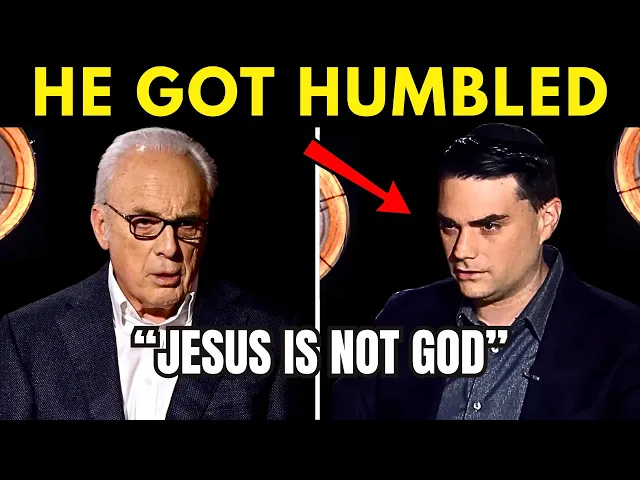
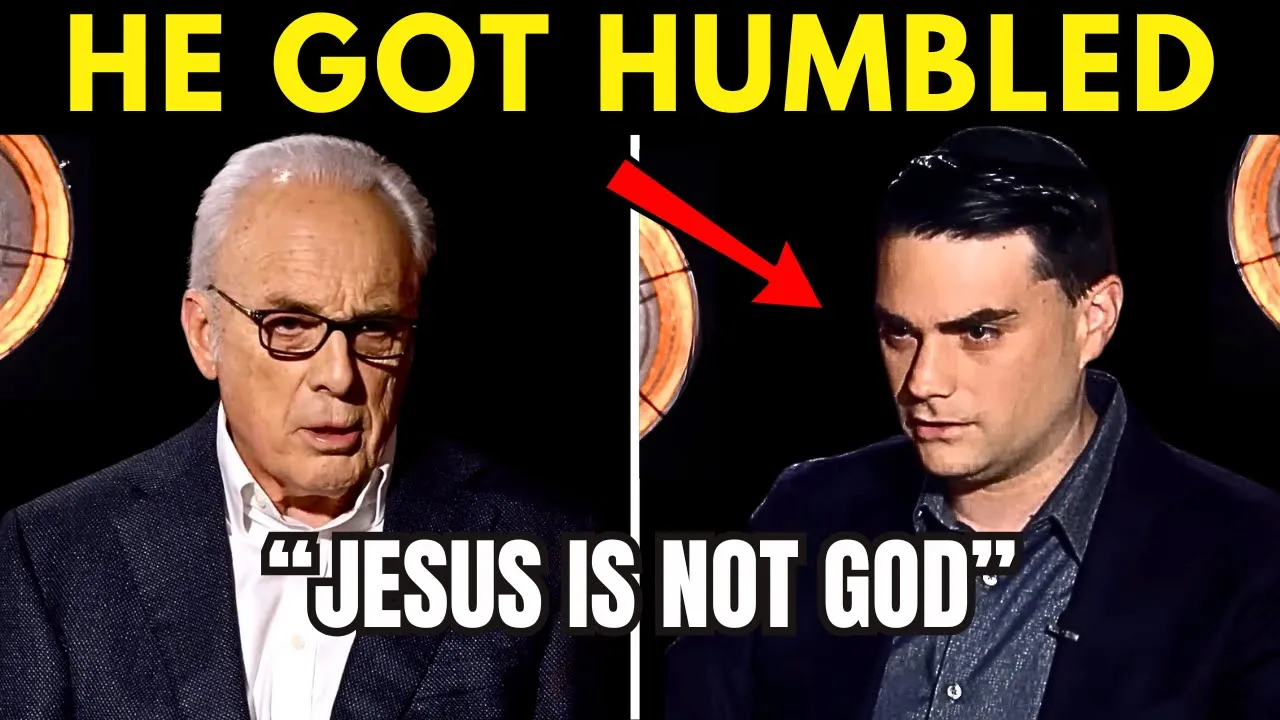
What you're about to see is one of the most powerful conversations between two leading voices in our world today. Ben Shapiro, a sharp political commentator and a devout Jew known for his intellect and quick reasoning, sits across from Pastor John MacArthur, a revered Bible scholar and pastor whose lifetime of preaching has impacted millions around the world. It is a confrontation between two major worldviews, human effort and divine grace, Judaism and Christianity.
Everything in this conversation builds to one ultimate question. Who is Jesus Christ? As you watch, I'll share two short pastoral commentaries to help you see the bigger picture, strengthen your faith, and challenge you to think more deeply about the truth.
And don't miss the powerful moment near the end where Pastor John shares something with Ben that clearly moves him. When it comes to the distinctions between Judaism and Christianity, as a Jew, whenever I hear pastors speak about Christianity, very often I think to myself, right, all that stuff's in the Old Testament. So when they say things like, you know, sin has to be cleansed by God, right?
We have an entire day yum kapour that is for that. I say three times a day a paragraph about doing repentance before God plus an additional section for repentance in the morning prayers. Uh the idea of of repenting and confessing your sins before God is something that that is endemic to Judaism and has been for for thousands of years.
uh the idea that you God is sovereign. Obviously, the two religions share philosophically speaking, put aside and putting aside the the basic crux of belief in one story uh or one historic incident in your interview. If you if you put that aside, what do you think is the the key distinguishing factor between the philosophy of Christianity and the philosophy of Judaism?
Well, first of all, I don't like to talk about it as a philosophy. Um I'd rather talk about it as a revelation. uh because it's divine.
Um so the same God who wrote the Old Testament wrote the New Testament. That's my conviction. The scripture has one author.
Uh and I need to say this. I am a Christian because of the Old Testament. Without the Old Testament, I I don't know whether I could believe the New Testament.
And that may sound strange to you, but how do I know that Jesus is the Messiah if I don't have all the predictions of the Old Testament defining him when he shows up? For example, um I wrote a book called the Gospel According to God. And um it's from Isaiah 53, that great chapter.
and you read Isaiah 53, and it's it's the biography of the Messiah, the servant of the Lord. Um, and it it's it lays out his arrival, um, and his rejection and his death and his resurrection and his ascension and his coronation. It explains the gospel in more specific terms than any chapter in the New Testament.
He was wounded for our transgressions. He was bruised for our iniquities. The chastisement for our peace fell on him and by his wounds we are healed.
Wow. That sounds like the Christian doctrine of justification because that's exactly what it is. And then it says his life was cut off.
And then it says he will see his offspring. Well, if his life was cut off, how could he see his offspring? When I die, I'm not going to see my offspring.
That's the resurrection. And then you have the coronation. You you even have in that chapter a shift because the chapter begins with the plural we um you know uh we saw him and he was like a root out of dry ground.
He was like a a a root sticking up you trip over. He was like a sucker branch. You whack it off.
He was meaningless, useless and there was no beauty that we would desire him. He didn't fit our messianic picture. And uh he he didn't do what we thought he would do.
he didn't knock off the Romans and he didn't set up the kingdom. Um he just didn't fit our model and so we we considered him as nothing. And the the language there they considered him as non-existent and that's exactly what happened because they completely rejected him and the Romans took him as a criminal and crucified him.
And then you have this stunning reality in that chapter. It's like time stops and you hear this in the past tense. He was bruised for our iniquities.
He was chastised for our peace. Whoa. What happened?
Zachchariah says, "The day will come when they look on him whom they've pierced and mourn for him as an only son. " Wow. That's what they will say.
Well, that's what the Jewish people will say when they look on the one they pierced and mourned for him as an only son. They'll say, "We thought he was stricken by God. We thought we were doing the work of God in taking his life because he was a blasphemer.
Now we see he was wounded for our transgressions. He was bruised for our iniquities. " And then says Zachchariah, a fountain of blessing is open to Israel and a fountain of salvation.
And then you have that followed by the kingdom and all the fulfillment of the old covenant. And all of it comes when Israel looks at the Messiah and sees him for who he is. The interesting thing about Isaiah's prophecy of that is he doesn't say it's going to happen.
It's he doesn't use future verbs. He uses past verbs because he's looking past Christ to when the Jews look back on the past. Now we see it.
The Jews expected a conquering Messiah who would free them from Rome, not a suffering savior who came to free them from sin. They longed for political peace, but Jesus came to bring true spiritual peace and reconcile sinners back to the father in right relationship. They imagined the Messiah riding in on a mighty warhorse to lead a revolution.
Yet Jesus entered Jerusalem in humility and on a donkey, conquering not by force, but by servantthood and sacrifice. When Jesus called the Jews to turn away from their traditions and works and to repent and trust in him as their only hope, they rejected him. Their hearts were hardened and they sought righteousness through their own works rather than putting their faith in Christ.
Isaiah 53 foreshadows the day when Israel will look back lamenting and finally recognize the one they pierced as her true Messiah. And this is why it's so interesting because when I when I read the New Testament myself and I obviously not a believer in the divinity of Jesus, but when I see what Jesus actually has to say about the Old Testament, it seems to me very similar to the stuff that Zechariah is saying or that Jeremiah is saying. Jeremiah says that the the sacrifices themselves are basically of no use unless there's actual meaning behind the sacrifices.
God wasn't there because he likes the barbecue, right? It actually has to have some meaning. And when Jesus comes along and he says, "You're focusing in on all the details of the Sabbath without actually recognizing the rationale for the Sabbath.
" And then he exaggerates it beyond the It's loving God with all your heart, soul, mind, and strength. Right. Exactly.
And then he even to make a point exaggerates it beyond the scope of what Jewish law would permit. So, for example, when he says you're going to leave a guy to die in a ditch on the Sabbath, that's against Jewish law. You can't do that.
You have to violate the Sabbath in order to save a life. This is like basic black letter Jewish law. But he's making a point which is you guys are ignoring what's important in order to focus in on the mundane aspect of of practice.
Like that is that's not unique to Jesus. In other words, there's a there's a long prophetic tradition of people saying exactly that. And in the modern Jewish world, it's called Muser.
basically just telling people what they should understand about the values beyond the beyond the black letter law. And this is why I think it's it's fascinating to me when I talk with people who are real biblical scholars in the from the Christian side that all the a not I won't say all a lot of the areas where Christian scholars think that Christianity has departed dramatically from Judaism I think are not really dramatic departures. They seem to be reflections of Judaism from a slightly different angle.
Even so far as a lot of the stuff in the sermon on the mount about, you know, love when when it says that you're supposed to uh love thy brother as thyself and and you're supposed to um and you're supposed to uh treat your brother as you would wish to be treated and all all this. I mean that's that's present in the Old Testament, too. No, I I think what Jesus did in the sermon on the mount was elevate the teaching of the rabbis.
Elevate it. He went above them. He He said, um, well, you you've been told you shouldn't commit adultery.
I'm telling you, if you look at a woman of lust after her, you've committed adultery in your heart. He got to the heart of the law. Uh, that they were content with the the practical application of the law.
He was not content with that. So I I I would say that Jesus was the purest Jew that ever lived because he understood the the the elevation of the law to the heart and the soul. Um it would be a it would be a monstrous responsibility for some committee to have invented Jesus.
uh that you know when you hear even the people in his time saying never a man spoke like this man that he is a person that doesn't seem to have been a product of human invention and you can say well Jesus is a good teacher but good teachers don't claim to be God they don't say I and God are one they don't say I created the universe that that's not a good teacher that's somebody who's crazy as a lunatic or somebody who's trying to pull off a huge deception so you you you cannot come to Jesus and just patronize him as a noble, good Jewish teacher because he crossed a line. He crossed a severe line and the Jews saw that either he's the Messiah or he is a blasphemer and he needs to be put to death. And those are really the choices you have.
So when you ask me to show the the variation between Judaism and Christian morally, no, there's none. In terms of God, the same we don't have the same God as Muslims. Allah is not the same God as Jehovah.
We don't have the same gods as any other false religion. But we have the same God as Jews and Christians. He is the one true creator God, the one true living God.
He has a seed. That is he is eternal by his own nature. He is uncreated.
The uncreated one. We believe he is he is more than one person in one god. That's why Genesis says let us make man in our own image.
And relationship comes from a God who has relationship within himself. But the distinction between Christianity and Judaism is what we do with Jesus Christ. Um the writer of Hebrews says if a sacrifice had been enough to atone for sin, they would have stopped making them.
But they never stopped. Morning and evening, morning and evening, morning and evening, morning and evening. You know, basically a priest was a butcher.
He had blood up to his waist. I mean, he was a butcher. He had blood up to his waist.
And the frustration of it even on Yom Kapoor, the day of atonement, all the bloodletting uh and year after year after year after year, this goes on, this goes on, this goes on. You have this most amazing thing. You come to the death of Jesus Christ.
And at the death of Christ, the veil in the temple is rent from top to bottom. The Holy of Holies is thrown open. Wow.
That's a statement from God because it couldn't have been ripped by men from the top down. The way to God is open. There's no more barriers because a a suitable sacrifice has been found.
This is the lamb of God. And amazingly, soon after that, the whole sacrificial system ends because that's the final sacrifice and God validates that sacrifice by raising him from the dead. the resurrection is a provable historical fact.
So I think that's the issue. Um it's what do you do with Jesus? Ben represents Judaism and its continual pursuit of atonement through repentance, rituals, and good works in order to earn God's favor.
But as MacArthur explains, every sacrifice and ceremony in the Old Testament pointed to Christ, the true lamb of God who would take away the sins of the world. Where Judaism seeks repeated forgiveness, the gospel declares that Jesus accomplished it once for all through his life, death, and resurrection. His sacrifice fulfilled the whole law, satisfied divine justice, and open the way for sinners to be made right with God.
The difference between Judaism and Christianity is not a matter of minor details, but of eternal significance. Salvation is not found in human effort, but in trusting the finished work of Jesus Christ alone. He was God's lamb.
Uh a spotless lamb without blemish. God put on him the sins of us all. This is a stunning theological truth because all the people who will ever believe through human history, their sins are covered by Christ.
Even those who believed going back to Adam, all of them h had to have a sacrifice that paid the price for their sins. whether it happened before Christ, their belief, or after Christ. Christ is the focal point.
So he bears in his body all the sins of all who had ever believed through human history. This is a stunning thing to think about. Um God putting all the sin and all the punishment on him.
People say, "Well, how could one person bear that? " Um the answer is because he's he's he's he's a cosmic person. He's he's an eternal being.
He's he's vast beyond us with a capacity to take that punishment. So he gathers up all the punishment for all the sins of all the people because sin must be punished. God is holy and uh that frees God satisfying his justice to offer grace to all who believe in him.
Um, I think that the Jewish believers in the Old Testament who were true believers in God and who did repent were waiting for that sacrifice knowing that no animal sacrifice ever did it because they had to go back and make another one and another one and another one. When is the one sacrifice going to come? And that's why that Isaiah 53 chapter is so critical because that's the focal point.
That's the focal point of Isaiah by the way. Anyway, Isaiah, interesting book. 66 chapters like the Bible.
The first 40 um are judgment like kind of like the Old Testament. First 39 like the Old Testament. And the 27 New Testament are about salvation.
The 27 chapters about salvation. The first nine are the the salvation of Israel from nations around it. The back nine are the salvation of the planet, the new heaven and the new earth.
And the middle nine are the salvation of people personally and individually. And in the middle of the middle nine, you have Isaiah 53. It's unbelievable what that book of Isaiah, it's it's it pulls it all together.
And as you narrow down and you end up with he was wounded for our transgressions, and this becomes the confession of all who believe in Christ, including one day Israel. So um I I want to say this to you personally. Um, you are a testimony to um the glory of God in man.
I I see the beauty of God's creation in you. I see um I I I see the use of reason and compassion and care. I I I see so many things in you.
So I I don't I'm not denying that reflection of God in you, but I'm saying you either believe Jesus is the savior or you don't. And that's the distinction. At the end, Pastor John MacArthur offers a deeply pastoral and heartfelt encouragement.
He affirms Ben as he is made in the image of God. And as he does this, it almost seems like Ben becomes emotional. Yet MacArthur also exhorts him clearly.
You either believe in Jesus as your savior or you trust in yourself, your rituals and your laws and perish. In other words, believe in Christ and be saved or reject him and face eternal judgment. The truth is like Ben, the human heart naturally wants to strive.
From childhood, we are taught that acceptance must be earned through grades and behavior. And even a parent's love can feel conditional based on whether we do good or bad. At work, we strive to gain approval, promotion, and success.
We often carry that same mindset into our relationship with God, thinking we must do more, serve more, pray more, read more in order to be loved and forgiven. But the gospel shatters that lie. God's love is not based on our performance, but on the finished work of Jesus Christ.
So stand firm in him, anchored in the truth that God's love is not based on your faithfulness, but in his unchanging and perfect faithfulness. Pastor John MacArthur reminds us that when Jesus died, the veil was torn from top to bottom, showing that through his blood, the way to God is open to all who believe. You do not have to earn his love.
Come to Christ today. Lay down your striving, your guilt, and your good works, and trust in the Savior who on the cross said, "It is finished. " If you enjoyed this content, click on one of the next two videos to see more.
Until the next one, this was your truth unleashed. To Jesus alone be the glory. God bless.