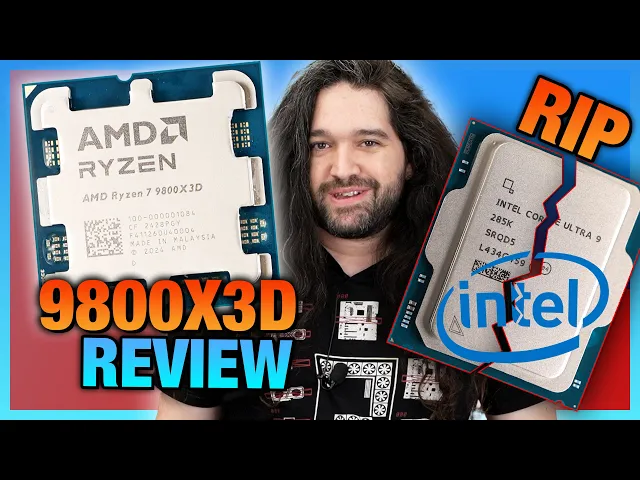
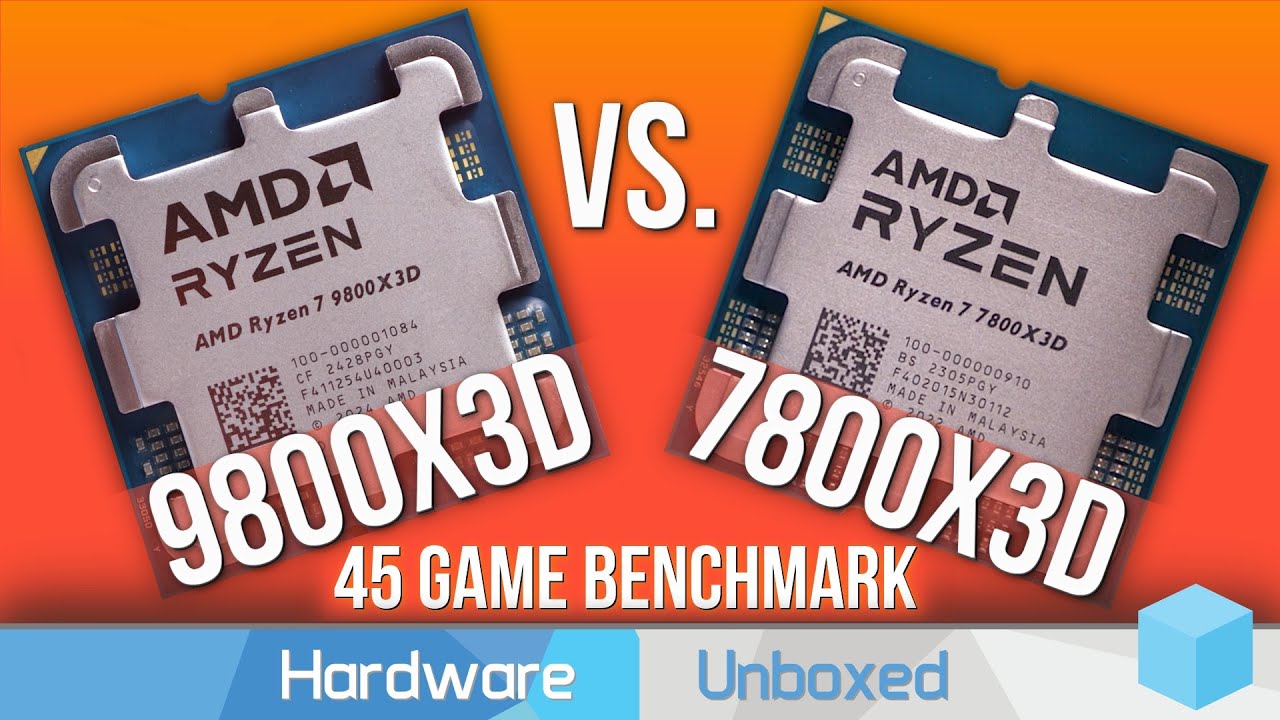
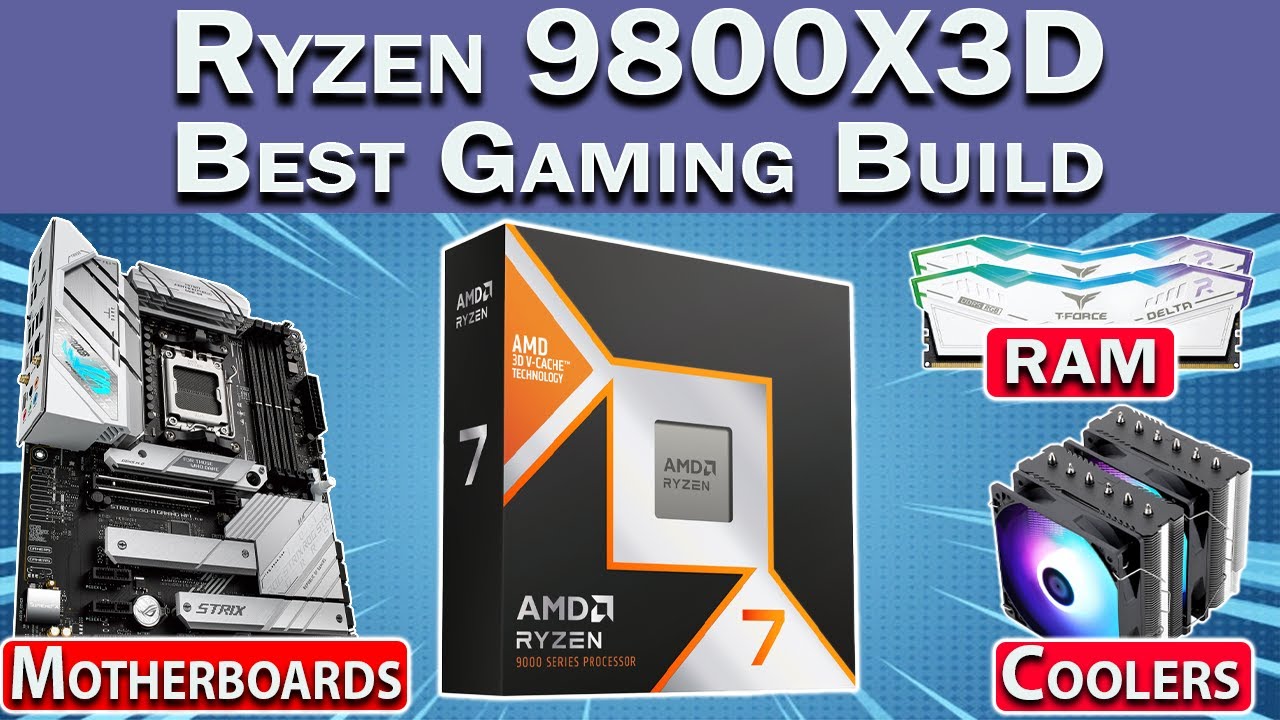
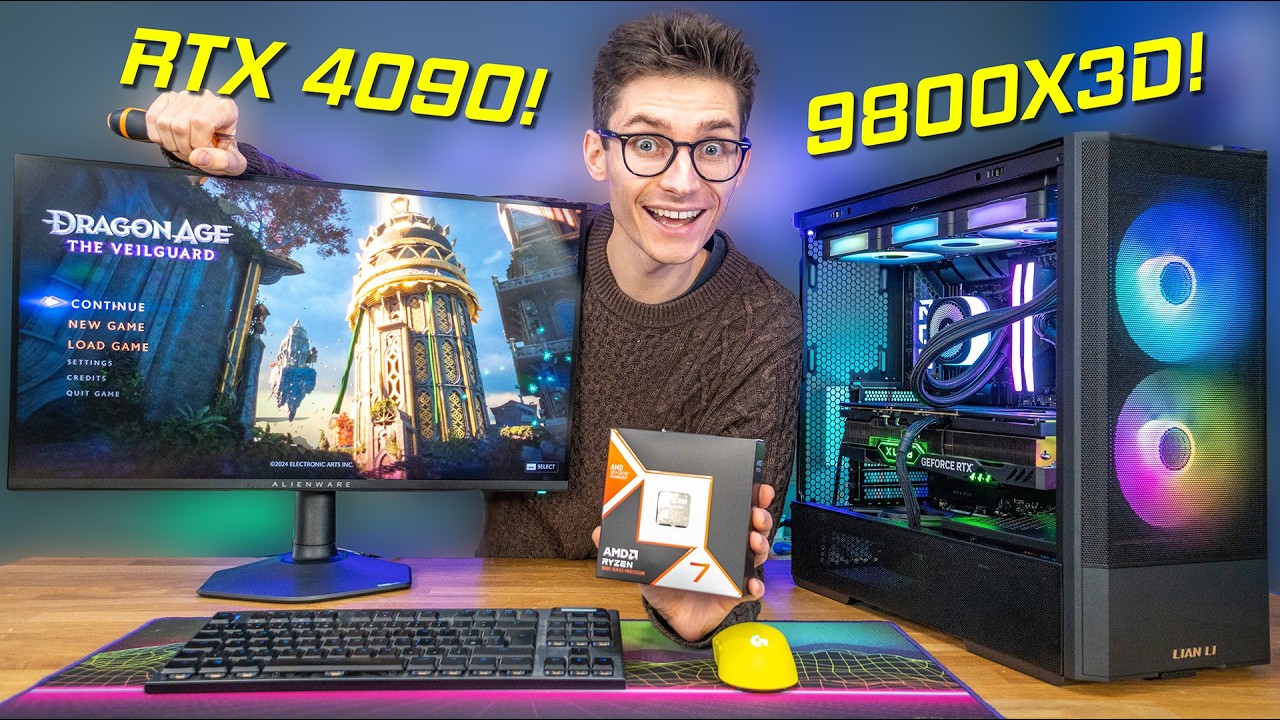
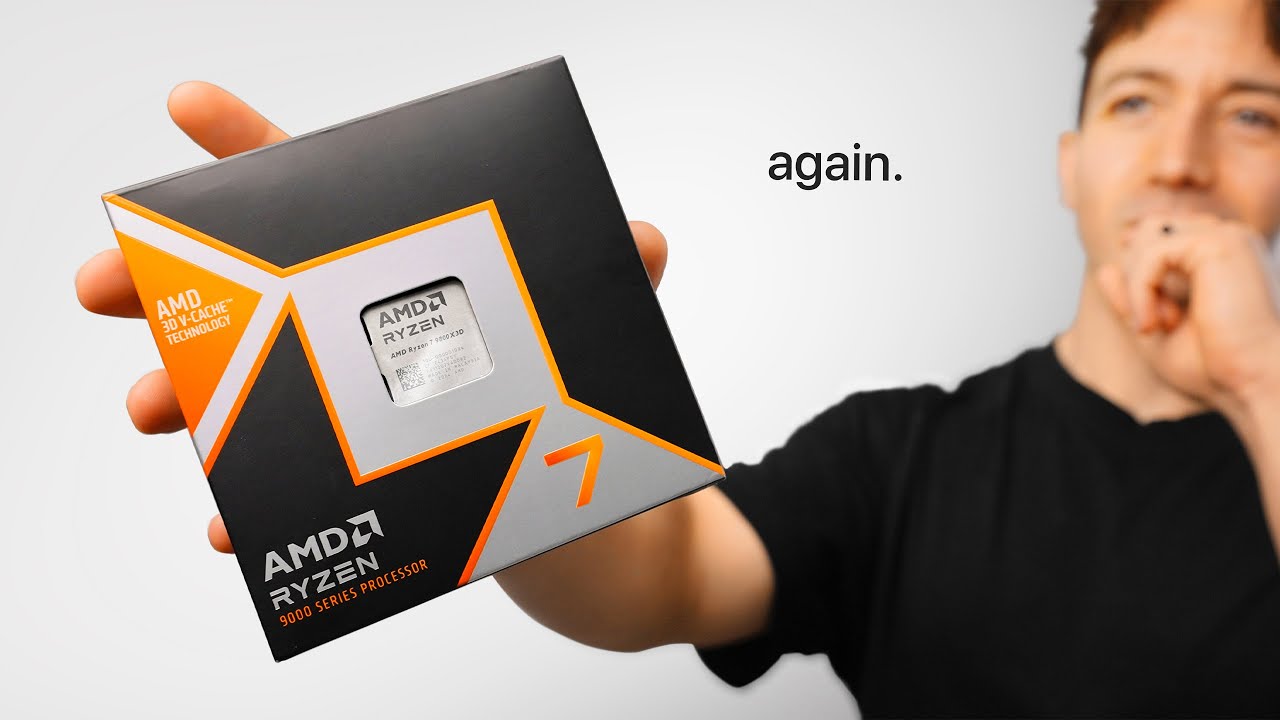
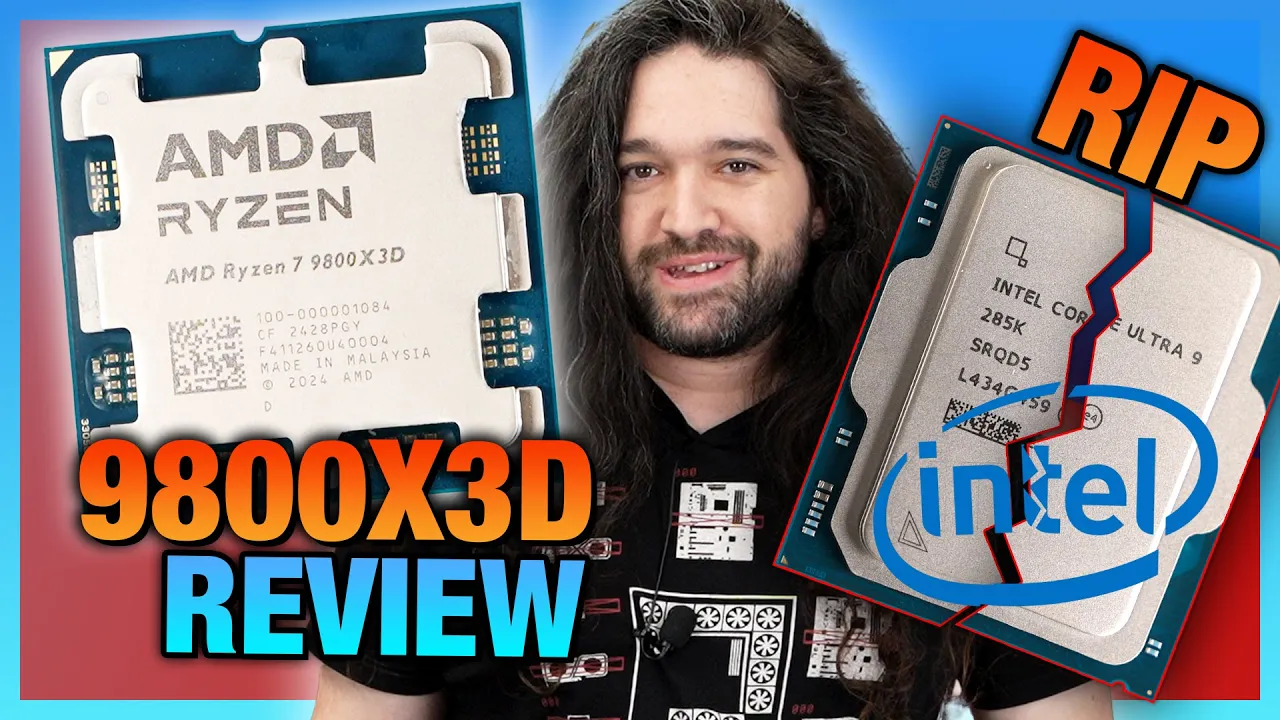
[Music] am's ryzen 7 9800 x2d embargo lifts today and we're reviewing it the 9800 x2d is a Zen 5 CPU it has extra cash on it and it has some critical changes to the location of that cash that should pretty seriously influence the performance as we talked about in a separate technical video the 9800 x2d has shifted the extra cash under the core complex so it's closer to the substrate this leads to more direct contact from the CPU cores to the IHS lid Underside or integrated heat spreader AMD has also eliminated some of its bonding layers within the CPU which reduces insulation further and it has removed the structural silicon that leveled the top of the cach die to better mate the IHS and prior x3d designs that's because the extra cash die and the core complex die are now the same physical dimensions previously if you looked at a deleted say 7800 x2d or something like that you'd see the chiplet with these two spacers basically on either side of it structural silicon and then the Cash die on top so that has moved to the bottom the Cash die there's no more structural silicon support in those locations and we talk about all that in a different video we'll link that below you should really check it out if you're interested in the technology and more of the technical aspects of this today however we are focused in this video on the performance and the value of the 9800 x2d so this is the review of the part so all of that should help with higher frequencies it should help lower The Thermals and then AMD is able to burn some of that extra power budget it now has to boost the frequency uh and it can choose how much of that extra sort of power in therbal Headroom it wants to eat in order to increase the performance of the CPU the 9800 x2d it's a $480 MSRP part this is for the am5 platform let's get into the review we brought you this video with our brand new inductor and snowflake dice set we just launched these highquality unique tabletop gaming dice for dndd Magic the Gathering and other tabletop games the dice come in two sets inductor which embed actual e-waist inductors within sharp edge resin Dice and snowflake which embed tiny snowflake the cap Miniatures we made modeled off of GN CEO snowflake herself each dice set comes with a custom foil card either snowflake or Goblin token we made a custommade wooden box that we designed in CAD featuring a latched fabric line top that flips to become a roll tray and a lid with an etched GN Alchemy logo featuring PC parts and electrical schematics we even benchmarked our dice to test for probability distribution of the roles to try and achieve reasonable balance despite the embedded cats and inductors and have a separate video coming up featuring wendle of level one text and some pattern recognition for the next few days only we are also choosing a low quantity of autographed snowflake dice purchases at random to receive a rare box autographed by snowflakes paw print in addition to my signature on the signed skew snowflake dice directly support our in-depth technical testing and benchmarking and our independent reviews by going to store. Gamers access. net thanks for your support So to start this out the Intel 200 100 series really didn't do well it was a terrible mess of a launch uh they launched something that was functionally incomplete it was not particularly stable in some conditions it had blue screening specific issues that intel was aware of before launch and wasn't able to resolve before launch uh the pricing was absolutely atrocious and so even though Intel improved its efficiency it screwed up everything else so impressively that uh the parts really just ended up being effectively a blunder and at this stage looking at the gaming side of things which is what x3d targets it really is a rip Intel situation that is not just like thumbnail titling stuff I mean in this current lineup and generational battle between AMD and Intel in gaming Intel cannot compete right now it is that simple the cheaper class the 5700 x3d wins uh the upper end today the 9800 x3d wins and we'll show you that in our bench works the only place Intel really kind of stands any kind of Chance is at the lower cheaper end with some of its older stuff but anyway getting ahead of ourselves here so uh the only possible way AMD could screw up this launch would be if the price does not match the performance and if there are better value options that flank uh or subvert the 9800 x3ds viability so uh let's get into the pricing table so 9800 x3ds MSRP is 480 bucks not listed as we write this we're just going to have to to go off of that uh this was all collected in the days leading up to review publication so of course we can't know the actual prices on the day this publishes but we're going off a few days prior assuming that $480 price some of its direct neighbors and competitors include the others on this list the 7800 x2d is $476 now and is out of stock with a listed former price of 450 bucks on New Egg the 7800 X2 has previously been as low as $300 to $330 with drops in August to around $360 some recently lately its price has stabilized higher which is convenient for the timing of the 9800 x2d launch because it makes the 9800 x2d look better insert your conspiracy theories here we have a policy of making comparisons against pricing at the time of review so we'll use that 476 to $480 figure today the 5700 x2d is priced at 187 to 230 bucks the 750x is a similar price to the 9800 x3d Landing it at about $500 that'd be the one to pay attention to for non-gaming work loads if you're considering something in am5 but maybe better at production type applications Intel's competition includes the 285k I guess to the extent that you can even call it competition seen as it barely competes with Intel's Own Parts on value the 285k is $630 where it can be found you shouldn't buy it the 265k is $400 the prior generation Parts like the 14900 K have fallen in price lately that's at 440 with the 14700 k at at 347 bucks or so again at the time of writing a little before this video posts so that'll set things up we have a lot to get through today let's get into the benchmarks we'll start with a comparison of frequency against the 7800x 3D this will help explain the performance differences we're going to see today in an allc coure workload with blender we observed the 9800 x2d maintaining an average all core frequency at a fixed 5225 MHz without any dropping the stability and flatness of this frequency is a result of the higher power limit which is allowing the core all the power it needs to maintain this boost the 7800 x3d averaged between 4,800 and 4890 MHz during the original review cycle for the same test it's significantly lower and less fixed shown by the line's variability in a single thread comparison with cinebench the 9800 x2d also held a maximum single core boost of 5225 MHz throughout the duration of the test the 7800 x2d held 50/50 MHz in the same test as a maximum single core frequency between these two tests the 9800 x2d holds a significant frequency advantage over its predecessor in both all core and single core workloads we also ran a quick voltage ID comparison just using software this time in blender the 9800 x2d held a VI of 1.
18 volts on average with the 7800 x2d at about 1. 07 volts the 7800 x2d is power limited and also running lower Glocks which combined to yield a lower viid using the same blender all core workload we measured a TD CPU temperature of approximately 77° C in a 21° celi environment when using a 360 mm liquid freezer 2 at 100% pump and fan speeds CPU die average was similar the L3 cache plotted just over 50° C with the CPU iodi temperatures around 41° with hot spot readings at about 50° the 9800 x2d cannot be directly compared to the 7800 x2d thermally by using internal sensors picked up by software it would be erroneous to do so without accounting for the changes that AMD has made in its sensors the AMD temperature sensors have been relocated within the Silicon for Zen 5 and moved to cooler locations to prevent clock dropping too early we talked about this in our 9700x review and provided a controlled comparison so you can better understand why the sensor readout isn't directly comparable between the architectures it can be directly compared to the 9700x though the 9700x pulls less power in this test and so it'll be cooler but it's still helpful to compare the 9700x ran a T die of about 52° Celsius under the same test conditions with the same cooler with PBO maxed out on the 9700x we saw about a 13 watt higher power draw than the 9800x 2D stock this landed the 9700 X at about 86° C it isn't perfectly comparable because the power isn't exactly matched and we ultimately don't have an easy way to directly compare the 7800 X thermals from the cash change without solutions that require more time than AMD gives in a review cycle we do have some ideas here though including some power matching between these two uh even still the key takeaway is that for now the 9800 XD is not burning the cores at excessive temperatures even with the Stacked solution and we have more we'd like to do we'll see how the timing pans out though let's get into gaming benchmarks Stellaris is up now we pulled this one forward because the results are so interesting so this is a 4X game it is tested for simulation time rather than frame rate and it's measured in seconds with lower being better if you don't play games like this then what you need to know is that the actual impact from CBU performance has a real world real time impact because you can process the next simulation faster and get on with what you're trying to do so Zen 5 has already shown advantages in this test the 9700x previously scoring the new Top Rank and The Benchmark and outranking all prior CPUs core count has some benefit but Beyond 8 cores for AMD not a ton but IPC and clocks really seem to matter we saw that with zen5 we see it again with the 9800 x3d the 9800 x3d absolutely crushes the prior top result with a 25. 8 second entry against the 9700 X's already barrier breaking 30.
3 second result this previously appeared to be a limitation of the memory which we can see reinforced with the 31. 1 second 285k at ddr5 8600 versus the stock result at 32. 5 seconds the original x3d CPU with the 5800 x3d posted a 35.
4 second result against the 40. 7 second result of the 5800 X so we're seeing a repeat of that era and that was impressive too the 9800 x2d also reduces the 7800 x2d simulation Time by 17. 6% Intel's best showing is the 285k with faster memory but that's not a likee for like comparison because we could boost the memory on AMD also the 285k required a 32 and 1/2 second uh time for simulation with the stock 2 85k to complete the work meaning the 9800 x3d reduces time required by 21% the 7950 x3d shows why we haven't retested it it underperforms overall for all the reasons we explained previously in our review of the part this is why it hasn't been on the chart the 14900 K and 14700 K are effectively tied and within error of each other and removing any limits wouldn't change that much this is a great showing for the 900x 3D Drgons Dogma 2 is up now another of our 2024 titles this game even with all its updates to improve CPU performance is still heavy on CPUs the 9800 x2d distances itself from the 7800 x2d with a 16.
2% uplift gaining on the original 111 FPS average to an impressive 129 FPS average we reran this one multiple times to ensure the result was right but it ended up not even being our biggest gain in the suite the gain on the 14900 K was about 177% up from 10 19. 6 FPS average the same is true of the prior 5800 x3d over the 285k we saw 23% uplift frame times were improved in this game but not as much or as disproportionately as we saw in some select titles the Improvement is more or less proportional to the average frame rate so there's no particularly impressive Divergence in the lows in other words it tracks with what we would expect of a 129 FPS average Final Fantasy 14 Dawn Trails up now released this year the 9800 x2d breaks the previous upper bound of the charge let's run through the flagships so the 9800 x2d CP ran at 373 FPS average which has it 5. 6% higher frame rate than the 7800 X while costing the same as the current 7800 x3d pricing at the time of writing uh obviously the super low pricing of the past is not available at least right now when we're writing this the 1400k ran at 310 FPS average giving the 9800 x2d a massive uplift of 20.
2% this is one of the games where Intel's new a lake CPUs are hugely regressive and impressively bad value so the 285k is 270 FPS average gives the 9800x an overwhelming lead of 38. 3% higher average frame rate as for the 5800 x2d the lead is 11. 8% over the prior AMD gaming Flagship 334 FPS average for some anchors to older Parts the R7 2700 and 2600 were around 145 to 150 FPS average with the 2600 benefiting from a frequency Advantage so you're getting potentially multiples here depending on how far back you're upgrading from the 3600 was at 170 FPS average the Intel 1200f is down at 186 for frame times we observed overall similar frame to- frame intervals for the 9800 x2d and 7800 x2d typically they oscillate between 2 Mill seconds and 4 millisecond intervals where 16.
66% would be 60 FPS the spikes are what matter though the 9800 x3d in this title had slightly shorter excursions for the mean than the 7800 XD the difference is hardly perceptible but on a technicality the 9800 x2d does deliver more consistent frame times in this title bers Gate 3 from 2023 is up next we want to caveat this one with some transparency and a disclaimer we saw a larger than typical gain in the 9800 x2d versus 7800 x2d for this obviously we decided to clear the data because it made it into the review but we spent a day troubleshooting it we came to the conclusion that there's no evidence to suggest any testing errors any uncharacteristic issues caused by the test or the game itself so we're going to run the data because it's interesting we'd pull it if we had substantiated concerns but we couldn't prove any of the suspicions we had so we checked with two other reviewers in peer review ran Hardware info logging ran the test multiple times on both the 98 and 7800 x2d and came to the same results so then here it is the game has the 9800 x2d way up at 160 PS average leading the 7800 x2d by an obscene 26. 9% the 7800 x2d in both our shown data set and our unshown additional tests have it in the 124 to 126 FPS range this was after we double checked it and got the same results each time the 14900 K ran at 105 FPS average giving the 9800 x2d a crushing advantage of 53. 2% the 7800 x2d already had a lead over the 14900 K of around 21% depending on which data set we looked at and then the 9800 X also leads the 285 K's 100 FPS average by 60% against the 5800 x2d we're seeing a boost of 33.
3% from the prior 120 FPS average balers gate three frame times for the 9800 x2d also improved over the 7800 x2d and this time it wasn't just proportional to the average uplift in the frame time chart here you can see the 9800 x2d maintained a tighter frame to frame interval with reduced amplitude of excursions from any given prior frame there aren't too many huge spikes for either of these really tend to not notice unless it's 12 to 16 millisecond some people can notice 8 millisecond excursions from frame n minus1 but the big thing here is that the 9800 XD is just tighter together both of these would be an overall objectively good experience though because this was an outlier we ran Hardware info login against the test as a separate run in this test the 9800 x2d average all core frequency was about 5225 MHz which is impressive for all core we think this is why the performance is so disproportionately good there's a much higher power budget so we're not trimming the frequency Peaks and the power consumption itself isn't overall excessive for the game the two combined to allow budget for full boosting and then plotting the 7800 x2d we see a much spikier less predictable average all core frequency that bounces between 4500 and 5050 MHz under load the highest single core frequency is also variable this is contributing to the behaviors discovered in the test in Rainbow Six Siege the 9800 x2d landed at 643 FPS average and led the 7800x 3D 622 FPS result by 3. 4% there are limited gains to be found at a game already over 600 FPS we'd have to re-evaluate this with whatever Flagship Nvidia puts out next to try and find the true CPU ceiling it at least gives perspective that you may not see big differences in heavily bound scenarios the 14900 K ran at 586 FPS average here so the 9800 XD has a 10% Improvement the new X Parts also about 10% over the 285k compared to the 5800 X the 9800 X gains 12% average FPS and we removed some of the other CPUs from this one to make space for APO on results as a reminder APO is now doing little for performance in any of our tests this includes Rainbow 6 which previously saw larger impact the 149 K is about 10 FPS different with APO on the 285k saw change only with an error and run- to run variant so it's irrelevant Starfield is up now a 2023 title in this game the 9800 x2d leads the 7800 x2d by 16% impressing again generationally the new results is 169 FPS average to the 145 of the 7800 xvd the 14900 K is led by 24. 6% with its 135 FPS result the new 285k did a little better than the 4900 K in this game at 143 FPS average that's still an 18% higher average frame rate for the 9800 xpd even with the DDR 58600 memory in gear 2 with the 285k which required blasting the vdm and some other settings tweaks it still caps out at 152 FPS average that was a great result but the 9800 x2d puts things into A New Perspective against the prior AMD 5800 x2d Flagship and it's 128 FPS results the new 9800 x2d has a 31.
4% uplift some quick reference older Parts include the 2600 at 59 FPS average the 2700 at 66 the 3600 at 70 and the 12100 F at 71 FPS f124 is another of the games with a lower boost over the 7800 x2d the 9800 x3d ran at 464 FPS average here with a 5. 8% Improvement on the 438 result of the 78 x3d the 14900 K ran at 385 FPS average so it's about a 21% uplift for the 9800 x3d the 285 K was massively regressive in this game and was down at 344 FPS that yields a 35% advantage to the 9800x 3D against amd's Flagship from the 5000 era the lead is 18. 6% over the 391 FPS result of the 5800 x3d Total War Warhammer 3 is one of the older games we test but it's important for perspective on external bottlenecks sometimes GPU sometimes memory depends on which CPU we're looking at the 9800 x2d ran at 490 FPS average which is within error of the 7800 X2 these two Bound by the same bottleneck which in this situation is the GPU there's only a 5% lead over the 1400k due to the same limitation with an 8% advantage over the regressive 285k the 5800 x2d ran at 457 FPS average so another 7% Improvement for the 9800 x2d here the 14600 K with its recent rerun we ran landed it up alongside the 14700 K with both encountering the same bottleneck as the 13700 K and the 7800 x2d sometimes people ask why a 13700 K could be better on a chart 14 700k it isn't here it's just that we actually can't see the Unbound scaling so they look the same this limits the usefulness of this test this game has 0.
1% low issues with the I9 CPUs due to their thread count you can see that pretty clearly here we don't task Community FPS mods so it's up to the devs to fix this it is however a real representation of the outof Box performance for these parts we'll now get into efficiency testing then the rest of the Benchmark so this testing looks at CPU performance per watt typically represented as FPS per watt for games which would be frames per jeal or myips per watt in the case of seven zip sometimes we have simulations per wat hour these tests look at a simple formula of the power and Watts drawn on average for the test versus the performance of the task adjusting either of these two parameters will have an impact on the result in seven zip compression the 9800x 3D computed to 1298 mips per watt or millions of instructions per Jewel putting it barely ahead of the 5700 x3d The increased power consumption of the 9800 x3d reduces its efficiency as compared to the lower power of the 9700x at 81. 6 watts versus 98. 4 the 9700x scored 1389 mips per watt the 9800 x3d ends up relatively efficient in compression but less efficient than the prior 7800 x3d the 7800 x3d wasn't a higher performer but because this is a calculation of both power and performance either one can help to counterbalance a deficit in the other meanwhile Intel's 285k measured at 1051 mips per watt which is improved upon its prior efficiency performance in the 149 00 K which was way down at 672 mips per watt that's with the EPs 12vt and ATX 12vt line measured on the 285k the AMD CPUs do not pull from atx1 12vt in any meaningful way in our testing the pcie slot is isolated when we do pull from ATX 12vt and the fans and RGB LEDs are also isolated or disabled 5vt from IO is also isolated this means that there's some overhead an ATX 12 volt on Intel for the 200 series from the RAM and other small devices but nowhere near enough to meaningfully move that needle closer to AMD decompression efficiency is up now in this one the 9800 xvd ends up at 1482 mips per watt just under the 5600x which is benefited by its 60 wat power reading and above the 750x at 183 Watts the 750x in eco mode is more efficient for its trade in performance down to 133 watts and now at 1936 mips per watt the 750 x2d boosts a little higher in score because its power draw drops even more now at 124 Watts for 16 cores the 750x could also be limited to 124 watts and would achieve a similar score the 7800 x2d is more efficient than the 9800 x2d due to its lower power consumption but its performance is also lower the 9800 x2d trades efficiency for more boosting here and this benefits it in gaming as we saw earlier despite costing more power Intel's closest CPU is the 285k toward the bottom of the chart at 162 watts in the same test and 1194 mips per watt moving on to games we'll start with balers Gate 3 balers Gate 3 positions the 9800 x2d has a new can of efficiency in the test with a 2.
4 FPS per watt result that has it just above the 2. 3 of the 7800 x2d the 7800 x2d utilizes about 13 Watts lower power as averaged in this test resulting in a smaller Gap than we might otherwise see the 9800 x2d at least maintains amd's trend of x2d Parts becoming the new efficiency leaders in gaming and Intel CPUs first appear with 245k at 1. 3 FPS per watt the 285k is below that at 1.
1 followed by Intel's last generation Parts Starfield efficiency is up now the 9800 x2d is almost at the top but not quite it performance gains were relatively high in this game but the power consumption increased significantly the 9800 x2d averaged 98. 7 Watts for the duration of the test with the 7800 x2d at 69 Watts this is what leads the 7800 X2 to a victory in this test despite the performance uplift AMD has lost efficiency here Intel CPUs first appear again at the 285k down at 1 FPS per watt the 14900 K is at about 0. 7 Stellaris is something of a repeat of that the 9800 x2d pulled 54 Watts on average leading it to a 2.
6 simulations per wat hour score the 7800 x2d ended up at 2. 7 or about a 4% advantage in efficiency despite a reduction in performance compared to the 9800 x2d the 12 wat lower power leads to this discrepancy Intel's closest part is the 245k at 1. 9 simulations per wat hour with the 285k at 1.
5 Final Fantasy 14 is final for efficiency comparisons in gaming for this one the 9800 x2d ranked at 7 FPS per watt which has it below the 5700 x3d and 7800 x3d the CPU pulls just under 54 Watts on average while the 7800 x2d ran at about 43 watts and the 5700 x2d ran at an impressive average of just 39 Watts despite higher performance the higher power tips the scale away from the extreme efficiency we've seen in previous x3d Parts it's still relatively high in the ranks above everything Intel and above amd's non x3d Parts but it's clear that AMD favored an increase in power for an increase in performance as it tries to find a balance between the two production benchmarks are next these tests look at a suite of applications outside of gaming the 9800 x2d is ultimately a gaming CPU our non-gaming tests don't regularly show advantages for extra cash but it'll still be advantaged here just from of the power budget boost versus some of the prior AMD CPUs depending on which generation you look at blender is up first for a 3D rendering pass of our intro animation the 9800 XD completed the frame render in 12 1/2 minutes about tied with the Intel 245k although we don't recommend the part the 245k is cheaper at $320 amd's 9800 x2d manages to at least outperform the 9700x with an atypical render time reduction of 16% it's atypical here because prior X 3D parts do not necessarily see such gains such as the 7800 xvd at 15. 9 minutes to the better results from both the 7700 and 7700x the reason for the atypical gain is largely the power budget where the 9800 X has more power available out of box to clock up the 137 00k also requires less time the 9800 x2d is improved which is better than we've seen in the past from x3d Parts but there are still far better performers and value options from Intel and AMD alike if applications similar to this are your daily use case szip can be one of the more sensitive to cash but it depends on whether it's compression or decompression in compression testing first the 9800x completed 128,000 myips which puts it with an error of the 14600 K and 13600 K it at least posts a 133% jump over the more power power constraint 9700x the lead over the 7800 XD is similar the 7950 XD performance is about the same as the 7950 X and within about 1% Intel's 285k has a large lead here about 170,000 mips with ddr5 6000 the gain in our ddr5 8600 test was massive in this Benchmark which puts it at nearly 202,000 mips that was pretty cool to see but the 9950 X manages to approach this result with the slower memory meaning an upgrade to its as well would Leap Frog the 285k decompression has the 9800x 3 at 146,000 mips it's between the 12900 K and 7700x the 9700x was regressive in this test against both the 7700x and the more like for like power 7700 the 9800x leads the 7800 XD by 10. 2% and the 9700x by similar again if you're heavily represented by this test You' be better off with a different CPU the 16 core AMD CPUs lead this chart and set that example the 750x has has been below $500 lately so it'd be a price comparable alternative to the 98 x2d that's more suited to this specific benchmark chromium code compiles up now the 9800 x2d requires 130 minutes to complete the compile with our settings putting it at the same level as the 14600 K and Intel 245k the 7900 non X leads the 9800 X2 here and benefits from the extra threats the 9800 x2d also benefits from an 18% reduction in time requirement against the 7800 X's 160 minute result likewise it leads the 149 minute result of the 9700x still the 12900 K 13700 K and 285k are all advantaged over the 9800x 3D as our AMD own 9950 X and 9900 X Parts Adobe Premier testing is done with the Puget Suite this testing lands the 9800 x3d at 10,50 points and aggregate for the extended test which includes raw intraframe and effects performance the result is between the 13700 K and 9900x above it and the 12900 K and 7800x below it the 9800 X does actually improve on both the 9700x and the 7800 x3d though both of which are around 9100 points in aggregate Intel's 265k outperforms the 9800 x3d by 6.
6% with the 7950 X above that the 285k does impressively well in this specific test with the 4900 K alongside it Photoshop also uses the Puget Suite the 9800x 3D does impressively well in this Benchmark with its average score Landing ahead of the 950x and the 9700x alike the 7800 x2d is 10,162 point result gives the 9800 x2d a lead of 1% AMD does well on this specific Photoshop test right now and so Intel's first CPUs show up way down the chart with the 14900 K and 14700 K the 285k does about the same as the 13700 K here Intel's 285k was already lowered into the grave when it launched but the 9800x has basically just contributed a significant aquous mixture of hydroxide chloride and pottassium with about 95% water onto the grave this impromptu hydrolysis reaction results in a product that you probably shouldn't buy even more than you already shouldn't have bought the 285k or said more crudely uh they pissed on the grave the 9800 XD is definitely the new gaming King and this time it's priced similarly at least right now when we writing this to the 7800 X the original launch price of the 7800 XD was 450 bucks and even at that price the 9800 xvd is actually a worthwhile Improvement and doesn't feel like stagnation for once this cycle finally we get to two experimental new charts we're trying out these are brought to you by our dice kits which financially support the extra effort it takes to play around with things like this we don't want you to place too much usefulness in these particular charts yet because they are experimental and we can't try new things if we're always trying to perfect them first but this one shows the delta in USD per FPS at various simulated prices for the 7800 x2d the 9800 x2d is fixed at $480 in all these simulations with the 7800 x2d variable based on the number you see in the chart Legend on the right a negative value means the 900 XD is that amount cheaper per FPS than the 7800 x2d positive value means the 9800 x2d is that amount more expensive per FPS than the 7800 x2d at near price parody the 9800 x2d has significant value advantages in Drgon dog with 2 balers Gate 3 Starfield and even Phantom Liberty value is functionally the same in F1 Rainbow 6 and Final Fantasy it isn't until $420 the price for the 7800 x2d that the Starfield value gains would be mostly eliminated at a $400 7800 x2d versus $480 9800 x2d the 7800 x2d starts to make a ton of sense widely speaking as a better value assuming that's how you shop basically if you're trying to pick between the two and the price changes after this review you can use this table to gauge the value this is also an experiment in this one we're showing the percent increase in power consumption for the application in the left axis versus the percent increase in performance the best result would be a larger performance increase than the power increased by percentage although linearity is also good and balers gate and Stellaris with the ladder converted to simulations per hour so that higher is better the percent performance increase is either improved or nearly linear with the percent power increase in Starfield the performance increase costs a substantial power increase we saw the same in Phantom Liberty these are two most power Hungry Games in the suite and fully leverage the power budget seven zip also saw this when Dawn tril is also bottleneck so can't be reliably used even when it's limited though power is higher and the might be past the most efficient point in its curve based on this but results like stillar support that it's still relatively balanced there are some big boosts to performance over the 7800 x3d Stellaris saw the 9800 x3d break through a glass ceiling and Propel to new heights against an already dominant 7800 x3d Starfield saw about a 16% Improvement Drgon's Dogma 2 also about 16% in our testing also breaking through what seemed like a ceiling for the game for efficiency the 9800 x2d doesn't manage to hold on to amd's multigeneration history of its new x3d CPU becoming the most efficient in our charts however the CPU is still efficient and we'd still classify it that way overall when considering everything else on the chart production isn't as competitive as other parts so if you're not building a gaming first system you should just buy a different CPU from the 9800 x2d amd's decisions on the engineering side to move things around to move the XD part down to the bottom closer to the substrate get the course closer to the top it better uh that is what has enabled AMD to have more thermal headro so that they can push more power into those cores and it's then able to utilize that extra thermal Headroom to make decisions on where to tune the VF curve volt frequency curve uh to to try and hit a number that is still thermally and and in terms of efficiency acceptable while actually pushing the performance whereas the prior solution for x3d they were dealing with significant thermal constraints and considerations that would not have given that extra budget to play around with to try and fine tune further so uh they have traded some efficiency for a lot of performance and gaming and you can check out our previous video on this part if you want more technical detail on that so Intel isn't anywhere close on the gaming charts so the 285k for whatever reason is some completely insane $630 to the price in gaming scenarios the 9800 x3d entirely invalidates a a 285k purchase we already considered it invalidated in gaming but now it's even further so uh sometimes that difference is 40 to 60% depending on the game if you cut balder's gate out of the data just cuz we we're still a little it's a little weird it's an outlier I mean we did validate it but uh let's just cut it and say it's 40 to 52. 3% so that's what the range is if you get rid of that outlier and now we've rolled the die let's just see what Intel got here literally I'm not making this up a one now unintentional but fortuitous self- product placement aside the 285k has beaten there we're seeing 25 to 35% when Unbound for the GPU and ignoring some of those heavier titles that really benefit AMD so it's still beaten heavily uh elsewhere GPU buying scenarios obviously the the differences start uh stopped to matter as much Intel does better in production benchmarks we still wouldn't recommend the ultra 200 series broadly but there are some places you can make an argument the 950x and 7950 X are also competitive in those with the 14900 K and 14 700k also somewhat competitive in the same production scenarios as compared to the 285k so there are some very limited use cases such as the sort of buzzword creation scenarios as people call it where the 285k makes some more sense and you can see that in at least one of the Adobe applications we test via Puget but Intel is marketing the 285k on efficiency and AMD is more efficient in every test we've run the entire last few months have been comically out of control for the CPU launches uh we saw to open up with Zen five for AMD where AMD fumbled the ball and lost five yards until then picked up the ball and started running towards its own goal at which point it tripped over its shoelaces that came unglued because they don't know how to tie them and AMD then picked up the ball and somehow accidentally stumbled across the have reached the end of my knowledge for sports endone is that I think that's the one that fits with this analogy hoop a a golf hole I don't know choose the sports thing somehow though it all worked just like that analogy AMD was set up for a slam dunk on this I've actually that was not intentional on this launch with both its own and Intel's fumbles and they under marketed the performance of the 9800 x2d by our testing which put them in a position where only the price could screw them if they had set it to $600 totally different story even five out of 50 or something uh but Andy seems to have been at least somewhat cognizant of that overall this launch was the most organized out of the last several we've covered so Zen 5 was a disaster Intel 200 was an even bigger disaster and one of the indicators we have that a product is ready for launch is the amount of time a company sort of gives in the review process a couple things here one from a sort of uh cynicism standpoint less time means a lot less time to find problems and when you're being critical and you have limited time you have to be really really careful what you're critical of because there's a lot more underlying complexity you may not have time to explore as a reviewer you really got to pick and choose Intel uh had less than a week on the 200 series for reviewers at least in our situation and Zen 5 was also pretty cramped they they delayed it it was a total mess and then they somehow still were late shipping out the parts so we can work with cramped timelines the concern is always does this reflect anything for the consumer and in the 200 series what we saw was blue screens of death uh some stability concerns issues with anti-che software and these are all bad things where a couple days before launch you're finding that stuff it's just this big red flag of what else is in here and then zen5 where uh AMD seems to have Mist tested its own stuff for the marketing slides and that caused a lot of confusion too so this one was organized they uh sent it out I don't know something like 2 weeks before the actual CPUs shipping and the platform seems mature there have not been any major overhauls mid test cycle it just it arrived and then it was ready to be tested and it stayed that way through the process uh without a lot of Chaos in between so it looks like this is a more confident launch uh with fewer issues to iron out that we would we don't have to worry about if we're not finding problems basically hopefully uh so anyway that's it for the 9800x 3D review you all have the numbers to make the decisions at this point so the 7800 x2d may make more sense in situations where its price Falls this entire thing just to be really clear is predicated on the price the 78 x3d is at the two largest retailers in the us at the time we're writing this which is about 480 bucks if it falls uh to say 400 420 and the threes especially it starts to make sense really consider it but either way the situation is the same in gaming scenarios 70 x3d and 908 X 3D make a lot of sense production scenarios uh like always if you're really heavy and non-gaming you should probably look at other CPUs uh these are still competent in them but they are not competitive by value it's just not what they intend to do they're good enough though if you do a little bit of it sort of as a hobby or or whatever so that's it thanks for watching subscribe for more check out our dice on store. Gamers access.