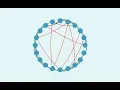
Now that we've seen several examples of complex systems, let's try to abstract some of the properties of the ones that we've seen. The first property is one that I've mentioned several times. Complex systems are composed of simple components often called agents.
That is, they're simple relative to the system as a whole. Another common property is that the components of the system interact in nonlinear ways. We'll talk about what the term nonlinear means in the next unit.
But very informally, it means that the components interact in such a way that you can't just sum up all their activities and thereby derive what the whole system is doing. Colloquially, we might say that the whole is more than the sum of the parts. That's really what nonlinear means.
We'll come back to that. We've also seen that in the systems we looked at, the components were not controlled by any central executive. There was no central controller for the ants or the immune system or in our economy or in any of the other examples I showed.
Instead, what we saw is that the system was able to organize itself in a decentralized way. Finally, a key notion that's important across all complex systems is the concept of so-called emergent behavior. The term emergent here refers to properties of the system that can't be easily understood from individual components or small groups of individual components but rather are collective outcomes of the whole system and have to be understood at the system level rather than at the individual level.
Let's give some examples of the kinds of emerging behaviors I'm talking about. The first one might be called hierarchical organization. This refers to things like biological organisms which have hierarchical structure ranging from cells to organs to bodywide systems to the whole body and even on to colonies and society.
How such hierarchies emerge in the first place and how the different levels interact are important questions for the field of complex systems. In this course, we'll see some examples of different kinds of hierarchies. A different kind of emergent behavior is information processing.
That is the system as a whole gaining information from the environment and about its own state as well and using this information to make decisions as a whole about what actions to take. the components don't gain the information or make the decisions individually. This kind of information processing can only be done on the level of the system as a whole.
We'll see how complex systems such as ant colonies, the immune system, and so on are able to collectively perceive and use information for the fitness of the whole system. Another example of emergent behavior is what I'll call the complex dynamics of the system. The word dynamics refers to how the system changes in its patterns in space and in time.
For instance, we might see ants building up foraging trails. So, the whole colony takes on a kind of pattern that changes in complex ways over time. You might also think of stock prices which change in a complicated and unpredictable way.
Having complex dynamics is a property of all the complex systems we're going to see. Finally, in all of these systems, we see evolution and learning. All these systems, whether they be biological, social, or technological, exhibit some kind of evolution in the Darwinian sense.
And this evolution often results in adaptation or learning. That is, systems improve themselves to survive or do better in some environment. This is something we'll focus on a lot in this course.
Now that we've seen several examples of complex systems, let's try to abstract some of the properties of the ones that we've seen. The first property is one that I've mentioned several times. Complex systems are composed of simple components often called agents.
That is, they're simple relative to the system as a whole. Another common property is that the components of the system interact in nonlinear ways. We'll talk about what the term nonlinear means in the next unit.
But very informally, it means that the components interact in such a way that you can't just sum up all their activities and thereby derive what the whole system is doing. Colloquially, we might say that the whole is more than the sum of the parts. That's really what nonlinear means.
We'll come back to that. We've also seen that in the systems we looked at, the components were not controlled by any central executive. There was no central controller for the ants or the immune system or in our economy or in any of the other examples I showed.
Instead, what we saw is that the system was able to organize itself in a decentralized way. Finally, a key notion that's important across all complex systems is the concept of so-called emergent behavior. The term emergent here refers to properties of the system that can't be easily understood from individual components or small groups of individual components but rather are collective outcomes of the whole system and have to be understood at the system level rather than at the individual level.
Let's give some examples of the kinds of emerging behaviors I'm talking about. The first one might be called hierarchical organization. This refers to things like biological organisms which have hierarchical structure ranging from cells to organs to bodywide systems to the whole body and even on to colonies and society.
How such hierarchies emerge in the first place and how the different levels interact are important questions for the field of complex systems. In this course, we'll see some examples of different kinds of hierarchies. A different kind of emergent behavior is information processing.
That is the system as a whole gaining information from the environment and about its own state as well and using this information to make decisions as a whole about what actions to take. the components don't gain the information or make the decisions individually. This kind of information processing can only be done on the level of the system as a whole.
We'll see how complex systems such as ant colonies, the immune system, and so on are able to collectively perceive and use information for the fitness of the whole system. Another example of emergent behavior is what I'll call the complex dynamics of the system. The word dynamics refers to how the system changes in its patterns in space and in time.
For instance, we might see ants building up foraging trails. So, the whole colony takes on a kind of pattern that changes in complex ways over time. You might also think of stock prices which change in a complicated and unpredictable way.
Having complex dynamics is a property of all the complex systems we're going to see. Finally, in all of these systems, we see evolution and learning. All these systems, whether they be biological, social, or technological, exhibit some kind of evolution in the Darwinian sense.
And this evolution often results in adaptation or learning. That is, systems improve themselves to survive or do better in some environment. This is something we'll focus on a lot in this course.