well hello folks this is ICT with the eighth and final installment in the scout sniper trading series this episode's going to be called escape-and-evasion now what it's going to be doing essentially is providing you a summary and an overview of what it is specifically that you should have gleaned going through each individual installment now it's not my aim to produce additional technical concepts in this episode in fact what I've done was I forced you to spend six months if you do two calculations on your calendars you'll see that we've spent six months from the initial
installment to now this one being the last in the series to be released because what I did was I forced you to look at the concepts over a period of time okay you have to have a sample set of looking at each individual component that was produced and released in modular form each episode had its individual premise in mind for you to study and utilize in your own exercise and training so that way allows in the individual of viewers the time that's necessary to adopt the understanding that each component requires once we understand all the
components collectively ok and intimately on each component once that's understood then it's very easy for someone that's a mentor or a teacher to conceptualize it into a trading plan or a process of engaging the market so I guess it's a long way around saying you need to take the time to study each individual component know it intimately understand why it does what it's doing ok and what am i referring to well the time of day theory ok what happens between 2 o'clock and 5:00 a.m. New York time barricades are in the London session what do
you typically see what type of price actions usually you know characteristic of that time of day the london close between 1500 and 1600 GMT that time window typically you know produces something else in turn of price action that's very generic and repeats itself over and over again the New York open okay twelve to fourteen hundred GMT okay what happens during that timeframe okay on a daily basis doing that over a period of time builds an understanding again intimately on what each individual component of each installment that we produced and shared with you so by having
that amount of time and that exercise oriented approach to learning hopefully you've done that if you haven't obviously this episode will more or less and force you to go back through it again okay and actually it's in my intentions really to make you go through that series one more time and it's not for YouTube views or statistics and you need to try to get more views because that's not my interest if I could get a handful of really exceptional traders okay that are consistently delivering the results that they aim for that's my goal you know
I don't monetize my videos I'm not trying to get you know hits or or stats so it's really the feedback okay that I get a high off of so it's with really that I'm hoping that if this video series has been helpful to you if it's insightful T is to help you build a foundation to price action analysis I would love to have you know some feedback you can reach me an iced et at the inner circle trader.com it's really the driving force behind why I do what I do is I do not sell courses
I do not sell seminars I do not sell books I do not sell any information whatsoever I do this because of you know just a sheer passion and sharing it I'm successful in my own right so by sharing it certainly not to take anything from me but I certainly do enjoy and really get invigorated by the the feedback of new developing traders or folks that have been trading for a long period of time they come on to the ICT concepts and it really gives a super charge to their understanding in price action and hopefully the
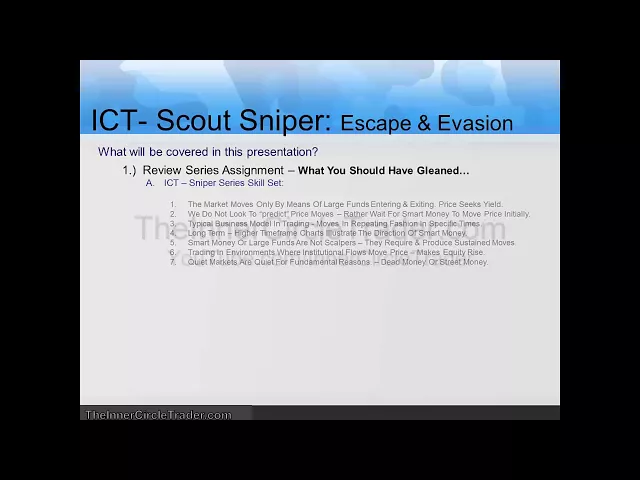
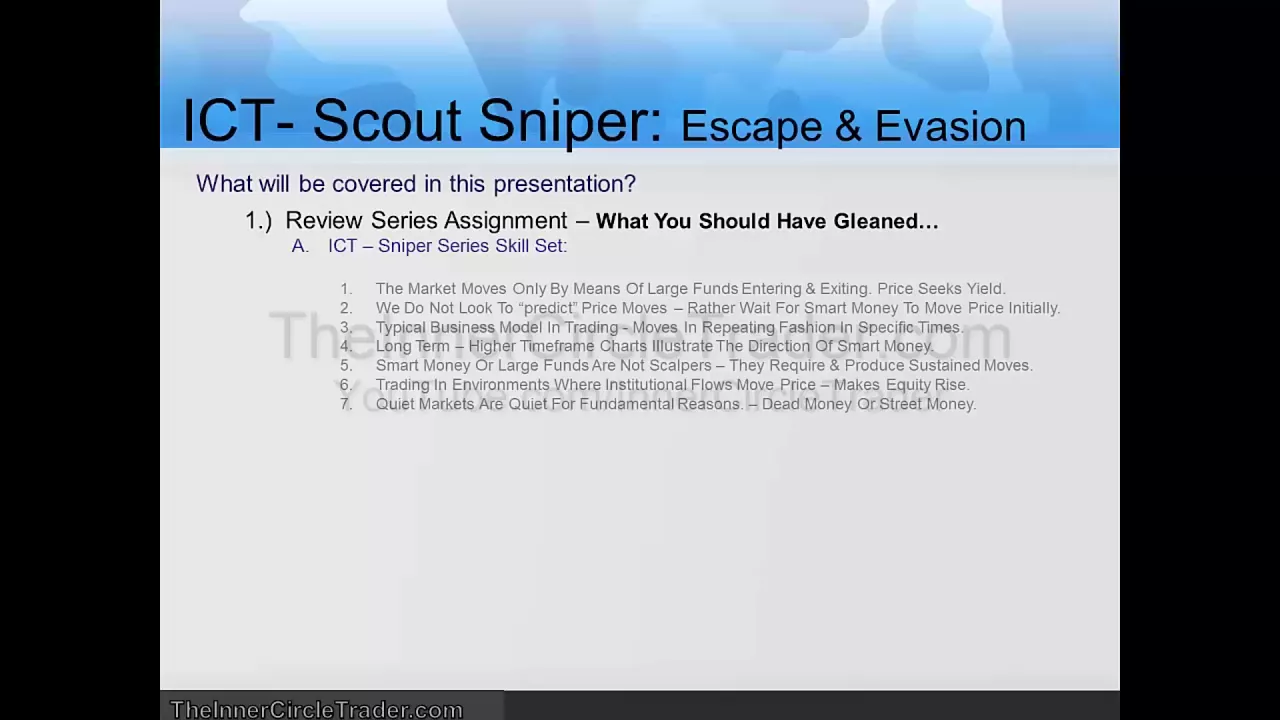
results are you know positive so let's get on to this presentation okay so what was it we're gonna be looking at in this presentation we're gonna covering well we're gonna be reviewing the series okay and basically going over what it is specifically that you as the viewer okay should have gleaned now we're going to be looking specifically at the ICT sniper series skill set we have to understand that you know going through this video series we've learned that the market moves only by means of large funds entering and exiting price seeks yield so where yields
are and where yields are moving towards that is going to be a catalyst for where future price action will ensue okay so you have to understand that price in itself isn't just simply moving around you know aimlessly there is a driving force fundamentally okay driving force behind price action we cannot always discern what that is okay there are fundamental traders that I admittedly they may be very very astute in terms of the fundamentals but me as a trader I simply can't grasp fundamentals as a central tenant to my trading so I rely on price acting
to convey those that are smarter than me in that realm okay because large funds and and banks are more in tune with the fundamentals and the drivers behind currency exchange I allow them to you pretty much leave their footprint in the sand and then if they're doing something specific I'm gonna be looking to follow suit okay so it removes all the necessity of being a genius and we do not look to predict price moves okay we would rather wait for smart money to move price initially now this is going to help you hone the skill
of patience and if you understand what that front print looks like and we talked about that in several examples in the series it allows you to simply wait for that if you will roadsign okay because most individuals sit in front of the charts and you have really have no idea what it is they're specifically looking for but hopefully with this series we have zeroed in on what specifically you're looking for that initial move that quick sudden move away from a particular price level that indicates fundamental flows being driven by institutional level trading okay retail trading
cannot move the market we are just little fleas on the big dogs okay so if the dogs running okay hopefully we're on for the ride and bottom line is we can just take a little bite here and there but ultimately we can't make the weight so we just ride them now the typical business model and trading is simply understanding that there's a generic price action theory that unfolds on a daily basis that goes over and over and over again between London to New York and London close okay there's a small little pocket of action that
goes on in Asia but we didn't spend any time of any significance really in that but I do have a video dealing specifically with Asian trading so if you look at that on my youtube channel you can certainly glean what it is that's useful for that that time window or kill zone but specifically moves repeat in specific times of day and specific days of the week and that phenomenon again is very generic it's not attributed to any one author it's not attributed to any one specific you know source it's just a generic observation that I've
made over the years and gleaning certain things from Larry Williams in trading day of the week understanding with his bond and as a P trading really gave me the insight to hey look you know what he's right you know because he mentioned in his teachings that you know humans by far and large were really good starters okay but we really suck really at you know finishing okay and we spent a lot of time throughout the week okay trying to chase money but as we get closer to Friday when the markets are closing our interest really
wins and we anticipate the weekend so we spend the most time of our weekend studying looking at fundamental data price charts and we're all in a hurry to get ready to do something new for the new week and that's why typically the weekly higher lows formed in the first couple days of the week in the weekly range unfolds with that in mind so we learned that there's a specific generic business model that takes place and we understand how market makers deal with in that overall price model long term higher timeframe charts illustrate to the direction
of smart money now a smart money again we've identified as the large funds the institutional banks the traders that have huge huge accounts and a large supplies of money to really caused these major shifts in price week as traders week and retail level we cannot cause these major price spikes okay it was just simply not enough of us but when we have higher level entities okay to have really deep pockets when they do exchange transactions in the marketplace they can't hide that okay so there's a very very telling footprint okay left in the charts if
you understand what it is you're looking for it really tips the cards and lets you know what it is they're doing smart money or large funds are not scalpers okay they require and produce sustained moves so that's that was hopefully one of the main paradigm shifts that you you encountered with this series because you're gonna need the understanding of waiting for specific price action okay to unfold before you take action on your retail account because if you're a scalper and you don't understand the concepts of how large funds and order flows directly impact you as
a trader even as a scalper you will fail okay you have time to have them you have to understanding that you know price has to move by a larger entity and without that institutional quote-unquote sponsorships I like to refer to as in price moves you're simply going to not see the advancements in price that you hope to make even as a scalper so we we did a very in death study of smart money and large funds and institutional level order flows so when you see that type of thing unfolding in your charts you know that's
a green light go you need to start following that market okay now trading in environments where institutional flows move price will as a direct result make your equity rise because you know that the market is predisposed to move on a grand scale not miners static little short-term blips and in this static price action that's not how you want to be trading even in any other asset class not just simply in FX you have to have that environment where things are moving okay as traders we need price movement if if price is stagnant there's a reason
for that and we're gonna talk more about that as we go quiet markets are quiet for fundamental reasons specifically dead money or Street money invariably trade during these times because they need to be doing something because they have no plan they're like a dog in a meat market they're nibbling on this and nibbling on that we as specifically detail-oriented traders okay very patient very goal-oriented okay we are we are trained to look for specific things in the market place we don't simply go in there because we have time to sit in front of the computers
to do some trading we are looking for something specifically in the price charts before we even contemplate putting on a trade okay and that's the divider between the stupid street money okay or the neophyte rookie traders that just because they read some website ok claiming to give you the introductory course on price and forex that will not equate to success because there's a whole lot of other things that have to go on that the majority of teaching and resources on the internet simply do not have the understanding or the you know the responsible nature and
we've been revealing it to you ok so just simply because it's and you think it's safe and you your stop-loss OBC because I hasn't been moving around that much think about it as a new trader when you first got involved fast markets are scary right why that's what you want is a trader okay you're in control of the risk you're in control of the leverage so a fast market can be tamed with your leverage okay but quiet markets are basically they're just graveyards waiting for you to begin to bury yourself in because you'll over trade
them because even if it's a small stop that you think you're safe by implementing small stops still get tripped if you're wrong in 90% of the time new traders have no idea what you're doing and this static price action alone will come down and tag you out but you are a new trader you're going to over trade a quiet market because you need to give that money back and the cycle repeats and we talked about that type of thing in this series you require the professional trader volatility and volatility is the tell-tale sign that's someone
with more money than you is moving the market and it's time to start paying attention to that particular asset class okay price moves typically in an overall weekly direction okay and you want to be trading in that direction whether your short term day trading or if you're looking like we teach in this series here one shot one kill one weekly setup per week to build discipline to build you skill set development and understanding how the institutional and large order flows move the market and you can sit on your hands and wait for really these cherry
setups where you just simply are just not you're not interested in all the little tiny minor moves you just want something that's really locked for a high probability low-risk opportunity dynamic and/or explosive moves result from higher time frame analysis and time and price theory by coupling the higher time frame analysis concepts and time and price Theory kill zones train day the weak premise you will have the ingredients for a very very dynamic price action based model of trading entering what markets move opposite to your intended trade is optimal that's the premise behind the ICT optimal
trade entering the OTE forces you to trade in the opposite direction of where you intend to profit from okay your selling during a rally you're buying during a decline that's how that price pattern works because you are doing that you will overcome the dealer spread much more quickly and you'll be closer to your stop versus waiting for the market to move we're looking for what you think is confirmation but it's moving farther away from where your intended stop loss placement should be thereby requiring you to take on more risk okay then necessary so we've learned
that with a paradigm shift of looking at how the markets are ideally and optimally traded when it's moving away from your intended trade direction and it takes some skill set exercises that require you to be in the market looking at how price moves on a lower timeframe because it gives you several opportunities a couple times a day where you can do these types of skill set exercises and see what it's like when you be buying when it's a bearish candle okay when's a bull face bears candle it takes some reverse thinking okay because it looks
like it's kind of continued to go lower and that's exactly what the myopic retail traders think and those that continuously lose their shirt you have learned how to think differently your mindset has now been plugged in to how smart money operates because they have to buy when prices go down and they sell when prices are going up market makers generally price markets higher to sell into the rally we understand that that's the market maker sell model by having that template in mind we can understand that when price rallies okay and goes into a resistance level
the price model okay generically speaking if you will will generally unfold as that graphic that I shared in the series a Kay depicts okay and the same thing is said for a market maker by model market makers will generally price markets lower to buy into that drop so it gets back to the fundamental premise that we do not we don't chase price okay we understand where price may be trying to get to and when it gets to specific price levels then in and then it only is when we stock setups and price patterns to facilitate
or execute a trade entry we don't care if prices explosively moved 150 pips and our setup has moved okay outside the parameters of potential entry and price takes off and goes and leaves us behind we do not care about that because we understand that the premise that we used to trading repeats over and over and over again we don't have to force ourselves into a trade and we don't have to chase it and jump on board after it's done moves 40 pips there's no there's no there's no need for that okay and hopefully this series
has produced that mindset in you because if you're chasing price you're looking through your count away very very quickly now significant price moves are typically seen immediately after stops are rated now we've given you exercises to look for where clean levels are on your chart if you see several times where the short-term highs have made rallies up to a specific price level but neither one made of any significant sweep above the previous high that is an indication that the levels to clean and folks that are trading that market they may sell into those highs okay
and their stop-loss orders would be just above those particular highs when you see that phenomenon and same thing said for equal lows okay or double bottom lows I don't like double bottoms because to me they're just classic scenarios for folks to put their stops bolete beneath it and then what'll happen is you'll get a turtle soup okay or a similar pattern like that where it will barely go down spike through it rate it and then very dramatically and dynamically run the other way okay and when you see that happen if you don't take action during
the raid itself okay if you're not student off to know how to trade those raids then you can simply wait for them to unfold and then wait for the order block to be retested after that initial move up because it's going to be the same thing that we look as a classic price rally we wait for the pullback and then we buy into it I mean same things said for a selling scenario now Fibonacci can be used in trade execution and we use it for stop placement and target setting okay and using the skill set
exercises that we released in this series there's nothing outside of that that I do with Fibonacci that is necessity or necessary rather that you need to do with Fibonacci to make it any more complicated than this you're looking to find a pullback between the 69 and 79 percent retracement levels and hopefully that is an overlay of an order block within a higher time frame directional premise and it's simply that you just wait for that to unfold and you use your swing projections and your mortgage structure to define highs and lows that you would look for
extensions in your Fibonacci for price objectives okay now London open and New York open are ideal day trade sessions with unique traits typically we learned that the long open has specific characteristics that's inherently directly related to the higher low of the daily range and the New York open typically has a specific characteristic that is in relationship to what takes place during the long and open and by specifically trading those time windows or ICT kill zones you have the highest probability to trade when specific market turning points take place now the majority of the daily range
highs and or lows form in specific time windows or what I commonly refer to as icy tilt ICT kill zones it's not enough simply because you have the free time to sit from the charts you expect price to move you have to be on board and plugged in when the the players are you know on the on the playing field if the banks are not looking to do anything transactionally the markets are not going to be moving and we've identified where they generally like to cluster in terms of volatility we see a volatility injection and
London open a volatility injection during to New York open and a volatility injection at the London close and very very minor little movements in Asia okay and we look for weekly set up stead of line with higher timeframe time and price at key support means less resistance levels so we understand how to look at higher time frames for resistance we understand how to break down the directional bias on the higher time frame daily and for our we understand how to look at specific times of the day in specific days of the week we understand by
blending all those things that's what facilitates or defines a high probability low-risk trade lastly trade with controlled risk management and equity management always it's not enough by having sound principle oriented trading concepts it's not enough if you over leveraged or if you over trade you will blow your account okay so it's important that you work within a demo account setting until you're absolutely 100% confident with your ability to stick to within a realm of rules and discipline oriented trading only then when you decide I can't define it for you I'm not suggesting that you should
start trading live money until you yourself have assumed a responsibility you've assumed the understanding that's necessary for you as a trader emotional psychologically before you place a single penny at risk in the market place you need to define yourself as a trader what specifically you're going to be doing okay and then when you understand that even then still keep your risk exposure very very low okay what analysis and process is used to study the daily chart okay we're gonna be looking at the Mac review one large funds and order flows now the ICT daily chart
time frame checklist is now this is what you're doing okay when you first sit down your your chart and you first begin your analysis on a particular payer asset class if you will you have your daily chart opened up okay what is it that you're supposed to be doing well our concepts that we shared in this video series okay teach us that the very first thing is that we look to see where yields are okay because the market seeks yield and where yields are supplied thereto is where price will draw to okay and we understand
that the 10-year German and the 10-year USD bond yields are useful you can look at the European UK rather 10-year bond yield as well and when you start seeing these divergence as we discussed okay that's usually a telling sign that we're going to be seeing a shift but if you are familiar with the futures market you could look at the ten-year T note okay and whatever the T no price is doing just that's going to be the opposite what yields are doing so if t knots are going up yields are going down and if T
notes are going down in the futures price that means yields are going up okay and yields that go up well generally oh no no higher time frame basis will generally pull price up in the currency market okay so it's always chasing your yield the yield itself is the directional premise you follow where the yield is okay or if you want to use the futures market it's gonna be the opposite with the T note you're doing okay now seasonal tendency these are something that I consider but they are not a panacea they're not a be all
end all and there's no guarantee now I use them as I suggested in this video series they're more like a roadmap and if I was ask you you know in the states we have you know pretty routine seasonal influences we understand when the snow is most likely to occur what months of the year we understand when it's gonna be hot we understand when it's gonna be cool we understand when there's going to be a lurchy season okay seasonal tendencies are valuable because we can look at when the large significant price moves are most likely to
occur specifically during certain months of the year I would counsel you to utilize the seasonal tendency in that capacity first until you grow in your understanding of how the seasonal tendency chart really communicates what's going on it's not simply looking at the lowest low and the seasonal tending to start and say okay well the market makes a low in this chart between this month and that months therefore I'm only to be looking to be buying then no you have to have some other technical you know characteristics behind the idea not just simply doing because a
seasonal tendency suggest that it's gonna make a lower high okay we're really more inclined to following when there's a large price swing that usually moves in one direction or the other that's really the basis for how I use seasonal tendencies okay we look on a daily chart for obvious key support resistance levels now we note these with at least two to three years of data on our screen okay by having that that amount of data on your chart it really will remove the necessity of having your weekly chart analysis done okay but it will at
least give you the higher level support resistance levels that may be outside the scope of most myopic you neophyte traders that simply don't look beyond into the last couple weeks okay now do not discount the levels acquired on the study of weekly and monthly charts okay because these two are odds builders they have the the impact okay of creating very very dynamic reversals okay and if you ignore them okay you really handicapping yourself so while I didn't spend a whole lot of time in this series doing that it would be very foolish of me not
to at least include it as jes tchen that you should be looking at the monthly weekly charts periodically not a whole lot just once in a while just take a gander and you'll and you'll hopefully see you're within a range that you know facilitates you know sound trading with the daily chart and lower timeframes in mind okay on the daily chart we try to determine the current market structure okay are we in a bullish market structure or a bearish market structure have we just encountered a market structure shift okay it has a specific key hide
and taken out so now we would be looking for a buy model to unfold or is it a swing low of any importance its unfolded where we now look for bearish markets moves and sell model to unfold okay and what price swing are we trading in is it a long term price swing as well and Mia turn swing or is a short term swing okay these are things that you have to discern that overly build upon the type of trade that you're going to be hunting what our large funds doing and where is the order
flow suggesting prices trading up or down basically it's like market structure or you know order flow where if we take out specific highs and lows again in conjunction with market structure as a whole if we see flows are bullish okay we need to be starting to look for our tools to suggest and support the notion that the higher prices are in order and vice versa for you know selling scenarios overlaying the nine exponential moving average and 18 exponential moving average okay for the buy and sell models is very useful for directional bias it's one of
the reoccurring themes I get an email all the time you know how do I know if the markets going to go up I don't know if it's gonna go down well first I'll tell you now like I tell everybody an email I don't know for certain it's always going to be up or down I just have a odds of knowing over a period of time I'm more often right than I'm wrong in terms of directional premise and that's all you need in trading but to mathematically define how you as a neophyte trader can classically determine
a bullish or bearish market okay just by looking at the nine and eight we'll give you a very very good tool for looking for weekly setups when a9 exponential moving average is greater than the expansion moving average that means the nine is above the 18 we look to focus simply on taking long trades okay we're only trying to buy that market when a nine exponential moving average is less than the exiting exponential moving average or in other words the nine is below the 18 we focus on shorts only okay we highlight key swing lows and
swing highs now by having that we we have to note the high to low to open the close on each of the three bars that comprise a swing high and swing low because those specific levels are going to be very very sensitive now if you spend a lot of time looking at price charts okay on a daily chart do some exercises indicate the further you build your understanding of how the high-low open and close prices are sensitive because when price goes back to those levels eventually at a later time you'll see many times that that's
exactly where price patterns will form and they'll happen to occur during an ICT kill zone identify major reaction levels where price obviously and strongly moves away from particular level okay that's the footprint we're looking for when we see that we know Winston we have institutional sponsorship so we have the first pullback that's what we buy or if it's declined the first rally up okay that's when we look to sell in to highlight potential order blocks where price will possibly react in similar fashion now I'm not going to revisit order blocks because I did it exhaustively
in this series so if you understand that concept of how I determine where institutional order blocks are you'll know what I mean by this okay and I'm going to take a moment here to to amplify what we're doing because this may look like an oversimplification so far in this video but I really want you to understand there was a whole lot of information delivered to you over seven individual videos I'm not going to build up each piece of this with examples because you already have that understanding in the video itself so you have to take
that information and build it upon this checklist okay and amplify your understanding what's necessary now all levels and order blocks are carried over to the lower for hour and 16 min and lesser timeframes okay what analysis and process is used on the study of the 4-hour chart now the intermediate view on large funds and order flows it's the ICT 4-hour chart time frame checklist okay now the daily analysis is kept in focus here occasionally because we're down on a 4-hour chart does not mean we simply toss away the analysis and the premise that's arrived at
looking at the daily chart and we hold on to this bias ok derived on the daily chart as our foundational basis for trade ideas while the daily analysis is in a by model we look for key support levels to stock setups on and conversely while the daily analysis is in a sell mode we look for key resistance levels to stock setups on majority of stop orders are discernible on this timeframe look for rating candidates because they're going to provide you the quiddity and where there's liquidity pools there's going to be very discerning clear highs and
lows that if taken out and it would still keep the overall price structure you need a bullish or bearish but you got to ask yourself always you know where's the guys that are profiting right now where are they placing their stop-loss order because before the next significant price move happens invariably that levels rated and tested and then quickly seeing price reject and go the other way define for our order flow and couple this with market structure what I mean by that okay well we look at the for our trend okay we look at key highs
and lows if a specific short-term high is taken out on a four-hour chart once that's taken out our overflow a market flow has changed to bullish okay and we're gonna be looking for that to be in alignment with the higher time frame daily ideally the same thing would be seen on the daily chart in other words if we have a short-term high taken out on a daily chart order flow is now bullish so if you're looking at the four hour time frame when the for our market flow and/or order flow changes to bullishness we have
both in agreement okay that's simply not enough you have to have that coupled with market structure are we having a entering a term a long term or short term low or high forming and where are we at in terms of price swings okay by blending all those components together okay you'll find that you're buying a support when the daily trend or bias is up and conversely the same thing could be said in Reverse when it for our order flow is coupled with the market structure okay you're gonna be selling resistance when the daily is down
look for reaction levels within the daily directional premise or bias that means your for our charts gonna see quick sudden rallies or declines okay ideally those moves will be in the same direction that you have arrived at for a bias on your daily chart if it's not you don't trade it that's not your trade okay so we're filtering out a specific side of the marketplace that we want to be you know executing our trades on yes you're gonna miss trades I'm promising you that you're gonna miss trades I'm promising you you're gonna miss explosive dynamic
moves that are counter-trend who cares you want to be consistently taking one solid setup per week profiting moving to the sidelines and waiting for the next setup order blocks can be fine-tuned on this period and more precise levels at or near institutional level so in other words by taking your your 80s your 20s your 50s and your full figures those levels will be very close if many if not many times these precision levels that you will see these formations and price patterns take place if in doubt on the daily chart the 4-hour chart can be
used as the guiding light on directional bias all for our analysis is carried out and over 2 to 60-minute chart and or lower timeframes okay what analysis and process is used on a study of the 60-minute chart now this is a short-term view on large funds and/or order flows the ICT 60 minute chart time frame checklist is as follows the daily analysis is still kept in focus here and again we are still holding on to this as our basis and foundational basis for trade ideas the daily analysis could be mixed so consult the for our
perspective if that's the case ideally daily in four hours should agree the order blocks on both daily and four-hour will produce the highest probability setups so it's important that you focus there first the reaction levels seen on the 60 minute chart will permit fine-tune entry with the utilization of order blocks and those order blocks will be selected based on the same premise that you find on the 4-hour and daily a sudden quick advancement in price or decline in price then a return to the point of origin viewing the weekly perspective on a 60 minute basis
will provide a good vantage point for swings now when you're looking at a weekly section of price action okay it's very easily studied with a 60 minute time frame if not a 60 minute a 15 minute is is good as any but for now sticking to the three hard timeframe if you look at your weekly basis overall perspective rather well in price action other words looking at two to three weeks worth of data one a one-hour chart is is ideal gives you a good vantage point for understanding where prices are swinging and and retracing back
into that way you can find what range you're trading within look for logical levels where retail traders and funds would possibly have their stops resting near again looking for possible liquidity pools before the next significant price advancement or decline use market structure concepts and fibs to stock possible confluences where setups will form again you're down to your lower other three higher timeframe perspectives by utilizing your fibs on this particular price chart we'll give you a very dynamic risk to reward ratio okay your risk will be very low many times ideally you want to be hunting
one two three risk the reward okay so don't you remain hoping to make it as much as three times what you're risking the day of the week theory is a rough idea where the weekly high or low is likely to form so by implementing that idea with studying the 60-minute chart with a two to three week vantage point in terms of how much data you have on your chart that will give you a very good basis to work within if we are bullish and hunting a weekly long set up typically Monday to wednesday typically the
weekly low is established if we are bearish and hunting and weekly short set up monday to wednesday typically the weekly high is established we are not looking to trade every day we're looking for one solid set up per week consistently that should be your goal you can trade intraday day trades in the same directional premises we've arrived at on the daily and for do not use the 60-minute without at least referring to the four-hour and ideally with the daily as well okay but if you are a day trader and you're using this course of understanding
in price action as your beginning point or foundational study and you simply want to be a day trader and aren't limiting yourself to just taking one set up per week if you're trading in the directional premise that's arrived at by using these concepts you can still do you day trading but still focusing on that one side of the marketplace either being a buyer or seller based on daily and for our all daily and for hour and 60-minute analysis is carried over to the 15 and or five-minute time frames okay what analysis and processes use the
study of the 15 and five-minute chart okay this is the execution view on large funds and/or order flows and the ICT 15 over 50 I'm sorry 15 or 5 minute chart time frame checklist the daily for hour and 60-minute perspective is maintained even while studying price action on the lower timeframe 15 or 5 minutes charts have the days separated with vertical lines to highlight possible day of the week theory again if we're looking for the weekly higher load of form it's going to generally happen between Monday Tuesday or Wednesday and there's more detail as to
when it's more specifically expected to happen in the video series if you go through the material but for now we can generalize it by saying Monday to wednesday the weekly high or low is formed so that way you can trade the rest of the week in that directional bias note the asian range high and low each day 5 GMT is the end of the asian range parameter so what happens after 5 GMT which is essentially 12:00 midnight New York time my time that's where I classify the new day now one could argue again like I
mention in the video course that the new day starts in Wellington and I'll leave that up to you to decide but for now if you want to look at the market the way I'm looking at the market I consider midnight the new day and what happens after that price point as many times many more valuable in terms of what takes place prior to that look for the daily highs to form in cell models between 7:00 GMT and 10:00 GMT this is typically the London session London invariably has a high probable likelihood if you will of
forming the daily candles high or low okay and if we formulated the trading bias to be bearish okay we could be hunting the daily candles high to form between a specific time window and generally that's 7 GMT to 10 GMT or the London session and consciously if you look at the daily lows you could find them forming in by models between 7:00 GMT and 10:00 GMT now typically the daily high or low is formed on a sharp counter trend direction on that day in other words it's the Judas swing it's a false move initially to
fake everyone out and then quickly rejects and goes the other way okay we stock the setups by combining time and price theory we hunt inside time windows and within large order blocks found on the 60 minute for our and daily time frames opposite daily high or low is formed inside the 15 GMT 216 GMT hours London close what am i mean by that that means that if the high is formed in London the low and the candle for that day is generally made during the 1500 GMT to 1600 GMT if the the reverse is made
in London okay the opposite spectrum of the daily candle range higher low is formed obviously during London close so I guess one could easily say that the higher lows formed in London open and during London close the higher lows formed conversely when time and price Theory overlap trading patterns will form and that could be in the form of an optimal trade entry harmonic pay trading patterns and even simple diversions okay so having this on this understanding will facilitate a whole nother level of trading for you in that way you can identify very very high probability
low risk trade scenarios where price action alone as the catalyst is already predisposed to move in that direction use fibs and swing projections to determine possible price objectives to form risk to reward ratios use fibs to fine-tune entry points inside order blocks with London and New York ICT kill zones if the London setup is missed or you were incorrect and stopped out you can use 12:00 GMT the 14 GMT do New York open session now most of the time New York open is a continuation set up on the heels of what London's action already placed
in so in other words if London posted the daily high and it's been going lower many times the New York open session will be a retracement within the range formed for the daily candle at that point from the high May in London to now continuation going into the London clothes completing the daily candles price action now you'll want to avoid the New York open setups if daily swings are maturing into key support resistance New York open could produce reversals all trades should be limited to one percent risk of total account balance ideally while learning 0.25
in other words one-quarter of 1% to 1/2 of 1% risk should be the beginning traders parameter so for maximum risk exposure as you get more consistent obviously you can move towards 1% risk but I would certainly advise you not to go above 2% even though it's commonly driven down our throats that 2% is the industry standard most professionals do not trade with 2% if a loss has taken reduced risk and leverage in half until the loss is recouped it's slow and steady that's what wins the race ok so even though one could argue it's going
to take you longer to recoup the loss if you have less risk exposure but I'm going to counsel you to go back to how we are looking at trades if we're looking with for trades that have three-to-one payout in other words we're making is many times three or more times what we've risk it doesn't take very long to recoup the loss okay so theoretically one could argue the thought process of that it's going to take you longer that doesn't hold water okay and if you put it too if you put these concepts to task you'll
see what I mean it's it's so much more understood obviously by applying it and seeing it in action even in a demo account setting which is what I advise you to do anyway do not rush the patterns wait for the setups and the time of day for the highest possible odds do not feel rushed you don't need to rush simply because you have time that be sitting in from computers does not equate to profitable trading so it's really important I hammer that in your head focus on 16 minute reaction levels for ideal risk to reward
ratios again many times 1 2 3 or better in other words you want at least three times what you hope to absorb as a not hope too but if you're willing to take a loss in other words if you take a loss of 20 okay you're looking for ideal trades at least 60 pips or more okay so the set up that you're trading do the parameters that outline that trade idea the the risk is defined to 20 pips ideally you want 60 pips or more in terms of profit potential okay so if you stay in
that realm you'll you'll be very very effective in terms of long term trading you only need to be about 70% of the time you know to be wildly profitable wildly profitable but if you trade with three to one you could be far less accurate in terms of your trading and still be profitable and that's really where you want to start as a trader if you have no foundation in the daily or four hour time frames you have absolutely zero reason to be this late in this stage of analysis don't even look at a 15-minute timeframe
don't look at a 5 minute chart because what you're gonna do is you're gonna talk yourself into a trade that may or may not have its foundation or premise built upon the higher time frame daily in four-hour and one-hour charts stay patient and stay focused results will manifest and absolutely surprise you now hopefully this course has been insightful to you and it's been crammed with a lot of price action analysis concepts that are unique to me but there are many in the world of naysayers okay that have watched some of my material or if not
all of my material and walked away thinking well he has too many moving parts okay and there's too many things for his concepts to be applicable and again I'm revisiting that because I want to close with the premise in mind that think about the the concept of writing a bike okay when you're a child and you watch someone maybe was your older brother or sister riding the bicycle okay you aspired to do that very thing and perhaps that person that you were aspiring to ride like okay was able to do a wheelie in other words
he could ride on his rear rear wheel okay or when I was growing up we were like the years of BMX bicycling and trick you know trick riding where you could sit on the handlebars and ride backwards on the bike and that's advanced level riding okay you can't do the things that those types of riders okay perform until you get past the training wheels but before you even get to the training list you got to be able to get on the bike and mount yourself and stay on it before you can even start pedaling there's
stages of development okay now obviously if you were to break down each component from the the grandest scale of being proficient at riding a bicycle to the minut detail of simply beginning the origin of aspiring to want to ride the bicycle okay anything and everything could be made very daunting with a immeasurable level of explanation but this in terms of trading in speculation is so dangerous to a trader with no real understanding it's important that you have as much understanding general knowledge before you put your money at risk okay and I think if you studied
this information and you had traded prior to understanding these things you would feel a little foolish on your part did you you're probably questioning why you were trading before you understood these types of things and that's good that you identify that but my main point here is while it takes a large amount of time and effort on my part and yours to discern the general approach and concepts and core tenants to how I view an analysis the overall summary of these things okay are very condensed and even this summer here once you understand specifically what
it is it's expected of you as a trader you could take this entire summary and place it in a form of simple text that will fit on a business card okay you basically this is a summarized view of what it is you should have gleaned from this course but ultimately it's this if the daily chart suggests it's going to go up and the 4-hour is in agreement that it's going to go up use the one-hour chart to set up a time frame set up that allows at least 3 to 1 risk to reward okay so
to summarize that would be simply this look at an hourly chart by when the daily and four-hour suggests it's it's likely to go higher use your fibs the full pull an optimal trade entry pattern where it overlaps with an order block you use a previous high as your first objective to exit with profit and then use Fibonacci extensions to take your additional profits look to be buying on a Monday Tuesday or Wednesday when it's bullish ok and diverse reverses said for sells you tying your entries during London in New York risk only 1% or 1/4
percent or 1/2 percent based on your understanding so it's either if you're brand new at this it's one quarter of 1% even in a demo account don't think just cuz it's not real money you know you're not gonna you learn anything you're gonna learn a whole lot or as much as a half of 1% but certainly no more than 1% because it's important that you develop the idea of growing your money steadily but not exponentially quick ok that can come at a later time when you understand a lot more about yourself as a trader not
in the beginning ok so simply having the understanding of all of the things that we've talked about in here ok and incorporating that into a process by doing that systemically over and over and over again it will become ingrained in your memory it'll be a process of simply just doing it and not thinking about it but collectively if you understand everything that was talked about and conceptionally broken down the understanding of actually doing those very things the procedure can be really condensed to a business card amount of space in terms of identifying but if you
were to take that business card in handed to someone that has no understanding or general understanding of how the markets operate that business card is the same thing I said when I initially came out on baby pips and said that I could put this information on the front of USA Today and it would go largely ignored because it would go right over everyone's head so that's why I forced you number one with six months of study time I forced you to have exercises modulae and now with this even though if someone's just looking at this
video module they're thinking this is ridiculous this is useless that's precisely my point you got to go back through the videos take those pieces of information that arrived at this summary and when you formulate it in this form here when you understand each component you have absolutely the ICT million-dollar trading plan and with that guys I wish you good luck and good trading