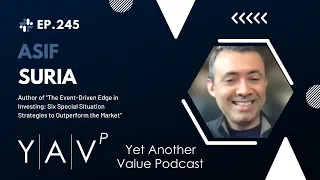
hello everyone and welcome to investing by the books a podcast by Redi I'm your host Eddie palan and with me in the studio is my friend and colleague nichlas savos today we are excited to speak to Asif suria an entrepreneur and investor in the US focusing on a specific investing strategy that we haven't talked that much about in the podcast yet so Nicholas which book will we discuss so the title for this conversation is asif's book The Event driven Edge in investing in which he explained six different event driven strategies for example merger Arbitrage and
stock BuyBacks and what do you think about the book so I like how the author has structured the book between presenting the evidence for why the different strategies work and how investors can can use them and as with many things in investing there is a lot of noise and the author helps us to distill which events carry more weight in the six strategies and we think this book is useful both for focused special situations invest but also for long-term investors in general the event driven Edge in investing was published by Harman house in 2024 and
we are delighted to discuss it on the show today here comes our conversation with a [Music] suo Hello Asif and welcome to investing by the books podcast thank thank you so much for having me on today I'm very excited to be on it's great to have you and where are we reaching you today I'm based in the San Francisco Bay Area um just a little bit south of the city of San Francisco okay and uh to begin we are curious to hear about your background and when your passion for investing started yes so my passion
for investing started in 2001 so this was uh right after the dot bubble had bursted and we were in a deep barel mark Market probably not the best time to start investing but it was a great learning experience um because I thought how could the market go any lower that it already had and sure enough it does always uh so that was a great way to start learning I started out as a value investor and then over time especially during the Great Recession of 2008 2009 I started looking into event driven situations starting with mer
Arbitrage um on the professional side I was a technologist I worked in technology including enterprise software for almost 20 years and my last uh job before I started focusing full-time on inside Arbitrage uh was with the mental health care company in San Francisco and today we will speak about your book The Event driven Edge in investing how did it come about yeah it was very citus in some sense um I met a friend for lunch in 2023 um he had recently retired after working at Google and we were both discussing things that were on our
bucket list so one of the things on his bucket list was to go to the bshar hatway meeting and I realized that that was on my list as well and so I decided to join him for the bsh had theway meeting and that caught me thinking about what are the other things on my bucket list and one of them was to write a book uh I started writing a book almost eight or nine years ago uh and I figured you know it was time to share you know my investing experience all the different case studies
I had encountered as an event of an investor so I reached out to Vitali katsin Nelson and I reached out to Tobias carile and both of them did warm introductions with Harman house actually within one hour of each other um so I was able to get Harman house on a zoom call and I told them you know it's been 25 years uh since jeel green blad's book you can be a stock market genius came out and maybe it's time for a fresh look at event strategies or special situations uh and it looks like that resonated
with them and that's how the book came about and for those not familiar with event driven investing or so-called special situations how would you describe it yeah so there are certain kind of events that have significant impact on the price of a company stock uh quarterly ear earnings announcements uh one of those things that everybody is familiar with but there are other kind of corporate events right like um one company buying another company uh a company deciding to break itself up into two or more parts or even a company declaring bankruptcy so each of these
events whether it's m& whether it's spin-offs whether it's bankruptcies they lead to opportunities for investors uh that they can benefit from so investing based on these kinds of corporate events is called event driven investing or more popularly special situations investing and I mean as you said before you tilted to become an invent driven investor yourself what do you think the advant are of that strategy yeah so if you look at most stock markets these days they're very efficient as soon as something happens such as Trump winning the US elections uh that information starts being uh
you know accommodated assimilated into the market very quickly in the short term at least uh then there are Sentiments of fear and greed that can move entire markets well outside where they should be trading so sometimes they trade well above where the intrinsic value should be sometimes they trade well below um so that is one kind of macro level inefficiency that patient investors could benefit from right uh the old saying buy when there's blood on the streets and be fearful when you're greedy but that doesn't happen all the time so event investing in a similar
way creates some inefficiencies or provide signals um that may not be very well understood by the market right away and that's what creates the opportunities for investors that understand these in inefficiencies or these gos and and what do you think are the biggest risk in this strategy absolutely so there is risk in every uh strategy no matter how exciting it sounds and there's a season for every strategy so for example merger Arbitrage which is a strategy where you buy a company after an acquisition is announced and wait for the deal to close that used to
work really well about 3 or four years ago when interest rates were near zero and the regulat en enironment in the US was not as restrictive as it is now um this could obviously change now uh if there's a new Trump Administration and they make some changes on the regulatory side of things so Mo arbitr was great three or four years ago not so good this year but at the same time if you look at uh something like spin-offs um they were not working so well about 3 four years ago they've started working much better
now so that's one of the risks where you have to understand why a certain strategy might be good for the current environment and why it might not always work and that's the reason I track six different strategies uh so that there's constant idea generation even if a strategy is not in season and when you say that a strategy is not in season is that sort of um I mean usually in investing it it takes a few years for you to understand that the strategy don't work and then you have already made a lot of decisions
so I mean how do you how do you sort of evolve continuously with that well when you look at you have to look at every different aspect of what's happening right so you got to look at what's happening with interest rates so when interest rates are high people have other Alternatives they can put their money in treasuries and earn a decent return uh they can put their money in uh CDs and so on and so forth so merg Arbitrage becomes less attractive in that environment it also becomes less attractive because you expect a greater rate
of return from it and usually you would get that only in the risky deals so you have to look at what's happening in the macro environment on the spin-off side uh you also have to understand what's going on with General market valuations and so on and so forth are companies in trouble are they trying to spin off because they're trying to get rid of a bad division are they trying to spin off because things uh are going really well and they just want to allow the spin-off to you know be its own independent company and
grow so you have to look at things in that context um there's also Insider transactions where I've seen at times that during the covid pandemic uh the March 2020 big drop in the market Insider stepped in and started buying way more than I'd ever seen a Buy in the 10 years prior so you can see these signals happen in some some sense in real time and you can adjust which strategies you want to focus on based on that and as you mentioned in in in your book you describe six different event Tri and strategies in
detail but uh we're curious how you selected these six yeah so there are strategies like bankruptcies that are so complex that very few retail or even professional investors can participate in them I selected six strategies for the book based on the ones that are readily accessible for all investors and not just institutional or professional investors and I personally used most of these strategies for more than a decade and I cover them on my website inside Arbitrage and uh if we go deeper in in a few of the strategies and starting with Insider transactions uh you
mentioned that some transactions by insiders are are more or less noise while others can be seen as a strong Catalyst uh could you provide an example from from the book uh that that shows the difference yeah so I mostly focus on Insider buying and opportunistic Insider buying so by opportunistic buying I mean an Insider that is not buying based on a pre-established buying plan that they' filed with the SEC and someone who hasn't purchased St frequently in the past so I look for those kind of insiders to provide signals um one good example uh that
I discussed as a case study in the book um was inside of buying in a company called Vex Pharmaceuticals uh this is a company that is quite large right now uh and they had a very successful cystic fibrosis franchise and there was an independent director who bought some stock in November 2020 and uh every weekend I write about uh Insider purchases and one of my subscri criers read uh about this Insider purchase and he wrote to me saying oh this is two briefcase Bruce that's buying the stock uh and if two briefcase Bruce is buying
I I'm going to buy as well and I wasn't sure what he was talking about so I reached out him and I said hey what do you mean this is two briefcase Bruce who who's two briefcase Bruce so he told me that in the early 1990s uh two briefcase Bruce um and him used to work in the same company together two briefcase Bruce is actually Bruce Sachs and he had a excellent work EIC where he would work throughout the week and then on the weekend when this was back at a time where you couldn't take
your laptop home with you uh he would fill two briefcases full of work related documents and take them home uh and work on them over the weekend and come back on Monday so he had a reputation for both being brilliant as well as being very hardworking and so I took a closer look at this and I realized that he'd been on the board of the directors of the company for almost 10 years but he had never bought stock in the company before so in November 2020 watching him buy stock and then in August 2021 both
him and the CEO of buying stock um I decided to make an exception I normally don't invest in biotech companies because I don't understand them but if two briefcase Bruce was buying I thought it would make sense to buy as well uh the financials of the company were actually pretty good so they were making good money this wasn't a preclinical uh biotech this was was a company that was actually making good money and was growing uh so that made the decision a little bit easier this is a historical example um you know this is something
I wrote about in the book and you know I wrote the book almost well over a year ago at this point uh a more recent example is uh the hotel re Pebblebrook Hotel trust so the CEO has a long history with the company and he started buying in August so just a couple of months ago so this is a hotel re that had cut its dividend as you would expect during covid uh but when the business rebounded after the pandemic instead of increasing the dividend again they kept the dividend really small and invested the rest
of the money in refurbishing their properties and fixing the properties um they also refocus from business to desure trouble so given how well the company is doing I think they're going to increase the dividend um now that their capital expenditure cycle is winding down uh so to make things interesting this Street also trades well below the value of all the hotels it holds so here something it hasn't played out yet but I think he's getting ready to increase the dividend now that the capital cycle is over and you get a hotel property that's trading below
its value on the books and and just to ask I mean how big was that transaction because I I think one of the points you make is that sort of big and infrequent transactions carry more signals than than others yeah so in some sense I do look for big transactions uh in this case I don't think it was a very large transaction uh but I think he might make a few more uh before uh things turn around um so it is more the infrequency of the transaction where somebody hasn't bought for a really long time
and then suddenly they buy and um you know you hope that it actually makes sense but the more likely scenarios it might not make sense based on all the data you have in front of you and after a very long time following this I'm beginning to realize that when it doesn't make sense is when it's actually more interesting yeah because it's interesting to know I mean you see the signal and you seem to very be very good at picking those up but then the question is uh when should you actually make the decision to to
buy or or sell something and in the book you write that quote insiders like value investors are often early to the party so why do you believe this is the case so markets are often irrational right they never trade at where the intrinsic value of a company should be and so insiders like value investors are viewing things rationally so what they are seeing can often take weeks or months to play out and the price action might even take even longer after the situation has played out so I often find that you know value investors and
insiders they see value but they're early because the market is going to continue to remain irrational for a little bit longer um so I've seen this pattern over and over again where whether it's j hog buying Zillow a few months before they announced a new CEO or in this case is the CEO of pebble BR buying often it can be several weeks or months in advance even in the case of Bruce saxs his first purchase was in November 2020 and the stock really actually took off after second purchase in August 2021 so it can take
some time for these situations to play on and do you usually wait or or how do you handle that situation that's a tough question um if the company makes a lot of sense to me right away I do end up buying there are times when I might actually have it on a watch list for a long time so I I main a very long watch list some that are based on Insider transactions some that are based on meeting other investors at a bsh hadway meeting and I got some ideas there um this month in November
in our November newsletter actually took a idea that I added on the watch list three years ago because now I'm starting to see really good inflection in the stock price um so at the end of the day it really is an idea generation uh strategy for me and then the inflection or when it becomes interesting could be several weeks months or maybe even several years later and in the book and also in this conversation you mentioned that you you do work every weekend and uh something that you mentioned in the book is that you every
weekend calculate a sell bu ratio so what is this yeah I probably work more on the weekends that it work doing the week uh I'm joking um but every weekend we look at every single Insider transaction uh every purchase and every sale we clean the data and then we calculate the aggregate amount of inside of baring and aggregate amount of inside of selling and we divide the insid of selling by the inside of buying to create something called the sell buy ratio um the reason we do this is we want to track this to see
are insiders selling significantly more stock than they used to or insiders buying all of a sudden a whole lot more stock than they used to you have what is called earnings related quiet periods so you know few weeks before earnings are released and few weeks even a few days after you're not going to see a lot of Insider transactions so outside of that once you adjust for that if you suddenly see a big spike and inside of buying or inside of selling uh that can be a macro signal uh so for me a macro signal
of sorts was in March 2020 when inside of buying exceeded inside a selling for the first time in a decade I'd never seen that before week after week inside a selling is almost 20 or 30 times the amount of inside of buying but in that one instance for 2 weeks inside of buying exceeded inside of selling and uh you could also see this at the sector level so in mid 2020 when WTI crew Futures went negative uh oil prices were negative uh Energy company insiders really stepped in and started buying Handover fist I saw the
same thing last year uh in early 2023 after Silicon Valley Bank failed you could see that the bank insiders were coming out of the woodwork to buy uh so I love looking at aggregate uh inside of buying and selling data both to see if it's giving me a macro signal on the whole Market or if it's telling me something about a specific sector and uh throughout the book you describe how investors can benefit from when some of the six strategies work in tandem such as BuyBacks together with Insider buying can you mention a situation for
us where where this situation made you interested yeah one of these interesting situation was the acquisition of uh this biotech company called biohaven uh by fiser so the acquisition price was around $148 uh biohaven was trading around 141 when I wrote about it so you got a chance to make about $78 on the acquisition and then right before the acquisition happened I noticed that an Insider director of the company was buying stock This is highly unusual you don't see somebody buying stock especially an Insider right before a deal is supposed to close and the spread
on the deal was something like 50 cents and that made no sense why would a director of the company want to buy this clock for 50 cents a profit and so I took a very close look at it and they had a situation where fiser was going to spin off certain assets so they were interested in the main migraine related drugs that biohaven made and everything else was going to get spun out after the merger closed into another company which they also decided to call biohaven just to confuse us investors um so I think his
interest was in the new biohaven because he knew that by buying stock before the merger closed he would get the spin-off shares and this was a strange situation where fisa actually put several hundred million doar into the spin-off as well so you had a spread you could capture on the merger uh you got the spin-off and you notice that that was inside a buying going on sure enough the spin-off went on to do very well and we continue to see inside of buying in the biohaven for months and years after the spinoff as well and
just just to recap a bit on the strategy as a whole I mean in merger Arbitrage situations there is of course like a high probability that the that the um merger closes but there is a risk also that it's not and then you you usually have quite a big selloff so so talking about risks in general how do you how do you think about portfolio Construction in connection with an event-driven strategy yeah so uh you're absolutely right none of these strategies are risk- free and especially merg Arbitrage is also called risk Arbitrage because you are
taking on the risk uh that the deal might not close and so with risk Arbitrage the way I used to position things uh realizing that 95% of all mergers and Acquisitions actually close the way I used to position things was I would do my standard position size like 5% of the portfolio and if I felt like you know um I had high confidence in the deal closing then I might go even more I used to do 10% uh back when uh regulatory environment wasn't so bad given how difficult it is these days to get a
deal through Regulators I don't no longer do that I'm I'm back to my standard position size of 5% in case of Highly risky deals uh I might even go down to a 2% position so I might scale back the position size based on the amount of risk I perceive in the deal in some situations I'm at actually use options I might use call options to limit my exposure and to juice the returns a little bit or I might uh even by put options as protection um and some ma Arbitrage Focus uh investors will use a
multile option strategy do both control risk and to increase the potential returns and how how do you handle the emotional aspects of of things I mean usually when you have sort of a date that you're waiting for and and you know that the risk a risk that there is a risk that something could happen in a negative sense I mean have you have you learned to cope with that or is that still an issue for you uh I think it's always going to be an issue for investors right um I try to control for that
quite a bit uh through the position sizing so if I if I had onethird of my portfolio in a risky position that wasn't working out I think I'll have trouble sleeping at night um and uh so by using position sizing I think I controlled for that quite a bit I'm usually not in just one merge arbitr situ I might be in multiple uh situations at the same time and then I have a portfolio constructed from other ideas as well so moo Arbitrage is a certain role in the portfolio and again within the specific ones I'm
investing I'm using position size so that it doesn't blow up the entire portfolio for deal blows up um you can also focus on deals that you know don't have the widest spread and attract the largest attention so everybody was interested in Elon Musk buying Twitter because there was a widespread on that uh it worked out well people are interested in Microsoft buying activation blizz that worked out well but then Jet bl's acquisition of spirit allies did not work out well um taper tre's acquisition of Capri is not going so well right now uh so you
know you have to look at these situations and say am I participating in the riskiest mergers with the biggest potential profit or am I participating in low risk mergers where I can sleep at night if I use proper position sizing and just to get everything right here so so in in terms of portfolio construction you think differently in all these different six event driven strategies um yeah right absolutely so if it's an idea where I've done fundamental work based on a spin-off or an Insider transaction it's a 5% position um if it's an MA arbitr
situation then it's the risk that determines if I'll make it a 10% position or maybe a 2% position great so let's let's move over to another type of of strategy which is spin-offs uh which we have seen quite quite a lot actually in Sweden in in the last years uh and uh of course A lot has has been written about the outperformance of spin-offs and you present the evidence for for why these situations uh may work and one reason is uh forced selling as some institutions are not allowed to own stocks in a spin-off due
to for example size constraints and another more long-term benefit that you mention is is that the company gets less bureaucracy uh and starting with the first reason can you please talk about and the aspect of size can have a particularly large impact yeah so let's say you own a large company like Jeff U which was an investment bank but it also because of its merger with lucadia had a bunch of operating businesses and so uh if you were a portfolio manager that had that was mostly focused on you know Financial firms and you had jeffes
and a Jeffrey spun off U Energy company like vtest energy um so you not only have the size Miss match where you end up with a company that's only a few hundred million doar in market cap but also a company in the energy industry which is cyclical and maybe it's something that you normally avoid so you have a situation where this Force selling by professional investors um because of size mismatch because it's an industry they don't follow they don't understand or they avoid uh so that's one of the reasons uh you could end up with
opportunities because of the full selling and why do you think uh because we have seen this many times why why don't the sort of the forc sellers why don't they sell before because usually it's it's sort of mentioned that the spin-off is is going to happen so why don't they sell before the spin-off is actually done actually that's a really good question because sometimes after the spin-off the parent can be even more attractive yeah right so maybe they're like Jeff and they say Investment Banking is a wonderful business in certain market conditions with really good
margins uh compared to a cyclical uh business like oil and gas and so they might look at it and say I'm actually glad they're getting rid of this division that was dragging down the parent company and if if anything they might buy more after the spin-off and I've personally done that where I've looked at a company doing a spin-off and I either buy before the spin-off because I like both the parent and the spin-off post spin-off which is uh what is happening with Western Digital right now or I might buy after the spin-off and I
say they got rid of the Bad Company If you will they loaded it up with debt and the pent is more attractive and I think an interesting point you you bring up is the timing aspect here that U about when to buy a spin-off and and I mean taking those two aspects I mentioned into account forced selling should be completed completed quite quickly um so I mean how do you keep up to date with the with the status and and how long how long does it typically take uh so we keep a list of all
spin-off situations just like we keep a list of all m&a uh mer Arbitrage situations in the US but I personally don't look at you know what kind of trading volume has happened in the spin-off post spin-off for me spin-off investing is more opportunistic so I usually look at them because something about the parent of the spin-off caught my attention because a subscriber asked me about it somebody who told me about you know two briefcase Bruce might mention hey as what do you think of Western Digital um or there might be an event like an Insider
transaction in the parent before the spin-off that make make me take a look so that's how I do it it's very opportunistic but my friend Rich how who focuses only on spin-offs he very carefully looks at you know what kind of trading volume are you seeing post spinoff and is it going to be like a week or is it going to be three months before uh most of the for selling is done so he he takes uh he does the qualitative work and he does the more quantitative work of figuring out when all the trading
has happened um that's not usually how I approach it interesting and and the the benefit of less bureaucracy uh for the company I mean it's quite appealing for the long-term trajectory of of a business do you have an example for us where with this change was especially clear oh absolutely there are so many examples uh going maybe almost two decades back you had Chipotle the Mexican restaurant chain that was spun out of McDonald's uh it was able to supercharge its growth by opening a whole lot more locations so that did very well you had Ferrari
that got spun out of Fiat Chrysler um so that helped Ferrari you know continue to perform very well on its own not be under a large bureaucratic automobile company uh we spoke about vtest energy which has done very well once it came out of an investment Bank uh Jeff so you have so many of these situations where you can just see that if the company that is being spun out is good uh they're not loading it up with a lot of debt um freeing them up out of the parent company really supercharges growth and we're
not going to mention all strategies from from your book in this episode uh we encourage everyone to buy it and read it for themselves but uh one that I would like to bring up is management changes as you mentioned as a strategy and at Red we also put a lot of effort and and focus on evaluating the people of a business we think this is very important uh but why do you consider management change as an event-driven investing strategy yeah so I feel like the CEO of a firm they Define the direction of the form
and more importantly the capital allocation strategy um so if you look at a CEO and you see that you know their pay structure is egregious it's very high and they're not aligned with shareholders that can mean uh something very significant in negative for a portfolio company if you already own it or if you see that the CEO is thinking about all stakeholders like employees and shareholders and you know their pay structures align with the interest of shareholders um they can do very well for the company uh you can also look at their past performance like
we did with Larry cul who came out of danur and he did very well at GE so you can look at the past performance at a different company and see if they really mve the needle uh if they stayed there for a long enough time to make a change happen so I see management changes as a very critical thing that strangely enough not a lot of investors pay a lot of attention to um and so I consider that a very significant event and I I added it as an inent and strategy of the book something
that is quite challenging I think as an investor is these kind of transition periods that can happen in companies when you had a long-standing CEO that is leaving and then you the company hasn't announced uh the new CEO uh how do you deal with with such situations yeah uh this is a difficult situation I don't have a specific strategy for it um I would look at it and see if the underlying business is very strong and if there are any red flags caused by this departure so is it a sudden departure where there wasn't enough
transition time provided to the board um or was this a long transition period where you know you have almost a year or longer uh to make sure that somebody else is coming in and is going to be successful as a CEO so threat of business and the transition period are something that I'm interested in that I look at uh otherwise I'm not quite as concerned um it also kind of depends on a Case by case basis so if you look at somebody like Phil light founder of Nike Howard shoes at Starbucks Larry Culp right now
A G or Bob Iger at Disney if one of these were leaving uh then I would be concerned and I might even consider selling uh but if it is not one of these Superstar CEOs and business is strong there's a long transition time then I'm a littleit less concerned good point because I think uh quite many of the investors that we speak to and and quite many of our listeners of this podcast are like a long-term investors looking for for companies to hold for for many years in in cases um do you think they can
also benefit from taking part of these kind of strategies that you are outlining in the book absolutely like I said uh my primary goal with these strategies and even with the book is to help you find strategies that generate ideas at the end of the day you have to do your own work on them you have to understand the companies and then buy them and hopefully hold them for the long term so when I bought Vex Pharmaceuticals been 3 years since I did that I still have that stock with me I hope to hold for
another few years uh so these are long-term uh ideas uh that these strategies end up generating for me uh the other advantage of doing your own work and fully understanding these companies or as much as you can understand given public information is when something doesn't work out and the market drops it gives you the conviction to hold on to the company even when things don't appear to be going well with the overall Market um so doing own work and diligence actually gives you the confidence to hold on uh if something is not going right and
if you've done your work and something is not going right with the company you will also understand that it's a company specific issue and not a market specific issue and I think it's it's interesting with these kind of combinations as well I mean we talked a little bit about it before but uh is there any other combination of uh these kind of strategies that you outline in the book or or other event driven strategies that you would like to highlight that are you have found are more powerful uh no the combinations are the ones that
I find the most fascinating they don't happen very often but we ended up building some custom screens on inside Arbitrage so that we know when they happen so one of them is we call it a spin cider screen it's spinoffs with inside of buying uh so we on that screen to take a look at you know which spin-offs are seeing inside of buying and which ones the buying is happening in the parent versus the actual spin-off uh we also have what is called a Double Dipper custom screen uh this is not a roller coaster you
write at a theme park it is actually a custom screen that lets you look at companies with inside of buying and the company is buying back its own stock uh so I like uh stock BuyBacks as well U not just stock buyback announcements but the company actually uh buying back its own stock and you know reducing the shares outstanding over time so I say apart from having written this wonderful book you're the founder of insid Arbitrage tocom please tell us about your your business yeah insert Arbitrage is a website that I created uh initially it
was just for two uh strategies merge Arbitrage and Insider transactions and then over the last several years about seven eight years I've grown it into six different strategies so it's a website that combines both tools and Analysis for every strategy that we follow we create a set of tools that our subscribers can use to look at the data or run their own custom screens like the Double Dipper or the spin cider that I talked about to come up with their own ideas or conclusions uh we also publish analysis related to the strategies so for example
every Sunday we write an article called Insider weekends or on Monday we write an article called merger Arbitrage Mondays um we also publish a special situations newsletter once a month and that has two Spotlight ideas usually from these event six event driven strategies that we discuss in detail and then we choose to add it to a module portfolio or to a watch list so the site is about you combining both tools and Analysis um you know for the do-it-yourself investors they can use the tools and find ideas themselves but the ones that want us to
do some of the analysis work we do that as well and and is it only the US you follow or yeah I have a hands full with just the us at this point we hope to expand to Canada someday and then uh UK and then maybe the rest of the world uh but not in the near future yeah or create a franchise yes indeed uh but but is it only I mean only but but is it mostly retail investors or are there also like professional users uh there are actually quite a bit uh of professional
users uh some of the largest merg Arbitrage Focus hedge funds use our data and our service uh so I would say it's a very good mix of professional and Retail investors uh the professional investors like our premium plans that combine the tools and Analysis uh retail investors might choose um a plus plan and where it's mostly about the analysis part of it uh so we we have a very large mix of professional investors in our subscrib BAS okay and how is your team it sounds like it's a team oh yes indeed it's very much a
team um I have different team members assigned to each of the strategies uh my daughter has been working with me for the last two years and she looks at inside the transactions with me every night uh so we meet every night and look at every SEC filing um and come up with ideas and on Saturday mornings we talk about which which idea was the most interesting that we'll write about uh so I have an amazing team that helps me with all of this because there's so much data to keep track of and then analysis on
top of that wow yeah that was my my next question how do you how do you do keep track of everything um so me with my team every day uh we publish something called uh you know event driven monitor every morning that has everything that happened on m&a spin-offs Insider transactions uh management changes uh so we put that together every single day and we look at it and uh you know we discuss what's the most interesting that thing that's going on in each strategy and then you know uh every weekend we try to look at
what's interesting for insiders that we'll write about uh every month we look and see if there are two Spotlight ideas that are really interesting for us to do further analysis on so it's collaborating with my team uh I have a quarterly meeting with some hedge fund managers that I have I go to different investor conferen so you know it's a lot of different sources with communicating with professional investors exchanging emails with detail investors uh talking to my team and looking at the data it's clear that you have a lot of passion for this day and
night absolutely uh it's one of the best things I could be doing right now I really enjoy it great and and how has the performance been over the years that you have covered and you mentioned a model portfolio and and so on so model portfolio until last month was at reaching its all-time high it was up about 47 48% since Inception uh which might not seem like much uh but conserving ma Arbitrage is similar to like an income uh type of strategy and the fact that we survived the 2022 bar Market without much damage uh
it has actually done quite well uh I'm happy with it uh I think some of these situations that I'm in are going to take some time to play out uh so you know I want to look at a longer time frame a 5ye or a 7-year return and I think eventually they'll do well um this year has been particularly difficult the portfolio has taken a hit uh because of bees like Spirit aines getting blocked or Capri uh taking a hit because the judge U you know ruled against them so this year actually has been harder
for us uh than than prior years so since some of these ideas are longterm I'm very confident that over a long period of time the portfolio is going to do well uh this year as I mentioned has been difficult because of certain ma Arbitrage situations not working out so as if as this is a book podcast we always like to wrap up with questions about reading and writing so uh besides your book do you have any other material about event driven investing or special situations investing that you would recommend to our listeners yeah so duel
green blads book you can be a stock market genius is an excellent introduction uh to event strategies um that's how I got interested in sense some sense if you think about inside Arbitrage it's a living version of the book you can be a stock market genius um and that's what motivated me to write my book as well uh so that's something I would recommend checking out if somebody has not read it yet um there was also Brian star's book uh special situations investing that was published maybe 15 years before Joel green blad wrote his book
you can be a stock market genius um Brian stock uh basically managed a multi-billion dollar event driven fund and he wrote the book in the 1980s uh I was actually very fortunate to have him read the early version of uh event Ren investing uh and he gave me some feedback on the book so I was very fortunate to have that his book is no longer in print so I need to get hold of a copy of it and I'm looking forward to reading it someday so those will be the two I would recommend perfect we'll
put those in the show notes and now you have uh written your first book do you have Ambitions to to write another one I do I have a couple of uh books that I'm on you know thinking about I don't know if it's going to happen it takes a lot of work uh writing the book uh and mo most books don't quite end up you know succeeding you you have a few thousand um you know sales if you will and most people whove written a book in the past had already warned me that if you're
doing it to make money uh you're going to make less than minimum wage uh you want to do it because you're passionate about it and so once I get really passionate about maybe another book I will do it do you feel like you got better as an investor writing this book that it helped you in some way oh absolutely um I find writing really distills my thinking and it really helps me think through ideas and I've been writing for about 19 years at this point uh on the public uh markets if you will or at
Seeking Alpha on inside arbitr so on and so forth so writing this book U you know was an extension of all of that but it also made me go deeper into each strategy because it wasn't about you know everybody's going to take my word for you know this works or doesn't work I had to find academic studies that actually backed up the intuition that I had about some of this uh so writing is an AB absolutely wonderful way of learning uh and to dive deep into a topic I sua thank you so much for coming
on investing by the books podcast to talk about your book The Event driven Edge in investing and and your business do you have something more you want to add here before we finish up um no this has been wonderful um if you want to look at my work you can find it on inside Arbitrage docomo find me on Twitter and Linkedin as asup serria um and is just wonderful um seeing the depth of questions that you guys had and I really enjoyed this thank you so much thank you safe thank you thank you for listening
to inves in by the books a podcast by Redi follow us on Twitter at ibor RI and email us at ib. podcast R.C to improve we'd love to hear your feedback so please rate and review us notice that the content in this podcast is not and shall not be construed as investment advice this information is meant to be informative and for general purposes only for full disclaimer visit red ey. SE I'm your host Eddie pan and until next time I sincerely wish you the best of luck on your journey through life and investing