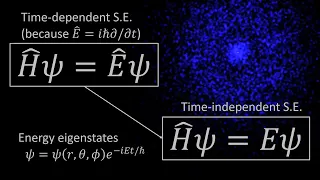
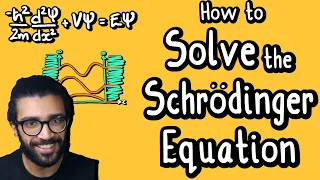
welcome to electron line in this video and many to come after this we're going to spend some time talking about the surging equation the equation that we use to describe the motion the energy the position of small particles and as we have learned that small particles actually behave more like photons than they do like real particles so to speak they have wave-like properties we needed an equation to describe how they move how they react to forces around them and so Schrodinger came up with his equation now known as Schrodinger's equation and we're not really able
neither was he able to come up with some derivation that says here's the equation that describes the motion of small particles there was no such way to do that he had to kind of go on the limb and make some assumptions to the best of his ability knowing what they knew at the time and we can do no better today in trying to compare how particles behaved and how photons behaved and sometimes that boundary kind of becomes very very gray and we sometimes took some Liberty as saying well if a photon works like this maybe
a particle will work like that as well or if a particle works like this maybe a photon will work like that and quite often when we made those analogies those analogies ended up being correct so in the same spirit shirting ER came up an equation to describe the motion of particles so here we're going to kind of take a look at the very generalization of what the equation should be like and then over the next several videos were going to develop where that equation actually came from and how it got to be the way this
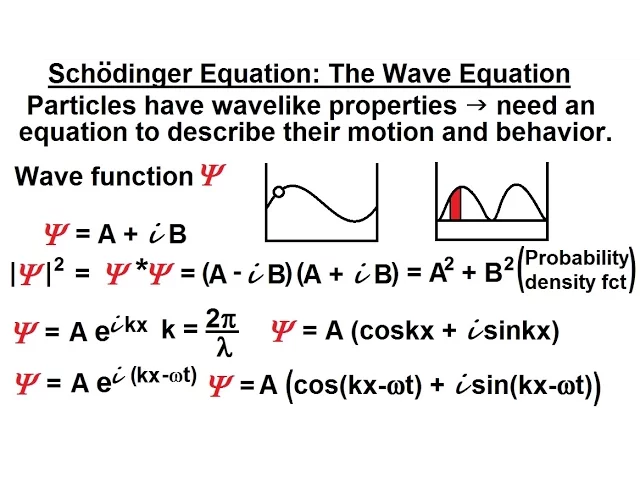
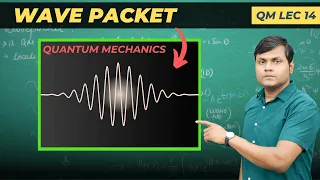
today and how we then used a Hamiltonian to describe the motion and the energy of these particles well we begin with the concept of course that particles have wave-like properties so there's a very thin line between photons and particles so we came up with a wave equation well we didn't sure jr. and his contemporaries dead and the wave equation was realized that it had no physical meaning the equation is absolutely useless on its own to describe anything to really represent anything that is reality but other words we understand that particles behave like waves but we
didn't think that particles actually moved like that they just appears if they move like that and have properties as vivid they did so instead of being able to describe the actual position as a function of time like we can do with real waves for example when you have a wave on a string the particle and the string actually move up and down as the energy moves perpendicular to the motion of the particles well we didn't see that happening with real particles but yet we had to be able to describe that wave-like property so we came
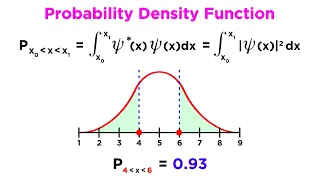
up with a wave function that had to be complex so it had to have a real part and an imaginary part and be able to do something with it to be able to turn that into a real quantity representing a real feature of particles we understood that we can come up with what we call the probability density function but other words if you take the wave function and you square it of course in order to square it we have to be able to get rid of the imaginary part and we can do that by multiplying
the function by its complex conjugate which is simply the same function but with a negative sign in front of the imaginary part so I'm going to multiply the two together the imaginary part disappears and we then realize that if we square the wave function we came up with something that represents the probability of where we could potentially find the particle the higher the function the higher the probability then density function the more likely you're going to be able to find the particle there in this example right here the particle is likely to be there we
can calculate what the probability is for that particle to be there by understanding or calculating the area underneath that probability density curve notice you can see that it's much more likely for the particle to be here than it is for it to be there and you can see that the probability of the particle being and these three locations here is near zero we also have to have something that could describe the wave function in terms of position and then we also wanted something that could describe the wave function in terms of time and so going
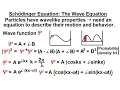
back to the typical equation for wave functions we knew that it had a concept of KX in there K is the wave number which is 2 pi over the wave length lambda and so the wave function could take on the form of some amplitude times e to the ikx remember again that this amplitude is part of a wave function that has no physical meaning the physical meaning only comes in when we then square the function and get the probability density function so here this should look fairly familiar and then of course if we expand this
into the sines and cosines it will of course look like this it has a real part and an imaginary part again no physical meaning but it represents a function that we see before if we have a wave function we know that it has an amplitude a sine or cosine and then the wave number in under position X if we then want to add also the time dependency in there we have to have the minus Omega T so this KX minus Omega T is a very common concept and something we use all the time to describe
waves in classical mechanics so we understood that we have to have some similar property like that to describe waves in quantum mechanics again to have a wave function we have to have a real and imaginary part an amplitude so the wave function became like this expanded it looks like this if we get rid of the imaginary part this looks very similar to something you've seen before if you've seen waves in classical mechanics also notice that quite often instead of writing this is the wave function they pull out a negative sign switch these two around and
will express it like this and Layana will come quite clear why we do that because it makes it easier then to represent the wave function in terms of energy and momentum which is after all the quantities that we use to describe motion and behavior of small quantized particles like electrons and protons actually even protons are quite large compared to electrons but for very small particles we definitely want to be able to quantize things and so this was the basis for starting with the concept of an equation that describes the wave-like properties of very small particles
again there was no way to actually derive it accurately like we derived some other equations but at least we drew the concept from wave motion and then we developed it further with making some dangerous analogies between particles and photons the only way that Schrodinger could then verify that this equation was correct - then experimentally see that the outcome of the experiment Maps outcome of these theoretical equations and by and large almost every experiment they did the experimental data Maps the truth or the experimental data match the equation data and so there's a lot of confidence
that sharing equation does indeed describe the motion of small particles so if you're interested in this stay tuned we'll have lots more videos slowly analyzed in describing this equation and then finally how to actually use that equation under all the various circumstances such as wells and barriers and things like that so we'll get into that in the later videos