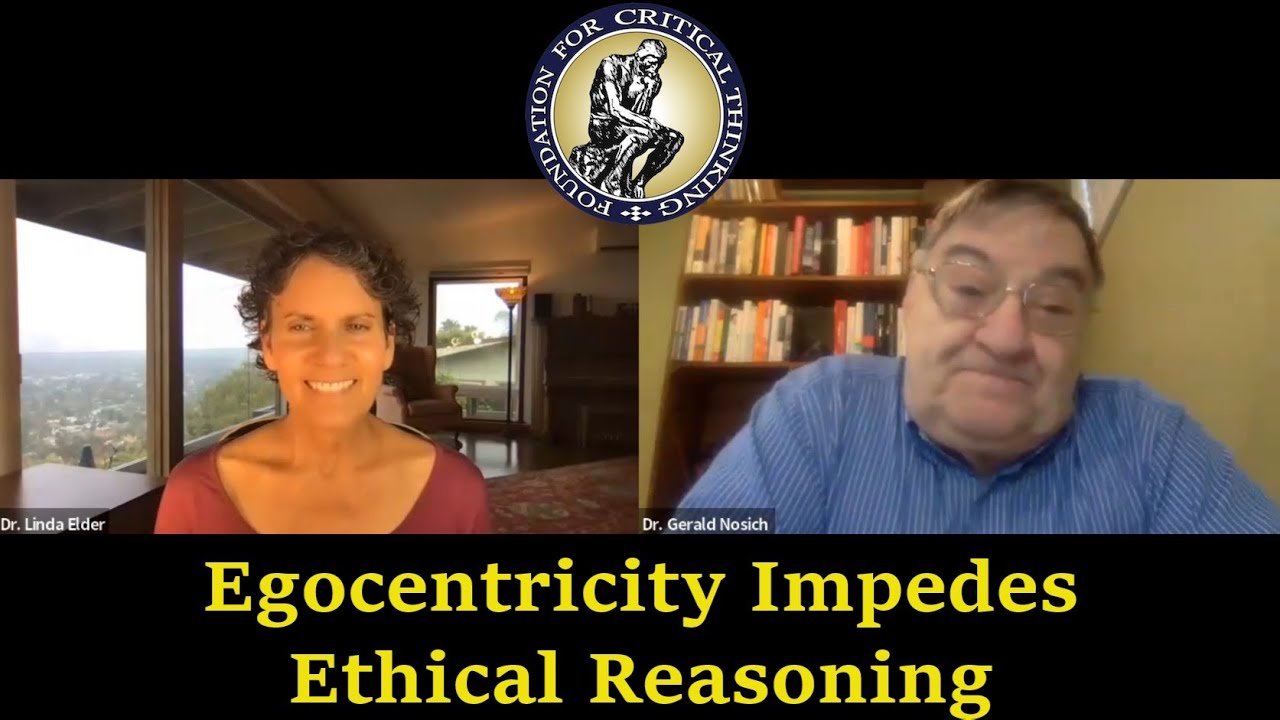
Hello I'm Linda Elder this is February the 9th 2022 I'm here with my colleague Dr Gerald nosich hello Gerald hi Linda good to be with you again questions yes we're we're we always enjoy our talks and uh we are um for those of you who don't know we are with the foundation for critical thinking which is a 501c3 nonprofit Organization in California we focused in this series on the analysis of reasoning going deeper so we're going beond the fundamentals that we normally focus on and in this particular part of the series we focus on questions
and today we're going to begin by talking about conceptual questions so one of the interesting things about questions as we see in this series is that there is a lot of fruitfulness in terms of angles from Which we can approach questions and this is an example as the other as as the content in the other sessions have also been examples of of that fact and so for example let's take let's take conceptual questions so we can we can make a a move right away we can divide conceptual questions into simple concept Cal questions versus complex
conceptual questions and so the simple questions simple conceptual questions are Questions that are settled through definition alone so in a way they're they're sort of easy if you understand that first move that basic move and I will'll give some examples in a few minutes as a starting place and then there are complex conceptual questions which are questions that are basically questions requiring reason judgment focused on a given question I I'm sorry a given com uh Concept all right so this would be an example of a simple conceptual question what are the basic differences between socialization
training indoctrination and education and actually this is a very uh fun and uh fruitful activity with uh students and with our colleagues and that is to look up the terms social in groups let's say or individually Socialization training indoctrination and education and maybe we group of four and each of us looks up one of the words words we look in multiple dictionaries to get the best definitions and then we discuss the basic differences based on those definitions so this would be a simple conceptual question because the answer is in the definitions would you like to
jump in there Gerald oh I I just wanted to say Something about uh the concept of concept or the concept of what makes a conceptual question because concept and conceptual the word concept has multiple meanings in English so uh we sometimes use the word concept to mean an idea no matter how complex it is um whereas when when I'm thinking of what's a conceptual question it usually centers around a or it's marked by a word like education or socialization or the more proper way to describe it is by a term so it could be Uh
it can be uh having uh two parts or three parts psychology of education is a is a concept that I can investigate and then what I'm looking for is it is it's uh is how to understand it accurately and clearly and relevantly in a way that sorts things out uh I I say that because sometimes uh people will quite properly given the our ordinary uses of English we'll say uh that a con concept is um they'll give us an example of a concept something like um uh honesty is the best Policy as a concept right
whereas it's a full-f flown idea whereas I think of that as an assumption or a conclusion that you might come to so I I just wanted to say something about Concepts before we begin and of course we're going to do a one or more sessions uh podcast on concept the so there we'll go in deeper there of course so when we think of the elements of reasoning and we have the eight different categories if you look within those categories You're going to find more complexity so so looking at Concepts we also have within Concepts the
element we have theories and we have principles and we have axioms and therefore we have to understand that the element the word that labels the element of reasoning is the best term the best one word can be found to capture the uh complexities within that element but we still have to be able to move in and out Of those right complexities and the example that you gave honesty is the best policy is actually I think of I think of that as a principle it's also a conclusion right but so it depends on where you're you
are in the elements or the con and and the in terms of the context so so you're right so then um and in this case when we think of conceptual questions we are focused on terms fundamentally they're they're there Would be exceptions to this of course but the easiest way in is to think of a simple questions focused on um definitions where where the the answer is given in the definition if you know the definition basically you're home free so to speak because you that's that's where you get your foundations now you still have to
be able to in a case like the question that we're focusing what are the basic differences between the meanings of the words Socialization training indoctrination and education after people going back to my activities so after people do this activity now they discuss the differences and often they're wrong in other words they've read the definitions they've presumably studied them and uh they are not able to see the differences as they down in the definitions right right right so that's another problem but that that comes from the fact that we are not um we don't get Experience
in working with dictionaries it sounds it sounds almost like something like Mickey Mouse like something you did when you were in elementary school when to to many people they don't appreciate the importance of language of words of definitions of how we move in and out of Def of definitions the words can be used in multiple ways sometimes in conf iting ways you these but this is again on Concepts So so we have so we have uh so here's another question can a country be called a democra this is another simple conceptual question can a country
be called a democracy if the political power is not in the hands of the people yeah so you see the the move that we have to make there so can a country be called a democracy well if I stop there I realize I have to know what democracy means right or I have to have definitions of democracy to work with Here and then once I have that I can go on if the political power is not in the hands of the people well the political power being in the hands of the people is fundamental to
democracy so that again that's sort of an easy question once you get the definition yeah but figuring out what the people is or in the hands of the people is is considerably more complex um yes yeah but let me say that um I mean what we say is can a country be Called a democracy if the power is not in the hands of the people and bring in the standards of standards of critical thinking what we mean by that is can a country accurately be called a democracy because of course many countries are in fact
called democracies when the power's not in the P when the power is not in the hands of the people at all um yeah yes yes that's a very good move so and a an improvement on the question would be can a be can a country properly be Called a democracy or be called a democracy socalled if so we can um can you love a person and not care about his or her welfare and interests yeah so there are certain fundamental elements to love and some people say well every Everybody every love relationship is different and
the answer to that is yes that's true that's very important but there is still going To be a core set of principles by which you would have to live and properly then be able to use the term love in application to that right right yeah otherwise people couldn't say at the time say when they're getting divorced you don't love me I mean if anything counts if anything you think of counts as love then you'd never be able to say accurately that you don't love me and of course we can say that I say that because
of many of my students who are All often most of the time very young will say uh love is whatever you take it to be um right exactly yes yeah yeah and then and people will this is very important because people will in a in a relationship let's say an intimate relationship one of the parties let's say it's being manipulative and acting in bad faith and not caring for the welfare of the other person but U acting like they Are and won't say he or she so just turn to they so they're they're they're acting
aart and they're not sincere and they are basically selfish and but they then will make the move but honey you know that I love you and you know this happens in abusive relationships you we've heard of the you know we understand the the cycle right and so afterwards the person is often remorseful and comes back and actually does mean it very often indeed yeah but It's not love if it does doesn't have these elements it doesn't matter how sorry you are later right yeah that's a the the fact that people say that and they're sincere
about it they actually mean what they're saying and the recipient perceives that is one of the things that makes it so deceptive because you you can see that the person the person is saying honey I love you and and you can see that they mean it and then your heart melts in turn and And but that's different from the question of whether that that can properly or accurately be described as a loving relationship very different things um not very they're they're they're startlingly different but they have some relationship in there well the the ego wants
to believe it and the ego I mean and the person is you know that has been abusive is not all bad maybe only when they drink you know that's part of the pr it can be Very complicated and the person who is being abused could actually and often is does love the other person that's being being abusive so but there but you see this is very important because we we manipulate one another as humans with the words that we use and this is a perfect example of that it's happening every day and that's you know
but honey I love you and well if you love me you don't really even need to say it I mean it's nice to hear it but I will know it If you love me and I will know it if you don't so this and I think people need to understand the power in in words and if they understand the these basic moves we're making that wait a minute if you love me then wouldn't there be a minimal you know minimum things that you would do for me wouldn't that follow that's let me see let me
get the dictionary out here what is now love is one of those that where it's hard to find a good dictionary definition for Love because it's so complex but we have the work of Eric from The Art of Loving so that book goes a very long way in helping us understand the concept of love so um if a government wages war on a ion population is it guilty of terrorism all right right yeah there's some very there's some very nice manipulative language that countries engage in that is that sort of tries to and officially defines
terrorism as an Act by a non-governmental agent um so that you just stick that in and that it's intended to get you off the hook of doing the very same activity the Terror the the terrorists were engaged in doing yeah this this is interesting and this leads me to uh thinking about the the concept of um the let's say if you're in war and you're supposed to kill other people that's why you're there to kill the other side to kill as Many as you can not be killed and but if you kill those other people
that's not called Murder right right but it's called Murder if you step out of that right context yeah and therefore you can see how people might get a little that doing the one could lead to doing the other and in any case this is why concepts are so important that we we have to understand what what the context is implying for the Words that we're using and yet and still we have to keep our footing with Concepts all right so we've got so these are some they may not seem simple but these were some simple
conceptual questions and the reason they didn't seem so simple is because when we're dealing with Concepts that's not simple andless un it's a Concrete easy concept right like so you know is this An ink pin so yes I'm holding up an in pin so therefore that's easy right but but when we do conceptual work it's it takes certain moves that we have to make in a disciplined way and that's what we're talking about here how you would approach these so-called simple conceptual questions and and I say one of the reasons uh their examples were simple
or seemed simple is that we are actually only explicating minimal conditions for love that is we Weren't trying to say exactly what love is in its fullness we were saying without this much it doesn't count as love whereas if we whereas if we were going to explicate what love was I think that would make it a a a complex conceptual question well interesting the term simple actually is probably not the right what we're trying to do here is is just suppose simple versus complex so that that that was all right except that These it's sort
of misleading to say these are simple right and and and what we have in our thinker guide to asking essential questions from which I'm reading right now um and I'm on page 11 the the the title for this section that I've been reading from says simple conceptual questions parentheses definitional so maybe we should call these definitional conceptual questions right and then that's more um accurate And they all are there there's not a so in any case that's something I've never thought about well but but even definitional may not capture it because if you think of
a lot of different definitions like the definition of critical thinking um those are they're definitional in one sense in that in that whoever tries to give one is trying to give a definition for critical thinking which captures all or as much of the complexity of critical Thinking as you can capture in a small in a very short state so it's definitional but it's also complex it's uh um and and I come from a philosophy background where um most of the many of the Phil philosophical questions that endure Through the Ages are have that kind of
complexity to them that's and even though the quest is to define justice or Define morality orics right yeah I'm really um um yes I'm really thinking About this and because actually a simple a a simple conceptual question would be something like Define a lamp just where you're see where you just ask for a definition of a concrete object I mean that you could think of something that could be right is is actually simple by by the way that you're describing the question but all of these were actually comp complex but settled through definition yeah and
the others are going To not be settled by definition alone there so let's turn to some of these okay and these would be multilog obviously we we've in our previous uh session we focused on three types of questions so that that is that content is presupposed here so in other words we know that it's a question requiring reason judgment so there's not just going to be one right answer and we're going to have to think within multiple Viewpoints um potentially and but at least through complexities and we can't so all right so let me give
you one question uh from the list to what extent is psychology scientific and then of course to what extent is it not now I think we can let we can burrow into some of these but let let me read a few and then let's come back and and burrow into some so so one so the next Question is democracy compatible with Communism are there different forms of democracy of Communism is democracy compatible with capitalism what does each concept presuppose and imply must what must we consider to decide these questions now let's let's let's grow into
that one a bit if we could and come back to the first one because I want to spend a little more time with that so um now one of the things that is being pointed out In these questions is that communism is parallel to capitalism it's an economic system it's not a political system system per se but we tend to think people tend to think that you you couldn't have a democracy and first of all is democracy compatible with Communism most people say of course not because those don't go hand inand but that would mean
that they're they're thinking that they're either both economic systems or both Political systems right yeah I think one of the great uh uh uh disad disadvantages or negative effect um is the fact that uh communism was paired so strongly with the Soviet Union and so almost completely the term communism has been tainted by its association with the Soviet Union and so is the term socialism to a large extent also without realizing that those those are those are really two quite separate uh economics is quite separate from from Uh political from the political structure and you
you can see this even with in relation to um what can I say uh reputable fair-minded historians or political scientists so if you read about the Vietnam War or you watch a video of the Vietnam War even a wellone one balance uh there's there's a a very nice uh multi-series uh on the Vietnam War they will say the the the the Communist soldiers came down and attacked the South Vietnam this way uh and they did that they and so North Vietnamese soldiers are often called communist soldiers as in as is of course perfectly correct because
they are but they never describe the O the other side the American side as the capitalist soldiers that and no one ever would even think to say fought in this battle against the Communist so they use the economic term to cover both political and economics but they use capitalism only reserved For the economics without without addressing the extent to which capitalism also is politically uh loaded um and what is missing in when we think about the concept of Communism we as you said we we tend to think about Russia and the tragedies that occurred there
under the banner but that that historical set of events doesn't it pales in comparison to the the communistic groups that have lived In among humans for thousands of years you know tens of thousands right I mean communistic community ities where you're sharing what you have was how humans would have had to survive we we began as Communists in that sense but that but this discussion in in this country is very uncomfortable to people and even to many college professors um so we have it's like if you say communism M you there's it's Like a we're
going to you know everybody's going to have this horrible life after that you know it's like it's just it's just all egocentric immediacy it's like everything bad's gonna happen under that umbrella without realizing that communism is is merely an economic system among others right and that socialism and that concept is not here but could be added to this list of questions right yeah Uh go ahead I I was going to say yeah I I I I don't have much affinity for communism as an economic system or of course as a political system but uh but
in in in fact it seems to me most times in your family you live communistic I mean you don't you don't uh support this child because this child has a job and is bringing in income and you don't support this child because this child doesn't have a job and is not bringing in in in come so it's uh so That but it's a different question of whether you can run a whole country in a family-like way that's an open question but but it's not as if communism is alien to us in that respect no and
in fact it's it's that this is what I mean this is why it's sad that we can't really even use the term so so take the concept of a commune the concept of a commune as in communal living has been tried is being tried has you know it it resurfaces as a Kind of revolutionary concept from time to time right so we have utopian communities that will emerge and then they usually not always fail but in in fact I think that this the the the this is a very important concept for the sustainability of the
human species over time because I think that our isolation is killing us quite literally and we're not designed to be isolated even if we think we are designed to be isolated and one answer to that is Communal living to some degree and that has you know has to be worked out but you know Family Farms you know you could think of all kinds of possibilities here so if you what my point is that if you if you're not allowed to use the word communism how can you have these kinds of discussions how can you even
think about the concept if you're not allowed to speak about the concept and this is is why we we should explore the concept A bit where we can and then you're right So we and we do we do share things in common as you mentioned in our families and and and some families don't do that some families are more let's say the the the parents are let's say stingy as an example or one of them is and so the the the whole family sort of they you know hay this is my stuff my stuff this
is my stuff right and so there there's that and so in other words it's a complex concept to be applied in any case right or whatever you're applying it to yeah We're not trying to apply this to a uh country yet we're just playing with the the term as is you know in terms of these questions that we're asking so then we so we know that we share certain things in common for example we share parks in common yeah right we share the and we we want more Open Spaces I think we're gonna have more
communal spaces in the future because you're gonna have we're going to think more about what is needed by the human like you know so in Other words we're not going to have these suburbs where there's just row row and rows and rows and rows of house we're going to have parks within communities and right places where so I'm just saying this is this is communism yeah and and I I might probably say tends toward socialism in my mind but if I think about things that are publicly owned which is kind of the essence of Socialism
or and communism things that are publicly owned we just Ignore uh how much our society is publicly owned you mentioned public parks but also streets are not I mean it's not as if you you you own your street and you charge other people for driving through police departments are publicly owned um Congress is publicly owned uh capital building is publicly owned the White House is publicly owned so we have vast our state universities are publicly owned so we have a vast amount of socialism without it's being Called socialism at all whereas when those were in
the Soviet Union we didn't say they were publicly owned we said they were state-owned and notice what a g different flavor it gives you if you say your University is owned by the state um exactly so then and when we think about um let's say is is a is socialism viable and I think of socialism is is is a kind of a go it's it's in between communism and democracy so I mean Capitalism excuse me so that we some things are shared in common and some things we hold uh privately right and so when we're
when we at but when we ask the question is socialism possible Is it feasible at the state level or you know for a government you know for a country well the answer to that we need to look at countries that have tried it and we need to look at all of them we need to consider all of these and we need to consider the Successes and the failur and then we need to examine why they succeeded and why they failed so of course one obvious example that comes to mind for me is Cuba which has
been very successful in many ways at least um since the Takeover from the United States and in terms of providing for the people basic having their basic needs met everybody you know having a place to live and so and also Costa Rica has a very liberal social policy and if you want if you if you are If you are employable you will have a job in in Costa Rica and they also have an anti-war um policy that don't they don't engage in war because they don't have any money to and basically they say well all
we've got the money for is our people we don't have enough of that so I now I'm not you know I know there are problems in both of these countries so I'm not I don't I don't want to be distorting the reality and when I say These things but my point is that there is a lot of good in in um what has actually been practiced right in terms of socialism and and Scandinavian countries have had a history of quite a bit of socialism and are extremely prosperous uh as well um and engage in rough
uh measurements of Happiness they tend to get on the Happy on the happy Denmark very highly on on the happiness quotient though if you ask D are you happy they say No but almost everybody say says that it's fascinating isn't it yeah so then there is a lot in there there is a lot in this nest of questions that we've just been focusing on then we've added some as well and here we see that to answer these questions and we haven't even gotten to them you know is democracy compatible with capitalism what does each concept
presuppose and imply so first of all we would need to do some dictionary work Here wouldn't we we need to figure we need we need to make sure we know what democracy means we know what communism means when we know what capitalism means I mean in terms of educated usage and then from there we can begin to answer these questions to the degree that they can be answered without context so then let's just run through a few more so what is a true [Music] Friend can you be a true friend to someone you dislike all
right nice question very nice question I don't have the The Thinker The Thinker guide in front of me uh so it's been a while since I've read these examples right yeah so every time no even if you've created them no matter how much time it's been since you looked I mean you you always can learn from your own your own work because you you go back and you revisit you come from Another angle when you wrote it maybe you just wrote the Senate the question didn't really think a lot about it at the time so
then you that's the beauty of critical thinking so what is it's interesting what somebody could ask wait a minute how is that different from one of those definitional conceptual questions and because and then I would say well I have to say the first question is what is a true friend it's not didn't say what is A friend but it's a little tricky so what is a true friend um so I don't know I'm I'm wondering if this is a little problematic in in the way that these are being this particular one whether it fits here
or fits over there um but anyway it doesn't really matter what matters is whether you understand What a question is asking of you yeah and that is what we have to remember so if the question is asking me to just look up a definition right then actually no okay so let me go back to that this is true this is why it's it's it's okay so the previous question which is let's just call it a definitional conceptual question was can you love a person and not care about his or her welfare and interests it did
not say what is love Right right so it's it took a core part of the definition that will be found in any good dictionary it included that and so that it was unequivocal in terms of your answer that's the difference right right okay so all right so then what is a true friend again if this said is it is a friend someone who is not concerned with your interest then you would make that a definitional that would be a definitional question right so okay so What is a true friend and then can you be a
true friend to someone you dislike okay so what do you think of that question J oh I think absolutely you could be I mean that uh if uh being a good friend involves maybe among other things looking out for the person's interest doing what will most help them a lot then I could do that for someone I'm not saying that I would I think I hope I would but I could do things for them that a true friend would do and in That sense I'd be being a true friend and that's independent of my feelings
for that person um you you find it often in people who been divorced but where it hasn't been one of those messy angry divorces they still have great they still have uh they still act it they can still act as good friends toward their former spouse um even though they might dislike them in many ways [Music] so and you could say so that those are a Good example so then you could also ask could you be a true friend to someone that you don't even know hm yeah I'd say I'd say exact I'd say the
same thing yeah so then let me give you an example of something that just happened I just read about so it's fresh so there was a there was a lot of snow and ice and there were there was a uh there were three cars that were stopped on the road because suddenly it just Came down in the middle of nowhere is I'm not sure exactly where and somehow the woman in one of the cars was able to FaceTime and figure out and somehow this 80y old man who lived in the neighborhood was alerted to to
this fact that these people were you know like I don't know they were half a mile away or four for the mile away some distance it was in it was not in miles so I didn't make the calculation but so he when he found out He W he he got on his gear and he walked and he found the car where the woman was and there were two other cars and he led them to his house and he had them spend the night and fed them and all of this and when they people tried to
say oh you know you're such a hero and he said no I mean anybody would do it and you're probably not correct in that but but many some people would do it anyhow yeah but that's that's actually a thing many Heroic people say yeah they say oh no anyone would do this and and uh um and an even broader example is someone like Nelson Mandela I think you could describe him as a good friend to South Africans to South Africans in general may maybe not to every South African depending on what done in the past
but a good friend to many people whom he didn't know at all who had never met him they weren't in any physical or or cont contact at all so um he seems to fit the Idea of a TR and this brings in the whole class of let's say Martyrs right people willing right to sacrifice their lives for other people there are lots of examples of those right I mean there's gandi there's uh Martin Luther King there's Malcolm X yeah and the the I was and and there were I was just just thinking about the the
group the small group of people that were trying to assassinate Hitler that were in his Right right uh that that were able to get to him yeah and they were willing to die they knew what they were sacrificing that brings up a another conundrum like question and that is uh could you be a true friend to someone you were trying to assassinate um you could you could assassinate someone part as part of being a true friend to others clearly right so you're putting that person out of its Misery causing so many other people misery I
don't know if that's a stretch yeah so there but these are a lot of fun you see because it it's it forces these questions force you to think beyond the way that you normally do about let's say in this case the concept of friend and then here's one what is the difference between love friendship and marriage emotional Attachment so now that's that's that's bringing up to answer that question then we have to be able to give love a different definition from friendship right right and that would be very it would be difficult and time consuming
to try to tease out the subtle differences because because they do seem quite distinct as Concepts but off the top of my head I I'm not going to be able to say I Wouldn't be able to say what fits in one versus what fits into the other well there are many people that would say let's say people who never had a deep intimate relationship love relationship but they have had deep friendships and they have told those people that they love them right right right and so if you ask the question is it possible to have
a friend that you love answer is yes because love and and Friendship are are not always if you if you have a friend that doesn't mean you love the person but many people who have friends would say that they do love those people right right we' Al also have to be wary of thinking of love as somehow being connected to certain kinds of intimate relationships I mean there's love between parents and children there's love between brother siblings with one Another there all there are a great number of varieties of love yes and uh and some
of those make characteristic differences in the concept and that those distinctions are brought out by Eric FR in his book The Art of Loving so he does a good job of going through different main types of Love well let me let me bring up one that having you know my one of my main interests is uh teaching and learning and we often say say in the context of this that Questions are essential for Learning and so it's part of what part of why we put so much emphasis on the element of questioning of questioning and
uh but the concept of learning is a kind of tricky one that because um so for instance I could say using the way I my ordinarily talk when I was in elementary school I learned the Gettysburg Address four scor and seven years ago our father was brought forth upon this continent a new nation da d d now a question is did I did I did I learn the Gettysburg Address certainly I learned the words to it so when I say questions are essential to learning what I really mean is something like questions are essential to
understanding and the difference between having my students understand something and having them learn it or be able to say back what it is they've heard in my class maybe with some changes of their own there's a big difference between those those two so Learning is one of those deeply complex uh questions um Concepts to explicate I would say yes what does it mean to actually learn something yes yeah would be one possible question there yes so then what is who is most responsible for the failure of the peace Pro process in the Middle East now
that question the reason why That is fundamentally a conceptual question is because the focus is on peace the concept of Peace of of establishing peace and that by the way is a question we've been using for decades and and I I might say it's a it's a question that is in that involves as a central part A conceptual question it also involves data uh about exactly yeah so it's also A borderline empirical [Music] question so then and and a question need not be necessarily one or the other again the important thing that is either conceptual
or empirical important thing is if you if there's a if there's an empirical Dimension do you see it if there's a conceptual Dimension do you see it right and con Concepts tend to be just shoved into the background right And that's one of the reasons why this is somewhat difficult what countries in the world should be considered Rogue States so the concept of a rogue state is not agreed upon yeah so countries that we would consider Rogue States um or we might not consider them Rogue States when we should others will consider them Rogue States
right and to me to me Linda it's a I'm I'm often just amazed uh and taken aback by how readily very sophisticated people can write Essays or books or articles or give videos and talk about things like Rogue States or democracy um with without addressing the question what exactly do I mean by a rogue state or what exactly do I mean by a democracy and and I kind I I tend to think that's kind of build into us as humans unless we make an active conscious intervention into our thought process so that I I step
back from the thing I'm asking myself uh from the Question I'm addressing I step back and I ask myself okay so what concepts are involved in that and how do I understand those concept like um how can I a question instructors have all all over the place how can I teach my class better and just a just to me what what I would want them to ask as the next question is wait what do I actually mean by teaching uh and how is that connected to learning um so that there's that characteristic I think of
it as a Characteristic of critical thinking that you're kind of stepping back from what you're actually the problem you're addressing and you're asking yourself the prior question about what I need to understand in order to be able to answer this question intelligibly yes so so so that this is very important the the so take the question what is education so this is a question I often bring in early into teaching when I'm working with faculty so I had them question one another on the question what is education and many of them realize during that that
they've never actually thought of that they've never even asked the question what does it mean to be an educated person so so there so we're we're in the classroom we're teaching but we don't know what the concept of education is Because we haven't ever really discussed it and the same will be true I think as you mentioned for critical thinking so critical thinking is now a term like education in that people will say well well they're Pres supposing that they're critical thinkers and they there's no need to Define it you see because it's it's it's
it's according to what I am I am the critical thinker whoever is thinking it right so and or or I am the educated Person the person that does the things that I do that that's that's what what an educated person is something like it's very vague but we're not even really thinking on that level that that would be at the unconscious level right right yeah not at the conscious level yeah vague and a little self- congratulatory too uh with regard to both of those educated and um and critical thinker so take this question what would
it take to actually Educate the students in public schools in the United States wow yeah right first of all you would have to Grapple with the concept of education and you have to have a concept and that concept would have to link with critical thinking once you have that then you could ask the rest of the question which is how do we then roll this out how do we actually bring it to the People so all right so now let's just do one other thing having to do with conceptual questions let's go back to the
first one which was to what extent is psychology science scientific I've been waiting for that one or oh now I've given you too much time to think now so to what extent is it and to what extent is it not now to to work through this question I'd like to go to some conceptual distinctions that really come To us from John Wilson's book thinking with Concepts from 1963 this we we used his distinction as a guide for this section but we have slightly modified his ideas so if you're if you're looking at the Thinker guide
that I'm looking at then you will you'll know this so this is very helpful I think so so Wilson says that when we are analyzing complex questions it's helpful to focus from a Few different angles one is on model cases so let me just give you the categories first so focusing on model cases versus contrary cases or related cases and now a model case would be a paradigm instance of the concept contrary would be depicting obviously the opposite of the concept related cases would be the concepts and cases that function in Relationship with the concept
we're exploring are similar to our concept or importantly connected to it okay so then there are borderline cases right cases with features both of the model and of cases ordinarily considered different from the model case and that gets a little messy but it's okay we don't need to the what we need to do is just just as students of of this work to just try to take one question and see how this helps Us answer that question so because we don't want just the theory this okay that's really interesting so John Wilson said this so
so so how does this help us all right so to what extent is psychology scientific so let's see if we can focus on model cases okay so I think that's pretty easy right so so there for example there are lots of research there's a lot of good research being done in Psychology okay and all of those would be cases of let's say when they're Using this scientific approach and they're using it appropriately obviously for humans then we could say those are examples of um scientific process processes or actually you could put that under a borderline
case possibly only because you could say person could say this look you can't actually do research on humans in the same way that you can on other animals uh you you can't it's not pure science because as soon as you have this Human there you got all kinds of complexities I mean I think that move could be made oh I see right so I'm I'm I'm considering moves that people could make that could fit into any of these categories all right so one so one but one model case would be so for example take um
any of the classic studies like The Obedience studies that were done in the 50s right so those were done in a very scientific way and those count as Scientific processes appropriate to psychology something like that so were you thinking of other examples of model cases of where psychology is a is clearly a science yeah I I read a lot in experimental psychology where they do uh they do fairly rigorous experiments with uh subjects and you do it to a lot of different groups so that you get a representative you got representative samples and they find
out things like um that uh Humans will very readily steal small objects they are they will not steal a $100 bill typically your friends are not g will not typically steal a $100 bill if you leave it on the dresser and they're staying at your house but they may very well steal your pens or I'm using the word steal just because it's the word used in the study they'll take without asking permission a pen or a ruler or a moment toe and uh so that get it gets very gets very well Established experimentally it's on
Behavior so it's not on what the people are thinking um and it's not therapeutic uh which puts it in a different category and there are a lot of such studies that way I'm not I'm not saying that all of them are are excellent but they all either conform to scientific method or attempt to conform to Scientific Method fairly rigorous way um so so experimental psychology would seem to me to be a good paradigmatic example of Psychology as a science that's not true of all psychology though but right right well especially or one example would be
the use of animal experimentation in to understand human psychology now I I'm hopeful that we're moving away from that uhuh but that has been um happening in the field right of experimental psychology right and obviously those cases would count as model cases right even it may even though it may not be good science it Still would be considered science and that we're trying to figure out whether we can it makes sense to actually call psychology a science and called ethical science but it might be good science in the sense of actually being scientific I think
that's what exactly exactly it's it's unethical right because it's not we can't justify the use of animals in that way not not from the point of view of um considering the rights and needs of other sent creatures so yeah that's a Different question so but now in this era in this point in history at this time in history science psychology is basically thinks of itself as a science that is it's increasingly called a science in Academia um and then there is this relationship between psychology and Psychiatry where basically the use of pharmaceutical drugs are an
early line Of defense and so that makes it there so psychology has been influenced by the psychiatric community and psychiatric Community is largely scientific um so there are other examples that we could come up with for that we that we could create for model cases here so we can we can make a case go ahead I was gonna ask you what can what's a what's a contrary case yeah model this is this is a so a contrary Case I think um is basically all of the good theory all of the good psychological theory that isn't
based in scientific studies yeah all of it counts all of the good theory that let's take all of the work of Eric frm right so he was not a scientist right and um and then even though Freud thought of himself as a scientist I don't see how he really counts right he doesn't he doesn't he Didn't he it's he not a his work is not a paradigm case of um scientific right processes so Freudian work is also in the area of I think contrary cases I agree yeah right so then um but just because it's
not scientific does not mean it's not empirical right right that's that's what I mean all of our experiences are based in some kind of empirical reality so but it doesn't mean we're Doing scientific experiments with our life every minute to figure everything out that we're figuring out so there's there's a lot of see that there's a lot of Science and psychology but there's also a lot of theory that has to be considered that that doesn't fit so take for example the work of Albert Ellis all of his work fits into this category and now his
work is increasingly being proven through Scientific studies it didn't have to be proven because it was already you see some things you can take uh by Logic and through reasoning not through a scientific experiment you don't need a scientific experiment for everything um so for example uh when Albert Ellis was was being trained he was trained in Freudian psychology and he tried that for many years for about 10 years and he just didn't think That his clients were getting any better and so you know so one thing that you're supposed to do is to get
the person that that can't fall in love or be in love with someone to fall in love with you and then then that's going to help them transfer to someone else and he says in one of his books he could get them to fall in love with him but not to transfer to someone else that maybe that was a little arrogant but it was probably also true um but anyway he was Making the point that it you know it sounds good as Theory but that didn't really it didn't actually work so what he did he
he said well let me go back to my own experiences and my own knowledge that I've used that have helped me live at I think a very fairly rational level and he realized like one of the things that he did is he remembered that he had studied epic tetus who of course a stoic philosopher and he had been living by stoic Principles and he immediately realized that that was one of the main reasons why he was functioning well of course stoics are closely related to critical thinking stoic philosophy is related directly to critical thinking theory
so that's another example so stoic philosophy is important to psychology and of course it's not scientific also psychology to be a good psychologist I Think you also need to be something of a philosopher something of a sociologist something of an anthropologist and more but not just in you know just studying what has been written in Psychology so these are I think all would count as contrary cases yeah and I uh I would actually partly for a reason reason you mentioned I would think of uh Albert Ellis's work as kind of B line um because it's
partly Theoretical and it's partly uh well at least to lots of the research says cognitive behavior therapy is is which is a kind of branch of what the cognitive behavior therapy is as far as I can I've read is the only way therapy that's been shown to be more effective than a placebo um and uh and so I think that fact that the theory is logical and makes good sense is not enough I think it actually has to come out in practice because it's very easy To reason something through and think that it makes sense
and then not have it work out in practice um the idea of punishing people when they do things that are bad that that'll make them that'll tend to make them do better that there's a way in which if I put myself in a certain frame of mind that makes perfectly good sense of course that's true and it's not it's it's it's very it's quite far from the truth though it's true enough of the Time and in certain cases to make us believe that it's true across the board so um I think that uh that Ellis's
work is just is gotten a great deal of quite Justified stature because of the way it's working out empirically experim well I think that that's interesting because when I was explaining Albert Ellis when I was talking about him I was thinking about him when he was first writing and developing his Theory and that theory that he that he was writing early on is the same theory that he developed later in other words it was right when it when it be came to fruition it was there and then he you know he refined it with certain
moves but um though at that time the science we didn't have something called cognitive behavior therapy right there wasn't the science wasn't there to support the theory but he was but Ellis as all good Theoreticians do was uh using empirical knowledge very well he was also explicitly focused on at least a few of the intellectual standards and elements of reasoning and so he focused for example on logic following Out The Logical implications he just hammered people with that so there you have logical and you have implications you Got a standard you got an element and
he worked it and he worked it and he worked he worked you into a corner until you just you had to accept that what he was saying was right was true because you couldn't give him a counterargument right so he was bringing in um critical thinking theory absolutely yeah more implicit yeah yeah i' say one one of the difficulties of of uh I don't want to say ver confirming um a theory like Ellis's or like Freud's or like uh Eric FRS is the personality uh and the characteristics of that theoretician so um so you know
it's hard to at least initially it's hard to divorce the effect of the theory from the effect of that therapist's personality the forcefulness Ellis right and so it wasn't until other people began practicing it with very different Personalities from Ellis that we could get an idea we could get some some findings that showed it's the method that actually produces good results as well perhaps as the practitioner well and there's there's another piece of this and that is if you reduce psychology to science then only those things that we've proven scientifically can we actually know to
be true oh yeah that's a a great mistake yes so right so if you take Albert Ellis's Theory all of his theory has every single bit of it been proven scientifically of course not so that means we're only going to use a part that's been proven scientifically that's how so that is how many people think and that's a very then so what that what happens there is we get begin to water down his work which is actually what has been done and cognitive beh behavior therapy is only using a small amount of his powerful uh
Theory based on the science you see because science has proven this it's proven that so we're gonna do so it's proven three things for example so we're gonna do those three things and this is why it's so dangerous to um reduce a feel like psychology to uh in this way to just say well it's just scientific because everything see therefore we're going to have to prove everything with a research study Yeah and that brings up the other part of is is psychology scientific and that's the concept of scientific I mean one of the one of
the problems is that when people think of science that their Paradigm is physics and one of the things about physics is that it's extraordinarily simple I don't mean easy but I mean simple there are only these few variables there's energy mass and force and and most everything is a function of just those three variables Whereas if you take uh biology as a science as it is things are a lot more muddy in biology how do biological organisms work there's great complexity and there's no way just as you said of Ellis there's no way to test
out completely biological theories test them out in all their fullness you test it out when they touch ground over here when they touch ground over here um so uh that that physics model of of science makes everything a it look makes it look As if everything has to be that simple that you have this formula like like Einstein's relativity formula it's really simple not easy but simple and you lay it out but that's a that's a misleading idea of what science is i' say what science is in general yeah that that's that's a good example
and then so if we move so let's move to related cases and I've actually given this away I think already because I said a good psychologist should also Know something of philosophy sociology anthropology so you see there are some related fields right related fields yes and so for example if I think of if I think of Psych ology if I were developing psychology Theory Theory within psychology but I did not have understanding of critical thinking which has its home fundamentally in philosophy I mean I think we can say that although we do have the Barriers
of egocentric and sociocentric thinking you see and sociocentric thinking comes from sociology so we need to so so I think these are examples of related fields well I I I think that I would take a different tackl on it remember my background is in philosophy and and I would certainly say that philosophy thinks critical thinking the field of philosophy thinks philosophy is thinks Critical thinking is grounded in philosophy but I think critical thinking is grounded in all Fields almost equally um so um uh so uh well the way that I think of that is it's
true what you say it's a it's a generalist Theory critical thinking is in other words every field can and does potentially contribute to critical thinking I'm thinking of the fundamental Theory coming out of really let's say Socrates out of stoic philosophy out of even the early the history the early history from in the 70s and 80s that you participated in it's emerged out of it was C maybe because critical thing was couched within philosophy to to teach it to students and so that's why I think of it but you're right so so from philosophy to
some degree we get um some of the elements of reasoning and we get some of the intellectual standards and yeah and we probably well If you consider beron Russell a philosopher then we get some virtues through his his thinking and others so it's a It's Complicated yeah and and I I would say I don't want to say this too strongly because I'm not that sure of it but I would say that with the exception of Socrates the emergence of critical thinking from philosophy is largely historical accident um that is it could have emerged crit critical
thinging as a Field could have emerged in many other fields I can easily imagine a sociologist stepping back from sociology and saying okay how do people act how do humans act how do they think things through and he steps back and goes into then the logic of how people think um and I made the exception of Socrates because there's a way in which he founds uh philosophy philosophy seems to be built on him and even the beron Russell case when when he's doing what he would Call philosophy that's the part that's very distant from critical
thinking when he's doing what right we would think of as social thinking or or a variety of social so sociology or psychology that's when I think he makes the best contributions to critical thinking that's what I was thinking of right because he he focuses on intellectual virtues for example he to some degree talks about intellectual discipline yes so then we've so we started with a Question here to what extent is psychology scientific we gave a few model cases Paradigm cases where we could say well it's scientific in these ways we also didn't mention there that
Neuroscience has really grown and it's tried to it's sort of trying to to me it looks like sort of trying to take over the field like everything can be reduced to the brain I'm sorry it's you got the mind and you have the brain there's an there interactions between the two but The mind is is uh it's not a concrete thing and so it's going to be very complicated and finding these Skinner connections is not easy and they've already figured out that it's not that easy but in any case we we can't so what I'm
what I want to sort of wrap this up I want to I want to say that to me it is very clear that scientists psychology is not a science and it has scientific Dimensions but it's much broader than That and we've given some model cases we've given some contrary cases and um I think we gave related fields if that counts and we talked a little bit about borderline cases with the Albert Ellis example which you mentioned Gerald and I guess to to en enclos on that I'd like to say I'd like for people to be
to see what Gerald and I just did I mean we were we didn't rehearse this we were're not so we were we're just exploring these um these ideas and sort Of figuring it out as we go and there's a beauty in that there's a messiness in that and you know that if you were actually going to write a paper on this you have to go back and do some more homework but you've got a good starting place and and then if you're if you're talking to someone as I am with Gerald who's got so much
knowledge and depth of understanding it's always a delight yeah it's a great pleasure Talking with you about this talking about critical thinking it's just all is is always wonderful with especially with you I mean this is this just becomes very rich for so Gerald I think that we should wrap it up then we've we we focused on conceptual questions and we just got started so we should so so everyone should be aware of the complexities in conceptual questions and um we will be coming back to questions or to Concepts in another Podcast but in any
case there's a lot there and it's just we're just getting started and then now it's it's over so uh thank you Gerald for this thank you Linda very nice