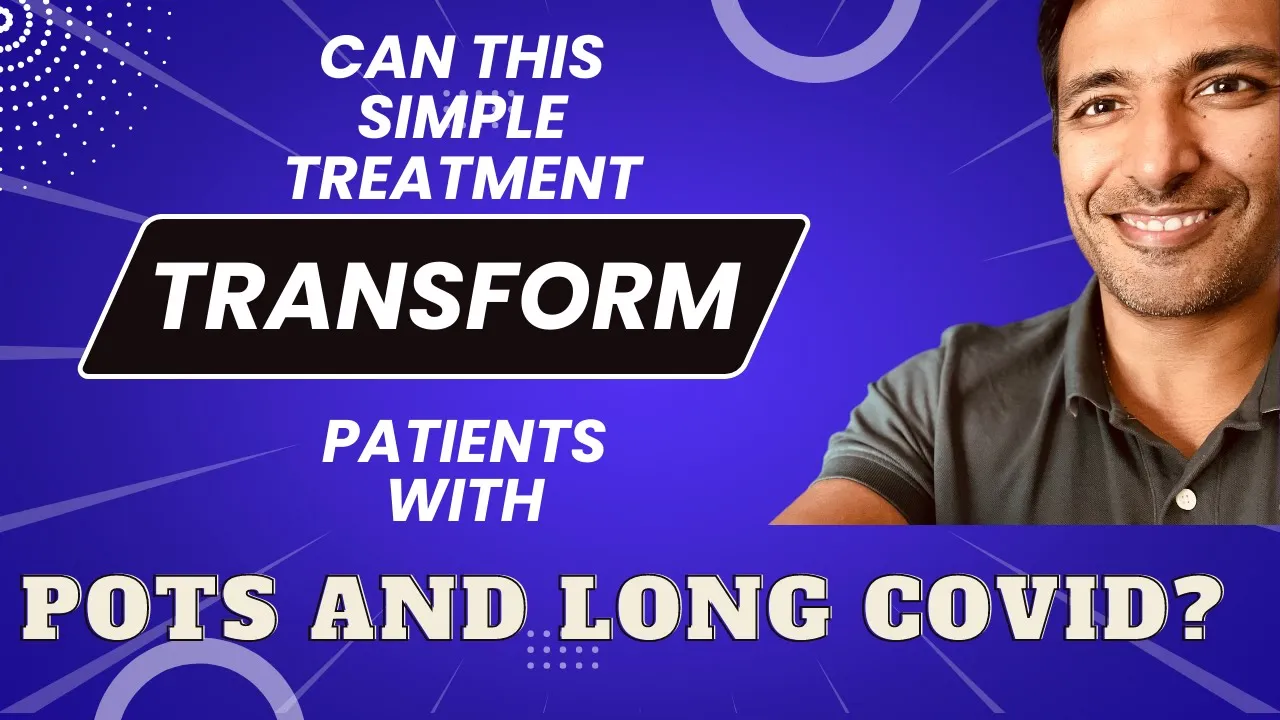
my name is sanjay gupta i'm a consultant cardiologist in york today i wanted to talk to you about a potentially transformative treatment for pots and maybe long covert okay let's get started what is pots pot stands for postural orthostatic tachycardia syndrome in this condition patients complain that when they stand up for a prolonged period of time they feel very uncomfortable with dizziness palpitation tremulousness and therefore they either have to sit or lie down or they risk collapsing when you examine them the heart rate can be found to be excessively fast especially when they're standing up
now as doctors sometimes when we can't explain what is going on we just take what the patient tells us give it a fancy technical name and make it a condition this patient says that her heart rate goes up excessively when she is in an upright posture let's call it postural orthostatic tachycardia syndrome that's not really a diagnosis it's just a medical jargon-filled term for what the patient has just told us it tells us nothing more than that but this is the term that we have ended up sticking with in fact i think the term pots
tells patients a disservice because of the name of the condition many clinicians have incorrectly assumed that it is only a condition that is manifest when the patient is upright or standing up this is incorrect i have over a thousand patients with pots and i've spent a lot of time listening to their stories all of them say i feel rubbish all the time i just feel rubbish air when i'm upright so what do they mean when they say they feel rubbish all the time well they're always tired they have bad brain fog they have issues with
lack of refreshing sleep they have horrendous gut issues they have chest pain breathlessness headaches they even have bladder symptoms and unfortunately the term pots does not capture all these other symptoms and therefore i prefer the term dysautonomia which means a disequilibrium between the flight and fight systems and the rest in digest systems in essence these patients spend a lot more time in flight and fight mode and very little time in rest in digest mode and therefore they're always simultaneously tired and wired and this is a far more appropriate and accurate name for this condition now
how do patients develop pots increasingly we're seeing that they often inherited genetic vulnerabilities such as ehlers-danlos syndrome joint hyper mobility variant and they have this vulnerability they get on in their lives and then at some point in their lives they get hit by some kind of infection this vulnerability is then unmasked by this infection and the patient starts noticing these symptoms in essence people are born with a genie in their lamps and then an infection comes along and the genie is unleashed and then unfortunately they struggle to get that genie back in that lamp the
most common infection that i've come across as a trigger for dysautonomias is glandular fever however there are other infections that can also trigger dysautonomias including coronaviruses and it is therefore not at all surprising that so many people have now developed this condition called long covet which has almost identical symptoms to a dysautonomia like pots and i would argue that perhaps pots and long covet are indeed the same condition why do i say this well let's look at the facts only ten percent of patients with covet develop long covert why if it were just about the
virus then surely everyone who got coveted would be expected to get long covered there must be something special about that ten percent which makes them more vulnerable two the severity of covet infection does not have a bearing on whether you get long covered or not well if it was just about the virus then logic would dictate that the more severe the illness the greater the chance of having long curve it we do not see this again it makes you think that the virus simply flicks the switch in those people who possess that switch three when
you talk to many long coveted sufferers they will admit to having some dysautonomic symptoms or beat even mild ones even before they caught covet many times they have just assumed that those symptoms were normal for them like oh i've always been a tired person i've always had ibs etc and then when they get hit by the infection that is when they find that their symptoms which were very mild get so much worse so it is highly likely that a majority of patients with long covert have pots and the problem is that because the definition of
the term pots are so narrow patients with long covet will be managed as if they have a completely separate condition rather than being managed as a post-spiral dysautonomia the way pots is managed and unfortunately nowadays there are too many doctors who are interested in treating conditions rather than treating patients this means that many patients with long curve it may miss out on lots of helpful treatments which we use for parts and they will just be asked to hydrate and pace whilst we all wait for some fancy american pharmaceutical company to produce a mega expensive and
potentially harmful new drug specifically for long covert i have hundreds of patients with long covert and i can categorically say that many of them feel much better when they're managed in the same way as i manage my pots patients in terms of optimal management for pots patients i use four approaches number one lifestyle modification number two physiotherapy number three medications and number four patient advocacy which is that the doctor if he is interested in truly helping the patient should try not only to get the patient feeling a bit better but you should try and help
the patient maintain their identity by advocating for them to access modifications school work etc so those are the four approaches i tend to use you'll find a lot more details about these approaches on my other videos on this channel and i've even set up a website called www.podspecialist.com so you can check those out but to be honest these measures do make a difference but they don't seem to transform patients i usually see with all these four measures i see like a 30 40 50 improvement but my patients still remain enfeebled so today i wanted to
talk about an intervention that in my experience can be transformative for some patients and in my opinion it should be offered far more widely than it has been today i'm going to talk to you about the benefit of regular intravenous saline infusions in pots and potentially even in many patients with long covert right now one of the most consistent symptoms in pots is that patients generally feel worse when they're upright the one thing that happens when we're upright is that gravity comes into the equation and gravity will pull blood towards it and therefore it is
more difficult for us to get the blood up to the brain which is the furthest organ from the ground and where that we therefore have to rely heavily on our leg muscles and our blood vessels and our legs to squeeze and help push this blood upwards in patients with pots this does not happen as well and therefore blood pools in the legs and therefore less blood is available for circulation we also find that this same phenomenon happens when it is warm because when it is warm our blood vessels open up and therefore the leg vessels
open up and this encourages more pooling more room for this blood to sink into which is being pulled down by gravity similarly patients will also feel much worse after a big carbohydrate-rich meal because the carbs need a lot more blood to go to the gut and the blood tends to pool in the gut this is a phenomenon called splenic pooling we also know that because of this reduction in circulating volume the heart has to work with less blood and therefore over a period of time the heart can actually become smaller which means that the heart
is now pushing less blood out with each heartbeat and has to beat faster to get the same amount of blood around in addition the leg muscles start getting deconditioned which then propagates this vicious cycle that the patient finds themselves in we also know that patients with pots tend to run low on the hormones that are produced by the kidneys to help retain water so not only can't they circulate the blood they can't even have they even have difficulty holding on to it this is why many patients with bots will say that they are constantly urinating
and many actually undergo investigation for a condition called diabetes insipidus because they're urinating so often that they are suspected to have this if we can therefore increase the circulating volume then patients feel better now the easiest way to do so at least theoretically is to ask the patient to drink more and this is why the first recommendation that we make is to ask the patient to substantially increase their fluid input to at least three liters of water daily and cut down on diuretics such as soda etc and reduce carbohydrate-rich meals because extra water does not
stay in the blood vessels we have to ask the patient to take more salt and electrolytes as these encourage fluid retention in the blood vessels however despite these measures patients only see a mild and at most a modest benefit and the reasons for this are manifold number one it requires a lot of discipline to make sure you're constantly hydrating and if you're feeling awful all the time that's quite difficult number two the frequent urination is inconvenient bothersome and tiring you know these patients struggle to even stand up trying to go to the toilet 20 times
a day is really hard many patients struggle with increasing salt intake and electrolytes because these can be very unpalatable patients with pots suffer from gut issues so they feel nauseous anyway and get easily bloated and they may also have impaired digestion and this may have an impact on what they're absorbing and finally when the water finally gets into the blood vessels they have difficulty holding on to it because of this deficiency in the hormones from the kidneys so in some ways if one could bypass the gut and in some way deliver the fluid with the
right concentration of salt directly into the blood vessels then you would expect to have quicker and more dramatic effects and this is where the idea of giving intravenous saline comes in the problem is that patients still struggle to hold on to the water for a prolonged period of time so even though you can bypass the gut get the water directly into the blood vessels they get better with that but because they cannot hold on to that fluid for long enough they deteriorate after a few days and this is why intravenous saline in this setting has
to be given repeatedly every week etc is there any evidence that intravenous saline infusions given repeatedly work well there's a very interesting paper by a very prominent pots physician called blair grub and he's from toledo in the us and he published this in the journal of interventional cardiac electrophysiology in 2017 and the paper was called effects of intravenous saline infusion in patients with medication refractory pods and these guys what they did was they took 57 patients who were already medicated and they were already on at least three different types of medications for their parts but
they were still struggling and they recorded measures of quality of life before initiating intravenous saline infusions regularly one liter of intravenous saline every week this was given by a peripheral cannula and in the small number of patients they were given through ports bigger you know bigger things uh catheters that are actually stuck in a bigger vessel but the majority of them were given the infusion through a little cannula in the arm here and they were followed up these patients were followed up over the next three to twelve months to see if they reported an improvement
in quality of life and the results are remarkable because it showed that only four patients out of these 57 did not feel that they had benefited all the rest reported a benefit and the benefit was seen in all domains across quality of life assessments most patients reported an immediate improvement in symptoms that lasted up to three days after the infusion many patients subsequently found that because they felt so much better they were able to use that improvement to do more physiotherapy get more conditioned and many were then able to discontinue the iv fluids altogether more
importantly there were no major adverse events from the intravenous cell line so this is clearly very encouraging even though the study was non a non-blinded observational study rather than the randomized placebo-controlled trial which most doctors pay more attention to despite these encouraging data as yet i'm unaware of anyone who is doing a randomized control trial and this is probably because there's no real money to be made from intravenous saline which is cheap as chips anyway on the basis of this study one would think that this is a simple safe intervention it's not expensive and it
would be something worth offering those patients who continues to struggle despite lifestyle physiotherapy and medication and i have many such patients who you do everything and they're still really struggling and so i was keen to explore this option for my patients unfortunately i found it far more difficult to convince the nhs gurus that this was worth trying for several reasons and i'll list them out many many doctors don't know anything about parts many who do know about it don't believe in it those who do believe in it fail to understand why just telling the patient
to drink more is not an adequate enough intervention as potts is not considered a dangerous condition it does not seem to be important enough to address even though to my mind quality of life is really important many doctors feel that the benefit is simply due to a placebo effect even though you have to ask whether that really even matters because if someone says i don't enjoy my quality of life and after being given a cheap safe intervention the same person says i feel so much better could you still call it placebo just because you can't
explain it does not mean that it's not worth doing because if it is about quality of life then the patient's perception of their quality of life is what is important and if you've made them feel better than you've delivered an effective intervention finally there are no easy mechanisms within a cash-strapped space of staff depleted nhs to provide such a service and despite all these challenges i was really keen to see if i could access fluids for some of my patients and my breakthrough came when one of my patients wrote to their mp who turned out
to be mr rishi sunak who was then chancellor of the exchequer and he was also her local mp and mr sunak wrote to me and said look you know on the basis of humanitarian grounds you should be offering this patient intravenous fluids because she's got children uh she can't look after them she's incredibly debilitated and she's missing out on life and i agreed with that but i was very grateful to have mr sunak's support so i took his letter to my hospital managers and they all agreed and we started offering this lady intravenous saline and
because we were able to offer her saline we could offer a few more patients intravenous saline so we started giving some of our worst affected patients intravenous saline infusions were via peripheral cannuli we don't put ports in because ports carry a much higher risk of blood clots and infections and therefore when you're trying out a new intervention you don't want to take anything do something that could expose the patient to any kind of risk so peripheral cannula very safe and i'm delighted to say that we are now we have now been giving intravenous fluids to
about 30 or so of my worst affected patients and the vast majority have found this simple intervention to be transformative they come once a week they sit in our day case unit they receive intravenous saline two liters of intravenous saline over a four hour period via peripheral cannula they then go home and engage with physiotherapy because they feel better they get more conditioned and then they come back in a week and get the fluid again we've not been able to offer it to more people simply because there's a shortage of resources but i'm hoping that
soon we'll be able to add our experience and develop an evidence base which will allow us to fund more resources now i wanted to share some feedback from my patients in their own words with you okay so let's this is from a gentleman called ben he said dear dr gupta i thought i would write to you now as we are a couple of months into my iv treatment i can't believe how much of a difference this treatment is making i admit i was skeptical at first but having run out of options in my treatment i
had no alternative but to give this a try to start with i didn't see much difference but then after a couple of weeks my wife commented that i looked different immediately after receiving treatment and that i looked well and my complexion was more refreshed my skin was less pale i had more of a glow about me i am able to get more done than i have in the last six years on the day of the infusion i can bear to stand up for longer where usually i would be rushing for a chair or my mobility
scooter this would last a day but that day is time i can spend with my family instead of being left behind as i was unable to participate i noticed a longer effect if i wear my compression stockings that i purchased from amazon ever since that i did this ever since i did this i'm able to extend these effects from my treatment into the following day although you only get one or two days of lesser symptoms from this treatment it has made such a difference to me i very much hope that funding will continue so that
i am able to have more of a life instead of being confined to my home this is another feedback another bit of feedback that i've received dear dr gupta h has now finished her once a week over four week course of intravenous infusions i have to say i did not expect the infusions to make such a difference to age but they have this therapy has given us glimpses of our daughter back that we haven't seen for over eight years she has struggled not only with ayla's channel or syndrome but with chronic fatigue brain fog auditory
delay headaches difficulty processing speech from others and giving a related answer therapy has given her so many benefits she has not had a headache since starting treatment for three days a week she's animated chatty and can process conversations correctly her energy levels have increased vastly for three days a week she can do hobbies sit down stairs she is normally bed bound and has now been doing so for a day has now been on days out this is huge for h and us as a family if age were to continue and possibly have infusions twice a
week she may benefit so much it would give her more family and friends time less time being fatigued in a state of all-consuming brain fog which makes life so hard for her she would not feel isolated in age's words she feels normal for those few days to a disabled person that word is huge to a parent it is a lifeline we thought she would never have thank you for this opportunity you have given to age so as you can see these are incredibly heartwarming stories and it is a shame that this is a service that
is not offered more widely to carefully selected patients although one of the reasons is that there are no mechanisms existing mechanisms in place to offer the service within existing nhs services a bigger reason is the attitude of doctors doctors these days have the mentality whenever they're faced with a complex problem or a complex patient they will say what will happen to me if i try and help this patient what inconvenience will i put myself through for this patient what will happen to me if i try and help this patient and actually what they should be
doing is they should be thinking what will happen to this patient if i don't help them my own feeling is that a doctor who is not prepared to put him or herself out of his aura comfort zone for the sake of the patient then that doctor is not deserving of their title i hope this video will empower patients who suffer from dysautonomia pots and long covert to access the care that they truly deserve as i say we now have a website that i've started for patients with pots you can access lots of free resources i've
compiled these resources over five six years of looking after patients with pots and i thought well should that not be available to everyone at no cost and therefore i set up a website and the website is www.potspecialist.com if you get a minute please check it out and please let me know how you think we can make it better and more useful so thank you so much i'm so glad um that i've been able to do a video this week i love hearing from you i read all your comments and all your comments contribute in making
me feel happy and worthy and i am so incredibly grateful thank you so much all the best you