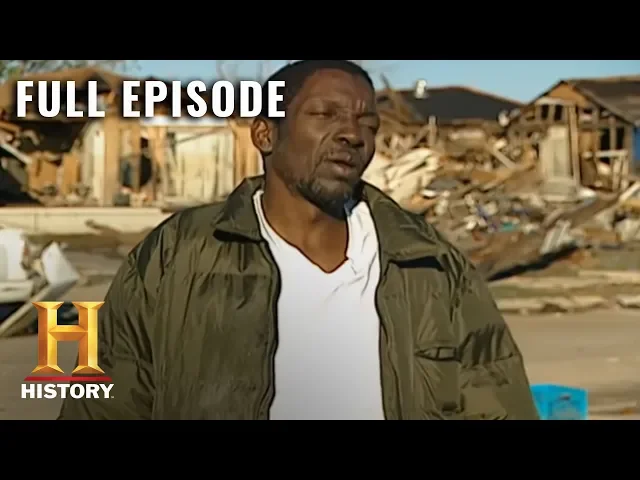
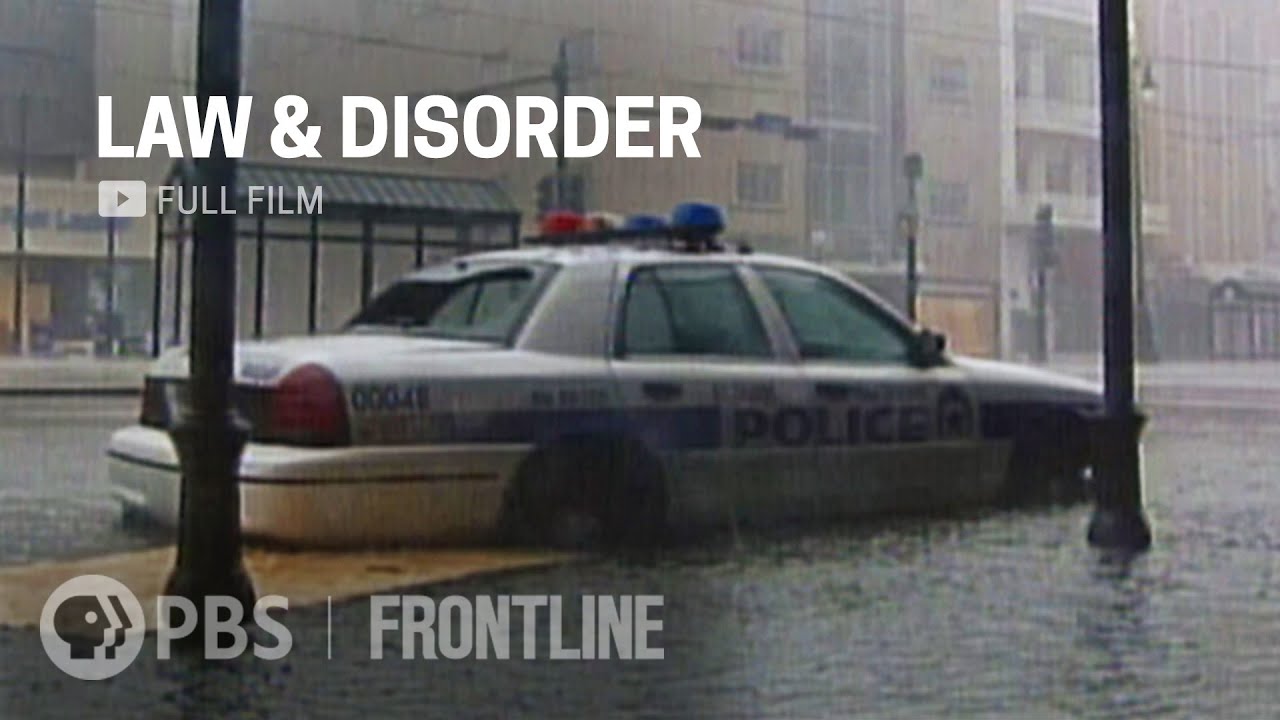
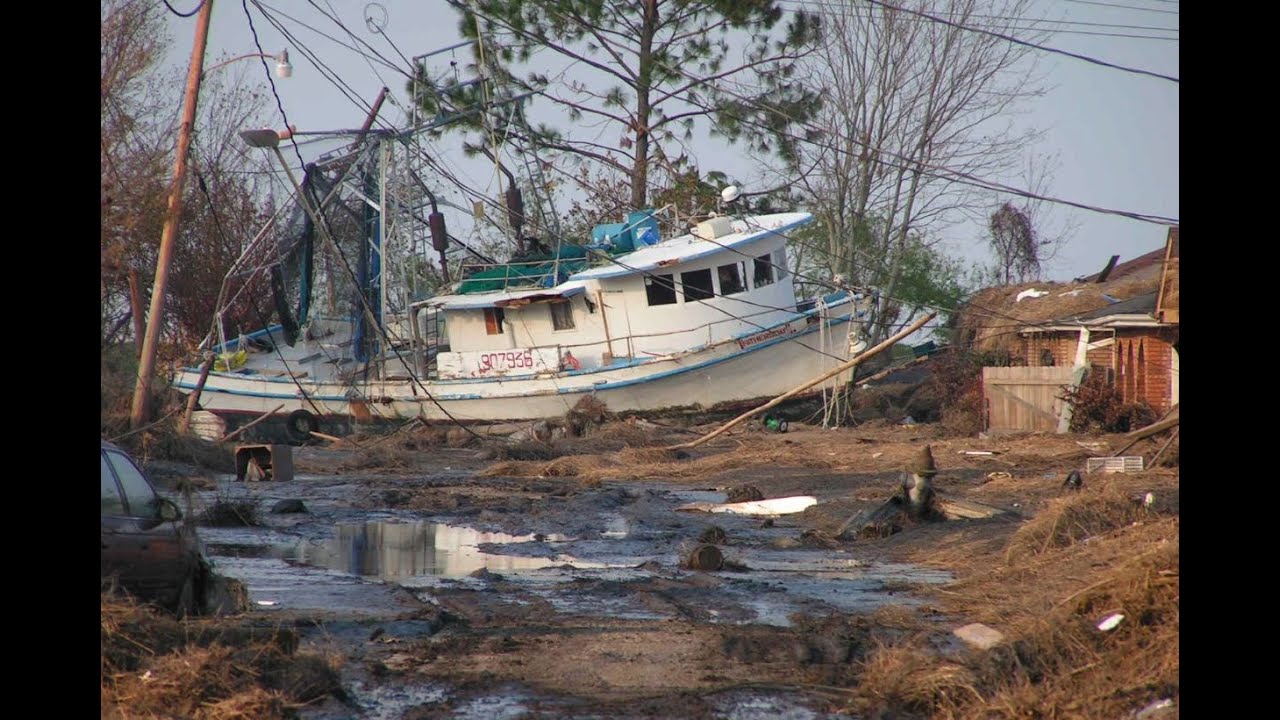
one of the deadliest natural disasters in United States history Hurricane Katrina devastated New Orleans submerging it under a torrent of floodwater levees failed and water pumping systems below sea level were flooded the roof of the Superdome where thousands sought shelter was torn to shreds and this bridge linking the city to outside relief efforts collapsed like a set of dominoes how could it all happen now engineering disasters New Orleans on modern marvels [Music] in August 2005 the close to half million residents of New Orleans knew all hell was about to break loose urge all citizens to put their own safety and the safety of their families first by moving to safe ground a monster named Hurricane Katrina was tearing across the Gulf of Mexico the category 5 hurricane packing winds of nearly 175 miles per hour was bearing down on the city and was predicted to make landfall after dark as expected Katrina pounded the Louisiana coastline however after it made landfall it was downgraded to a category 4 storm with winds of less than 150 miles per hour and the eye of the hurricane veered northeast away from the city at the last second it made this little turd and we're all so excited like no we're not gonna get the brunt of the storm New Orleans is gonna make it we're gonna make it celebrations would prove to be short-lived by missing the city Katrina's ferocious winds moving in a counterclockwise pattern over Lake Pontchartrain to the north and the Gulf of Mexico to the east such an estimated 15 foot storm surge into the city through its backdoor drainage canal system storm surge is the swell of water caused by the hurricane winds and it raises the water level so it's as though it's a high tide that is enormous lehigh and just comes in fast only the levees and floodwalls could protect the city from the impending catastrophe but in a series of engineering disasters the levees failed on a massive scale once the breach occurred there was a wall of water released like a tsunami that flowed into this residential area first a levee flood wall broke along the industrial canal waterway on the city's east side [Music] storm surge water rushed through the breach into an area known as the Ninth Ward then a second flood wall on top of the 17th Street canal levee suffered a - city block wide breach this allowed the water of Lake Pontchartrain to run into the city then a third levee flood wall collapsed along the London Avenue canal you can clearly see how the walls come down the water just kind of pushed over it these levees and flood wall bricks put more than 80% of Orleans Parish underwater thousands of victims were left stranded we're dealing with one of the worst natural disasters in our nation's history with the city submerged New Orleans system of mammoth water pumps used for more than 80 years to drain the city was of little use our biggest problem was water water rolled into the station rolled across the floor the power had to be cut to him water rose to this height right here that's it our pumps are shut down we're dead in the water would decommission no more pumping but the flooding wasn't the only disaster Katrina visited upon New Orleans despite evacuations up to 25 thousand residents remained in the city many fled to the Louisiana Superdome a structure built on higher ground and supposedly engineered to withstand hurricane-force winds however most of its roof was ripped apart during the storm thousands were rescued from high water many from rooftops [Music] getting relief to victims became extraordinarily difficult in another engineering disaster a main route into the city the interstate 10 twins fan bridge collapsed as a result of the storms massive water surge the city was left with no power scarce drinking water dwindling food supplies and incidents of looting up to 1300 victims did not survive New Orleans looked like a third-world country it was really an apocalyptic event for the city to flood and fires to break out in the water and people to be trapped in their homes the collapse of civilization seeming to be imminent why had New Orleans been so vulnerable a shocked nation began to look for answers the mystery that we're trying to uncover in terms of the engineering performance of the design is what caused the variety of failures that we saw was it a strong hurricane or a weak design an army of scientists geologists and engineers descended on the crippled city to unlock this mystery one of the so-called geo detectives was dr. Joseph su haida an oceanographer geotechnical coastal engineer and former professor at Louisiana State University right after the storm hit I investigated the causes for some of the breaches and flood wall failures that occurred we had to do this immediately after the storm before any evidence would be erased by either repairs or some natural processes that would obscure what we were trying to look at dr. su Haider reached the scene without a moment to spare a robbery lead the Army Corps of Engineers was rapidly repairing the levee and flood wall breaks to protect against further storms which could strike during the remainder of what would turn out to be an extremely active hurricane season there are a lot of unknown factors in terms of the levee breaches and so we had to look into the factors that would explain why they failed under conditions that would appear that they should not have failed under in fact the engineering failures may have been over 300 years in the making beginning when the French arrived at the end of the 17th century the first settler is found a swampy area they called la float all the floating land the soil on which New Orleans was built is naturally very wet even spongy and consists of silt carried from the Mississippi River the city is mostly surrounded by water only parts of New Orleans are a few feet above sea level most of it is either at or ten feet below sea level the topography has been likened to a soup bowl because the front the river and is high on the rim and the middle is low like the bottom of a bow before it was known as the Big Easy New Orleans was named the Crescent City the French first built on the crescent-shaped high elevation along the Mississippi River this is where the famous French Quarter is now located from the beginning the French had problems with flooding from a Mississippi River so they began to build a system of levees a levee is an earthen dam that runs along a waterway the levee system goes literally to the founding of New Orleans I would say at the very very latest 1720 and possibly 1718 after the Louisiana Purchase in 1803 the United States took control of the city as it grew the swampland below sea level was converted into farmland during the next hundred years some 350 miles of levees were built to protect this new land individual landowners plantation owners were responsible for building and maintaining the levees so it was a very private based non-governmental type of action the dirt that comprises the base of the levees is that soft spongy Mississippi Delta soil what we have here is an example of a delta soil in terms of its characteristics of having high organic content being very very weak having high clay content in 1927 the United States Army Corps of Engineers took control of the levee system the Corps widened many of the levees and built them higher but as the system was strengthened there was another problem New Orleans and the metropolitan area is sinking because of the geology of the soils beneath the city the water that's in the material is being squeezed out and so the surface has been moving down and will continue to move down for hundreds of years this sinking is known as subsidence it's caused by the reclaiming of swampland when water and mud were pumped out the area began to fall even further below sea level subsidence at one time had been balanced by sedimentation new silt sand and clay deposited when the Mississippi River flooded but since the levees were constructed the river has been controlled and sedimentation has stopped in New Orleans the estimates are very for the sinking rates but we have them as high as one inch a year but they typical being about a half an inch of year of actual sinking of the surface downward over time even at a rate of a half inch per year the city will subside or sink more than four feet in a century for decades geological experts warned of the peril of this sinking city and the fragile levee system that protected it this was a disaster waiting to happen because we knew there were hurricanes that could flood the city with the protection that we had dr.
su hater was determined to find the failures that caused the levees to break the evidence he was about to uncover would provide the first clues to how this engineering disaster could have occurred [Music] an estimated 200,000 homes in New Orleans were destroyed or damaged by Hurricane Katrina engineering disasters New Orleans will return on modern marvels [Music] we no return engineering disasters New Orleans on modern marvels weeks after Katrina wreaked havoc on New Orleans the city remained mostly underwater the critical question why did the levees fail did Katrina overwhelm the city's flood defences or did faulty construction caused them to burst open the levees and floodwalls were built to what we were referred to simply as a category three fast-moving storm the National Hurricane Center classifies hurricanes according to wind speed and storm surge the scale ranges from the least severe category 1 hurricane with winds of 74 to 95 miles per hour and a storm surge of 4 to 5 feet to the most destructive category five were wind sword to more than 155 miles per hour with a storm surge of higher than 18 feet well we started the hurricane protection project back after Hurricane Betsy in 1965 Katrina wasn't the first hurricane to devastate New Orleans in 1965 Hurricane Betsy a category 4 storm with winds of 125 miles per hour hit New Orleans dead-on and plowed through the outdated dirt levee system flooding the Ninth Ward and killing 75 people although Betsy caused less damage than Katrina there was an effort to ensure that this would not happen again the US Congress gave the Army Corps of Engineers the responsibility of building concrete floodwalls on top of the 740 levees to give the city more protection they're known as AI walls one-inch thick steel sheet pilings were driven 20 to 25 feet underground to secure the base tied to them reinforced concrete walls six inches thick were built on top of the dirt levees however the Army Corps constructed only eight-foot high flood walls on top of the levees for an average total of about 15 feet of protection these could contain only a category 3 hurricane storm surge to fully protect the city against a category five storm surge critics warned higher flood walls should be constructed the Carmi corps of engineers in New Orleans was only authorized to build a category three protection type system by the Congress of the United States a category 5 would have required different authorizations an extremely high amount more of funding Katrina was a category 4 storm with an estimated surge of more than 15 feet geo detective Joseph su haida uncovered evidence suggesting one flood wall failure was caused by the action of the water over topping it this occurred on the east side of the city at the industrial canal it was a condition like this where the water would come over the top of the flood wall and actually plunge down and scour at the base and here below me you can see what is remaining of the pit that was scoured out by the flowing water and that scouring action would continue as long as the water kept flowing over the top of the FUD wall scouring occurs when flood water pours over a wall like a waterfall the force of the falling water from the top of the flood wall scours or digs out the dirt along the walls foundation undermining it and causing the entire wall to collapse from top to bottom after the breach occurred there was a wall of water released would be hundreds of thousands or millions of pounds of force the wall of water was unbelievable they had cars and everything once ignited this everything in his taking everything in his parents cause and everything popping up from the surfers and everything and I never seen nothing like that in my life it was unbelievable Ninth Ward resident Palazzolo Simmons lived just a few blocks from the industrial canal levee when it failed his home was totally destroyed right inside of him when that strong come to him and I could not been here talking to y'all could have been day the waters so deep I had to swim from one rooftop to another rooftop I was praying it for three days three days with no rescue help whatsoever I got out of this area a guy came in with a boat rowing a boat he's seeing me and he can't pick me up Ella Zolo Simmons was lucky he survived in his Ninth Ward which was hit hardest by the storm surge miles of homes were destroyed [Music] you we now return to engineering disasters New Orleans on modern Marlins a more insidious culprit caused the massive failures on both the London Avenue canal and the 17th Street canal the very building material of the levees themselves the soil as we can see here the flood wall is in place it's vertical it's got a nice clean edge we don't see any of the breaking or bending that occurred and the industrial canal and that's because the mechanism of failure was different in this case the soils that were holding up the flood wall were saturated by the storm surge weakened and failed and then slid and raised up pushing that soil mass into flood walls into the homes this is known as heaving as Katrina's storm surge filled the canal water pressure rose in the soft Delta soil underneath the flood walls when the rising pressure and moving water overcame the soil strength it suddenly shifted taking surrounding material and the flood walls with it this is an extraordinary situation here what we have is a piece of the original soil that was holding up the flood wall that was about 40 feet to my right right along the 17th Street canal so this material here was actually alongside the channel at one time it got displaced and lifted up with this fence was slightly outside the area of the flood wall so we've seen a movement in an uplifting of the soils by about 40 feet this movement might have been prevented if another engineering failure had not occurred the steel sheet pile bases driven 20 to 25 feet underground gave the flood walls insufficient support a deeper sheet piling would probably have anchored the flood wall and much stronger soil if the soil movement takes place below the bottom of that sheet pile then the sheet pile is really passive and doesn't protect from the soil motion and that's what happened at the 17th Street canal but if the soil is strong enough then the sheet pile actually holds up the concrete wall along the London Avenue canal the Army Corps of Engineers is repairing the flood wall breaches with deeper steel sheet pilings perhaps they'll prevent a catastrophe of this kind in the future these are the old cheap piling underneath the flood wall the new sheet piling we're driving our 79 feet of these big ones right here and these are the old ones which are 22 feet it's a much stronger sheet pile section than the the old sheet pile another repair the Army Corps has undertaken with is the replacement of the old walls with what are known as tee walls [Music] the football is secured with a concrete base embedded underground attached to the base our steel sheet pilings of up to 70 feet deep so you have a lot of capacity in these piles where they can't be moved so the wall can't turn as long as those poles are there although the damaged levies are being rebuilt by the Army Corps they still will only withstand a category three storm surge there are no plans to heighten the flood walls to protect against a category five the estimates it would take many many years five to ten years at least dollar estimates range in the twenty plus billion dollar range just for New Orleans area however dr. Joseph su Hado believes even if the flood walls were built higher that wouldn't take into account the soil uncertainties raising questions about the design of the entire levee system the analogy can be made that when you have very soft soils even if you have a very strong structure on top of that then the whole structure is going to fail somewhat like if you put bricks on jello the bricks can be very very strong but it's the string to the jello that really determines whether the bricks are going to move one of the solutions to the problem of minimizing the threat associated with flood walls is to build flood gates at the northern end of our drainage canals and therefore keep the storm surge from coming into the drainage canals and from threatening the flood walls flood gates are enormous walls that can be raised or lowered by hydraulic systems to regulate water flow the Army Corps is looking into the possibility of placing flood gates and canal openings the gate would be raised above the level of the water so the water would generally pass beneath it in the event a storm was approaching the gate would be lowered so that would block the flow of water rebuilt levees flood walls and flood gates could constitute New Orleans first line of defense against another hurricane catastrophe that might help protect New Orleans second line of defense a system of 24 water pumping stations that flooded after Katrina and left New Orleans crippled for weeks in a polluted swampland according to one tradition New Orleans nicknamed the Big Easy was coined by jazz musicians who found it relatively easy to get work in the city we now return to engineering disasters New Orleans on modern marvels for more than two weeks after Katrina hit New Orleans remained underwater [Music] the city has one of the world's largest water pumping systems capable of pumping 30 billion gallons a day but because the levees failed the pumps located below sea level became inundated with blood water waters coming in first time ever electricity and water don't mix I'm afraid to shut the station down shut the motors off and D energize not only were the electric pumps immobilized pump workers literally had to swim for their lives at that point I had just the Bible going through my mind I wanted to live we were all scared pump station attendant Wallis Rainey had to swim in 20-foot deep flood water to reach a stable place before being rescued this is where we stood as the waters was rising it was coming in through the windows the windows was broke had the water coming across the tops of the pumps it was lapping at our feet we were pretty scared we didn't know we were gonna make it through that day the men who constructed the pump stations could never have imagined the catastrophic flooding scenario that followed Katrina for centuries New Orleans had attempted to deal with water accumulation problems but it wasn't until 1912 when Albert Baldwin would invented a successful screw pump that the city found a solution remarkably many of would screw pumps over 80 years old are still in use today the pumps work on a very simple principle encased in a sealed cast-iron drum air is transferred out creating a vacuum inside the water is sucked in by the vacuum and a 14 foot diameter screw or propeller turning at 83 RPM propels the water out it wasn't the actual pumps but rather the electric synchronous motors which supply the power that were affected by the flooding the motors are exposed to the elements and positioned in pits partially below the floor the water got approximately this high on this pump there and when water hit electricity boom basically you have no more operations it took weeks for the water to be pumped out of the stations and the motor is to thoroughly dry then another problem caused even more delays in getting the pumps back online we look at this station and a lot of our other facilities as working in an actual museum because you could look at these pumps and motors and they are extremely old there's no manufacturer to go back to for these particular ports so you're looking at either fabricating myself or yourself or going to another fabrication shop that have had done the city's sewerage and water board is preparing its pump system for future flooding already there are a few prototypes in place to shield and protect the pumps electrical motors after the hurricane the water was approximately here it inundated this pump over at this pump the water didn't get into the workings of the pump it's a call to sealed pump this pump was able to be started when we got here this is a possible solution for a situation if we ever have it again that's just traumatic as the storm flooding the city another remedy is to elevate the entire electric system which runs the pumps this has already been accomplished at one station some of this equipment is in the basements of some of these pumping station those that equipment possibly needs to be higher so that if we do get a situation where we need the pumps in there's a lot of water in the city that these this equipment stays dry it took 21 grueling days to pump out New Orleans but if the pumps hadn't been flooded with the city itself of state above water if our drainage pumping station had not been damaged and the levee breach could be stopped in its early stages it would take 12 to 20 hours possibly to pump out what ran in during that time instead standing flood water left the city in an uninhabitable soup thousands sought shelter in the New Orleans Superdome but another engineering disaster would make this shelter of last resort a living nightmare one of the 14-foot screw pumps designed by Albert Baldwin wood has the capacity to discharge 7,500 gallons of water every second for 648 million gallons per day engineering disasters New Orleans will return on modern marvels [Music] we now return to engineering disasters New Orleans on modern marvels with thousands of survivors left stranded in floodwater Louisiana Superdome became a shelter of last resort this is a football stadium it's not a hospital it's not a hotel we're equipped to handle people for four hours not for days conditions deteriorated rapidly after Katrina's 145 mile-per-hour winds ripped apart the superdome's nine acre roof hurricane-force winds began to cut pierce and slice this roofing system resulting in something similar to an onion beginning to peel back the layers first the membrane then the insulation then the structural deck inside the Superdome rain pouring in from the damaged roof shorted out the main electrical system the dome had to depend on a backup generator it's like living an epic disaster film it was it's an unbelievable experience so there's minimal lighting there's no air-conditioning and it's just a matter of time before you lose water pressure you have you know 15 to 20 25,000 people eventually in your building using the restroom with no water pressure you can imagine what that's like so we lost the toilets and the ability for people to use the facilities in here after a couple days constructed in nineteen the 1. 9 million square foot indoor stadium was one of the first sports domes of its kind the stadium itself covers 13 acres it reaches 27 stories at its peak and encloses a volume of more than 125 million cubic feet some 20,000 tons of steel and a hundred and fifty thousand cubic yards of concrete were required for its construction and certainly the Superdome was built to the code at that time in 1975 the building structurally is very sound so yes it was it was built to withstand hurricane-force winds why then did the roof fail when subjected to Katrina's winds the engineering disaster involved not the structures roof itself but rather the surface that covers the roof it's a rubber membrane over a 2-inch styrofoam based material that is laid over a metal deck and we lost one of the apex vents one of the exhaust dampers at the very top very apex of our roof 270 feet above the floor the exhaust dampers are housed in five foot high 20 foot long box structures resting on the roof surface when the hurricane winds blew one of the dampers off the road the resulting breach exposed the rubberized roof membrane it began to tear once this occurred the winds were able to move under the membrane seal and shred it piece by piece the effect on this roof was the removal of almost 70% of the membrane itself exposed in all of the structural metal deck and opening up the holes into the roof itself the Superdome roof would have to be rebuilt by November 2005 the roof had been covered with a thin temporary hardened foam surface but now we're gonna move to a long-term solution a long-term solution of a galvanized structural deck with a new foam roofing system hopeful will protect the dome better than ever it will result in a better system a deck that will resist the inevitable next hurricane however in that desperate week after Katrina there was another engineering disaster impacting the thousands in the Superdome and across the city the interstate 10 twins bambridge across lake pontchartrain collapsed because of the hurricane storm surge since this was one of the main routes into the city relief supplies were difficult to deliver the tremendous force of nature and the awesome power that unleashed on this bridge is something that you just had to see to believe when you're looking at these 265 ton concrete segments just being tossed around like toys the twin span bridge was constructed in 1964 linking New Orleans with interstate 10 it's a concrete structure spanning 5.
4 miles of Lake Pontchartrain the bridge consists of approximately 460 concrete segments each weighing about 265 tons the segment's are held up by pilings that are sunk a hundred feet into the lake bed but rise less than 10 feet above the lake surface the pilings withstood the storm surge but because of a design flaw some of the girders supporting the concrete segments did not under this bridge span right here the tidal surge came up and it reached probably about to the top of this girder or right around there it trapped air between these girders and that caused about a million pounds of pressure that shoved up on this concrete segment at about the same time you've got probably about 3/4 of a million pounds of pressure from a tidal surge as hitting the side of this segment so all of that combined to just shove this segment up and out and it just kind of tossed it into the lake like was a domino a total of 435 segments of both spans were damaged making the bridge impassable because this passageway is critical to the city it needed to be rebuilt as soon as possible it took just 17 days to repair one of his fans what we had to do was cannibalize segments for one span and put them on the other span so that we could establish two-way traffic on one span that left us with huge gaps in the remaining span and what we did is we used bridge panels that we attached to the current structure basically made of steel galvanized steel so instead of replacing those missing spans with other concrete spans we put in these bridge panels you can see with this new truss system and with these panels there's really no place for any significant air pressure to build up so it's really not going to be susceptible to the same kind of air pockets and air pressures as the concrete panels were so that's one way that you can fix this by early January 2006 both sides of the twin spam bridge have been rebuilt and opened to traffic however these are just short-term repairs the long-term solution to this is to build an elevated bridge at least twice as high as the current bridge we want to make sure that it's not susceptible to that kind of tidal surge we believe that kind of bridge would cost about six hundred million dollars but we believe it would be worth it to ensure that this type of tragedy never happens again before the Katrina disaster the twin span bridge carried close to fifty five thousand vehicles a day [Music] on Bourbon Street the neon lights are flashing and the booze and jazz are flowing the Big Easy is making its best effort to come back but the French Quarter is located on the city's highest ground and received the least amount of flood damage beyond it vast areas of the city have been extensively damaged to fund what is likely to be the largest demolition and rebuilding project in America's history the mayor of New Orleans is asking for tens of billions of dollars in federal aid but we are working very fever asleep with banking institutions with financial folk as well as federal officials to secure a line of credit that will sustain us but there is a looming potentially cataclysmic crisis that may doom recovery efforts in New Orleans eventually what's going to happen is is that the coast Louisiana is gonna be inundated by the Gulf of Mexico dr. Roy Dhaka a professor of civil and environmental engineering at Louisiana State University is now using high-powered Global Positioning satellites to develop true elevation points in the state well this is a GPS measuring device this is the antenna up here what we're using this for is to figure out exactly how high we are above sea level but more importantly how low we are below sea level and what that's been able to do is that that it's shown us that that the sinking is occurring much faster than what people had thought before and it's occurring in places that we didn't know it was happening dr.