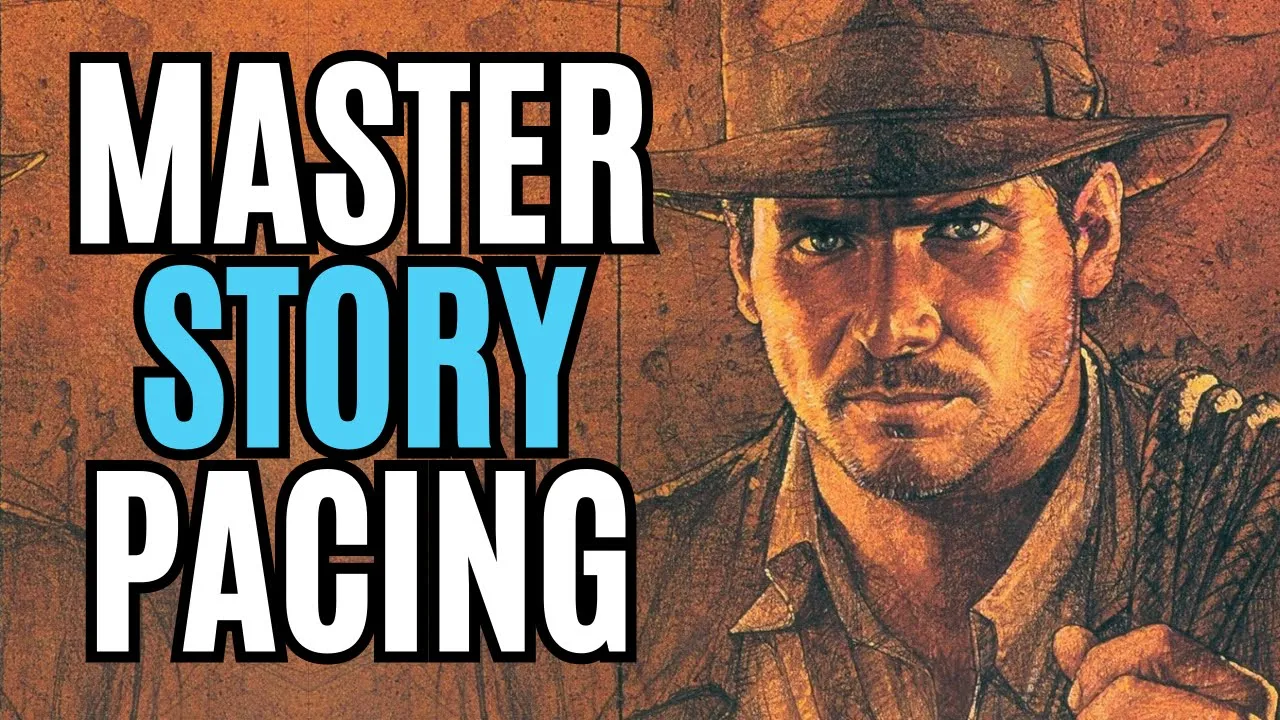
get ready to jump today we're going to talk about time jumps and how to use them to manage your stories pacing by the way my name is Brandon McNulty I'm the author of bad parts also the author of Entry wounds and welcome to my riding Channel my subscribers have been asking me to do a video on time jumps so I thought we'd talk about that today we'll Define what they are we'll discuss how they work and finally I'll give you some Advanced tips for using them I'll also be talking about Indiana Jones today so if
you're not familiar with those movies consider this your spoiler warning but let's start off by answering the question what is a time Jump and very simply it's a pacing technique that enables the story to skip ahead in time you skip the mundane boring repetitive or irrelevant parts of a story you skip the filler and what you're doing you're carrying the audience from one meaningful scene to another by using these time jumps and just to be clear time jumps have nothing to do with time travel there's simply a technique that can be used in any type
of story now time jumps come in small and large large sizes when we're talking about a small time Jump this is when you jump seconds minutes hours or days ahead and typically these types of jumps aren't noticeable audiences just take them in stride the story moves along now with larger time jumps you might jump days weeks months years decades ahead and typically these are going to be more noticeable and when you pull them off you need to get your audience back on board you need to show how the characters in the world have changed over
these larger spans of time and you've probably noticed that I use days as an example of both a small and a large time Jump and that's because depending on the scope of your story a day may be a significant chunk of time or it may be something more minor all right now let's talk about how time jumps work and the thing is stories don't have to occur in real time so when an important moment or scene concludes you can jump ahead to the next important moment we're seeing and this can eliminate filler and it could
boost your story's pacing here's a small example from Raiders of the Lost Ark during the opening sequence Indy finds the entrance to the temple that he's been looking for and before he enters he fills a bag with sand and then he grabs a torch from his companion's backpack then we jump ahead in time a minute and we see Indy inside the temple with a lit torch this is a small subtle time Jump but it saves us from having to watch him light the torch which really wouldn't have any impact on the characters of the plot
it's not something we need so we just jump ahead we skip over it now here's an example of a larger time Jump after Indy grabs the golden idol and he escapes the temple he gets the idol taken away from him and he has to run for his life he eventually boards a plane and he flies out of Peru and into the sunset then we time Jump Ahead several days and we know that several days have passed because we're in a new location it's a sunny day and India's dressed for his day job as a college
professor and remember this location time of day your character's appearance and what they're doing those are great ways to signal that time has passed the time Jump here saves us from watching unnecessary events like Indy's flight home and how he returns to his daily life it's also worth noting that we pick things up at the end of his lecture which is important because audiences aren't here to learn about the Neolithic Age they're here to watch an action movie and once class ends that's when the story starts rolling again all right I'll give you one more
example this is an extra large time Jump That spans decades and it comes near the beginning of the third Indiana Jones movie The Last Crusade if you remember this movie opens up in 1912 with young Indies stealing a valuable artifact from some grave robbers who eventually steal it back from him then we time Jump Ahead to 1938 and see Indiana ship in the middle of the storm he's trying to recover the artifact once again as an adult and since this is such a significant time Jump we're shown the date on the screen and that's something
to remember when time jumps span years decades or centuries you may want to clue in the audience you can show the date on the screen or if you're writing a book you can start your next chapter or section by saying three months later or 20 years later or whatever it is all right now I want to give you five practical tips for using time jumps five tips that'll help boost the pacing in your story first tip is to start your scenes as late as possible and end your scenes as early as possible in that example
I gave you from the Last Crusade we have a scene that opens up with adult Indy getting punched in the face while trying to obtain the artifact this scene starts late it starts right in the middle of the action we don't see how he gets on the ship or anything like that because that stuff doesn't matter what's important is him getting the artifact that's the heart of the scene and once he recovers it the scene ends shortly afterwards with the ship exploding and Indie clinging to a life preserver tip number two prepare your audience before
a time Jump this means that you want to signal that time will pass you want to hint that characters plan on doing something or they plan on going somewhere in the future in Raiders when Indy flies away from Peru we know that he failed to secure the idol but he managed to escape with his life and as his plane is getting smaller and smaller on the horizon the scene's energy drains out and this whole scenario signals that he'll be heading to safety that he'll be regrouping and that's exactly what happens in the next scene when
he talks to Marcus he talks about how he could possibly get the idol back tip number three after a Time jump reorient your audience and I already mentioned this with the classroom example when you're reorienting you want to establish a new location you want to establish the time of day what your character is doing what they're wearing and so on and so on tip number four get creative with your time jumps use different images or story elements to show that time has passed in the Last Crusade example the scene with young Indy ends with him
receiving his iconic hat then we time Jump and we see the Hat on a much older Indie now the Hat hasn't changed but the guy underneath it has aged two decades and that signals a time Jump and tip number five use time jumps to create a sense of mystery or tension and sometimes after a jump the audience is disoriented at first and that can be a good thing a skilled Rider can use time jumps to manipulate the audience into becoming curious or fearful for example toward the end of Raiders Indy and his sidekick Marion escape
the Nazis and board a ship hoping to take the ark to safety then there's a love scene between Indy and Marion that ends with him falling asleep from exhaustion the next time we see the characters Marion wakes up to see Indy loading his gun it's an Abrupt moment and the audience ends up feeling disoriented just like she does soon we learned that the ship's engines have stopped and this raises some questions that get us worried for the characters and the time Jump here does a great job of not just moving the story from night time
to morning but it also creates tension it raises questions and it gets us wondering about what will happen next so hope this helps question of the day what is the most memorable time Jump you've come across in a story let us know in the comments section below thank you for watching if you want to support the Channel please pick up a copy of either one of my books bad parts is great if you like small town horror it's about people trading away their sick and injured body parts in order to get healthy again and then
entry wounds is great if you like Thrillers it's about a guy who picks up a Haunted Gun and he cannot put it down until he kills six people with it also be sure to check out my other videos like share and subscribe and as always remember to keep on writing