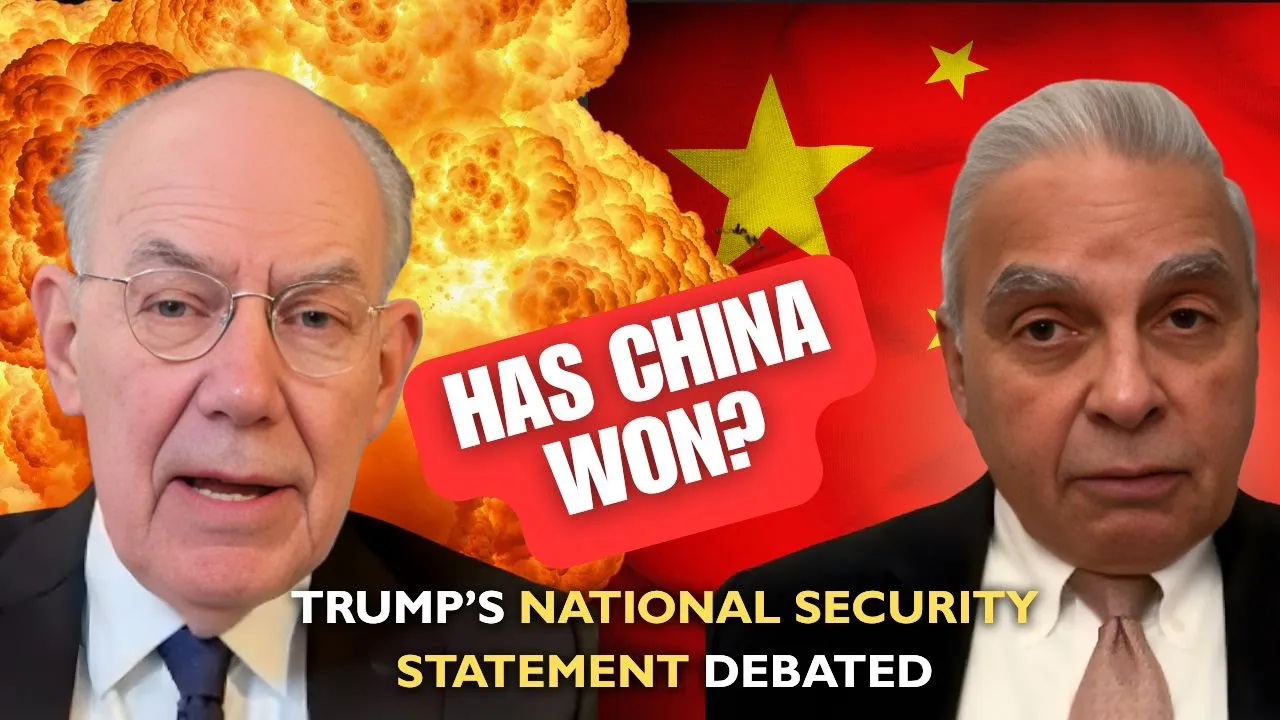
Has China won the strategic competition with America? >> If you're a great power and you're faced with a potential regional hgeimon, you don't talk about cutting them slack. At least in the realist world that I operate in, >> China's position has become much stronger.
Look, look at how terrified uh Europe is today. >> [music] >> Hello and welcome to Switzerland, [music] a new program about politics, modern history, and international relations. I'm your host, Tom Switzer.
Today on the program, Keshaw Marubani, former diplomat [music] and policy maker from Singapore and author of Has China One: The Chinese [music] Challenge to American Primacy that was published in 2020. And John Mshimemer, professor of political [music] science at the University of Chicago and author of The Tragedy of Great Power Politics that was published in 2001. Two of the world's heavyweight intellectuals, Marble Barney versus M.
Shimmer with me, Tom Switzer Keshaw. John, welcome to my new program. Keshaw, >> thank you, Tom.
Great to be here. >> I agree completely with Keshaw. It's wonderful to be here for your new show.
Well, let's start with your reactions to the Trump administration's national security statement. Now, Keshaw, you've been critical of US policy towards China in recent times, but many commentators and I think of the Guardian on the left and the Wall Street Journal on the right, they say the remarks on China were milder than predicted. So, in your judgment, Keshaw, has the Trump administration got the right tone with respect to China?
Well, I think you know to judge the Trump administration, you can look at the words of the national security strategy, but you know, as someone who's been involved in uh diplomacy and watching international relations only [snorts] for 55 years, I can tell you at the end of the day, the words don't matter. The deeds do. And you got to look at the actual policies and actions of the Trump administration towards China.
and and there's no doubt that overall uh the Trump administration is behaving much more realistically and pragmatically uh towards China than say the previous Biden administration was which was actually had a very strong ideological bent when it came to China. And I think this realistic pragmatic attitude of uh Trump uh up by the way after a few punch-ups, [laughter] you know, the Trump administration did raise tariffs on China to 145%. Okay, so I mean there were punchups along the way, but at the end at the end of the day, they seem to have settled into a groove where they've decided that both sides have to learn to live with each other.
And here I think the most important development uh in US China relations uh is that probably for the first time since the opium war of 1842, China was able to retaliate against a great power by you know it restrictions on rare earths and telling them >> you can no longer push me around. So the the whole balance has changed in the US China relationship. I think it'll take some time for both the United States and China to adjust to this relationship, but I would give President Trump some credit for at least trying to approach it in a realistic pragmatic way without any ideological bias.
>> Okay. But the national security statement still identifies China as a greater threat than Russia. It places less strategic emphasis on Europe and it's determined for America not to be drawn into more Middle East conflicts.
John, that sounds a lot like the John Mshimer grand strategy that you've espoused in recent decades. Now, you've been very critical of Trump's foreign policy, but in fairness, hasn't this administration at least got a better strategic sense than its Democratic and Republican predecessors whose policies led to debacles such as the forever wars with which both you and Keshaw opposed, John? >> Well, as Keshaw pointed out, there is a fundamental difference between actual policy and what is written down on paper.
Uh and I think if you look at the national security strategy, this new document that's been issued, uh I like it a lot, at least the basic framework in the document because it does reflect on my views on what US grand strategy should be. Uh but in terms of actual policy uh I think there's a real disjuncture between what the Trump administration has done uh and uh what is said in those uh pages of the national security strategy and if you look at what President Trump has done uh he's really messed up on China as Keshore was alluding to he started off by playing hard ball with the Chinese thinking he could push the Chinese around and the Chinese quickly reminded him that uh they had cards to play and they could make life miserable with the Americans. So, he had to back off.
I think you could make an argument that he's been humiliated by the Chinese. Uh furthermore, he's got us into this mess in Venezuela, >> uh which I don't see how he gets out of. Uh he went to war against the Houthies this past summer, promising that he was going to win a decisive victory very quickly.
After one month, he quit. Admitted the h the Houthis were tough ombres and he couldn't beat him. Uh he went to war against Iran with the Israelis.
They claimed it was a great success at the time, but if it's such a great success, why are they talking about attacking Iran again? Uh furthermore, uh Trump, like Biden, is complicit in the genocide in Gaza. Uh he makes all these claims about shutting down this war and that war.
Uh if you look closely at what he's done, he's done no such thing thing. And the best evidence of that is the Ukraine war. He said he was going to shut it down before he entered the White House and if not then shortly after he got into the White House.
He's failed to shut down the war in Ukraine. It goes on and on. So if you look at his policy performance, uh it uh is a pretty uh a pretty negative assessment is due on it.
And uh I don't think it reflects the more balanced view of how to deal with the world that's uh found in a national security strategy. >> Yeah. But if if you look I mean I'll just push back gently John.
I mean many people would say that Iran you know America's strategic nemesis in the Persian Gulf since the 1979 revolution. Iran's on the back foot. Its Shia cresant has been really diminished.
You think about those Shia militias Hezbollah in Syria. it's greatly weakened. Uh the US maintains very good relations with the Saudis and the Sunni Gulf States.
And you know, even with respect to China, the Trump administration has just uh presided over a record arms um deal uh to Taiwan that's worth more than 1 billion. Um you'd support that. And of course, here in this document, the Trump administration's trying to make it clear that they want to place less emphasis on Europe.
You would agree with that too, wouldn't you, John? >> No, there's no question that if you look at the document, how Trump talks about dealing with China is fine by me. And the fact that they've given 11.
1 billion dollars to Taiwan is fine by me. So, I'm not criticizing that. What I was criticizing was the fact that early in his administration, he decided he was going to play hard ball with the Chinese.
And the Chinese told him, "You're not playing hard ball with us because if we play hard ball with you, we'll win in that competition. " And the fact is the Chinese beat him. He backed off.
He clearly backed off. And with regard to the Middle East, Hezbollah is alive. It's wellarmed.
Uh, and it's not going away. Hamas has not been defeated. It's not going away.
And again, I would remind you that Trump is complicit in a genocide, which according to most people in the world is the greatest of all crimes. Uh, and with regard to Iran, if it was such a great success, why are they talking about attacking Iran again? Because it wasn't such a great success.
And the idea that they shut down the nuclear enrichment program in Iran forever is a myth. That's not true at all. They didn't solve that problem.
Uh the only problem they solved was Syria and over the long term we'll see how well that works out. >> Well, you both both you and Keshaw would agree with this statement in the national security statement. Quote that the days of the United States propping up the entire world order like Atlas are over.
And Keshaw Trump has attracted some unlikely supporters. Here's the former Australian Prime Minister Paul Keating. This is the quote.
Trump all by himself is employing his mandate to alter America's post-war strategic direction to both acknowledge and accommodate other great powers in a manner last comprehensively articulated by Franklin Roosevelt. Trump has one virtue and one virtue alone. He may prevent a World War II.
Uh Keshaw, your response to the former Australian prime minister. Well, first of all, I must commend him for his courage. Okay?
As especially in the western media, for any western leader, current or past, to praise Trump, you get you get attacked viciously if you say anything positive about Trump. So, Paul Keiting took a lot of courage for him to say that. And I would I would also agree with him on one thing that visav the other nuclear powers Trump understands that you're playing with fire if you push around the other nuclear powers >> [snorts] >> uh in in in in in the war situation.
I mean he can push and impose trade sanctions that's fine trade sanctions are not going to lead to war but he is very and that's why you notice that on on even though he clearly hasn't succeeded yet uh in achieving a peace deal in Ukraine I can tell you that the Europeans are absolutely terrified terrified by what uh Trump is trying to do which is trying to reach some kind of understanding with Russia some kind of agreement uh to say at the end of the day this war has to end. Now he's of course discovering as John highlighted that it is never easy to switch off a war that's been going on for a couple of years. It takes a lot of hard work and and things.
But at the but at the same time I I thought that by now with so much European resistance and European lobbying and European uh to quote uh Susan Glasser the European strategy of strategic selfabasement kawing to Trump that they might be able to nudge him away from his uh efforts to try and stop the war in Ukraine. He hasn't stopped doing it. He hasn't stopped trying.
Okay, he hasn't succeeded but he hasn't uh stopped trying. and the fact that he's handling the nuclear especially the major nuclear powers China and Russia very carefully I think when future historians look at Donald Trump I suspect that the biggest uh tribute positive tribute they would give to him is that he sort of recognizes that the era of the western domination of world history is over and the and the United States and the west has got to learn to live with people who are very different and you know we don't try and change their societies. So for example, categorically he said on Saudi Arabia it's not our mission to change Saudi Arabia's uh political system right uh that that's something that no other previous administration would say they would say no we must we must push our values and so on so forth but just by saying that it is not our mission to push values western values down the throats of other countries we just have got to accept that they have different societies and to live with them that's a that's a significant turn from all previous uh American administrations.
>> Well, given everything that Keshaw has just said, John, um and especially when it comes to China, Keshaw mentions Trump's instinctive desire for realism and pragmatism when it comes to relations with Beijing. Is all this why uh is why America will allow Nvidia to sell one of its more advanced chips to China? This is the the Economist magazine just in the last week.
They say this shows that the administration is ready to sacrifice some of its technological edge over China in exchange for goodwill. So is this a sign that America is buckling to China, John? Well, the fact is that Trump got into a trade war with the Chinese, as I emphasized before, >> and he thought that he held the upper hand, and it turned out that he did not have the upper hand, and he's been forced to make compromises.
And this is one of the compromises that he's been forced to make. The Chinese have been playing hard ball with them. They started on April 4th when they made it clear that they were going to contail the flow of rare earths and especially rare earth magnets into the United States.
And then on October 2nd, the Chinese explicitly up the ante. And uh this was a huge problem for the Trump administration. And furthermore, as you know, Trump depends heavily on support from farmers.
and the Chinese said they were going to stop importing American soybeans and this was a huge problem. So what's happening here is that Trump on the trade front uh is being forced to make certain concessions and with regard to the H200 uh chip that uh he's now agreed to sell to uh China, you see evidence of the extent to which he's been forced to back off. And by the way, I'll give you another example that I think is an important one is where he didn't really stand up and back the Japanese prime minister when she said on uh November 7th that if the Chinese were to attack Taiwan, that would be seen by Japan as a threat to its survival or it might be seen by Japan as a threat to its survival.
You would have thought that the Trump administration would have immediately backed her, but they did not. But that doesn't disguise the fact, Keshaw, that many states in the region, I'm not just thinking of Japan that John just mentioned or Taiwan, but also Australia, uh, India, the Philippines, they want the United States heavily engaged in the region to deter China because they're increasingly anxious about China. I mean, you just think about China's escalating defense buildup, its persistent uh uh cyber espionage, it's pumped up nationalism, uh huge propaganda disinformation campaigns, the takeover of Hong Kong, the bullying of Taiwan, the Philippines, John mentioned Japan just now, um or the um the aggressive buildup of military outposts beyond its border in the South China Sea and so on and so forth.
So, uh, are we downplaying the China threat here, Keshaw? >> Well, uh, I this, by the way, you're absolutely right in your first statement that countries in the region want to see the United States stay engaged in the region. You're right.
uh not just for the reason uh you mentioned of uh detering China but also there many countries in the region have had very very long-standing uh relationships [snorts] uh with the United States and as you know in in Southeast Asia and the ASEAN region they're huge reservoirs of goodwill towards the United States but that said I would say the story is much more complicated than the one you present that these the countries in the region were looking for United States as an insurance against China. And the reason and the reason why this the story is much more complicated than the the way you portray it is that there are over 50 states in Asia and you mentioned five and you're right, you actually you mentioned four states and one uh Taiwan. Uh so the uh if you look overall there's no question that China's relations with the majority of states in Asia is on a very positive track and and all you have to do is look at the statements that are coming out from Indonesia from Malaysia from Thailand uh from Bangladesh you know you can get a sense of how states around the region are coming to terms with the fact that China is emerging as a new great power.
And by the way, you know, this is 2,000 years of history. >> Yeah. >> When a great power emerges in your neighborhood, okay, the wisest thing you have to do is to adjust to the fact that the new great power has arrived in your neighborhood.
and and and this is where frankly the the pragmatism of the Asian states overall uh is a big asset. We're not we're not choosing sides. We're not saying we're going to be with United States against China.
We're not saying we're going to be with China against United States. He said no, we're going to be friends with both of you and we're going to live uh with both of you. And that that I think is the dominant strain.
Now, if you when you mention the specific cases, I frankly think that it was a huge mistake for the Japanese prime minister to make a pronouncement about Taiwan because at the end of the day that the Chinese one of the things the China wants to do is to remove all traces of the century of humiliation and one of the lowest points of the century of humiliation was when Japan seized Taiwan from China after losing the after winning the SinoJapanese war in 1895. So that being that being such a sore point in China Japan relations, it was an absolute mistake for the Japanese prime minister to say things in the way that she did so. And and and and by the way, uh John is right.
President Trump didn't support Japan uh when she made that statement. So, so I would emphasize to you the key point is don't push things into a binary black and white choices. The story is very complex and countries have very complex relationships with China and with the United States.
>> Yeah. Well, well, John Khaw says that China's rise and the region's reaction to its rise is more complicated than what I portrayed. Now during the last 25 years you've really distinguished yourself John by warning that western engagement with China has just made China more prosperous and more powerful.
uh we have in your language just been feeding the beast and you also say that structure is largely determinative that there's little we can do to change the situation which means we're con we're consigned to waging an intense security competition with China that can be best managed on the margins to prevent disaster that's your argument how would you respond to Keshaw Marble Barney's response >> well I think that there is no question that China is interested in dominating East Asia. It's interested in becoming a regional hgeimon. And I think it made good sense for the United States to give Taiwan 11.
1 billion dollars in military aid. And I also think it made good sense for the Japanese prime minister said to say uh in effect that Japan would come to the defense of Taiwan. uh if you're interested in containing China and preventing China from becoming a regional hegeimon which most states in East Asia are interested in doing and the United States is certainly interested in doing.
You have to create a balancing coalition and you have to have a clear deterrence policy and the Chinese are determined to capture Taiwan. And I studied the issue quite carefully and I believe that if Japan and the United States and even Australia, but Japan and the United States mainly come to the defense of Taiwan, I think that the Chinese cannot capture Taiwan and they will therefore not attempt to capture Taiwan and you will avoid war. So I think it makes good sense for the United States and for Japan and even for Australia to make it clear to the Chinese, not in a provocative way, but in a clear and concise way that they will come to the defense of Taiwan should China try to conquer it because I think that facilitates deterrence and I'm deeply interested in making sure that we avoid war in East Asia.
>> So deterrence works. Quesaw Mabani. Well, I would say if you want me to be very blunt, uh, if Australia follows John's advice and says that it will stand up and defend Taiwan, it is committing geopolitical suicide because at the end of the day, geography matters.
Geopolitics is a combination of two words, geography and politics. And remember with western power will receive more and more from Asia. Australia as I've said before will be left as the lonely western outpost in Asia and is therefore in Australia's interests to see how the other Asian countries are handling China's rise and also handling the sensitive Taiwan question.
This doesn't mean they're saying that Taiwan should be handed back to China immediately. No. But they're also saying that the Taiwan issue has got to be handled very carefully, very delicately to avoid any kind of war over the region.
And remember, at the end of the day, the United States has clearly since World War II ensured that it never got into a direct military conflict against another nuclear power. You use proxies. Fair enough but you never get engage yourself directly in a war against a Soviet Union for example.
[snorts] So though therefore the the the in the question of Taiwan what the Asian countries are doing is that they understand the sensitivity of the issue and therefore they're managing it very carefully and very delicately. And I would say it's in Australia's best interest to watch what ASEAN is doing and see what Australia can learn from ASEAN rather than say okay we will join the United States and attack >> but but John unlike Khaw obviously you support a containment policy towards China but you opposed containment of Russia. What's the difference?
Or let me put things this way. uh China and Russia are rival great powers of the United States and you in your much much of your scholarship over the last four to five decades you have argued that great powers will go to great lengths to defend their vital strategic interests in their spheres of influence so the question here is if Russia as you've argued will play hard ball to ensure that Ukraine is not a western bullwark on its borders Shouldn't China, by your logic, a rising great power, also grow to great lengths to protect its sphere of influence, whether it's the Taiwan Straits, the East and South China Seas. Um, or as your mother used to say, John, what's good for the goose is good for the gander.
John, what's good for the goose is good for the gander. But let me explain. First of all, the reason that China is a serious threat to the United States and Russia is not is because China is a threat to dominate all of East Asia.
It is a threat to become a regional hegeimon and the United States does not tolerate regional hegeimons. There were four potential regional hegeimons in the uh 20th century. Imperial Germany, Imperial Japan, Nazi Germany, and the United States.
We played a key role in putting all four of those countries on the scrap heap of history. We do not tolerate regional hegeimons. That means we will contain China.
Russia is not even a threat to conquer all of Ukraine, much less dominate all of Europe. It is not a potential regional hegeimon. In fact, we should have good relations with Russia.
Russia should be an ally of ours in trying to contain China. The fact that it isn't is a remnant of this foolish war in Ukraine. Now my second point is regarding what's good for the goose is good for the gander.
As you know well Tom, we have a Monroe doctrine and the Monroe doctrine basically says that the Western Hemisphere is our sphere of influence and no great >> 1920s >> 1823 and the basic precept of the Monroe Doctrine is that no distant great power is allowed to put military forces in the Western Hemisphere or form a military alliance with a state in the Western Hemisphere. Now, of course, the Chinese prefer to have a Monroe doctrine of their own. They do not want the United States on their doorstep.
They do not want the United States in their face. And I don't blame them one bit. As I have said on numerous occasions, if I was the national security adviser to Xi Jinping, I'd tell them we have to do everything we can to push the Americans beyond the first.
If Donald Trump is pushing them beyond the second cut, cut them some slack. Why not cut the Chinese some slack? That's what Donald Trump would say to you, >> Tom.
If you're a great power and you're faced with a potential regional hegeimon, you don't talk about cutting them slack. At least in the realist world that I operate in, you go to great lengths to contain them. And that's what we should be doing and that's what we are doing.
As the national security document that just came out made clear, containment of China is imperative for the United States. It's imperative for Japan, South Korea, the Philippines, and Australia as well. >> Well, Keshaw, I mean, what's your view here about great powers exercising a sphere of influence in their near abroad?
Because many western commentators, whether they're neoconservatives or liberal interventionists, say that this is a fetish from the 19th century. But with respect to China, they some commentators not unreasonably would complain about China threatening uh sovereign states in its hemisphere. You know, uh remember the Hague ruling in 2016.
And of course, that's not to mention China's bullying of Taiwan, Japan, and the Philippines. This causes great angst. So what's your view about great powers and spheres of influence Kishaw?
>> Well I would say be careful about using analogies from the 20th century in the 21st century. So yes the United States buried imperial Germany, United States buried imperial Japan but the whole logic of history and the way in which countries dealt with each other was very very different. that was a a much more I would call it an imperialistic world and remember that until about the middle of 20th century uh most of the world was colonized by the west right remember how the 100,000 Englishmen could rule over 300 million Indians effortlessly exactly 100 years ago 1925 so you can see therefore that that was the tenor and chemistry of history in the early 20th century But this is the 21st century and countries are much more interdependent in deeper ways than they have ever been.
And clearly China has anticipated this containment strategy that John uh mentioned. And it has carried out a preemptive strike against any such containment strategy by making sure that most countries in the world trade more with China than they do with the United States of America. And remember that one of the things that gave the United States such amazing power at the end of World War II is that it had about 50% of the world's GMPP at the time.
And I suspect John can probably has a data 60 to 70% of manufacturing capacity of the world at the end of World War II. I suspect that was the United States position in the world. Now I want to remind you that in in the 21st century when it opened in the year 2000 China's share of global manufacturing capacity was 5%.
Now it is already reaching 30% and by 2030 is going to hit 45%. Now this has made China an indispensable supplier of products to every country in the world. And believe me, you know, in the scenario that John mentioned earlier of a war breaking out, let's say between US and China, the United States would suddenly find that all kinds of spare parts that it needs for all kinds of things, you know, all kinds of machines, aircraft and so on so forth, you'll suddenly hit a critical shortage.
So therefore in this interdependent world to talk of using 20th century analogies of containment and so on so forth will not work in the 21st century. And and and I can also tell you that that for the vast majority of countries in the world are much more autonomous actors in the 21st century than they were in the 20th century. And therefore they themselves are not going to join any kind of games that easily in the way that you did in the cold war for example.
And remember the cold war United States had allies not just in western Europe not just in not just in Japan or or South Korea it also had Indonesia it had Pakistan you had Egypt it had Za now that those days are gone that kind of lining up to join a containment policy is not going to happen. >> Okay. So therefore I would say deal with the 21st century and the interdependent world we're living in because that's that's that's the reality for most states in the world.
>> So John Keshaw's line is that these countries in the region have a lot of economic intercourse with China. We all know that they're becoming more autonomous to the extent that China's rise continues. That's going to make it very difficult for the United States to form a coalition of balancing states against China.
Isn't it John? No, because the more powerful China gets, the more other countries fear it and the more interested they are in balancing with the United States against China. First of all, the Chinese think much more the way I think than Keshore thinks.
The Chinese believe in balance of power politics. They're realist to the core. As he pointed out before, they suffered the century of national humiliation that taught them that you don't want to be weak.
The Chinese also fully recognize that the United States is one of the most ruthless great powers in recorded history and they want to do everything they can to make sure that the balance of power favors them and not the United States. They're realists and they understand uh that the best thing they can do is to achieve regional hegemony in East Asia, which means driving the Americans out beyond the first island chain and the second island chain. They want their Monroe Doctrine.
They should have a Monroe doctrine from their own point of view. But you want to remember that the United States doesn't want them to dominate Asia and most countries in East Asia don't want them to dominate uh East Asia. So it will not be that difficult for the United States to put together a balancing coalition.
And you want to remember, Keshore, that the United States, it's not as powerful in relative terms as it once was, is still a remarkably powerful country and it's armed with nuclear weapons. And that is a country, the United States, that is bent on containing China. And you never want to bet against the United States.
>> Well, in case in 2020, you wrote a book called Has China One. And at the time of the launch, the three of us, you, me, and John, uh, we had a lively exchange on YouTube and that attracted nearly 700,000 views. 6 years later, what do you think now given everything that John just said there?
Is China's path to victory looking looking more likely? >> Well, there's no question that since I wrote the book, Has China won? In relative terms, China's position has become much stronger not just economically but as I mentioned in terms of its manufacturing uh capacity in the world and also frankly as you know uh the allies of the United States are questioning their relations with the United States.
I mean this is this is this is not me saying anything new. I mean look look look at how terrified uh Europe is today. And if you look for example another country take India for example you know for 27 years the United States has been courting India since Bill Clinton's famous visit to India you know discovery of India trip and then you had uh George W.
Bush courting India. You had Barack Obama courting India. But you can see how all this courtship of India has come to a halt over the last few months.
And I'm sure the Indians are asking themselves this simple question. Isn't it better for India to be an independent autonomous player in this new geopolitical game rather than to be an ally of the United States or an enemy of China? Why not be an independent force on this stage?
and and and so therefore the geopolitical picture of the world is I I want to emphasize this point is very complicated because countries are recalculating their national interest very carefully and the sort of coalition that John is speaking about of a of a kind of a global or even a regional coalition against China isn't going to emerge well I think uh when you talk about who won uh there's no way you can give an answer to that question at this point in time. What you have taking place here is a security competition between two great powers between the United States and China. And neither side has won.
There's no question that China has gotten increasingly powerful v to be the United States since the early 1990s. and it may even get more powerful relative to the United States over the next decade. But that certainly doesn't mean that China has won.
[snorts] With regard to India, I think there's no question that the Trump administration has blown it. Right? We had worked for about 27 years as Keshore said to greatly improve relations with India.
And when Trump first took over, Modi was one of the first people to come visit him in the White House. And it looked like we were going to continue to have good relations. And as both of you know, it was in our strategic interest, America's strategic interest to have good relations with India.
And then in large part because of the Ukraine war, Trump turned on the Indians. And he has in good part poisoned relations with India, which is not in America's strategic interest. But this is just another example of how Trump has mishandled American foreign policy.
But this doesn't mean that we're not going to try to contain uh China. And it does also not mean that we will not work with India more and more over time once we get the Ukraine war behind us because it's in our strategic interest and it's also in India's strategic interest to work with us because China is a threat to India despite what Keshaw thinks. >> BB continued, uh John Keshaw, we've known each other well over the last quarter century.
Uh, let's do this again next week. Thanks so much for being on the program this week.



![[WKF2024] The End of China's Rise and the Future of World Order](https://img.youtube.com/vi/IL6OHMr21f8/mqdefault.jpg)