Hi, this is Professor Guilherme Orbe and in this course i will teach you how to create your book simple way, with practical activities that will help you write any kind of book you want to write. Activities can serve to create of any kind of story, but the focus of this course is to write a book. The final objective of the course will be to write a book, the initial proposal will be up to 12 chapters, but feel free if you want make more or less chapters.
In this course I will not teach fixed rules how to write books, not least because there's that kind of thing, and I'm not even going to teach a closed formula, because it would be terrible at an artistic level, and not at all efficient. What I'm going to pass in this course is a method to help you create a story, some techniques to help with the creative process. It is a base, especially for those who are starting to venture into this new world which is writing.
And what I'm going to teach can be applied to any type of book, and by anyone. Because it is a base, a structure, it serves to help as a starting point and organization to keep the story cohesive, well structured and without narrative holes. Let's talk about creating more characters realistic, build the plot, the script, even define a writing routine, among others important points for the writing process.
Let's go through all the processes of creation of a book, until publication. And I will create a story as a demonstration of technique, to exemplify, to stay very clear what I'm saying. Following the steps in this course you can manage to write a book in less than 1 month, of course it can vary according to the time you have to dedicate to the project, how many chapters, or even the complexity of history.
As the objective of the course is to create a story short of up to 12 chapters, as an exercise, it is quite possible to complete in up to one month. But it's not a rule, take your time to write your book. But enough of an introduction, and let's start at once.
Where to start creating our story? It doesn't necessarily have to be from the beginning. Some ideas come out of nowhere when we're walking, listening to music, watching a movie, or even talking to someone.
But these ideas are often in a state embryonic, we can say so, it needs be polished to actually gain body. The form that I will present in this course is an objective and organized way that you you can go any way you want, I advise follow this organization because it will facilitate. But as I said, it is not a rule.
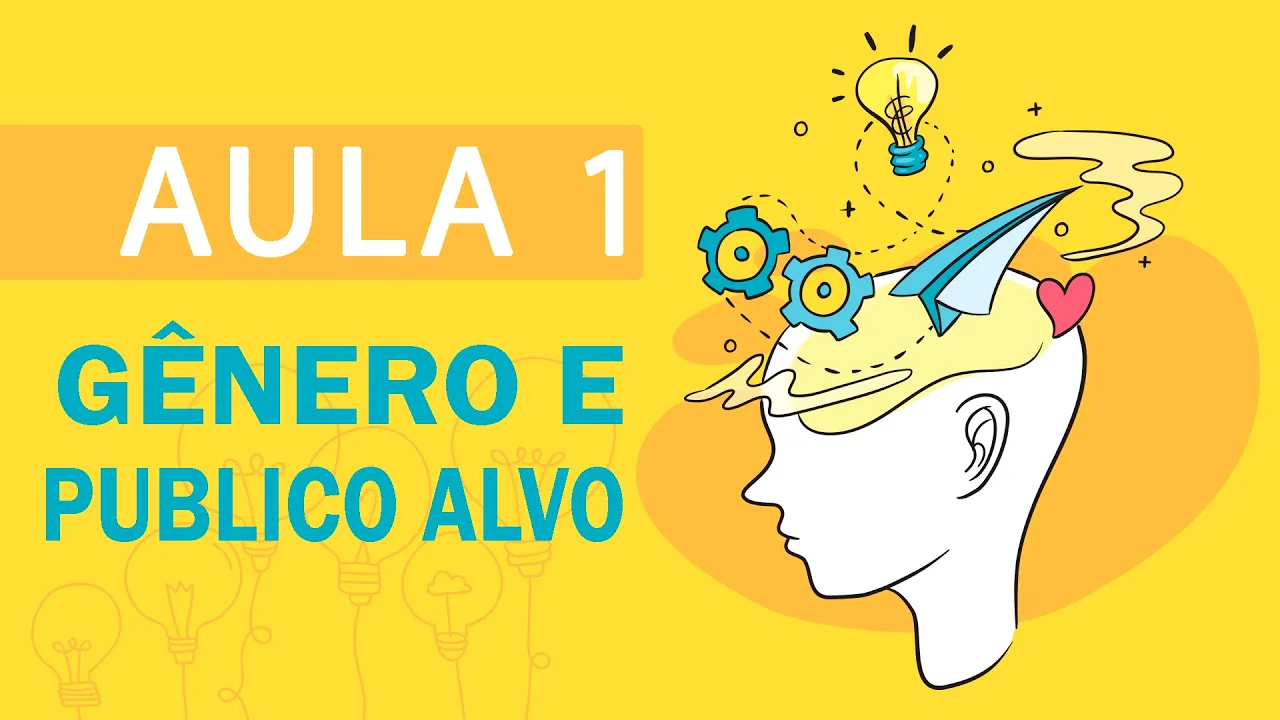
With that initial idea or not, it is important define the genre of the story. If it's going to be romance, horror, suspense, fantasy and etc. don't worry because we will talk more about plot creation in the next class.
It is important to define the genre of the story and what the target audience is. For example, if it will be for children, teenagers, adults, if it's a story that has as target the female or male audience. And it's important to say that having an audience defined target does not mean that only these people will read the book, it serves mainly for you to define the language and the elements that they will have in history.
For example: men generally like romances more direct, stories with more action, but it doesn't mean that many men don't will like books as the fault is of stars or something. The novels that the target audience is female is usually more detailed in the novel and feelings and relevance to events of history, but it is not a rule, women has varied tastes. And it can vary according to age.
Adults may prefer readings with themes deeper, more serious or maybe even more heavy. For an audience of children and youth it needs to be different. Understand where I'm going.
For those who are starting an easy way to define the target audience of the story and think about your own taste. What kind of story do you like to read, think about writing a story for people your age, with similar tastes to those their. This can make it easier for those just starting out.
But again I say, they are not rules, they are observations that can facilitate for anyone It's starting. So choose a genre for your story in a target audience. You don't need to have just one gender, for example: it can be fantasy and terror, and so on.
But target audience is important that you define just one for you to define the type of language. You either write for children or for adults. There are books that can go through several target audience, like the little prince.
Even having a more childlike language, there are layers that maybe only adults reading carefully will be able to achieve. But the target audience is well defined, but like any good book it goes beyond the basics, of the simple. Harry Potter has a well-defined target audience, is a juvenile, and manages to attract so much boys as well as girls.
So as a first exercise think about which is the genre and target audience of these books: Game of thrones, who is the target audience? Hunger Games Peter Pan Pride and Prejudice Blame it on the stars IT, the thing They are simple books to see the target audience. Note that even though you have a defined target audience, several other audiences also read and like it.
Aiming at a target audience is not getting stuck to him, is to make sure you get something right. At this first moment we need to define the direction the story will go, if you can't be confused. So to finish this class I leave as activity the definition of gender and audience target of your story.
In the next classes we will continue the process creative, and let's define the theme, the plot of history. And little by little we build the project. So until the next class!