patients with newly diagnosed advanced Hodgkin's lymphoma are often treated with one of two chemotherapy regimens a BVD or be a cop these regimens have been associated with similar overall survival however several recent studies have suggested that be a cop might have five to ten percent increased survival at five years at a cost of substantial increase in toxicity a BVD has few long-term toxicities although pulmonary toxicity from the bleomycin affects about 6 percent of patients be a cop on the other hand is a more intensive regimen with long-term toxicity that affects nearly every patient including infertility
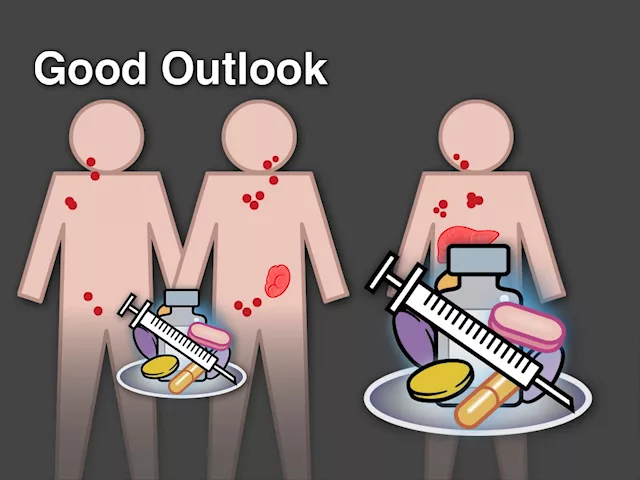
fatigue and future risk of cancer the current investigators explore the potential for adapting therapy by de-escalating treatment for patients with a good outlook and intensifying it for patients at highest risk for treatment failure they designed a randomized controlled non-inferiority trial patients with newly diagnosed advanced Hodgkin's lymphoma underwent a baseline PET CT scan then two cycles of a BVD followed by an interim PET CT scan patients with negative interim scans were randomized to continue a BVD or to omit bleomycin in cycles three through six patients with positive interim scans received be ikot the primary endpoint was
three-year progression free survival with a pre-specified non-inferiority margin of 5% after two cycles of a BVD 937 patients or eighty three point seven percent at negative interim PET scans 470 received a B VD and 465 received a VD three-year progression free survival for these groups was eighty five point seven percent and eighty four point four percent the remaining hundred seventy-two patients or 16.3% who had positive PET scans received via cop their three-year progression free survival was 67 point five percent these results did not meet the pre-specified non-inferiority margin because the upper limit of the 95
percent confidence interval for the difference between a B VD and a V D was 5.3 percent however the emission of bleomycin after a negative interim PET CT scan led to reduced pulmonary toxicity without evidence of reduced efficacy full trial results are available at any JM org