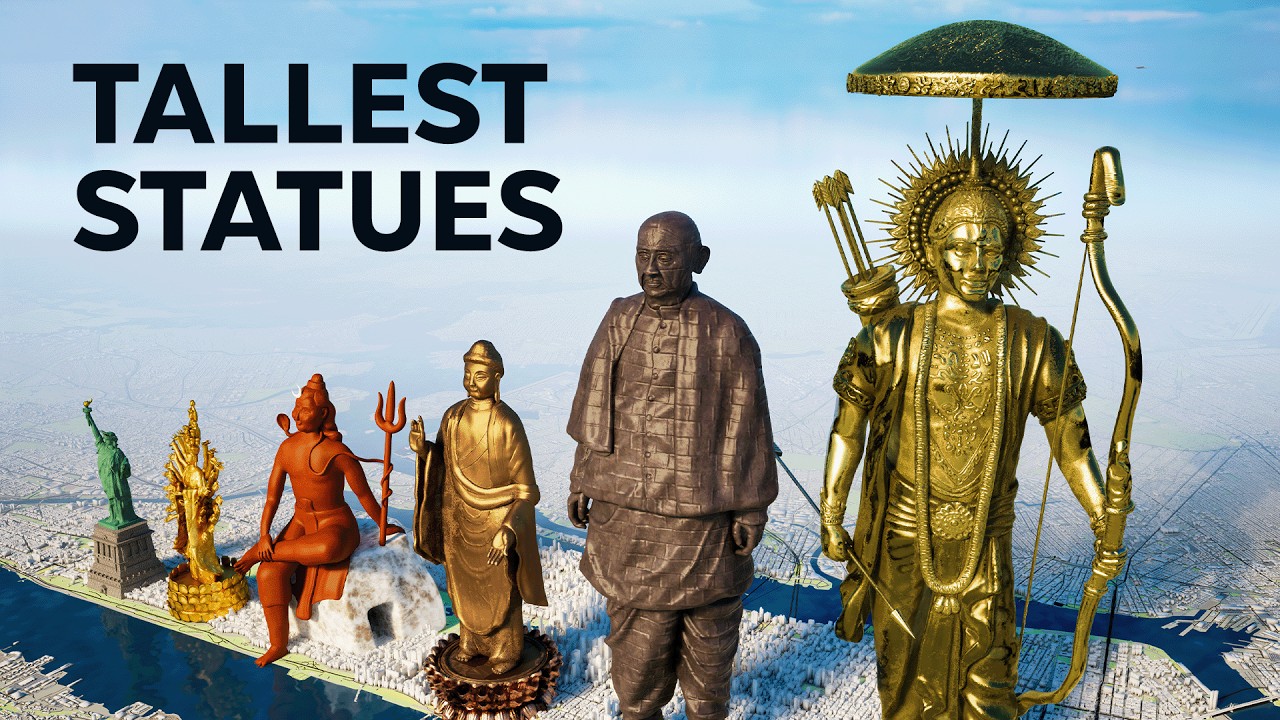
these colossal monuments scattered around the globe range from ancient sculptures carved into Rocky outcrops to towering figures standing Sentinel over forgotten lands join me as I count down 15 of the most mysterious giant statues starting with number 15 the lashan Giant Buddha in China the lashan Giant Buddha which is in the Sichuan province of China is the largest stone Buddha statue in the world carved directly into the Cliff face of lingon mountain at the meeting point of the Min River d River and Ching Yi River it stood as a symbol of Buddhist faith and Chinese artistry for over 1200 years the statue which reaches a height of about 233 ft or 71 M depicts mraa a b satva traditionally associated with the Buddha in Buddhist beliefs construction began in 713 CE during the tong Dynasty under the supervision of a Chinese monk named haong haong began this project with the hope that the presence of the Buddha would calm the turbulent Waters at the Confluence of the three rivers with which were notorious for causing dangerous currents and shipwrecks the statue took approximately 90 years and the efforts of several generations to complete and it was finally finished in 803 CE the Buddha is seated with hands resting on his knees and its Serene expression is designed to instill a sense of peace and protection the statue is so large that even its ears are 23 ft or 7 m long and its shoulders are 27 ft or 8. 3 M wide huge thought went into its design including a sophis icated drainage system Engineers carved a series of hidden gutters channels and drainage pipes into the statue's head arms and behind the ears to protect the Buddha from erosion by rainwater this system has helped preserve the statue for over a millennium despite its exposure to the elements number 14 thech colossal heads in Mexico now these are some of the most impressive sculptures of ancient mesoamerica they were created by thech civilization which flourished on the Gulf Coast of Mexico between about 15 BCE and 400 BCE these massive Stone heads carved from single blocks of Basalt are one of the most enduring legacies of the old Mech people 17 colossal heads have been discovered to date mainly in thech Heartland which includes sites like Sans Lorenzo laventa and traes in the modern Mexican states of verac Cruz and Tabasco these heads range in height from about 5 to 11 FT 1 and 1/2 to 3 and 1/2 M and can weigh as much as 50 tons the size of these heads combined with the Precision of their carving shows remarkable skill and morganization by the old Mech people the facial expressions of the heads are often Stern and imposing conveying a sense of power and authority some scholars believe the heads were carved to commemorate important leaders perhaps as a way to immortalize them or to serve as symbols of their divine power the basal used to create these heads was quarried from the tkla mountains located about 30 to 60 Mi away from the sites where the heads were eventually positioned the purpose and meaning of these heads remains a subject of debate and while it's widely accepted that they represent MCH rulers or Elites the exact role within thech Society isn't fully understood some theories suggest the heads were part of a larger ceremonial or ritualistic context possibly related to ancestor worship While others proposed that they were used to display the might of the ruling class number 13 the theu Valar statue in India the theu Valar statue located on a small island near kanyakumari in the southernmost part of India is a huge trib to one of the greatest Tamil poets and philosophers standing at a height of 133 ft or 40 m the statue commemorates the author of the ti kural a classic Tamil text that's revered as one of the most important works of Tamil literature the ti kural is a collection of about, 1300 couplets offering wisdom on ethics politics love and even morality and has had a profound influence on Tamil culture and Beyond the statue of T valuar was completed on January 1st 2000 and has since become iconic symbol of the Heritage and philosophy ideals of Tamil the decision to build a statue was made by the Tamil Nadu government to honor theu valar's contributions to literature and promote his teachings of virtue wealth and love the height of the Statue is symbolic representing the 133 chapters of the TR kural Each of which deals with specific aspects of human life and conduct its position on a rocky outcrop in the Indian Ocean about 1300 ft from the mainland is where the mystery around it comes from it's made up of 3681 stones and weighing a total of 7,000 tons no one knows for certain quite how long it will remain in place as in line with its subject's teachings the world can always be unpredictable eventually it will be worn Away by the ocean but this could be in decades or centuries number 12 kakuru dutu Japan the Kamakura daibutsu also known as the great Buddha of Kamakura is one of Japan's most revered monuments it's located in the coastal city of Kamakura in Kanagawa prefecture this massive bronze statue of amid Buddha was originally cast in 1252 CE during the Kamakura period the monument was commissioned by the Regent Hojo tokori as a symbol of buddhism's enduring influence and new military government's patronage of religious institutions statues around 44 ft or about 13. 3 M tall making it one of the largest bronze Buddhist statues in Japan the dutu depicts amid Buddha the Buddha of infinite light who is Central to the pure land Seck of Buddhism am Buddha is venerated for his boundless compassion and promise of rebirth in the pure land a paradise where all beings can attain Enlightenment the statue's expression with half closed eyes and a gentle smile embodies the Buddha's peaceful and compassionate nature inviting contemplation and reflection the surface of the statue is covered with fine details too including the folds of the Buddha's robe and the intricate pattern of his hair curls despite the statue's massive size the overall impression is one of of calmness and Grace number 11 the moai of rapanui in Chile the moai of rapanui is also known as Easter Island and some of the most mysterious and iconic statues in the world are there he massive Stone figures carved by the rapan people between 1400 and 1650 CE have captivated imaginations of explorers archaeologists and even tourists found in the Rano Raku Quarry where most of the moai were sculpted and they vary in size with the tall standing at around 33 ft or 10 m and weighing over 80 tons however some unfinished moai remained in the Quarry and one that would have been nearly 69 ft or 21 M tall if it was completed the moai have large elongated heads heavy brows and deep set eyes many of them originally had red stone Top Knots known as puka in place on their heads and some also had Coral Eyes giving them an even more imposing presence the moai are believed to represent deified ancestors the spirits of important Chiefs or other high-ranking individuals by creating these statues the rapanui sought to honor their ancestors and ensure their protection and prosperity by the time the Europeans arrived in the 18th century the island Society had undergone significant changes including the toppling of many moai during intertribal conflicts despite these challenges The moai Remains a powerful symbol of the Island's cultural heritage and the resilience of its people number 10 the statue of Aura Mazda in Iran the statue of auram Mazda though not widely as known as some of the other ancient monuments on this list holds significant religious importance in Iran Aura Mazda is the Supreme deity in Zoroastrianism one of the world's oldest monotheistic religions which originated in ancient Persia around 1500 bcee the figure of Aura Mazda is a symbol of divine wisdom righteousness and the cosmic order playing a central role in zoroastrian belief systems Zoroastrianism found founded by the prophet Zoro eser was the dominant religion of Persia before the rise of Islam aor Mazda meaning wise Lord was revered as the creator of the universe and the source of all goodness the most famous depictions of Aura Mazda are not statues in the traditional sense but rather bar reliefs and rock carvings found at ancient sites across Iran particularly those dating back to the aate and sesanian Empires one of the most prominent representations is found in the ancient Persian ceremonial capital of pipo which was built during the reign of Darius the great in the 6th century B.
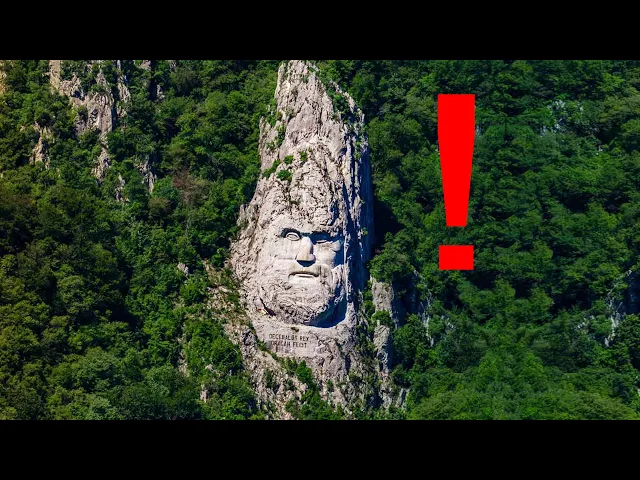
C here auram Mazda is depicted as a winged figure often seen in the form of a far of AAR a symbol that combines a human torso with outstretched Wings representing Divine Glory the Soul's journey and the moral guidance offered by Aura Mazda the most famous depictions appear in the Rock reliefs at Nash de rustam an ancient necropolis near prpo these reliefs carved into the cliff showed the god bestowing Royal diadem upon Persian kings including Darius the great and and his successors these images symbolize the Divine sanction of the king's Authority underscoring the idea that Persian rulers were chosen by Aura Mazda to maintain order and Justice on Earth number nine budur vagala Sri Lanka budur vagala which is in the Southeastern part of Sri Lanka is one of the country's most important ancient Buddhist sites known for its impressive Rock Cut statues budur vagala translates to mean the rock within the Buddha statue the main rock face actually has a series of seven Buddhist statues carved directly into the granite cliff and the central figure is a towering statue of the Buddha standing at about 49 ft or 15 M tall the Statue is carved in the classic style of Sri Lankan Buddhist art with the Buddha depicted in the abhaya mudra a gesture of protection fearlessness and reassurance now flanking the central Buddha statue are six other figures believed to represent various batas or enlightened beings who have postponed their own Nirvana to help others achieve enlightenment one of the most interesting apart from the main one is the statue of aalo kesara a batva associated with compassion this figure is really striking because of the white streak of lime that runs down from the top of the rock face to the bis sata's head symbolizing a sacred anointment avalokitesvara is accompanied by two other batas Viara Pani who holds a thunderbolt symbolizing the power of Buddhist teachings and a female figure believed to be Tara the goddess of protection and mercy in addition to its obvious religious significance Ur vagala is also an important archaeological site the statues provide valuable insights into the evolution of Sri Lankan Buddhist art particularly the influence of Mahayana Buddhism which is reflected in the depiction of these bis satas number eight the aanene Colossus in Italy the aanene Colossus is a huge sculpture that stands as a masterpiece of Renaissance art it's located in the park of villa petrolino near Florence in Italy and it was created by a Flemish sculpture in the late 16th century after being commissioned by Franchesco the first de medich the Grand Duke of Tuscany as part of the elaborate Gardens of his home completed around 1580 the statue was intended to represent the aanene mountains which run down from the spine of Italy and the designer known for his Dynamic sculptures and Mastery of the human form created the Colossus as a personification of these mountains the Colossus stands at over 35 ft or about 10. 6 M and is constructed from a combination of brick and stucco covered with Limestone to create a natural istic appearance the statue depicts a giant bearded man emerging from the ground his body partially integrated with the rock this Fusion of man and nature is a central theme in Renaissance Art and reflects the era's fascination with the harmony between the two surprisingly the statue is not a solid Mass like it looks but it contains several hidden Chambers and grotto each with its own unique function for example the colossus's head houses a small room that was once accessible by a staircase offering views of the surrounding Park through Giants size water features also play a key role here as originally water could flow from the colossus's mouth and beard and grotto within the statues torso was designed to contain a small fountain over the centuries the aanene Colossus has weathered the elements and undergone periods of neglect but it's also seen restoration efforts the statue is now a central attraction in the park which has been recognized as a UNESCO world heritage site moving on to number seven The Rock sculpture of desalis Romania the sculpt of desalis is a huge tribute to the last king of daia desalis who fought fiercely against the Roman Empire at the turn of the first in 2nd centuries carved into a limestone cliff on the Romanian side of the danu The Rock sculpture of desaba stands at 141 ft or 42. 9 M tall and 104 ft or 31.
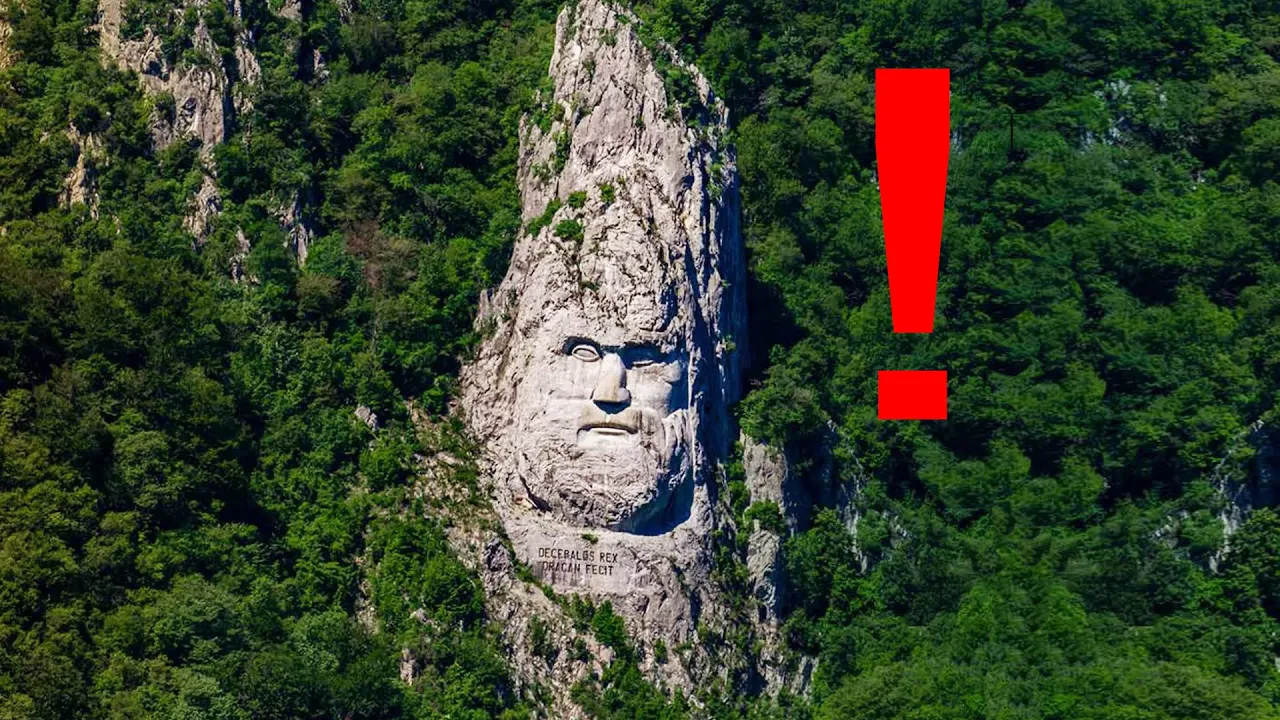
6 M wide being depicted with a Stern Majestic expression embodying the warrior King's resilience the idea for this sculpture was put forward by Romanian businessman and historian Yosef Constantine dragan who was inspired by desab bis's Legacy of the history of daia the ancient region that corresponds to present day Romania and mdova thean wanted the sculpture to be a way to honor desist who celebrate the cultural heritage of the Romanian people and the project was launched in 1994 it took over a decade to complete with work finishing in 2004 the team that created it used Dynamite to remove large sections of rock followed by more delicate chiseling and carving to create the detailed features on the face face the project was funded entirely by Duran who invested millions of euros into bringing his vision to life the sculpture is close to the iron gates which is a gorge on the danu river that forms part of the border between Romania and Serbia the location is historically significant as it's close to the site where the Romans built Tran's Bridge one of the greatest engineering achievements of the ancient world the sculpture is now a major tourist attraction and it's a reminder the enduring Legacy of the dacians who played a critical role in shaping the cultural and historical identity of this region the inscription below the sculpture reads in Latin theis Rex Drn fit which translates to King debellis made by Drn number six the Monta prama statues sardinium the Monta PR statues discovered on the island of Sardinia in Italy are among the most significant archaeological finds in the Mediterranean and have shed light on the ancient nuragic civilization these statues which dates back to the 11th and 8th centuries BCE represents one of the early examples of large scale Stone sculptures in Europe they were discovered in 1974 when a farmer unearth fragments of a large Stone statue while plowing his field near Cabra in western part of Sardinia archaeologists soon uncovered a vast collection of pieces eventually piec together nearly 30 statues along with smaller several models of nagui the distinctive tower-like structures from nuragic architecture these statues carved from local Limestone are huge in size standing between 6 and 1/2 ft and 8 ft or 2 and 2 and 1/2 M tall and have uniquely stylized and geometric forms the statues represent three types of figures boxers archers and warriors all of which are depicted with an extraordinary level of detail and craftsmanship the faces of the statue are really noteworthy with large circular eyes with some Scholars interpreting as symbols of vigilance or divine power the geometric stylization of these figures with their elongated Limbs and exaggerated features reflects the unique artistic style of the nagic civilization the important of mon pra lies not only in their artistic and cultural value but also in what they reveal about the nagic civilization the people who are somewhat mysterious to historians were known for their Advanced Metal working impressive architectural achievements and complex social organizations the discovery of these statues adds a new element to our understanding of their society suggesting that they had a rich tradition of sculpture and a sophisticated symbolic language in 2011 after Decades of painstaking restoration several of the statues were put on on public display where they continue to draw visitors and researchers eager to explore this ancient Sardinian culture number five the Ze Idol Ukraine the Ze Idol is one of the most unusual relics of the pre-christian Slavic paganism discovered in 1848 on the zubar river in what is now Ukraine this Stone statue provides a rare glimpse into the religious practices and cosmology of the ancient slaves before the Advent of Christianity in Eastern Europe the zabur idol is a four-sided Stone pillar or statue that stands about 8. 8 ft or 2.