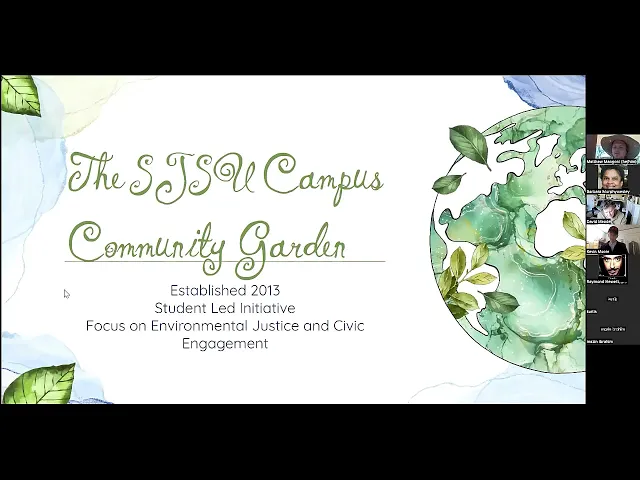
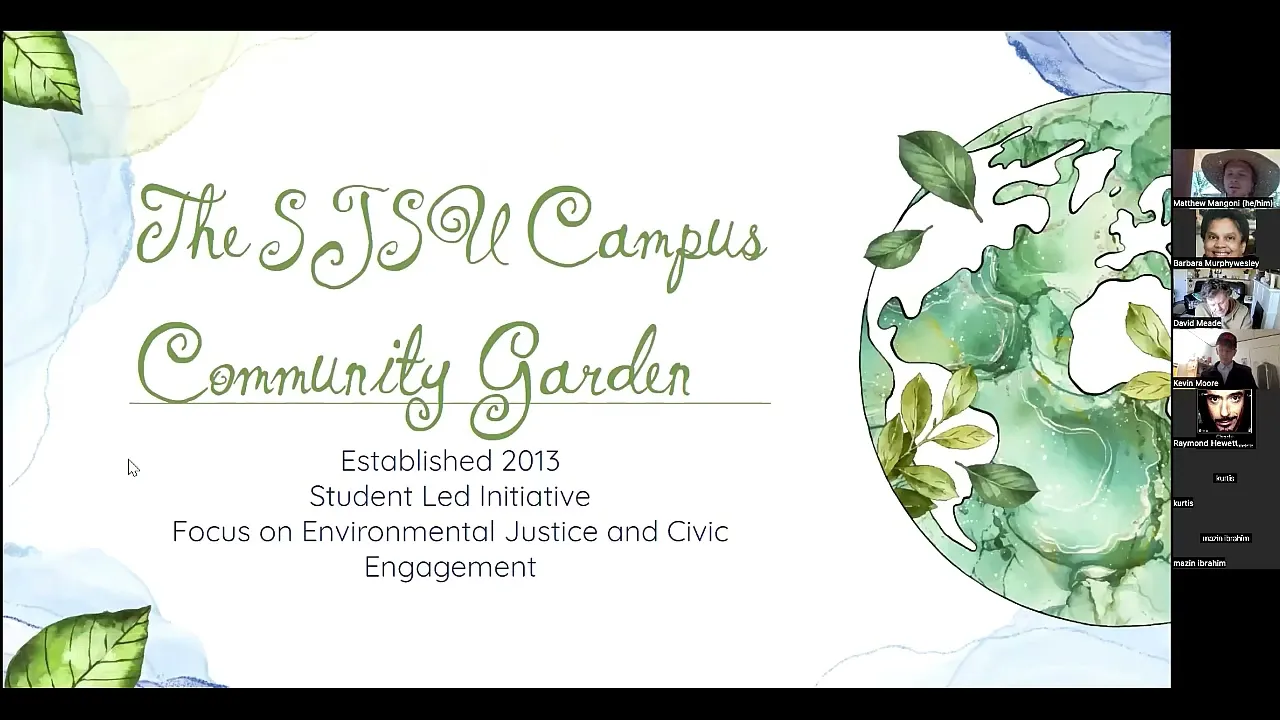
okay um I would like to go ahead and introduce our speaker who is Matt monei he is manag of our sjsu community garden in this position he coordinates all the garden operations he's responsible for program development and oversight Community collaboration engagement as well as um staff and volunteer management and administrative metrics and data he has a lot more to tell you about what he does so I will go ahead and uh get him started thank you for joining us today Matt hi thank you so much for having me and thank you for that introduction um
yeah so for I'm going to be presenting a slideshow um in a couple minutes but for the first five minutes I'm just going to be talking a little bit about myself um I think it's really important in spaces like this that um we talk about the people doing the work and not just the work itself so as you find yourself you know graduating and being in positions where you're going to be giving presentations um you know just take the first couple minutes to talk about yourself who you are as a person because I think it
helps your audience kind of connect a little bit because I'm not just like um you know a machine that does this job I have this winding path and it's brought me to where I am um so for the first couple minutes if you want to turn your camera on you don't have to just so I'm not talking to um blank squares and then once I start the presentation you know feel free to shut your your camera down again um yeah so uh my name is Matthew mangoni um I am originally from New York Upstate New
York kind of in between rural and urban areas and um I grew up loving the outdoors I have baby pictures of myself gardening um pulling Leeds with my my family my parents and grandparents um all like to Garden kind of just as a hobby um and then I have some uh ancestral stories about family members who were farmers um you know some of my uh on my mom's side I had great great grandparents you had like a horse and buggy and a farm and they would bring uh they would sell their fruits and veggies like
mobile with the horse carriage go to people's houses and sell that way and these are all things I learned you know later in life only a few years ago just by probing and asking my family to kind of give me details about gardening and food and Agriculture and I encourage everyone to ask your family members those same questions because um One Way or Another all of us have ancestors who were deeply involved in agriculture uh you know it was a huge Pastime in the last 10,000 years and also for a lot of that time just
like our livelihood um and for a lot of us we we now feel some disconnection to land and gardening and food um so it's a way for us to try to reconnect and reestablish that relationship just by learning the stories um and if you talk to everyone in your family and no one can remember a time when they were growing food then you can be the generation that restarts that connection and so I grew up Outdoors gardening uh have a little bit of a family connection I did a lot of landscaping through High School uh
you know just working on flower beds and tree trimming and Bush trimming and things like that and I decided to get my environmental science degree um it was very science-based and I graduated in 2018 in the last six years I've had a couple different jobs in the environmental field um I worked as a hiking guide I worked as uh a state park I mean my first job at the state park I was mostly just cleaning toilets and campsites and I eventually convinced my manager to let me do some interpretive work and talk more with um
the guests and people visiting the park so that was really great and then I moved into some environmental Consulting doing mostly botney work and some uh soil work extrem ecology stuff like that and at that point um my wife got a job in San Jose she's an environmental engineer and I followed her out here to come to school at sjsu uh for two years I worked at a nonprofit teaching environmental and garden education to elementary school students in the area and then the last two years I've been here at the campus Garden um as the
garden coordinator kind of managing all the different aspects of what goes into the garden which I'll be talking more about um yeah through the presentation so that's just a little bit about me and hopefully there's something in my story that you can connect to um it was not a straight line and I still don't know I'm moving back to New York this summer I don't really know what the next thing will be for me um but we'll see and as Barbera mentioned as I talk throughout the presentation you know please drop me questions if you
have them um and I'll be happy to answer throughout and then we can we can also have some questions at the end so thank you for for listening to my story now I'll talk about the garden uh all right so um a little bit of garden history so the campus Garden um where we are now we were established in 2013 and we have a really unique history in that uh the university didn't hire like um a landscape architect or someone to build this garden and it actually wasn't even faculty and staff or university Personnel that
advocated for the garden in the first place it was actually students uh so you know people just like us um in the mid 2000s there were a couple groups of students on campus who had this General sense that they didn't have enough access to fresh healthy organic food or food that mattered to them and they kind of were just talking amongst themselves they brought up their concerns to some people in the administration um at San Jose State and kind of just got like yeah you know there's the DC uh you know I think you guys
are pretty you're doing okay um and students didn't really like that answer so they uh worked with some faculty and staff and formed a student hunger committee and they did some surveys across campus uh several of which got over 5,000 respondents from students and they found around 33% around onethird of students identified as food insecure meaning they didn't have enough food to eat at least once a week um so they gave this data and their findings and things over multiple semesters to the administration and said hey look there's a problem here and um the university
said okay yeah I think you have major point and they first allocated this small area which I'll show you in a couple slides to the Nutrition department to have a campus Garden um but it was really small it's just two little raised beds in the center of campus and then after two years students said this isn't enough and our facilities on campus actually said you know these food crops aren't really pretty and the students are like oh sorry you know just feeding ourselves but okay I guess it's not pretty um so it's kind of mutually
agreed not a good fit and then we were given the well we were allowed to operate a garden on the land where we are now which the university still owns we still pay rent to and um the land was allowed to be developed as a garden under Associated students which is our Student Government body uh so yeah student initiative and and because our garden is operated through the SAR Chavez Community Action Center Department of our Student Government we have a focus on environmental justice and Civic engagement um so yeah a little bit of a history
a quick overview of the center that we are a part of um the goal of the center we're a department on campus it's not like a club we're actually a department that serves students so um if you haven't been to the Center or the garden part of your tuition a very small part um goes to funding both these things it's a service for you as a student um our goal is to connect you with Civic engagement and social justice opportunities um so to serve uh students on campus as well as the outside Community a little
bit and we were originally funded because the CSU our college system um had this mission of incorporating Service Learning and Community engagement into class curriculum so that's why we work with students on campus and a couple signature programs in the center we have spart leadership training this is our programs throughout the semester that focus on Civic engagement learning about social justice how we can fit into um different orgs and things like that in San Jose as a student you know what value we have you know training ourselves to to be leaders in these spaces and
solidarity is a program where we collaborate with other centers on campus to focus on bigger goals K through2 mentorship uh they have a program where they recruit students to uh go into elementary schools and help uh students improve their reading literacy and then the Legacy project is actually focused on highlighting student activism of the past and present day student activism um so San State we have a ton of examples of student activists on campus um dating very far back into our history so this is the original location of the campus Garden uh just to the
right of this picture is the Tommy Smith and John Carlos Olympic statues and these two beds were where campus first allowed us to plant some food but you can see it's really small so then in 2013 they gave us this plot of land it's about 1 of an acre and this is a photo from about three years into uh farming here we had a lot of beds in the ground here's a little nectarine tree on the left picture some other trees and then on the right is a couple years later we had some rais beds
built and um in the last 10 years we've really exploded so these are some recent pictures now in the left picture you can see the nect green tree is like 10x what it was we now get 60 to 100 pound of fruit from it every year we have this beautiful deck um it's Ada accessible we're the first Garden in the CSU system to have an ADA accessible space so this is where we host our workshops and different things um and on the fence you can see a little passion fruit plant growing we just got 50
pounds from that plant this year and the picture on the right is our rais bed area those are some summer crops this picture on the right was from uh early this spring and then I just took this one this morning so everything is kind of growing crazy um we've harvested around 420 pounds of plants uh or pounds of food from the garden this this uh just from January 1 um so yeah we've been growing a lot and I'll talk a little bit more about what we grow and I'll just pause real quick nothing in the
chat okay so some of our main focuses in the garden um you know why we originally set up was to support food insecurity on campus so one of our biggest goals is growing food for the food pantry on campus and our Spartan Pantry actually also came out of that student hunger committee as well it was kind of the other really big thing that students accomplished through the committee um so here's just a picture we have these wheelbarrows we use wheelbarrows to bring the food unfortunately the garden is on the other side of campus from the
food pantry um so not was convenient but it's pretty fun it's fun to walk through campus with the food students can see kind of what we're doing there's a bunch of plums more plums we get tons of fruit from the fruit trees over the summer uh we have lots of different fruit we actually have 20 fruit trees in our small space um and 16 raised beds so there's some nectarines figs squash bees Peppers okra cucumbers uh beets a lot of leafy greens lettuce kale nabalis Cactus Aeros tons of different kinds of peppers um and we
actually grow over a hundred different varieties of fruits and vegetables you'll be able to see oh actually in this picture here you can see all these signs we have signs in all the beds on the picture on the right um and we currently have all the signs in English Spanish Vietnamese and Hindi so we try to food that's represented the student body um that way people from you know International students or from different parts of the US um can find fruits and vegetables that are important to them um as well as it gives an opportunity
for students to learn cross culturally about other fruits and um vegetables that that people eat in different parts of the world so yeah we drop this semester we're dropping off every Tuesday um food at the pantry so if you never been to the food pantry I highly recommend checking it out it is another service for all students um that you're able to get access to some some fresh fruits and vegetables and they also have uh you know dry foods and non- perishables as well so a second uh main thing that we do at the campus
Garden is teach students about growing food um so we do this through volunteer days I posted uh in the chat our volunteer days this semester every Tuesday Friday and Saturday and we do different things you know throughout the year as as what we have to work on in the garden changes and um so we do stuff like teach students just really basic things how to plant seeds know you don't have to have any experience to come learn from us so everything from planting seeds to transplanting the plants growing stuff in a greenhouse watering pruning plants
weeding pruning fruit trees um you know we pretty much do everything other than like drive a tractor or spray pesticides that a normal Farm does um we do most other things and here we're doing a little composting Workshop we do a lot of compost I'll talk a little bit more about it um towards the end of the presentation but composting is a great way to mitigate our climate impacts and our lifestyles um in the United States we waste a lot of food granted most of it isn't Consumer waste uh most of it is waste from
the farm to actually getting to our plate but if you do have stuff that's left over from your plate um instead of having your green waste go to a landfill where it breaks down anerobic you know creates methane gas and all this other stuff you can compost it you can also bring it to us we have a compost window that you'll see later um and we recycle these nutrients we have this special system to keep air inside the compost so that it breaks down aerobically with oxygen and it actually sequesters the carbon instead of releasing
it we also do a lot of woodworking uh with students so some students measuring and cutting stuff with saws using drills and nails if you want to learn stuff like that uh it's a good space to come you know if you've never h a drill before we can give you some Basics and also I know you are all engineering students I don't know kind of what sector of engineering you're in but we have a pretty good relationship with the mechanical engineering department uh we've had three mechanical engineering uh Capstone projects in the garden so as
you get further into your education if you have a Capstone that you have to complete um you know come visit us at the Garden maybe you can work on something that is beneficial to the garden and we'll also pay um a portion or sometimes for the whole project we can fund your whole Capstone project and we'll pay for all the materials and you build it then leave it to the Garden so we've had a solar system built here that we use um for movie nights and our refrigerator and a couple other things we've had a
solar dryer built uh which is pretty cool and also our Greenhouse was built as a Capstone project um and if you're not a mechanical engineering student you know there's there's probably other things that I'm not even aware of that you could provide you know as the um I don't know biomedical engineer environment engineer chemical engineer there's probably something you can do with us in the garden um and another thing we do our cooking demos which I'll talk a little bit about in a minute the importance of that and then kind of our last frame of
focus is around supporting food and environmental justice activities in the broader community so we're part of the South Bay food Justice collaborative it's a group of other organizations like Second Harvest uh the other farms in San Jose there's five or six other kind of small farms in San Jose and yeah it's kind of a group of farms and then a group of food banks and a few organizations that work on policy and we try to put our brains together and develop some policy goals for San Jose and our our broader Community uh we also in
the past have worked with the city of San um on Evans Lane Community Garden there is a small transitional housing um called Evans Lane and we helped them build the garden and irrigation system for their garden and we provided some workshops uh Reed Street Garden that's a collaboration with the South Bay Community Land Trust we're helping uh give them advice mostly on on growing food in our urban area and then the United Methodist Church right around the corner we have some Wildflower kind of Partnerships and in the past we've had some food Partnerships with them
as well so just check quick there's no questions okay okay uh we also have a bunch of signature programs so these are things that happen every year and all of our programs are free for students we give away like t-shirts and water bottles reusable uh utensil Weare stuff that helps you be a little B more sustainable kind of as an incentive to come and we also have free food um and some of our workshops are kind of just open to as many students as we can fit in the garden like Harvest Festival this last year
we had I think around 140 students some of them are more limited because we we only have so much of a budget to buy stuff but yeah the Harvest VES is really fun it happens every fall um this past year we focused a lot on uh the autumnal Harvest Festival practi in multiple Southeast Asian cultures um so we had kind of a garden walk through with a few local Vietnamese gardeners and a Vietnamese American alumni we had a cooking demo we also did some latinx cooking so this was a cooking demo Nepali wos and a
couple other stuff in there little Piñata making uh and then this was part of the Vietnamese American gardening area we also did moon cake making which is really fun uh we two years ago we did spring rolls which is really fun just getting students to experience it if you haven't or remin if you had and then we just Harvest a bunch of food um and bring bring you know students are allowed to take on that day as much food as they want and then we bring the rest of it to the pantry and last year
we had our largest single day Harvest we Harvest over 120 pounds just in one day on the Harvest vestival which is really uh yeah it was fun and crazy I couldn't believe that we had that much so here's just a snapshot of some stuff tomatoes sillas peppers uh so some of our other programming we have so we have a bunch of cooking demos uh some of them are with whisk which is a student group on campus Wellness Health inspired student kitchens they come to a lot of our events and support us uh some of them
are also with the dining Commons usually once a month excuse me we have the dining Commons come to the garden and they have like super professional chefs uh like I don't even know the like super trained chefs to come cook these really fancy meals in the garden uh for the garden volunteers and it's really fun and always really delicious oh yeah so there's Chef Mario he's one of the chefs from Spartan eats in the dining Commons and and if you go to the dining Commons a lot you don't like their food um you should definitely
come to the garden and eat you know straight off the skillet because it's always super good Oh and before I move on the reason we do these cooking demos is um know a large part of reconnecting with food is learning to cook um I'll just speak for myself being in the younger generation uh you know I didn't really spend time in the kitchen with my parents no one taught me how to cook I don't know you know if they thought I wasn't interested or I just wasn't good enough to help them or you know whatever
reason there was a disconnect I just really didn't get to translate any skills from from uh than to me uh in the past couple years after moving out I have built somewhat of a relationship with that um just by calling them and talking about stuff I want to cook and asking about Home recipes but for a lot of us it's a struggle you know we especially if you're living on campus and just being a college student it's difficult to to cook nutritiously for us so we try to have these cooking Demos in the garden to
show students how to use stuff we growing um especially because we have stuff from around the world a lot of students might not be familiar with stuff from other countries that they've never tried before so we like to try to show you know how can you Foster this connection and learn how to you know what are their n nutritional values of all these different things I saw something in the chat was there a question okay one question for cooking demos how they use vegetables and fruits for making uh these healthy recipes um yeah so the
part of the cooking demonstration is talking about each ingredient um most of the ingredients we get from the garden sometimes the recipes are more complex they have to have stuff from the store as well but uh that's basically what it is about we'll talk about each ingredient you know what is the nutritional value what makes it healthy and um then also you know how to cook it like there are all these secrets that Chef Mario has about building flavors as you go through the cooking process and I've actually learned a lot uh just just through
the cooking demos as well about kind of building flavor and balancing out some things in the recipe great question okay one of our other signature programs are garden movie nights so we have movie Nights at least once a semester um typically in the spring we have only one because of the rain and stuff like that and then in the fall um we have more I think last saw we had four movie nights around once a month uh and it's really fun see oh we have uh this screen we hang up in the in the garden
and a big projector big speaker we can fit around 70 students think that's the most we've had come to a movie night um and yeah it's really fun it's fun to be downtown kind of at night especially for me because I I don't live on campus and you can't Garden at night so I'm not usually out here right and um it's fun to be there we pop popcorn that we grew here at the Garden we just started a bunch of popcorn in our Greenhouse for next semester movie nights and um all the movies are I
think this is manari the one that's pictured so there's some you know based in agriculture or food or environmental justice um we play a whole bunch of different ones so at the end of this month I think the last Wednesday this April we'll be playing bigest little farm which is a a movie about a biodiverse farm in Southern California really good kind of heartwarming movie um and you can sign up through that through our Instagram and I think I saw another question is there Place previous recipes are saved uh yes so we actually I don't
know how many of the cooking demo recipes we have but we had started a garden recipe book and you can access that through our link tree I'll actually just drop in the chat real quick um because yeah I think we have around 20 recipes in there right now of stuff that we commonly uh grow in the garden and it's a good place to start uh because I think we just have one recipe for each ingredient but yeah we're we're slowly working on adding a couple recipes every semester to kind of build out our recipe book
and uh if you look if you want to look up more recipes there's another Farm in San Jose called Taylor Street farm and they have a recipe book as well that has a lot of good recipes for fresh birdies great question okay we also have so I'm a full-time employee and then we also have four student assistants uh that work at the Garden and every semester the students work on their own program to host uh for other students so some stuff we've had in the past um a flower bouquet workshop for Valentine's Day and we
actually use dried flowers which are a little bit better um in terms of sustainability uh because a lot of freshh flowers are kind of mass-produced they're flown in from other countries for Valentine's Day most of the Roses come from Central America and um to make them fresh they spray you know all these flowers and stuff with preservatives and different things uh it's very energy intensive so if you do dried flowers it's a little bit better they last a long time you don't have to ship all these big heavy wet flowers and you're not reserving them
you you preserve them through the drying process so you don't have to spray them with stuff we've done bird houses in Boba so these are more like come to the garden and just enjoy yourself kind of events um every fall we do an open mic night this is probably my I it's hard to pick between the Harvest Festival and this but this is a really great event um probably my favorite it's just great to see uh a different group of students being in theard we don't uh for this we we partner with the College of
humanities The English Department and the art Department um which we don't get too many students from them on a regular basis so to have them all in the garden um you know singing and doing poetry or hanging up their art in the garden it's a really fun uh program it's me talk to crowd uh two years ago we had some students that live in the apartment next to us ing from the rooftop that was really cool uh and then we also have some Garden based workshops so this Workshop was around seed harvesting and Seed keeping
uh we do we try to save seeds from all the crops we grow uh in order to have the next generation of plants already in our hands helps us be sustainable we don't have to buy from big box stores or other nurseries and it's actually a way for us to be resilient to climate change um because if you are saving your own seeds from the fruits and vegetables that do well in your garden they are adapting to a warming climate and if you save seeds every year you're able to kind of incrementally uh change the
genetics of the plant just like our ancestors did through farming and they'll be able to keep up with a changing climate and someone just asked what program or process is is it called to repurpose leftover food uh so if by repurpose you mean turn into soil that would be called composting uh that's where we take leftover food and turn it back into soil uh if you're talking about like using carrot heads and the stuff that maybe we typically throw away but could be eaten uh some people call that like upcycling um your your scraps so
there are actually a lot of things um a lot of cool stuff on the internet about the things we commonly throw away like the pits of the peppers or the the peels of oranges uh there all these things we can actually do with them we can make spices or uh like different um things for tea and stuff like that so you can find ways to to not even have any food waste just by reusing the stuff that that we don't typically eat the bottom of lettuce and the tops of carrots yeah good question um yeah
and then another way that we're kind of being resilient to climate change with our seede keeping is that we swap seeds with other farms in the area and then we'll plant those two things next to each other they'll cross-pollinate and it it allows us to have um good genetic diversity because if we're just only saving from our own farm and doing that over and over again generation after generation uh we'll start getting in breeding depression and some genetic problems oops and this was a storytelling event that we had few semesters ago uh if you can't
tell I really VAR into stories um so we did like rock painting painted a couple rocks that represented a story from our past in the outdoors it was a fun activity um and then we have a couple programs coming up this semester uh this Friday we have our program Garden mindscape which will be doing some candle making and chilling in the garden drinking tea having some muffins and things like that and for the candle making we have a bunch of ingredients like dried flowers and things that we putting into the candles um although we already
filled up our registration for that program but then next Friday if you want to come do something in the garden we have our climate Cafe so this event is all about sharing um kind of just being open with our feelings about climate change trying to sorry uh destigmatize the conversations around climate change um you know it can often Focus really heavily on kind of Doom and Gloom and what can we do about it and honestly one of the most powerful things we can do is just have conversations about it you know try not to avoid
the scary and also talk about our hopes and dreams for what our future could be if we find ourselves on the right path um and then we also have a cooking demo that will be happening during the climate Cafe so the whole climate Cafe is from 10 to 1 and then the cooking demo will be at 11: so if you want to come for that um we still have I'm not I'm not going to put a registration cap on it because we're kind of just sitting around and mingling we shouldn't overflow the garden I don't
think no questions so um another big thing we do in the garden is our next Generation Garden leadership Fellowship uh so this happens every spring we take a cohort of around 24 students and the whole idea of the program is for students to to improve their leadership skills and learn about environmental justice so if you feel like you could benefit from this if you want to learn more about environmental justice uh and how you can kind of plug into different organizations uh the applications for it will be in the fall uh I think around October
they'll open on our website and on our Instagram and then it'll happen again in Spring of 2025 so each week uh we we invite a different environmental justice organization to come to the Garden talk to students talk about who they are and the work that they do and then how we as students can kind of be be a part of this greater kind of social justice um ecosystem and then you'll you'll work on all these skills over time this is one of our cohorts and I just finished my third uh cohort with students it's really
great program and you also earn a$ thousand stip in for attending all the workshops and stuff um so we pay you a little bit for your time and some ongoing Partnerships we work with around 10 to 15 campus and Community Partners every semester the work is very collaborative environmental work in general is very collaborative um some of the reasons why we are in such a dire situation is because in the past our work has been so siloed you know people are kind of doing their own thing in environmental spaces and not talking to each other
um sometimes you know accidentally leaving out um perspectives or different communities and sometimes purposely ignoring the perspectives um of lower income and Bop communi so um that has led us to where we have to focus on environmental justice and we have all these issues so our work now is working collaboratively and uplifting the voices of the people who are facing environmental concerns um and we really strive towards long-term relationships in the two years I've been here I think we've fostered uh really good relationships with folks that that are coming back to the Garden you know
over and over again to to be with student and and to share the expertise they have one of our recent Partnerships we have is a seed library in the MLK Library on the fifth floor so if you have you know even space to have a little pot in your kitchen or something you can go to the library and then get seeds that we've harvested and they also buy some seeds from other places too um yes we our compost program I talked a little bit about it um over ,000 pounds last Academic Year we Harvest from
a bunch of different places the food pantry on campus nutrition Labs jamama juice and Bandit Express we take the dining common coffee and then we have this window so this window is located at the front of our garden it's open 247 you can drop your veggies in this is a pretty typical day we get 20 to 30 pounds of of food scraps from students and residents in the community if you can we prefer it to just be kind of out you don't have to put it in a plastic PL bag I know for for some
people it's more convenient for you at home to put it in a plastic bag but if you can just give it to us in paper or you just dump it right right into the bucket and then we have a super active compost bin uh we produce around 50 cubic feet of finished compost every semester um because of the volume we get it gets super hot I think in the picture it's a little below 140 sometimes we'll get up to 180 degrees just from the respiration of microbes inside the and couple other collaborators you know on
campus we work pretty closely with the environmental Resource Center I mentioned the mechanical engineering department the office of sustainability and then some Community Partners uh the University California collaborative extension Santa clar Master Gardeners these other ones are other Farms veggie Lucian laa ver Garden the table valy ver if you are interested in agriculture at all these are great organizations to to check out and I mentioned those guys Fresh Approach that's uh advocacy and also Farm they do a lot of stuff with um uh farmers markets and the last thing I'll talk about is uh building
native habitat so if you've ever heard of the term gorilla gardening this is a form of gardening where you grow in spes that you don't technically have the authority to but if you're doing something really nice and people like it you can kind of create some informal relationships and and beautify spaces um and and not only that you're providing um ecosystem services to the people around you and the community as well as lots of animals and insects and things like that so we all walk around campus and see dirt patches like this you know we
see this every day when we're driving around this is next to the 7-Eleven I tried to do something with it this year but the stuff I planted got weed whacked by their landscapers but that's okay um so the first year I I started working at the Garden we had this space this is the the fence in front of the garden we had this vacant kind of space it's really small um in total it's like 20 square feet worth of um this is like less than one foot cross and so it's it's not a lot and
there's a little bit more over here another 20 or 30 square ft um and we actually do have access to this it's it's I mean it's the University's property but it's part of the garden so main so we planted out a bunch of stuff it's kind of hard to see small little things in the spring and then this is what it looked like come summer and these are California poppy lots of native flowers some non-native but gulum we have some sucs and things in here and then a different view of it what it looks like
in the summer so it started out you know mostly just as plants native plants and then after a couple weeks couple months I started seeing lots of different bugs using the space and now if you go by there's pretty much always bugs in here we'll see birds and things flying through so it's it's a service to our local Wildlife um as well as you know it's really pretty to look at when you walk by and I do see people like taking flowers for bouquet I'm cool with that if you're appreciating the flowers you know go
for it um so then next we moved on to this Hillside along Joe West uh this was our first year we planted we just threw seeds down in the in the fall before the winter rains and then there's a couple poppies in here and this is a sunflower so a couple things grew and then next fall we did it again we got some more poppies and a lot more green stuff you can see and then this is it I just took this morning full of California poppies Lacy felia um and it's pretty minimal upkeep uh
the hardest thing is keeping is making this kind of informal relationship with the facilities workers um just kind of through a handshake giving them some oranges and some fruits and veggies here and there and saying hey please don't destroy this area and it's worked um and now if you walk by I mean if you're having a bad day go to Jo and just sit at the bottom of the hill you'll see dozens and dozens of bees um birds all sorts of bugs flying around through here uh this is the other side of Joe West Hill
so this was the first year just a couple plants last year we got a bunch more now this year tons of flowers um and actually the first time we planted this facili herbicid and everything they just like spray everything and killed it you know they didn't know I don't blame them for it um and they're really understaffed um but again I just talked to them about it I showed them which plants were which and helped them a little bit with some weeding and now they've been letting it go and it looks beautiful another part of
Joe West Hill same time frame this area it doesn't get as much sunlight so we're not getting as many flowers but it's looking pretty good it's providing at least shade and habitat for bugs uh this is in front of the CDC but Child Development Center on campus same time frame I just took this picture this morning there's I didn't notice the flare at first but there's a bunch of flowers in here it looks really good you should walk by and then last summer we planted a bunch of native milkweed in this area and Facilities replaced
it all with a bunch of patunas and stuff so we're still you know kind of actively you know working back and forth seeing what works seeing what what will get them to let us do um but you actually can accomplish a lot you know just by doing what you can and talking to the people on the ground I've had a lot of conversations with uh you know like the administrative people and Facilities that kind of just don't go anywhere we have some Partnerships to harvest the fruit trees on campus but we weren't able to get
anywhere you know through the formal process so we've just been kind of working informally and nobody's getting hurt by me planting flowers so if you have the opportunity to do this in spaces around you I say go for it the best time to throw seeds down is in the fall um or summer and then when it rains in the winter stuff will start coming up and then since you are all engineering kind of data junky people I just wanted to put this the metrics and things that we collect um every semester we do a lot
of data collection to justify the funds that the university gives us um and yeah I like playing around with graphs and stuff if you are bored and you want to volunteer at the Garden but you don't want to get your hands dirty you don't want to work in the sun you know you can play around with our data too and help us make graphs and show different things there's definitely uh opportunities to to do this stuff because uh sometimes I'm too busy to to get to it all so yeah that's kind of the presentation I
have and I kind of just want to end with um The Prompt for me coming to you guys today was you know the talk is about the environment um and I think for me it's sometimes hard to frame because everything is the environment I think the biggest one of the biggest hurdles we have to overcome is that the envir is where we live work and play you know all of you guys are inside your house or a dorm or some of you might be outside if you're indoors you're still in the environment you're breathing air
around you um depending on where you live you might have better air quality worse air quality because of policy decisions and decisions made by people that impact your health because of the environment around you um so it's good to think about everywhere that we are occupying space is the environment our bodies we think of ourselves as one being but we have millions of different organisms living inside of us on our skin in our hair in our gut um things that we could not live without if they didn't exist within us um so the environment kind
of is everything to me and if we can start to understand the things around us then we can do a better job of protecting um and and that's kind of one of our one of our biggest jobs in the garden is just getting students in the garden and seeing the connection that we have to to land and food and everything that is around us so Claire just asked you discussed environmental justice could you explain what it means particularly as it relates to sjsu yeah so um environmental justice as a concept is um the reality that
different groups of people experience the environment differently because of policy decisions um because of racism environmental racism we have a long history in the United States but this happens across the world as well um and environmental justice is the goal or objective of finding equity for the environment so that all groups of people have equal access to the benefits that we get from being outdoors having access to healthy food or food that is close by um having access to public parks having clean water clean air having our voice be represented in the policy decisions and
also protection from the negative so a lot of the environmental movement in the 1970s um worked towards cleaning up the environment cleaning up Industrial waste nuclear waste but because it didn't have a Justice perspective a lot of that waste actually just got funneled into communities of color and because of the environmental win in some areas there is environmental negatives in others so it's protection from the negatives and what that means to us at sjsu um we have not the greatest access to uh fresh produce and organic selections we don't really have Farmers Market down Town
um and the food that we do get here is really expensive so I think food security is a big thing um for us as students and something I hear quite often um and then honestly probably the other biggest thing as a relates to downtown San Jose is housing security as I mentioned the environment is where we live work and play if we have difficulty finding a place to house ourselves to live um where we're not cramped together um that is an environmental justice issue as well those are the kind of two big things that come
to mind but there's a lot I mean in an urban area we also we don't have a lot of tree cover downtown it gets really hot um heat is actually the biggest environmental killer in the United States so heat related death is you know maybe not super dangerous for younger college students but college students come in all ages and you know our community members do as well okay I'm going to go to the next question what does it mean to prune something just curious and how can you tell what parts of a plant AR SL
tree are dead so yeah pruning is exactly that it's removing parts of a plant um you might do this for different reasons sometimes we prune living parts of the plant uh a lot of times that's done to improve the structure so that if we say are growing a big tomato plant if it puts out a bunch of side branches we might prune those off so that it doesn't get too heavy and fall over um a lot of pruning is to do with structure and weight bearing um but then also to prune off dead stuff uh
Santa clar County master garders has a really great pruning guide if you want to Google that and how to tell what parts are dead or alive most times you can use just use your fingernail to scratch at a portion of the plant and if you see green stuff underneath the outer skin then it's if it's brown it's dead next question hi Matthew I'm doing a project on environmental justice and my focus topic is on Community Gardens how they're beneficial for the community and sustainability I'd really like to get your opinion on the cost analysis of
starting up a garden and maintaining one what more reasons why Community Gardens are beneficial I think um Alexander let's connect offline um to have a longer conversation about that but I'm definitely happy to do so uh oh and that's what you suggested so yeah we'll do that I'll drop my email if anyone else has questions to um after this you're welcome to just hit me up on my email and yeah any other questions so I'll stop sharing if you guys want to you can unmute yourselves too if you want to and ask your question oh
is Barbara I have a question um so Matthew I I seem to remember that people were people said that during covid a lot of people started Gardens I guess you know since we were kind of uh sheltered in place uh did you find do you find that people are still starting Gardens or doing more gardening or I'm sorry go ahead yeah yeah great question the I get from students is that I do hear a lot of students that come to the guard and say oh yeah I started during Co but um probably half or maybe
more you know have dropped out of it um which is unfortunate but it's great that a lot of people started and are still doing some form of gardening and I think it just goes to show you know during times of stress and kind of overwhelming circumstances we can fall back on these relationships with plants plants are easy to get along with they don't run away from us um and they can feed us so yeah um I think it's I think it goes you know 5050 some some people stuck with it and some people at least
have a fond memory of starting a garden in Co okay thank you yeah so students if you have any other questions we still have a little time left you could either put them in chat or yeah I was wondering Matthew um I'm looking at the map of San Jose State and I can't seem to find the garden where are you guys at yeah so ah I hate that they do that some maps include us some don't um we are Technic we're not in like the main block we're just right across the street on San Salvador
Street um I'll drop our address it it is on campus technically but it's across s Salvador Street uh right across from Joe West in the dining comons you can also type in Google Maps sjsu Community Garden or you can type the address I just dropped and yeah every Tuesday we have open hours from 8 to 3 so if you want to just come hang out you don't have to work we have a hammock we have a couple straight cats we have campus Wi-Fi it's a fun place to be you can take class or um yeah
just hang out and any anytime if you're walking by and you see the gate is open you're welcome to come in cool awesome thank you yeah oh Raymond and the yeah um so I just dropped in the chat as well and the best way to keep up with stuff we're doing um is following our Instagram we'll always post our updated hours and and I try to keep our Google Maps updated as well does anyone have any uh ideas of a capson project they could do here help us out you guys already have a pretty good
watering system um yeah most of our all of our beds are on drip irrigation but uh you know a mechanical engineering student group came to us and said that they could build us um like a a live water sensor that could detect soil moisture alive so we could see like how it spikes after watering how much it goes down and when maybe help us be a little bit more water efficient but then they never did I don't know if that's something you could do that'd be cool oh have you guys ever thought of like capturing
rain water and saving it or is that an idea that ever comes to your mind yeah so we actually have a bunch of stuff but it's not fully set up yet so we're still working on that um what we have now would be enough water for April and May so that's not that much you know just two months of the year but um there's these really cool things called Ecco blocks if you want to check it out they're really expensive so it would we have to apply for a grant to try to get it but
basically you can create an underground water storage for rainwater so it doesn't take up space because we're very space limited here um yeah and since I'm sitting in the garden I'll show you guys a little bit of stuff this is [Music] our right now is lots of stuff growing Bri trees our Compass system yeah it's a really nice space uh yeah thank you all for listening hopefully you connected with something and and really go go talk to your parents or grandparents whoever the oldest person is in your family a great uncle or somebody and just
ask them like what was do we have any family ancestry related to agriculture growing food or that your parents make you work in the garden when you were younger and you you'll probably learn something new um even though I was doing this stuff my whole life I learned tons of new stuff when I started asking these more specific questions wow well thank you Matthew for a really really good presentation and uh we do hope that you will come back and join us again in the future so students um we are uh at our time now
it's almost one so I think that um and U you've got Matthew's email and I'm sure he'll be if you think of some questions later he'll be happy to answer those okay so Matthew again thank you and uh like I said I hope we can see you again in the future and I hope you get plenty of and visitors yeah we we can always use more hands okay good all right okay thank you and thank you students for attending we will be back next week next week uh is our last screen talk so um so
thank you for attending today okay goodbye everybody than you e